
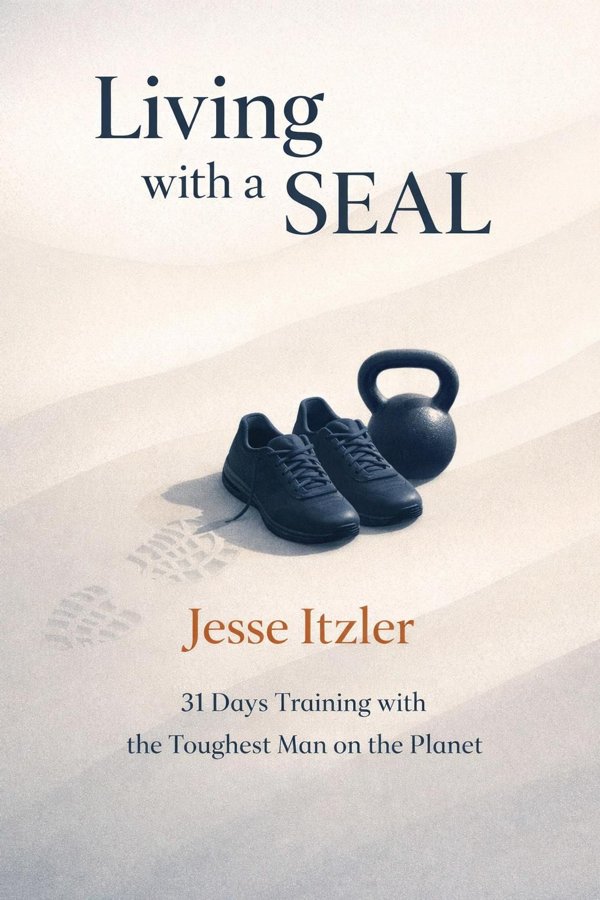
Living with a SEAL: 31 Days Training with the Toughest Man on the Planet: Summary & Key Insights
by Jesse Itzler
 10 min9 chaptersAudio available
Key Takeaways from Living with a SEAL: 31 Days Training with the Toughest Man on the Planet
Growth often begins with a decision that looks unreasonable from the outside.
Real transformation rarely announces itself politely.
Personal change never happens in isolation.
The most important muscles trained in the book are not in the legs or shoulders.
Many limits survive because they are never tested.
What Is Living with a SEAL: 31 Days Training with the Toughest Man on the Planet About?
Living with a SEAL: 31 Days Training with the Toughest Man on the Planet by Jesse Itzler is a biographies book spanning 5 pages. What happens when a successful entrepreneur deliberately invites extreme discomfort into his perfectly comfortable life? In Living with a SEAL, Jesse Itzler answers that question by bringing a Navy SEAL into his home for 31 days and agreeing to follow his brutal, unpredictable training regimen. What begins as a wild personal experiment quickly becomes a deeper exploration of discipline, identity, and the hidden limits most people place on themselves. Through freezing runs, endless pull-ups, sleep deprivation, and relentless mental tests, Itzler discovers that toughness is not reserved for elite warriors alone. It can be trained, borrowed, and built. The book matters because it translates elite performance into everyday insight. It is not really about becoming a Navy SEAL. It is about seeing how much stronger, more adaptable, and more resilient you can become when you stop negotiating with comfort. Itzler brings unusual authority to this story because he is already an accomplished entrepreneur, endurance athlete, and someone deeply familiar with high achievement. Yet even he finds himself humbled by the SEAL’s standards. Told with humor, honesty, and humility, the book is both entertaining memoir and practical wake-up call.
This FizzRead summary covers all 9 key chapters of Living with a SEAL: 31 Days Training with the Toughest Man on the Planet in approximately 10 minutes, distilling the most important ideas, arguments, and takeaways from Jesse Itzler's work. Also available as an audio summary and Key Quotes Podcast.
Living with a SEAL: 31 Days Training with the Toughest Man on the Planet
What happens when a successful entrepreneur deliberately invites extreme discomfort into his perfectly comfortable life? In Living with a SEAL, Jesse Itzler answers that question by bringing a Navy SEAL into his home for 31 days and agreeing to follow his brutal, unpredictable training regimen. What begins as a wild personal experiment quickly becomes a deeper exploration of discipline, identity, and the hidden limits most people place on themselves. Through freezing runs, endless pull-ups, sleep deprivation, and relentless mental tests, Itzler discovers that toughness is not reserved for elite warriors alone. It can be trained, borrowed, and built.
The book matters because it translates elite performance into everyday insight. It is not really about becoming a Navy SEAL. It is about seeing how much stronger, more adaptable, and more resilient you can become when you stop negotiating with comfort. Itzler brings unusual authority to this story because he is already an accomplished entrepreneur, endurance athlete, and someone deeply familiar with high achievement. Yet even he finds himself humbled by the SEAL’s standards. Told with humor, honesty, and humility, the book is both entertaining memoir and practical wake-up call.
Who Should Read Living with a SEAL: 31 Days Training with the Toughest Man on the Planet?
This book is perfect for anyone interested in biographies and looking to gain actionable insights in a short read. Whether you're a student, professional, or lifelong learner, the key ideas from Living with a SEAL: 31 Days Training with the Toughest Man on the Planet by Jesse Itzler will help you think differently.
- ✓Readers who enjoy biographies and want practical takeaways
- ✓Professionals looking to apply new ideas to their work and life
- ✓Anyone who wants the core insights of Living with a SEAL: 31 Days Training with the Toughest Man on the Planet in just 10 minutes
Want the full summary?
Get instant access to this book summary and 100K+ more with Fizz Moment.
Get Free SummaryAvailable on App Store • Free to download
Key Chapters
Growth often begins with a decision that looks unreasonable from the outside. For Jesse Itzler, that decision came during a 24-hour ultramarathon in San Diego, where he encountered a Navy SEAL who seemed to operate on an entirely different mental and physical level. While everyone else managed energy, pain, and expectations, the SEAL kept moving with a kind of relentless composure. That contrast hit Itzler hard. He realized that although he was successful, fit, and ambitious, he had still built a life that protected him from too much discomfort. So he made a radical choice: invite the SEAL to live with him for a month and train him without compromise.
This moment matters because it reveals an essential truth: most people do not need more information; they need a stronger challenge. Itzler was not lacking motivation in the conventional sense. He was lacking exposure to a standard that would shatter his excuses. By choosing temporary hardship, he created the conditions for transformation. The experiment was never just about fitness. It was about seeing who he would become when his routines, comforts, and self-image were disrupted.
In everyday life, your version of hiring a SEAL may be less dramatic. It could mean signing up for an endurance event, learning a difficult skill in public, working with a brutally honest coach, or committing to a challenge that scares you. The point is to stop waiting for change to feel convenient.
Actionable takeaway: Choose one deliberate discomfort this month that forces you beyond your usual standard, and commit to it before you feel ready.
Real transformation rarely announces itself politely. On the first day, the SEAL did not ease Jesse Itzler into a carefully periodized program or offer motivational speeches. He simply said, “We start now.” That immediate beginning set the tone for the entire month. Training was spontaneous, unforgiving, and designed to expose how quickly the mind looks for escape. Long runs happened in terrible weather. Ordinary moments turned into physical tests. Convenience disappeared.
This approach works because hesitation feeds resistance. The longer we prepare to begin, the more time we give ourselves to negotiate, delay, and protect our ego. The SEAL understood that comfort is not just physical; it is psychological. People want a perfect plan, the right gear, ideal timing, and emotional certainty. But toughness is built by acting before all those conditions align. By removing the luxury of overthinking, the SEAL forced Itzler into presence. He had to respond, not debate.
The first workouts also taught another lesson: your body can often do more than your mind predicts. Much of the suffering came not from actual inability but from the shock of being held to a higher expectation. Once Itzler completed a task he initially thought impossible, his personal definition of difficult began to shift.
In practical terms, this idea applies to work, health, and creativity. If you only act when you feel prepared, you stay stuck in planning mode. Sometimes the strongest move is to begin immediately and let discipline catch up with intention.
Actionable takeaway: Identify one goal you have been overplanning and take the first physically visible step within 24 hours, even if it is imperfect.
Personal change never happens in isolation. When the SEAL moved into Jesse Itzler’s home, the experiment disrupted more than Jesse’s schedule. It affected sleep, meals, family rhythms, and the emotional atmosphere of the household. His wife and children did not just observe the challenge; they experienced the ripple effects of living with someone whose standards were radically different from normal domestic life. This creates one of the book’s most revealing tensions: self-improvement can be inspiring, but it can also be inconvenient for the people around you.
The SEAL’s presence highlighted how deeply habits are social. We tend to assume our routines are personal choices, but many of them are reinforced by family patterns, shared expectations, and a culture of ease. Waking up earlier, training harder, eating differently, or refusing laziness changes group dynamics. Sometimes it creates admiration. Sometimes it creates friction. The book shows both. Itzler has to balance his fascination with the SEAL’s toughness against the reality that he still has responsibilities as a husband and father.
This tension makes the story more useful, not less. It reminds readers that real discipline is not about escaping life to become intense. It is about integrating higher standards into the life you actually have. That requires communication, humor, flexibility, and self-awareness. Extreme growth becomes sustainable only when it is translated into habits that fit your broader values.
For readers, the lesson is to expect resistance when you change. Do not interpret that resistance as proof you are wrong. Instead, learn to manage it with honesty and respect.
Actionable takeaway: Before starting a demanding new goal, talk with the people affected by it and agree on what support, boundaries, and trade-offs will make it sustainable.
The most important muscles trained in the book are not in the legs or shoulders. They are the mental habits that determine whether someone keeps going when discomfort arrives. Again and again, Jesse Itzler discovers that physical pain is only part of the challenge. The deeper battle is internal: the urge to quit early, the stories we tell ourselves about what is fair, and the voice that magnifies temporary discomfort into a reason to stop.
The SEAL trains this mental dimension constantly. A run is never just a run. It is a test of attention, attitude, and self-command. When Jesse focuses on how much farther he has to go, the task feels overwhelming. When he narrows his focus to one more mile, one more hill, one more repetition, he becomes capable of more than he expected. This is a powerful principle: resilience often grows through segmentation. You do not conquer a hard thing all at once; you survive it in manageable pieces.
Another mental lesson is that feelings are unreliable leaders. The SEAL does not wait to feel motivated, inspired, or comfortable. He acts according to standards. That distinction is crucial. People who rely on mood perform inconsistently. People who train identity and discipline become dependable under pressure.
This concept applies far beyond exercise. In business, parenting, studying, and creative work, the ability to continue through boredom, fear, or fatigue often matters more than raw talent. Mental conditioning is simply the repeated practice of staying aligned with your commitment when your emotions drift.
Actionable takeaway: When facing a difficult task, break it into the smallest next unit and focus only on completing that piece before evaluating the whole challenge.
Many limits survive because they are never tested. Over the course of the month, Jesse Itzler confronts repeated situations that make him anxious, resistant, or doubtful. Some are obviously physical, like punishing workouts and endurance sessions. Others are psychological, like public vulnerability, loss of control, and the embarrassment of being weak in front of someone who embodies toughness. Each challenge reveals the same pattern: anticipation is often worse than reality.
The book treats fear not as an enemy to eliminate but as a signal that growth is nearby. The SEAL repeatedly pushes Jesse into uncomfortable territory, and while he often complains, he also begins to notice a shift. Tasks that once felt impossible become survivable, then repeatable, then almost normal. This is how confidence is built. Not through positive thinking alone, but through evidence. Every completed hardship becomes proof that the mind’s initial warnings were exaggerated.
Setbacks are part of this process. Jesse does not become superhuman. He struggles, fails, aches, and sometimes resents the entire arrangement. But the value lies in recovering from those moments instead of avoiding them. Fear loses authority when you keep functioning in its presence.
In everyday life, most people do not need to seek danger. They need to stop backing away from productive discomfort. Difficult conversations, stretching career moves, public speaking, cold outreach, and challenging physical goals all train the same capacity. Courage is not the absence of dread. It is action despite dread.
Actionable takeaway: Make a list of three things you have postponed out of fear and complete the smallest one this week to create momentum and evidence.
One of the book’s deepest insights is that transformation becomes real when it changes how you see yourself. At first, Jesse Itzler is a successful entrepreneur trying an extreme challenge. Over time, something more significant happens. He starts accumulating proof that he can endure more, wake up earlier, complain less, and recover faster than he once believed. The external feats matter, but the internal rewrite matters more. He is no longer just someone who admires toughness from a distance. He has begun to practice it.
This is important because goals often fail at the identity level. A person can want to run, write, lead, save money, or become healthier, but if they still think of themselves as inconsistent, fragile, or comfort-driven, their actions eventually snap back to match that identity. The SEAL’s method interrupts this. By placing Jesse in repeated tests, he forces him to gather evidence against his old self-concept.
The lesson is not that everyone needs an all-out boot camp. It is that identity is built through repeated, visible behaviors. If you consistently do hard things, even in small doses, you stop needing constant inspiration. Your standards begin to feel normal. Over time, discipline shifts from performance to personality.
A practical example is someone trying to become a reader, runner, or creator. Instead of chasing huge milestones, they can focus on becoming the kind of person who reads daily, trains regularly, or ships work on schedule. Small proofs, repeated often, carry enormous identity power.
Actionable takeaway: Pick one identity you want to strengthen and perform one non-negotiable behavior tied to it every day for the next 14 days.
Intensity alone can inspire, but intensity mixed with humor becomes memorable and sustainable. One reason Living with a SEAL resonates so strongly is that Jesse Itzler does not tell the story like a grim military manual. He tells it with self-deprecating wit, disbelief, and a sharp eye for absurdity. He is often overwhelmed, confused, and hilariously outmatched, and that honesty makes the lessons easier to absorb.
Humor serves a serious purpose here. It lowers defensiveness. Readers are more willing to confront their own softness when the message is delivered through laughter rather than shame. Humor also helps people endure difficulty by creating psychological distance from suffering. A hard moment becomes more manageable when you can observe its absurdity instead of drowning in it. The SEAL provides the pressure, but Jesse provides the interpretation that lets the experience remain human rather than heroic propaganda.
This balance matters in real life. Too many people approach discipline with unnecessary heaviness. They turn every missed workout, imperfect habit, or failed attempt into moral drama. That mindset often leads to burnout. Humor keeps standards high without making the process emotionally brittle. You can take your commitments seriously without taking yourself too seriously.
In teams, families, and personal goals, this principle is powerful. High performance cultures tend to last longer when they include levity. People can recover faster, stay connected, and learn from failure without collapsing into self-judgment.
Actionable takeaway: The next time you are in a difficult stretch, deliberately name one ridiculous or funny aspect of the situation to reduce tension and stay engaged.
Sometimes the fastest way to elevate your life is to spend time near someone whose baseline is higher than yours. The SEAL brings more than a workout plan into Jesse Itzler’s home. He brings a different operating system. His normal is harsher, sharper, and less forgiving than Jesse’s. He wakes earlier, expects more, complains less, and treats excuses as irrelevant. Simply being around that standard begins to alter what Jesse considers acceptable.
This is one of the book’s most transferable lessons. Environment is not just furniture, geography, or schedule. It includes the expectations of the people around you. If you spend most of your time with people who normalize delay, distraction, and comfort, your own standards quietly drift downward. If you spend time with people who embody consistency, courage, and discipline, you begin to absorb those traits through comparison and imitation.
Importantly, this does not mean copying someone else’s lifestyle exactly. Jesse does not become a Navy SEAL, nor should he. The value is in exposure. By temporarily living inside a much tougher framework, he gains access to capabilities that were dormant, not absent. That is often how personal breakthroughs happen. We borrow belief, structure, and intensity from someone else until we can generate them ourselves.
Readers can apply this by choosing mentors, peer groups, coaches, or communities more intentionally. You do not need constant motivation if your environment keeps reminding you what is possible.
Actionable takeaway: Audit the people, media, and routines shaping your standards, and add one stronger influence this week through a coach, peer group, or disciplined role model.
A month of extreme training makes for a compelling story, but the lasting value of the experience depends on what remains after the spectacle ends. By the close of the book, Jesse Itzler is not simply reflecting on pain endured or miles completed. He is asking a more important question: what parts of this challenge deserve a permanent place in his life? That question separates meaningful transformation from temporary intensity.
It is easy to confuse dramatic effort with durable change. A brutal sprint of motivation can create memorable moments, but if it never turns into routine, it becomes performance rather than progress. The SEAL’s influence works because it gives Jesse more than anecdotes. It changes his relationship to discomfort, routine, and self-imposed limits. He now knows what it feels like to operate with greater discipline, and that memory becomes a reference point for future choices.
For readers, the message is clear: after any breakthrough, you must integrate the lesson into ordinary life. That might mean keeping an early wake-up time, preserving a daily training habit, tightening your internal dialogue, or becoming less dependent on ideal conditions. You do not need to preserve the extremity. You need to preserve the principle.
The most successful personal growth efforts end not with applause, but with quieter standards. You become the person who follows through more often, tolerates discomfort better, and chooses challenge sooner. That is less cinematic than a month with a SEAL, but far more useful over a lifetime.
Actionable takeaway: After any intense goal or challenge, write down the three habits or mindsets worth keeping and schedule them into your normal week immediately.
All Chapters in Living with a SEAL: 31 Days Training with the Toughest Man on the Planet
About the Author
Jesse Itzler is an American entrepreneur, author, speaker, and endurance athlete known for building businesses and pursuing challenges that test the limits of comfort and performance. He co-founded Marquis Jet, one of the pioneering private jet card companies, and has been involved with several consumer brands, including ZICO Coconut Water. Beyond business, Itzler is recognized for his passion for ultrarunning, adventure, and personal growth experiments that turn bold ideas into lived experience. His writing blends humor, curiosity, and practical motivation, often centered on the themes of discipline, mindset, and intentional living. In Living with a SEAL, he draws on both his entrepreneurial success and his appetite for challenge to explore what happens when a high achiever submits to an even higher standard.
Get This Summary in Your Preferred Format
Read or listen to the Living with a SEAL: 31 Days Training with the Toughest Man on the Planet summary by Jesse Itzler anytime, anywhere. FizzRead offers multiple formats so you can learn on your terms — all free.
Available formats: App · Audio · PDF · EPUB — All included free with FizzRead
Download Living with a SEAL: 31 Days Training with the Toughest Man on the Planet PDF and EPUB Summary
Key Quotes from Living with a SEAL: 31 Days Training with the Toughest Man on the Planet
“Growth often begins with a decision that looks unreasonable from the outside.”
“Real transformation rarely announces itself politely.”
“Personal change never happens in isolation.”
“The most important muscles trained in the book are not in the legs or shoulders.”
“Many limits survive because they are never tested.”
Frequently Asked Questions about Living with a SEAL: 31 Days Training with the Toughest Man on the Planet
Living with a SEAL: 31 Days Training with the Toughest Man on the Planet by Jesse Itzler is a biographies book that explores key ideas across 9 chapters. What happens when a successful entrepreneur deliberately invites extreme discomfort into his perfectly comfortable life? In Living with a SEAL, Jesse Itzler answers that question by bringing a Navy SEAL into his home for 31 days and agreeing to follow his brutal, unpredictable training regimen. What begins as a wild personal experiment quickly becomes a deeper exploration of discipline, identity, and the hidden limits most people place on themselves. Through freezing runs, endless pull-ups, sleep deprivation, and relentless mental tests, Itzler discovers that toughness is not reserved for elite warriors alone. It can be trained, borrowed, and built. The book matters because it translates elite performance into everyday insight. It is not really about becoming a Navy SEAL. It is about seeing how much stronger, more adaptable, and more resilient you can become when you stop negotiating with comfort. Itzler brings unusual authority to this story because he is already an accomplished entrepreneur, endurance athlete, and someone deeply familiar with high achievement. Yet even he finds himself humbled by the SEAL’s standards. Told with humor, honesty, and humility, the book is both entertaining memoir and practical wake-up call.
Compare Living with a SEAL: 31 Days Training with the Toughest Man on the Planet

You Might Also Like

An American Marriage
Tayari Jones
10 min
Benjamin Franklin: An American Life
Walter Isaacson
10 min
I Know Why The Caged Bird Sings
Maya Angelou
10 min
Long Walk to Freedom
Nelson Mandela
10 min
Persepolis
Marjane Satrapi
10 min
Surely You're Joking, Mr. Feynman!
Richard P. Feynman
10 minBrowse by Category
Ready to read Living with a SEAL: 31 Days Training with the Toughest Man on the Planet?
Get the full summary and 100K+ more books with Fizz Moment.