
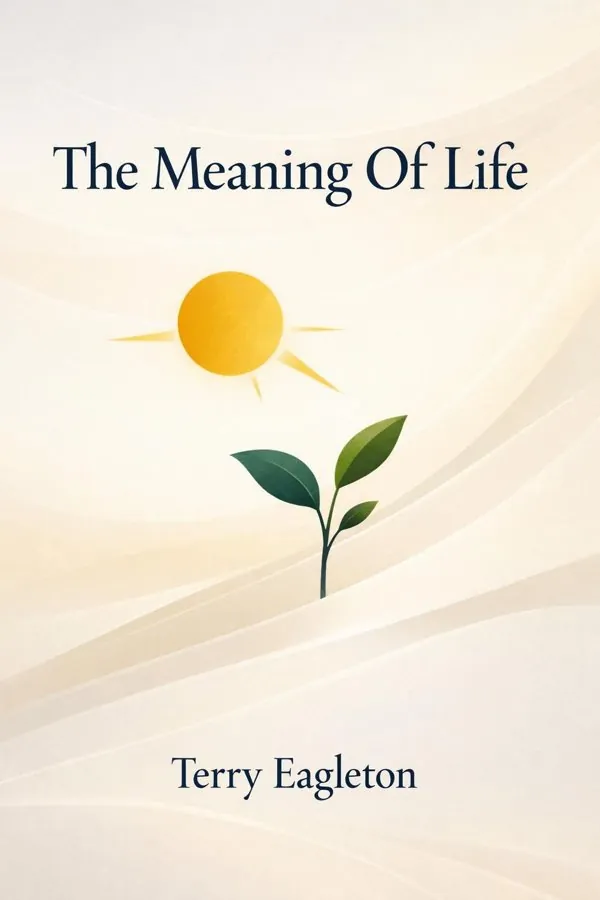
The Meaning Of Life: Summary & Key Insights
 10 min9 chaptersAudio available
Key Takeaways from The Meaning Of Life
One of Eagleton’s sharpest insights is that asking “What is the meaning of life?
A life does not become meaningful simply because we happen to enjoy it.
Modern culture often tells us to “find ourselves,” as though the isolated self contains the secret of life’s meaning.
Instead of treating meaning as an abstract riddle, Eagleton connects it to the older ethical idea of human flourishing.
A striking thread in Eagleton’s book is the claim that love may disclose more about life’s meaning than abstract speculation.
What Is The Meaning Of Life About?
The Meaning Of Life by Terry Eagleton is a western_phil book. What if the question of life’s meaning is both profound and slightly misguided? In The Meaning Of Life, literary critic and philosopher Terry Eagleton takes on one of humanity’s oldest obsessions with intelligence, humor, and refreshing clarity. Rather than offering a sentimental slogan or a neat philosophical formula, Eagleton examines how great thinkers, religious traditions, and modern culture have tried to answer the question of why we are here. Along the way, he exposes the confusions hidden inside the question itself: are we asking about cosmic purpose, personal fulfillment, moral duty, or the kind of life that is worth living? That distinction matters, and Eagleton makes it central to his argument. Drawing on philosophy, theology, literature, and politics, he shows that meaning is not something we simply discover like a buried object, but something bound up with love, community, flourishing, and forms of life larger than the isolated self. Eagleton is uniquely qualified for this task: one of Britain’s most influential public intellectuals, he combines scholarly depth with a witty, accessible style. The result is a short but rich book that turns a cliché question into a serious and rewarding inquiry.
This FizzRead summary covers all 9 key chapters of The Meaning Of Life in approximately 10 minutes, distilling the most important ideas, arguments, and takeaways from Terry Eagleton's work. Also available as an audio summary and Key Quotes Podcast.
The Meaning Of Life
What if the question of life’s meaning is both profound and slightly misguided? In The Meaning Of Life, literary critic and philosopher Terry Eagleton takes on one of humanity’s oldest obsessions with intelligence, humor, and refreshing clarity. Rather than offering a sentimental slogan or a neat philosophical formula, Eagleton examines how great thinkers, religious traditions, and modern culture have tried to answer the question of why we are here. Along the way, he exposes the confusions hidden inside the question itself: are we asking about cosmic purpose, personal fulfillment, moral duty, or the kind of life that is worth living? That distinction matters, and Eagleton makes it central to his argument. Drawing on philosophy, theology, literature, and politics, he shows that meaning is not something we simply discover like a buried object, but something bound up with love, community, flourishing, and forms of life larger than the isolated self. Eagleton is uniquely qualified for this task: one of Britain’s most influential public intellectuals, he combines scholarly depth with a witty, accessible style. The result is a short but rich book that turns a cliché question into a serious and rewarding inquiry.
Who Should Read The Meaning Of Life?
This book is perfect for anyone interested in western_phil and looking to gain actionable insights in a short read. Whether you're a student, professional, or lifelong learner, the key ideas from The Meaning Of Life by Terry Eagleton will help you think differently.
- ✓Readers who enjoy western_phil and want practical takeaways
- ✓Professionals looking to apply new ideas to their work and life
- ✓Anyone who wants the core insights of The Meaning Of Life in just 10 minutes
Want the full summary?
Get instant access to this book summary and 100K+ more with Fizz Moment.
Get Free SummaryAvailable on App Store • Free to download
Key Chapters
One of Eagleton’s sharpest insights is that asking “What is the meaning of life?” often mixes together several very different questions. We may be asking whether life has a cosmic purpose, whether my own life matters, what makes human existence worthwhile, or how we should live. Those are not the same problem, and much confusion arises when we treat them as if they were. Eagleton’s first move is therefore diagnostic: before answering the question, we need to understand what kind of question it is.
He suggests that modern people often ask for “the meaning of life” as though life were a sentence waiting to be decoded. But meaning in ordinary language usually depends on context, use, and relationships. A word means something because it belongs within a practice of communication. Likewise, a human life may gain meaning not from some hidden metaphysical label attached to it, but from the way it is lived within a network of purposes, commitments, and shared forms of life.
This matters because the search for meaning can become unproductive if it is framed too abstractly. A person who asks, “Does life mean anything?” may actually be wrestling with grief, boredom, isolation, or moral uncertainty. In those cases, the answer is unlikely to come from a universal slogan. It may come from friendship, meaningful work, participation in a community, or a deeper sense of responsibility.
In practice, Eagleton invites readers to replace vague metaphysical anxiety with more precise reflection. Instead of asking only “What is the meaning of life?” we might ask: What makes a life worth living? What obligations do I have? What kind of person should I become? These questions are harder, but also more fruitful.
Actionable takeaway: When you feel stuck on the “meaning of life,” rewrite the question in concrete terms—ask what gives your life purpose, connection, and direction right now.
A life does not become meaningful simply because we happen to enjoy it. Eagleton resists the popular idea that meaning is entirely subjective, as if any activity counts so long as it feels satisfying to the individual. Personal fulfillment matters, but he argues that meaning cannot be reduced to private preference without becoming trivial. If everything is meaningful merely because someone chooses it, then the concept of meaning loses its force.
He draws attention to the difference between pleasure and significance. A person may spend years chasing entertainment, status, or distraction and still feel that something essential is missing. Conversely, a demanding life devoted to care, justice, art, teaching, or political struggle may involve sacrifice and frustration while remaining deeply meaningful. Meaning, then, has some connection to objective goods: love, truthfulness, solidarity, creativity, and human flourishing.
This does not mean Eagleton advocates a rigid moral code imposed from above. Rather, he suggests that human beings flourish in certain ways because of the kind of creatures we are. We are social, vulnerable, dependent, language-using beings. A meaningful life grows from capacities that are realized in relation to others, not in isolation from them.
You can see this in ordinary experience. Raising a child, caring for an elderly parent, building something beautiful, mentoring a student, or standing up against injustice may not always maximize happiness in the short term. Yet such activities often feel more meaningful than endless self-indulgence because they connect us to values larger than immediate gratification.
Eagleton’s challenge is especially relevant in a culture that treats all choices as equal so long as they are freely made. Freedom matters, but it is not enough. The content of our commitments also matters.
Actionable takeaway: Evaluate your pursuits not only by how enjoyable they are, but by whether they contribute to truth, care, growth, or the well-being of others.
Modern culture often tells us to “find ourselves,” as though the isolated self contains the secret of life’s meaning. Eagleton pushes back against this individualist assumption. In his view, the self is not a sealed container of purpose. We become who we are through relationships, language, history, and shared social life. If that is true, then meaning cannot be manufactured entirely from within.
This argument has both philosophical and moral force. Philosophically, it challenges the fantasy of radical self-sufficiency. None of us invents our own world from scratch. We inherit languages, traditions, institutions, and moral vocabularies. Morally, it reminds us that a life centered only on personal advancement tends to shrink rather than deepen. The person who treats everyone else as a backdrop to private ambition may achieve success yet still experience emptiness.
Eagleton suggests that meaning emerges when the self is decentered—when we participate in practices and relationships that draw us beyond narcissism. Love is a key example. To love someone genuinely is to recognize that the world does not revolve around oneself. Friendship, political commitment, artistic collaboration, religious devotion, and acts of service all share this feature: they orient us toward goods that cannot be reduced to ego.
This does not mean selfhood is unimportant. It means the self becomes most itself when connected to larger ends. Consider the difference between a career built only on prestige and one shaped by contribution. In both cases a person may work hard, but only the second links identity to something shared and durable.
For readers trapped in endless self-optimization, Eagleton offers relief. Meaning is not hidden in a more polished version of your personal brand. It often appears when you stop obsessing over yourself and become absorbed in worthwhile realities outside you.
Actionable takeaway: Choose one regular activity—service, collaboration, caregiving, mentoring, or community work—that shifts your attention from self-display to shared purpose.
Instead of treating meaning as an abstract riddle, Eagleton connects it to the older ethical idea of human flourishing. A meaningful life is not just a life with a declared goal; it is a life in which distinctly human capacities are developed well. This brings his thinking close to classical traditions, especially Aristotelian ethics, where the good life involves cultivating virtue, reason, friendship, and participation in a just community.
The advantage of this approach is that it makes meaning practical. Rather than waiting for a revelation about our cosmic role, we can ask whether our lives are becoming richer in courage, generosity, understanding, and love. Flourishing is not identical to comfort. A person may be comfortable yet stunted, busy yet directionless, successful yet morally thin. To flourish is to grow into the kind of being one is capable of becoming.
Eagleton also emphasizes that flourishing is social. Human beings do not prosper alone. We need institutions, communities, and material conditions that allow us to develop our capacities. This adds a political edge to his argument. Meaning is not merely a private spiritual achievement; it is partly shaped by whether societies permit people to live with dignity, security, and mutual recognition.
In everyday life, this perspective can change what we value. Instead of focusing only on achievement metrics, we might ask whether our habits are making us wiser, kinder, and more responsive to others. Instead of measuring a job only by salary, we might ask whether it enables creativity, usefulness, and integrity. Meaning becomes less about having a dramatic destiny and more about inhabiting life well.
This does not eliminate tragedy, failure, or conflict. But it gives us a more humane standard than either pleasure or success alone. A flourishing life may still involve suffering; what matters is whether that life is ordered toward genuine goods.
Actionable takeaway: Review your weekly routine and identify one habit that strengthens a human capacity—such as attention, generosity, courage, or friendship—rather than merely increasing productivity.
A striking thread in Eagleton’s book is the claim that love may disclose more about life’s meaning than abstract speculation. Philosophical systems can define purpose in grand terms, but love shows what meaningful existence feels like from within. In love, we encounter self-transcendence, commitment, delight in another’s being, and a sense that value is real rather than merely invented.
Eagleton’s interest in love is not sentimental. He means something broader and deeper than romance alone. Love includes friendship, solidarity, compassion, and forms of mutual concern that bind people together. It is important because it takes us beyond possession and utility. In a world shaped by competition and consumption, love treats persons as ends rather than instruments.
This helps explain why some of life’s most meaningful moments are often ordinary: caring for a sick friend, listening attentively, forgiving someone, building trust over time, protecting the vulnerable. These acts may not solve the metaphysical mystery of existence, but they answer the question in lived form. They show that meaning is found not only in ideas but in the quality of our relations.
Love also has a demanding side. It requires patience, vulnerability, sacrifice, and the willingness to be changed by others. That is partly why it matters philosophically. A meaningful life cannot be built solely on control, self-protection, or calculated advantage. It requires openness to goods we do not fully command.
In practical terms, Eagleton’s emphasis on love rescues meaning from abstraction. The question becomes less “What universal principle explains existence?” and more “What kind of relationships make life deeply worth living?” For many people, that shift is clarifying.
Actionable takeaway: Strengthen one relationship this week through a concrete act of care—an honest conversation, sustained attention, practical help, or an expression of gratitude.
Eagleton does not treat the meaning-of-life debate as a simple contest between believers and atheists. One of the book’s strengths is its refusal to caricature either side. Religious traditions, especially Christianity, have often framed life’s meaning in terms of divine purpose, love, sacrifice, and redemption. Secular philosophy, meanwhile, has explored ethics, happiness, freedom, and the conditions of human flourishing without appeal to revelation. Eagleton moves between these worlds with unusual fluency.
His point is not that one must adopt a specific creed to live meaningfully, nor that secular thought has solved the issue once and for all. Rather, he shows that both traditions ask serious questions about value, suffering, obligation, and human destiny. Religious perspectives can preserve the sense that meaning involves more than self-interest and utility. Secular perspectives can sharpen critical inquiry and resist easy dogmatism. The most interesting conversation happens when these traditions are allowed to challenge and enrich one another.
This balanced approach matters in a polarized age. Many readers assume the choice is between simplistic faith and empty relativism. Eagleton rejects that false opposition. He takes religion seriously as an intellectual and moral tradition, but he is equally alert to weak arguments, complacency, and ideological misuse. Likewise, he values secular skepticism without assuming that skepticism alone can nourish a meaningful life.
In practical terms, this invites readers to be less tribal in their thinking. Someone struggling with meaning may learn from scripture, philosophy, literature, political theory, and everyday moral experience without forcing all wisdom into one camp. The question of meaning is too large to be monopolized by a single vocabulary.
Actionable takeaway: Read outside your usual worldview—pair one secular philosophical text with one religious or spiritual reflection on meaning, and compare what each reveals and overlooks.
It is fitting that a book about life’s ultimate meaning is also witty. Eagleton’s humor is not decorative; it serves a philosophical purpose. Questions about meaning easily become pompous, melodramatic, or vague. By treating the topic with irony and lightness, he clears away some of the self-importance that often prevents genuine thought. Humor can expose bad arguments, puncture clichés, and remind us that confusion is often built into the way the question is posed.
This is one reason Eagleton is so readable. He refuses both academic obscurity and inspirational fluff. Instead, he brings intellectual seriousness together with verbal play. That combination matters because the meaning-of-life industry is crowded with solemn answers that collapse under scrutiny. A humorous style allows him to point out when a fashionable claim is simply incoherent, or when a supposedly deep question is actually too muddled to answer.
There is also a deeper point here. Humor itself reveals something about human existence. To laugh is often to gain perspective, to see that reality exceeds our rigid categories and ego-driven dramas. A person who can laugh at the search for meaning is not necessarily dismissing it; they may be approaching it more honestly. After all, if meaning is real, it should withstand scrutiny rather than demand reverent vagueness.
In ordinary life, humor can help us navigate existential pressure. People who obsess over whether every moment is significant may become paralyzed. A lighter touch makes room for patience, fallibility, and the unfinished nature of understanding. It encourages reflection without despair.
Eagleton shows that seriousness of subject does not require heaviness of tone. Sometimes the wisest response to a grand question is to ask it carefully, answer it modestly, and smile at our tendency to overinflate ourselves.
Actionable takeaway: When wrestling with a big existential question, note one cliché or exaggerated assumption behind it; use humor to loosen the grip of confusion before seeking an answer.
Perhaps the deepest lesson of The Meaning Of Life is that no single slogan can settle the matter. Eagleton does not end with a tidy formula because the subject resists reduction. Human life involves purpose, morality, love, suffering, freedom, embodiment, community, and mortality. Any answer that ignores this complexity will feel thin. Yet complexity does not mean the question is hopeless. It means we need better, richer ways of answering it.
Eagleton’s alternative is not relativism but maturity. A meaningful life is one shaped by self-transcendence, love, social belonging, and the flourishing of human capacities. It is not a treasure hidden behind the universe but something enacted through forms of living. We do not solve the problem once and for all; we inhabit an answer through our practices, commitments, and relations.
This perspective is liberating. It frees us from waiting for a dramatic revelation that will suddenly make everything clear. Meaning may emerge gradually through work well done, bonds faithfully kept, truths honestly faced, and responsibilities willingly assumed. It also explains why suffering does not automatically destroy meaning. A hard life can still be meaningful if it remains connected to love, dignity, and worthwhile ends.
In everyday terms, this means we should distrust simplistic promises: that wealth will satisfy us, that total freedom will complete us, or that private happiness alone is enough. Meaning is deeper, more demanding, and more shared than that. It asks what kind of life can be justified as genuinely good.
Eagleton leaves readers with a task rather than a slogan: live in such a way that meaning becomes visible in action. That may be less comforting than a neat answer, but it is far more honest.
Actionable takeaway: Define three enduring commitments—such as love, truth, service, or craft—and use them as a practical compass for major decisions instead of chasing short-term intensity.
All Chapters in The Meaning Of Life
About the Author
Terry Eagleton is one of Britain’s most prominent literary critics and public intellectuals. Born in 1943, he became widely known for his work in literary theory, Marxist criticism, cultural studies, and the relationship between ethics, politics, and religion. He has taught at major universities, including Oxford, Manchester, and Lancaster, and has written numerous influential books on topics ranging from Shakespeare and ideology to faith and contemporary culture. Eagleton is especially admired for his rare ability to make complex intellectual debates engaging, witty, and accessible to general readers. His writing combines deep scholarship with sharp cultural criticism and a strong moral seriousness. In The Meaning Of Life, he brings those strengths together to explore one of philosophy’s oldest questions with clarity, humor, and insight.
Get This Summary in Your Preferred Format
Read or listen to the The Meaning Of Life summary by Terry Eagleton anytime, anywhere. FizzRead offers multiple formats so you can learn on your terms — all free.
Available formats: App · Audio · PDF · EPUB — All included free with FizzRead
Download The Meaning Of Life PDF and EPUB Summary
Key Quotes from The Meaning Of Life
“One of Eagleton’s sharpest insights is that asking “What is the meaning of life?”
“A life does not become meaningful simply because we happen to enjoy it.”
“Modern culture often tells us to “find ourselves,” as though the isolated self contains the secret of life’s meaning.”
“Instead of treating meaning as an abstract riddle, Eagleton connects it to the older ethical idea of human flourishing.”
“A striking thread in Eagleton’s book is the claim that love may disclose more about life’s meaning than abstract speculation.”
Frequently Asked Questions about The Meaning Of Life
The Meaning Of Life by Terry Eagleton is a western_phil book that explores key ideas across 9 chapters. What if the question of life’s meaning is both profound and slightly misguided? In The Meaning Of Life, literary critic and philosopher Terry Eagleton takes on one of humanity’s oldest obsessions with intelligence, humor, and refreshing clarity. Rather than offering a sentimental slogan or a neat philosophical formula, Eagleton examines how great thinkers, religious traditions, and modern culture have tried to answer the question of why we are here. Along the way, he exposes the confusions hidden inside the question itself: are we asking about cosmic purpose, personal fulfillment, moral duty, or the kind of life that is worth living? That distinction matters, and Eagleton makes it central to his argument. Drawing on philosophy, theology, literature, and politics, he shows that meaning is not something we simply discover like a buried object, but something bound up with love, community, flourishing, and forms of life larger than the isolated self. Eagleton is uniquely qualified for this task: one of Britain’s most influential public intellectuals, he combines scholarly depth with a witty, accessible style. The result is a short but rich book that turns a cliché question into a serious and rewarding inquiry.
You Might Also Like
A Little History of Philosophy
Nigel Warburton
10 min
Areopagitica
John Milton
10 min
How To Think Like A Philosopher: Essential Principles For Clear Thinking
Peter Cave
10 min
Language, Truth and Logic
A. J. Ayer
10 min
The Age of Reason
Thomas Paine
10 min
The Essays
Michel De Montaigne
10 minBrowse by Category
Ready to read The Meaning Of Life?
Get the full summary and 100K+ more books with Fizz Moment.