
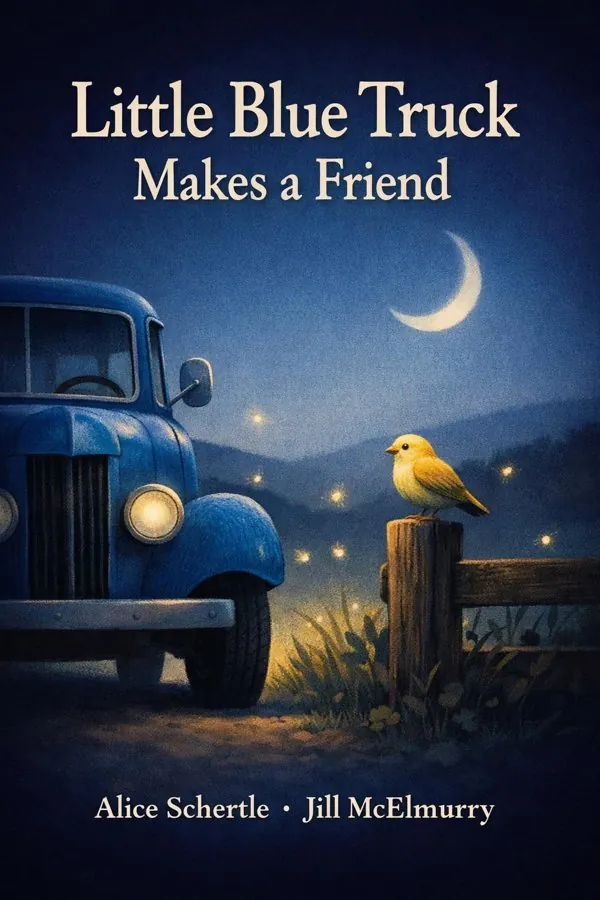
Little Blue Truck Makes a Friend: Summary & Key Insights
by Alice Schertle, Jill McElmurry
 10 min8 chaptersAudio available
Key Takeaways from Little Blue Truck Makes a Friend
Children often learn best from stories that begin in a place of comfort.
A new arrival can stir both curiosity and discomfort at the same time.
Most friendships do not begin with dramatic gestures.
When the animals react with uncertainty to the unfamiliar yellow truck, the book acknowledges something important: caution is a normal social response.
True friendship is often tested not in introductions but in moments of need.
What Is Little Blue Truck Makes a Friend About?
Little Blue Truck Makes a Friend by Alice Schertle, Jill McElmurry is a parenting book spanning 7 pages. Little Blue Truck Makes a Friend is a gentle, reassuring picture book about what happens when someone new enters a familiar world. In this installment of Alice Schertle’s beloved series, Little Blue Truck sets out along his usual country road, greeting the animals and enjoying the comfort of known routines. Then a bright yellow newcomer appears, changing the rhythm of the day and inviting everyone to respond to something unfamiliar. What follows is a simple but meaningful story about kindness, openness, empathy, and the small acts of help that turn strangers into friends. For parents, caregivers, and educators, the book offers more than a sweet story. It creates an easy, memorable way to talk with children about welcoming others, managing uncertainty, and noticing when someone needs support. Schertle’s signature rhyming text makes the lessons feel playful rather than preachy, while Jill McElmurry’s warm illustrations help young readers understand emotions through facial expressions, movement, and color. Together, they deliver a story that is brief in length but rich in social and emotional learning, making it especially valuable for families raising kind, confident, and inclusive children.
This FizzRead summary covers all 8 key chapters of Little Blue Truck Makes a Friend in approximately 10 minutes, distilling the most important ideas, arguments, and takeaways from Alice Schertle, Jill McElmurry's work. Also available as an audio summary and Key Quotes Podcast.
Little Blue Truck Makes a Friend
Little Blue Truck Makes a Friend is a gentle, reassuring picture book about what happens when someone new enters a familiar world. In this installment of Alice Schertle’s beloved series, Little Blue Truck sets out along his usual country road, greeting the animals and enjoying the comfort of known routines. Then a bright yellow newcomer appears, changing the rhythm of the day and inviting everyone to respond to something unfamiliar. What follows is a simple but meaningful story about kindness, openness, empathy, and the small acts of help that turn strangers into friends.
For parents, caregivers, and educators, the book offers more than a sweet story. It creates an easy, memorable way to talk with children about welcoming others, managing uncertainty, and noticing when someone needs support. Schertle’s signature rhyming text makes the lessons feel playful rather than preachy, while Jill McElmurry’s warm illustrations help young readers understand emotions through facial expressions, movement, and color. Together, they deliver a story that is brief in length but rich in social and emotional learning, making it especially valuable for families raising kind, confident, and inclusive children.
Who Should Read Little Blue Truck Makes a Friend?
This book is perfect for anyone interested in parenting and looking to gain actionable insights in a short read. Whether you're a student, professional, or lifelong learner, the key ideas from Little Blue Truck Makes a Friend by Alice Schertle, Jill McElmurry will help you think differently.
- ✓Readers who enjoy parenting and want practical takeaways
- ✓Professionals looking to apply new ideas to their work and life
- ✓Anyone who wants the core insights of Little Blue Truck Makes a Friend in just 10 minutes
Want the full summary?
Get instant access to this book summary and 100K+ more with Fizz Moment.
Get Free SummaryAvailable on App Store • Free to download
Key Chapters
Children often learn best from stories that begin in a place of comfort. Little Blue Truck starts his journey on familiar roads, surrounded by recognizable sights, sounds, and animal friends. This opening matters because it reflects a truth about emotional development: before children can explore new relationships or ideas, they benefit from a sense of safety and predictability. The countryside setting, the repeated greetings, and the steady rhythm of the text all create a feeling of order. That calm foundation prepares young readers for the moment when something unfamiliar arrives.
In parenting, routines work much the same way. A child who knows what to expect at bedtime, school drop-off, or mealtime is often better able to handle surprises during the day. The story quietly models that familiar rituals are not boring; they are stabilizing. Little Blue’s normal route gives him confidence, and that confidence later allows him to respond kindly instead of fearfully.
A practical application is to use recurring family habits as launch points for discussing change. For example, while driving the same route to daycare, a parent might say, “We know this road well. How do you feel when something new happens on a road you know?” That helps children connect the story to their own experience.
The broader lesson is that resilience is often built on routine. Children do not become open to difference by being pushed into uncertainty without support. They become open when they feel grounded first. Actionable takeaway: create one or two dependable daily rituals, then use them as safe spaces to talk about meeting new people and handling change.
A new arrival can stir both curiosity and discomfort at the same time. When the bright yellow truck appears, it disrupts the familiar pace of the road. The newcomer is different in sound, appearance, and energy, and that difference immediately changes the emotional landscape. The animals notice. Little Blue notices. Readers notice too. This is one of the book’s most useful insights for families: when children meet someone new, their mixed feelings are normal.
Young children often experience novelty in extremes. They may be intrigued by a new classmate, neighbor, or babysitter, yet still feel shy, cautious, or possessive of their routines. The story validates those reactions without turning the newcomer into a threat. Instead, it shows that unfamiliarity is simply the first stage of relationship. Difference gets attention, but it does not need to lead to rejection.
Parents can use this moment to explain that being “different” is not the same as being “wrong.” A practical example might be a child who notices that a new student talks differently, dresses differently, or does not yet know the classroom rules. Rather than rushing to correct the child’s observation, adults can guide it: “Yes, they’re new. What might help them feel welcome?” This shifts attention from judgment to empathy.
The yellow truck’s arrival also reminds adults that first impressions are powerful. Children watch how caregivers react to outsiders. If adults greet difference with warmth and calm, children are more likely to do the same.
Actionable takeaway: when your child encounters someone new, name both sides of the feeling—“It’s exciting and it can feel strange”—then ask one simple question that invites empathy rather than evaluation.
Most friendships do not begin with dramatic gestures. They begin with a greeting. One of the loveliest elements in Little Blue Truck Makes a Friend is Little Blue’s instinct to extend warmth before certainty. He does not wait until the new truck has proven itself. He offers friendliness first. That choice captures a deep social truth: inclusion often starts with one brave, simple act.
For children, the idea of welcoming someone can feel abstract unless it is broken into concrete behaviors. This story helps translate kindness into visible action. A hello, a smile, making room in a game, showing someone the rules, or simply not excluding them can all be forms of welcome. The beauty of Little Blue’s response is that it is low-pressure and accessible. He models friendliness that is open but not overwhelming.
In family life, this idea can be practiced in many ordinary settings. A parent might coach a child before a playground visit: “If you see someone alone, you can say, ‘Do you want to play with us?’” At school, a teacher can assign a classroom buddy to a new student. Even siblings can practice by welcoming a visiting cousin into an activity rather than defending territory.
The story also reminds adults that children need examples, not just instructions. Saying “be nice” is vague. Demonstrating how to introduce yourself, offer help, or include someone in a routine is much more effective.
Welcoming others does not guarantee instant closeness, but it creates the conditions where friendship can grow. Actionable takeaway: teach your child one specific inclusion phrase—such as “Do you want to join us?”—and encourage them to use it the next time they meet someone new.
When the animals react with uncertainty to the unfamiliar yellow truck, the book acknowledges something important: caution is a normal social response. Children do not always welcome new people immediately, and that does not mean they are unkind. They may need time to observe, compare, and decide whether the new person feels safe. By including hesitation in the story, Alice Schertle makes room for emotional honesty rather than forcing cheerful acceptance from the start.
This matters because children often feel ashamed if they are shy, slow to warm up, or resistant to change. Parents may also worry that reluctance signals a deeper problem. But in many cases, hesitation is simply a developmental step. The key question is not whether a child hesitates, but how adults help them move through that hesitation.
A practical way to apply this lesson is to avoid labeling a child as “rude” or “unfriendly” too quickly. Instead, narrate what may be happening: “You’re not sure yet because this is new.” That language validates the feeling while keeping the door open to connection. Adults can then scaffold the next step. For example, rather than demanding full participation, they might suggest a manageable action such as waving, standing nearby, or asking one question.
The story also suggests that groups can be cautious, not just individuals. Families, classrooms, and communities often need guidance in making space for newcomers. Inclusive habits rarely happen automatically.
Hesitation becomes harmful only when it hardens into exclusion. Actionable takeaway: when your child seems unsure around someone new, validate the feeling first, then offer one small social step instead of expecting instant friendliness.
True friendship is often tested not in introductions but in moments of need. When trouble appears on the road, the story shifts from curiosity to action. This is where the emotional lesson deepens. The yellow truck is no longer just “the new one.” In a moment of difficulty, everyone sees what matters most: who shows up, who helps, and how cooperation can turn uncertainty into trust.
Children understand fairness and assistance most vividly through situations. A character in trouble creates a clear opportunity to discuss empathy in action. It is one thing to say, “We should be kind.” It is another to show kindness through helping push, pull, wait, share, or rescue. In Little Blue Truck stories, assistance is never abstract. It is practical, immediate, and communal.
Parents can use this part of the book to talk about real-life helping behaviors. If a child sees a classmate drop crayons, the equivalent of “helping on the road” may be picking them up. If a new student does not know where to line up, helping may mean showing them. If a sibling is frustrated with a puzzle, helping may mean offering support without taking over.
This section also teaches that help builds trust faster than image does. The yellow truck may look different, sound different, or behave differently at first, but once a challenge arises, actions speak louder than impressions. Children need repeated examples of this principle because they naturally sort the world by surface cues.
Actionable takeaway: ask your child after reading, “What does helping look like at school or home today?” Then invite them to choose one real act of assistance they can do before the day ends.
Help can solve a problem, but gratitude transforms a helpful moment into a relationship. After the road trouble passes, the emotional shift in the story comes through recognition and appreciation. Gratitude says, “I see what you did for me, and it mattered.” That acknowledgement is essential because friendship is not built only on receiving care; it grows when care is noticed, valued, and returned.
For children, gratitude is a social skill as much as a moral one. Saying thank you is often taught as a rule of politeness, but this book hints at something deeper. Gratitude helps children understand interdependence. It teaches them that support connects people. A child who learns to recognize help is more likely to become generous toward others later.
In practical terms, parents can expand gratitude beyond automatic manners. Instead of only prompting “Say thank you,” they can ask, “What did they do that helped you?” This encourages specific noticing. For example, “Thank you for waiting for me,” or “Thank you for showing me where the blocks go,” is more meaningful than a quick, disconnected response.
The story also models how gratitude can soften prior uncertainty. Once appreciation is expressed, the new truck is no longer outside the group. Gratitude creates belonging because it confirms mutual value. In homes and classrooms, this can be reinforced with rituals such as sharing one helpful thing someone did each day.
Children who practice gratitude become better at sustaining friendships because they learn not to take others for granted. Actionable takeaway: teach your child to pair thanks with specifics by using the sentence frame, “Thank you for helping me by…” at least once a day.
A community becomes stronger when it expands rather than closes ranks. By the end of Little Blue Truck Makes a Friend, the story moves beyond one-on-one kindness into a broader sense of belonging. The newcomer is not merely tolerated; the group’s world feels fuller because someone new has been welcomed. This ending matters because it shows children that inclusion is not a sacrifice of comfort but an enrichment of community.
Young readers often think of friendship in pairs: my best friend, my sibling, my favorite playmate. This book gently widens that lens. It suggests that healthy communities have room for many personalities, sounds, speeds, and styles. The countryside feels lively because it includes a range of characters, not because everyone is identical.
Parents and teachers can apply this idea by creating visible rituals of inclusion. In a classroom, that might mean a welcome song for new students. At home, it could mean including a new neighbor in a playdate or inviting a quiet child to a birthday gathering. In family conversations, adults can ask, “How can we make our group bigger, kinder, and more fun?” This reframes inclusion as a creative act.
The story also counters a common fear children have: that welcoming someone new means losing their own place. Instead, it shows that friendship is not a limited resource. Care can multiply.
Celebration is part of the lesson too. When children see that making space for others leads to joy, they begin to associate inclusion with positive emotion rather than obligation. Actionable takeaway: create one simple family or classroom ritual that intentionally welcomes newcomers and makes belonging visible.
All Chapters in Little Blue Truck Makes a Friend
About the Authors
Alice Schertle is an American children’s author and poet whose work is known for its lyrical language, warmth, and strong read-aloud appeal. She has written numerous books for young readers, but she is especially celebrated for the Little Blue Truck series, which has become a favorite among families and educators for its themes of kindness, community, and empathy. Jill McElmurry was an American illustrator and author admired for her distinctive watercolor style and expressive, inviting artwork. Her illustrations brought tenderness, movement, and emotional clarity to many children’s books, including the Little Blue Truck titles. Together, Schertle and McElmurry created stories that combine memorable rhythm with emotionally resonant imagery, helping young children understand friendship, cooperation, and belonging in simple but lasting ways.
Get This Summary in Your Preferred Format
Read or listen to the Little Blue Truck Makes a Friend summary by Alice Schertle, Jill McElmurry anytime, anywhere. FizzRead offers multiple formats so you can learn on your terms — all free.
Available formats: App · Audio · PDF · EPUB — All included free with FizzRead
Download Little Blue Truck Makes a Friend PDF and EPUB Summary
Key Quotes from Little Blue Truck Makes a Friend
“Children often learn best from stories that begin in a place of comfort.”
“A new arrival can stir both curiosity and discomfort at the same time.”
“Most friendships do not begin with dramatic gestures.”
“When the animals react with uncertainty to the unfamiliar yellow truck, the book acknowledges something important: caution is a normal social response.”
“True friendship is often tested not in introductions but in moments of need.”
Frequently Asked Questions about Little Blue Truck Makes a Friend
Little Blue Truck Makes a Friend by Alice Schertle, Jill McElmurry is a parenting book that explores key ideas across 8 chapters. Little Blue Truck Makes a Friend is a gentle, reassuring picture book about what happens when someone new enters a familiar world. In this installment of Alice Schertle’s beloved series, Little Blue Truck sets out along his usual country road, greeting the animals and enjoying the comfort of known routines. Then a bright yellow newcomer appears, changing the rhythm of the day and inviting everyone to respond to something unfamiliar. What follows is a simple but meaningful story about kindness, openness, empathy, and the small acts of help that turn strangers into friends. For parents, caregivers, and educators, the book offers more than a sweet story. It creates an easy, memorable way to talk with children about welcoming others, managing uncertainty, and noticing when someone needs support. Schertle’s signature rhyming text makes the lessons feel playful rather than preachy, while Jill McElmurry’s warm illustrations help young readers understand emotions through facial expressions, movement, and color. Together, they deliver a story that is brief in length but rich in social and emotional learning, making it especially valuable for families raising kind, confident, and inclusive children.
You Might Also Like
Never Enough
Jennifer Breheny Wallace
10 min
Bluey: Sleepytime
Joe Brumm
10 min
In My Heart: A Book of Feelings
Jo Witek
10 min
Love From The Crayons
Drew Daywalt, Oliver Jeffers
10 min
Pete The Cat: Big Easter Adventure
James Dean, Kimberly Dean
10 min
Smart Money Smart Kids: Raising the Next Generation to Win with Money
Dave Ramsey, Rachel Cruze
10 minBrowse by Category
Ready to read Little Blue Truck Makes a Friend?
Get the full summary and 100K+ more books with Fizz Moment.