
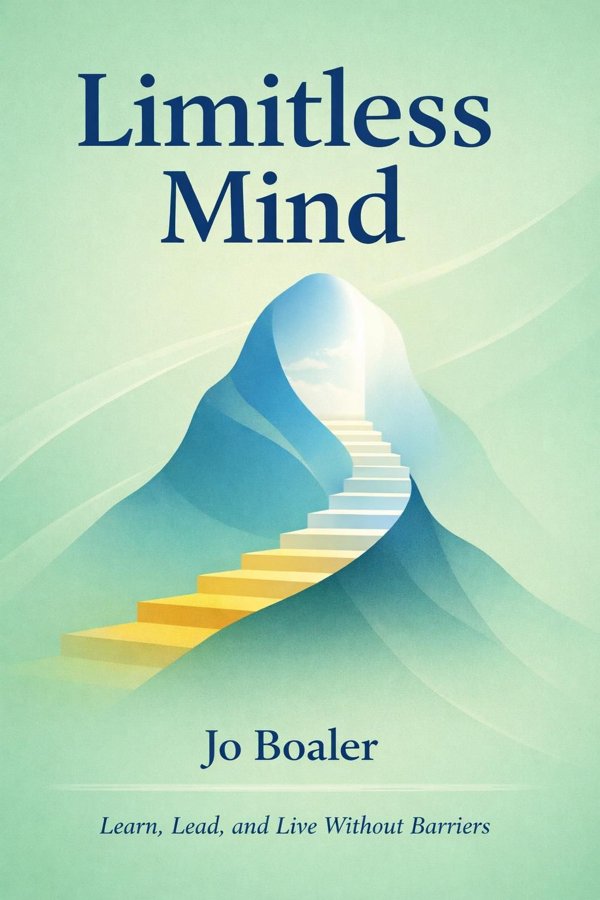
Limitless Mind: Learn, Lead, and Live Without Barriers: Summary & Key Insights
by Jo Boaler
 10 min9 chaptersAudio available
Key Takeaways from Limitless Mind: Learn, Lead, and Live Without Barriers
One of the most harmful ideas in modern education is also one of the most widely accepted: the belief that intelligence is something you either have or do not have.
The brain is not a finished machine; it is a living system that reshapes itself through learning.
Many people experience mistakes as proof of inadequacy, but Boaler argues that mistakes are among the most valuable events in the learning process.
People often assume that if learning feels hard, they must not be good at it.
How people think about intelligence changes how they perform.
What Is Limitless Mind: Learn, Lead, and Live Without Barriers About?
Limitless Mind: Learn, Lead, and Live Without Barriers by Jo Boaler is a education book spanning 12 pages. What if the biggest obstacle to learning is not ability, age, or talent, but the belief that these things are fixed? In Limitless Mind, Stanford professor Jo Boaler challenges one of the most damaging assumptions in education and everyday life: that some people are naturally smart while others simply are not. Drawing on neuroscience, classroom research, psychology, and years of work in mathematics education, she argues that human potential is far more expandable than most institutions allow. Boaler shows that the brain is constantly changing, growing, and rewiring in response to challenge, effort, and experience. Mistakes, struggle, creativity, and collaboration are not signs of weakness; they are essential parts of deep learning. This perspective has powerful implications not only for students, but also for teachers, parents, leaders, and anyone who has ever felt boxed in by labels or past performance. The book matters because fixed ideas about intelligence quietly shape schools, careers, and identities. Boaler offers a more hopeful and evidence-based alternative: a limitless view of human capability. Her authority comes from decades of research at Stanford, her leadership in mathematics education, and her commitment to making learning more equitable and humane.
This FizzRead summary covers all 9 key chapters of Limitless Mind: Learn, Lead, and Live Without Barriers in approximately 10 minutes, distilling the most important ideas, arguments, and takeaways from Jo Boaler's work. Also available as an audio summary and Key Quotes Podcast.
Limitless Mind: Learn, Lead, and Live Without Barriers
What if the biggest obstacle to learning is not ability, age, or talent, but the belief that these things are fixed? In Limitless Mind, Stanford professor Jo Boaler challenges one of the most damaging assumptions in education and everyday life: that some people are naturally smart while others simply are not. Drawing on neuroscience, classroom research, psychology, and years of work in mathematics education, she argues that human potential is far more expandable than most institutions allow.
Boaler shows that the brain is constantly changing, growing, and rewiring in response to challenge, effort, and experience. Mistakes, struggle, creativity, and collaboration are not signs of weakness; they are essential parts of deep learning. This perspective has powerful implications not only for students, but also for teachers, parents, leaders, and anyone who has ever felt boxed in by labels or past performance.
The book matters because fixed ideas about intelligence quietly shape schools, careers, and identities. Boaler offers a more hopeful and evidence-based alternative: a limitless view of human capability. Her authority comes from decades of research at Stanford, her leadership in mathematics education, and her commitment to making learning more equitable and humane.
Who Should Read Limitless Mind: Learn, Lead, and Live Without Barriers?
This book is perfect for anyone interested in education and looking to gain actionable insights in a short read. Whether you're a student, professional, or lifelong learner, the key ideas from Limitless Mind: Learn, Lead, and Live Without Barriers by Jo Boaler will help you think differently.
- ✓Readers who enjoy education and want practical takeaways
- ✓Professionals looking to apply new ideas to their work and life
- ✓Anyone who wants the core insights of Limitless Mind: Learn, Lead, and Live Without Barriers in just 10 minutes
Want the full summary?
Get instant access to this book summary and 100K+ more with Fizz Moment.
Get Free SummaryAvailable on App Store • Free to download
Key Chapters
One of the most harmful ideas in modern education is also one of the most widely accepted: the belief that intelligence is something you either have or do not have. Jo Boaler argues that this assumption has quietly shaped classrooms, testing systems, career paths, and personal identities for decades. Students are sorted into advanced and lower tracks, adults describe themselves as “not a math person,” and organizations reward early performance as if it predicts permanent capacity. The result is not just inequality, but self-limitation.
Boaler shows that fixed-ability thinking becomes a social script. Once people are labeled gifted, average, or struggling, they start acting in ways that confirm the label. High performers may avoid difficult tasks to protect their identity, while low-labeled learners may stop trying because effort feels pointless. These responses are often mistaken for natural differences in talent, when they are actually the consequences of a narrow belief system.
This matters far beyond school. In workplaces, people may assume leadership, creativity, or analytical skill are inborn traits. In families, children can internalize comparisons that follow them for years. The fixed mindset creates fear, caution, and resignation. A limitless mindset, by contrast, opens the possibility that ability develops through experience, challenge, and support.
A practical way to apply this idea is to replace identity statements with growth statements. Instead of saying, “I’m bad at presentations,” say, “I’m still learning how to present clearly.” Instead of praising a child as naturally brilliant, praise the strategies they used and the persistence they showed. Actionable takeaway: notice every time you or someone around you uses a fixed label, and deliberately reframe it in terms of learning, progress, and possibility.
The brain is not a finished machine; it is a living system that reshapes itself through learning. Boaler draws on neuroscience to explain brain plasticity, the process by which neural pathways strengthen, reorganize, and expand in response to new experiences. This means learning is not metaphorically growth; it is literal biological growth. Every challenge, practice session, and conceptual breakthrough changes the brain.
This insight undercuts the excuse that some people are simply wired for success while others are not. While people begin from different circumstances and may develop at different rates, the core point remains powerful: ability is not fixed in the brain. Even adults who have spent years believing they cannot improve can still build new skills and deeper understanding. This is particularly important for people who carry old wounds from school, especially in subjects like math, writing, or science.
Boaler also emphasizes that the brain grows most when it is actively engaged, making connections, and working through meaningful problems rather than memorizing isolated facts. Rich learning experiences create stronger and more flexible neural networks than passive repetition alone. For teachers, this means designing tasks that invite thinking, questioning, and multiple approaches. For individuals, it means pursuing stretch experiences instead of staying only with what feels easy.
In everyday life, this could look like learning a language later in life, returning to school after years away, or approaching a difficult work skill as something trainable rather than predetermined. The science supports hope, but only if people act on it. Actionable takeaway: when you face something difficult, remind yourself that confusion and effort are signs your brain is adapting, then stay with the task long enough for that growth to begin.
Many people experience mistakes as proof of inadequacy, but Boaler argues that mistakes are among the most valuable events in the learning process. When we make an error and then examine it, the brain becomes especially active. Productive mistakes create opportunities for reflection, adjustment, and stronger understanding. In other words, the moments we often want to hide are often the moments when the deepest learning becomes possible.
This idea challenges a school culture that rewards speed, accuracy, and polished answers while treating visible struggle as failure. Students learn to fear being wrong, so they avoid difficult questions, stay silent in class, or choose easier tasks. Adults do the same in meetings, projects, and creative work. The cost is enormous: fear of mistakes narrows thinking and discourages experimentation.
Boaler encourages learners and educators to treat mistakes as data rather than judgment. A wrong answer can reveal a misconception, an untested assumption, or an incomplete strategy. When errors are discussed openly, they become resources for everyone. In math classrooms, for example, comparing different wrong and right approaches can deepen understanding more than quickly moving to the correct procedure. In workplaces, reviewing failed initiatives without blame can improve systems and innovation.
A practical application is to build “error analysis” into learning routines. After a test, presentation, or project, ask: What did I misunderstand? What pattern do I see? What new strategy should I try next time? Teams can do the same through after-action reviews. The goal is not to celebrate failure blindly, but to use it intelligently. Actionable takeaway: the next time you make a mistake, resist the urge to hide or dismiss it; spend five minutes studying what it can teach you before moving on.
People often assume that if learning feels hard, they must not be good at it. Boaler flips this assumption. Genuine struggle, she argues, is not evidence of low ability; it is often evidence that real learning is happening. When the mind wrestles with ideas, tests possibilities, and works through uncertainty, it is building deeper understanding than it would through easy recall or routine completion.
This distinction is crucial because many learners have been conditioned to equate being “smart” with being fast. Quick answers win praise, while slow thinking is viewed suspiciously. Yet speed and depth are not the same thing. A student who pauses, explores multiple methods, and revises their thinking may be learning far more than one who produces an instant answer from memory. The same applies at work: meaningful problem-solving usually includes ambiguity, delay, and revision.
Boaler does not romanticize frustration. Unproductive struggle, where learners are confused without support, can discourage and exhaust them. The goal is productive struggle: challenge paired with encouragement, tools, and the freedom to persist. Teachers can create this by asking open questions, allowing think time, and valuing multiple methods. Parents and managers can do it by resisting the urge to rescue too quickly. Learners can do it by staying with hard problems a little longer before concluding they are incapable.
Consider learning statistics, coding, or public speaking. The awkward middle stage, where nothing feels natural, is often where the most important growth occurs. If you quit there, you mistake development for defeat. Actionable takeaway: when you feel challenged, replace the thought “this means I can’t do it” with “this is the stretch zone where my understanding is expanding,” then use one supportive strategy to keep going.
How people think about intelligence changes how they perform. Boaler shows that beliefs are not decorative ideas sitting on top of ability; they actively influence motivation, resilience, attention, and achievement. When people believe they can grow, they approach challenge differently. They persist longer, interpret setbacks more constructively, and invest more effort in improvement. When they believe ability is fixed, they protect themselves through avoidance, excuses, or withdrawal.
This is why changing beliefs can be transformative. A student who has spent years thinking, “I’m just not academic,” may suddenly engage differently when they understand that learning changes the brain. An employee who assumes leadership is innate may be more willing to practice communication, strategic thinking, or decision-making once they view these as developable capacities. Beliefs alter what people attempt, and what people attempt alters what they become capable of doing.
Boaler also warns that limiting beliefs are often socially transmitted. Parents, teachers, peers, and institutions all reinforce messages about who is likely to succeed. Casual comments like “your brother is the math one” or “some people are just natural writers” seem harmless, but they can quietly narrow identity. Reframing these messages can widen opportunity.
One practical way to shift beliefs is through language. Use “yet” generously: “I don’t understand this yet.” Focus feedback on process, strategy, and revision rather than ranking or innate talent. Reflect on areas where you have improved over time to build evidence against your own fixed assumptions. Actionable takeaway: identify one limiting belief you carry about yourself, write a growth-based alternative statement, and repeat it whenever the old script begins to return.
The image of learning as a solitary act hides an important truth: human understanding often grows best in connection with others. Boaler argues that collaboration is not just a social add-on to learning; it is a powerful cognitive tool. When people share perspectives, explain reasoning, challenge assumptions, and build on one another’s ideas, they develop richer and more flexible understanding than they typically do alone.
This is especially important in systems that glorify individual brilliance. Students are often taught that the strongest learner is the one who works independently and gets the answer first. Professionals may believe asking for help signals weakness. But collaboration can deepen thought by making reasoning visible. Hearing another person’s method in mathematics, for example, reveals that there is often more than one path to understanding. In organizations, group problem-solving can reduce blind spots and increase innovation when psychological safety is present.
Boaler also links collaboration to equity. Students who might remain silent in competitive settings often thrive when dialogue, mutual explanation, and shared inquiry are built into the environment. The classroom becomes less about proving who is smartest and more about constructing understanding together. This changes both learning outcomes and emotional climate.
Practical applications include group tasks with multiple entry points, study partnerships, peer teaching, and workplace meetings structured around idea-building instead of quick judgment. The key is not simply putting people together, but creating norms of listening, respect, and curiosity. Actionable takeaway: in your next learning or work challenge, invite another person into the process and ask them to explain how they see the problem before you settle on your own solution.
A person can be held back long before they encounter a difficult task. Boaler explores how labels and emotions shape learning by influencing what people believe is possible. Words like gifted, remedial, advanced, slow, or not creative do more than describe performance in a moment; they often harden into identities. Once that happens, people begin filtering experiences through the label. Success feels like pressure to maintain status, while setbacks feel like confirmation of inadequacy.
Fear intensifies the damage. Anxiety narrows attention, undermines working memory, and makes challenge feel threatening instead of energizing. This is particularly visible in mathematics anxiety, an area Boaler has studied extensively, but the pattern applies widely. Learners who fear judgment often disengage, memorize mechanically, or avoid participation. Adults carry similar emotional barriers into presentations, negotiations, and technical work.
Boaler’s broader point is that learning is not purely intellectual. Emotions are part of cognition. Environments filled with comparison, humiliation, and constant evaluation shrink people’s willingness to think openly. In contrast, environments marked by safety, belonging, and encouragement make risk-taking possible. Teachers can normalize uncertainty, avoid public ranking, and celebrate varied approaches. Leaders can invite questions, reward learning, and respond to mistakes without blame. Parents can be careful with sibling comparisons and identity-based praise.
To apply this personally, notice where fear rather than ability is shaping your behavior. Are you avoiding a subject, conversation, or skill because it threatens your self-image? Actionable takeaway: choose one area where a label or fear has limited you, then create one low-stakes opportunity to engage with it in a supportive environment and redefine the experience.
If minds are truly limitless, then many common educational practices need to change. Boaler argues that schools often undermine learning by emphasizing speed, ranking, narrow testing, and passive instruction. These systems reward answer-getting over understanding and make many students feel that intelligence is a race they are losing. A limitless approach to education asks different questions: Are students reasoning deeply? Are they making connections? Do they feel safe enough to explore, question, and revise?
This shift has practical implications for teaching. Rich tasks should allow multiple methods and entry points so more learners can participate meaningfully. Assessment should capture growth, understanding, and thinking processes rather than only final answers. Teachers should encourage discussion, visual reasoning, creativity, and reflection. Instead of treating struggle as a problem to eliminate, they should design support that helps students work through it productively.
Boaler often uses mathematics as a vivid case study because it is a subject where fixed beliefs are especially widespread. Many people decide early that they either “have a math brain” or they do not. Yet when math is taught as pattern, meaning, visual connection, and exploration rather than speed drills and memorization alone, far more students can succeed. The lesson extends to other subjects and to adult learning as well.
For leaders, this idea applies to training and team development. Do your systems reward fast confidence over thoughtful growth? Do they sort people too early into stars and strugglers? Actionable takeaway: examine one learning environment you influence and remove one practice that promotes fear or fixed ranking, replacing it with a structure that supports inquiry, discussion, and gradual improvement.
The deepest message of Boaler’s book is not only about school achievement; it is about human possibility. A limitless mindset changes how people learn, but it also changes how they lead, work, create, parent, and age. If ability is expandable, then many life decisions can no longer be organized around old verdicts. People can re-enter subjects they once avoided, pursue careers they once thought were out of reach, and develop capacities that seemed reserved for others.
Living without barriers does not mean pretending all constraints disappear. People face real inequalities, unequal access, and genuine setbacks. Boaler’s point is not that effort solves everything, but that internalized limits often add unnecessary barriers on top of external ones. When people stop treating current performance as destiny, they become more willing to experiment, persist, and seek support. They move from self-protection to self-expansion.
This mindset also changes leadership. Leaders who believe in growth create cultures where people are developed rather than sorted. They invest in coaching, welcome questions, and build systems where mistakes generate learning. Parents who adopt this view stop defining children by narrow categories and start nurturing curiosity and resilience. Individuals who embrace it become less attached to appearing capable and more committed to becoming capable.
In practice, a limitless life may begin with small acts: enrolling in a difficult class, speaking up in a meeting, revisiting math after years of avoidance, or learning a creative skill later in life. The point is not immediate mastery, but sustained openness to growth. Actionable takeaway: choose one area of your life where you have accepted an invisible barrier, and take one concrete step this week that treats your future capacity as larger than your past performance.
All Chapters in Limitless Mind: Learn, Lead, and Live Without Barriers
About the Author
Jo Boaler is a British education researcher, author, and professor of mathematics education at Stanford University. She is one of the most prominent voices in the fields of math learning, growth mindset, and educational equity. Boaler’s work focuses on how teaching methods, beliefs about intelligence, and classroom structures affect student achievement and confidence, especially in mathematics. Over the course of her career, she has challenged traditional assumptions about fixed ability and argued for more inclusive, creative, and concept-driven approaches to learning. She is also the co-founder of YouCubed, a widely used educational initiative that provides research-based resources for teachers, parents, and students. Through her books, courses, and public speaking, Boaler has helped reshape global conversations about what learners are capable of achieving.
Get This Summary in Your Preferred Format
Read or listen to the Limitless Mind: Learn, Lead, and Live Without Barriers summary by Jo Boaler anytime, anywhere. FizzRead offers multiple formats so you can learn on your terms — all free.
Available formats: App · Audio · PDF · EPUB — All included free with FizzRead
Download Limitless Mind: Learn, Lead, and Live Without Barriers PDF and EPUB Summary
Key Quotes from Limitless Mind: Learn, Lead, and Live Without Barriers
“One of the most harmful ideas in modern education is also one of the most widely accepted: the belief that intelligence is something you either have or do not have.”
“The brain is not a finished machine; it is a living system that reshapes itself through learning.”
“Many people experience mistakes as proof of inadequacy, but Boaler argues that mistakes are among the most valuable events in the learning process.”
“People often assume that if learning feels hard, they must not be good at it.”
“How people think about intelligence changes how they perform.”
Frequently Asked Questions about Limitless Mind: Learn, Lead, and Live Without Barriers
Limitless Mind: Learn, Lead, and Live Without Barriers by Jo Boaler is a education book that explores key ideas across 9 chapters. What if the biggest obstacle to learning is not ability, age, or talent, but the belief that these things are fixed? In Limitless Mind, Stanford professor Jo Boaler challenges one of the most damaging assumptions in education and everyday life: that some people are naturally smart while others simply are not. Drawing on neuroscience, classroom research, psychology, and years of work in mathematics education, she argues that human potential is far more expandable than most institutions allow. Boaler shows that the brain is constantly changing, growing, and rewiring in response to challenge, effort, and experience. Mistakes, struggle, creativity, and collaboration are not signs of weakness; they are essential parts of deep learning. This perspective has powerful implications not only for students, but also for teachers, parents, leaders, and anyone who has ever felt boxed in by labels or past performance. The book matters because fixed ideas about intelligence quietly shape schools, careers, and identities. Boaler offers a more hopeful and evidence-based alternative: a limitless view of human capability. Her authority comes from decades of research at Stanford, her leadership in mathematics education, and her commitment to making learning more equitable and humane.
You Might Also Like

Bedtime Biography: Florence Nightingale
Isabel Thomas
10 min
Introduction To Museum Studies
Howard H. Hoyt
10 min
A Mind for Numbers: How to Excel at Math and Science (Even If You Flunked Algebra)
Barbara Oakley
10 min
AI for Educators: Learning Strategies, Teacher Empowerment, and the Future of Education
Matt Miller
10 min
Animation For Beginners
Morr Meroz
10 min
Artificial Intelligence for Learning
Donald Clark
10 minBrowse by Category
Ready to read Limitless Mind: Learn, Lead, and Live Without Barriers?
Get the full summary and 100K+ more books with Fizz Moment.