
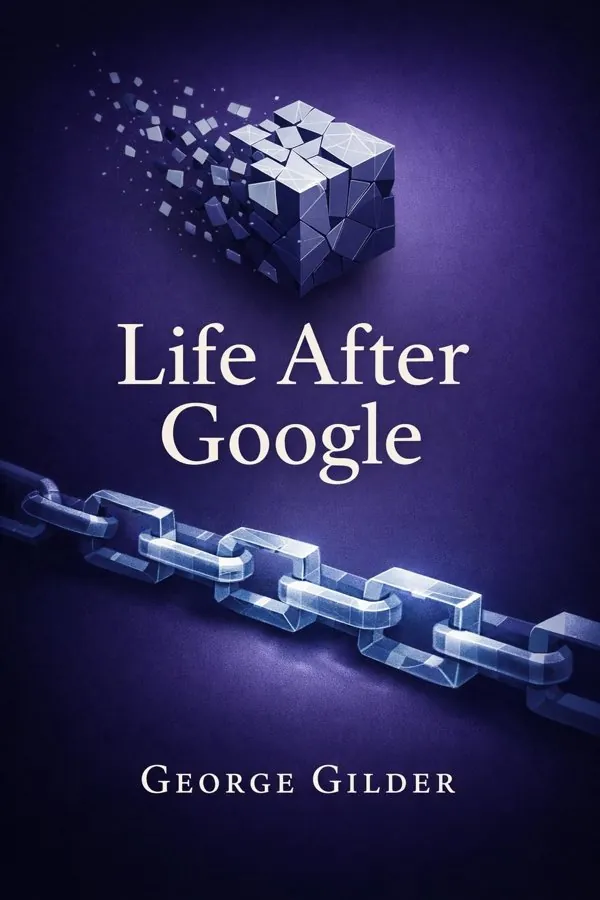
Life After Google: The Fall of Big Data and the Rise of the Blockchain Economy: Summary & Key Insights
 10 min11 chaptersAudio available
What Is Life After Google: The Fall of Big Data and the Rise of the Blockchain Economy About?
Life After Google: The Fall of Big Data and the Rise of the Blockchain Economy by George Gilder is a future_trends book spanning 11 pages. In this book, George Gilder argues that the era of big data and centralized cloud computing, epitomized by Google, is coming to an end. He envisions a new economic paradigm driven by blockchain technology, which restores security, privacy, and individual ownership of data. Gilder explores how decentralized systems will reshape the future of technology and economics, challenging the dominance of Silicon Valley giants.
This FizzRead summary covers all 11 key chapters of Life After Google: The Fall of Big Data and the Rise of the Blockchain Economy in approximately 10 minutes, distilling the most important ideas, arguments, and takeaways from George Gilder's work. Also available as an audio summary and Key Quotes Podcast.
Life After Google: The Fall of Big Data and the Rise of the Blockchain Economy
In this book, George Gilder argues that the era of big data and centralized cloud computing, epitomized by Google, is coming to an end. He envisions a new economic paradigm driven by blockchain technology, which restores security, privacy, and individual ownership of data. Gilder explores how decentralized systems will reshape the future of technology and economics, challenging the dominance of Silicon Valley giants.
Who Should Read Life After Google: The Fall of Big Data and the Rise of the Blockchain Economy?
This book is perfect for anyone interested in future_trends and looking to gain actionable insights in a short read. Whether you're a student, professional, or lifelong learner, the key ideas from Life After Google: The Fall of Big Data and the Rise of the Blockchain Economy by George Gilder will help you think differently.
- ✓Readers who enjoy future_trends and want practical takeaways
- ✓Professionals looking to apply new ideas to their work and life
- ✓Anyone who wants the core insights of Life After Google: The Fall of Big Data and the Rise of the Blockchain Economy in just 10 minutes
Want the full summary?
Get instant access to this book summary and 100K+ more with Fizz Moment.
Get Free SummaryAvailable on App Store • Free to download
Key Chapters
When I speak of the Google Paradigm, I refer to a worldview that believes information can be perfectly organized and owned within centralized data centers. Google’s bright engineers built what seemed to be a rational system: provide free services, attract billions of users, and fund the infrastructure by selling advertisers access to the vast data those users generate. This architecture grew from the assumption that data, not creativity, is the source of value.
But in economic reality, the formula that turns human curiosity into ad impressions erodes the foundations of innovation. Every click and search is stored, profiled, and monetized. Users are not participants in creation but commodities in extraction. The more granular the data, the greater the illusion of omniscience. Yet that omniscience is false, because the real value in human systems lies not in predictable patterns but in surprise — the very essence of information according to Claude Shannon’s theory.
The Google Paradigm is deeply entropic. It consumes the uncertainty that makes creativity possible, then sells the consolation of control. This control hides an implicit fragility: central servers make attractive targets for hackers, and systems based on advertising require constant surveillance to maintain their edge. The result is an ecosystem that privileges those who can hoard, rather than those who can imagine. In the long run, such systems cannot scale with creativity. They turn vibrant innovation into predictable consumption.
The idea that the internet should be free is perhaps the most seductive lie of the digital era. 'Free' was Google’s gift to humanity, but the price was hidden: your habits, your interests, your movements, your thoughts — all quantified into a data footprint that could be bought and sold. When I unpack the economics of 'free', what emerges is not generosity but a perverse moral calculus: payment in privacy.
This fallacy corrupts economics because it transforms the classical notion of voluntary exchange into asymmetric exploitation. True markets function on transparency and consent; Google’s system rests on opacity and surveillance. Users contribute unknowingly, reinforcing the myth that information itself has no cost. Yet information, as I argue, is the measure of surprise — of knowledge achieved against the backdrop of uncertainty. When information is reduced to data, when human creativity is turned into fractions of prediction, the moral texture of exchange disintegrates.
The 'free' model brings with it a moral hollowness. It assumes users will trade their autonomy for convenience. It replaces the dignity of property rights with the abstraction of metadata profiles. In doing so, it defines a generation’s economic expectations around dependency rather than enterprise. To transcend this, the next stage of the digital economy must redefine value not as data-owned but data-empowered, returned to the individuals who create it.
+ 9 more chapters — available in the FizzRead app
All Chapters in Life After Google: The Fall of Big Data and the Rise of the Blockchain Economy
About the Author
George Gilder is an American economist, writer, investor, and technology theorist. He is known for his influential works on supply-side economics and his forward-looking analyses of technological innovation. Gilder has authored several books on economics and technology, including 'Wealth and Poverty' and 'Knowledge and Power'.
Get This Summary in Your Preferred Format
Read or listen to the Life After Google: The Fall of Big Data and the Rise of the Blockchain Economy summary by George Gilder anytime, anywhere. FizzRead offers multiple formats so you can learn on your terms — all free.
Available formats: App · Audio · PDF · EPUB — All included free with FizzRead
Download Life After Google: The Fall of Big Data and the Rise of the Blockchain Economy PDF and EPUB Summary
Key Quotes from Life After Google: The Fall of Big Data and the Rise of the Blockchain Economy
“When I speak of the Google Paradigm, I refer to a worldview that believes information can be perfectly organized and owned within centralized data centers.”
“The idea that the internet should be free is perhaps the most seductive lie of the digital era.”
Frequently Asked Questions about Life After Google: The Fall of Big Data and the Rise of the Blockchain Economy
Life After Google: The Fall of Big Data and the Rise of the Blockchain Economy by George Gilder is a future_trends book that explores key ideas across 11 chapters. In this book, George Gilder argues that the era of big data and centralized cloud computing, epitomized by Google, is coming to an end. He envisions a new economic paradigm driven by blockchain technology, which restores security, privacy, and individual ownership of data. Gilder explores how decentralized systems will reshape the future of technology and economics, challenging the dominance of Silicon Valley giants.
You Might Also Like
Futureproof: 9 Rules for Humans in the Age of Automation
Kevin Roose
10 min
The Third Wave
Alvin Toffler
10 min
2030: How Today's Biggest Trends Will Collide and Reshape the Future of Everything
Mauro F. Guillén
10 min
A Very Human Future: Enriching Humanity in a Digitized World
Rohit Talwar, Steve Wells, Alexandra Whittington
10 min
AI 2041: Ten Visions for Our Future
Kai-Fu Lee, Chen Qiufan
10 min
Abundance: The Future Is Better Than You Think
Peter H. Diamandis, Steven Kotler
10 minBrowse by Category
Ready to read Life After Google: The Fall of Big Data and the Rise of the Blockchain Economy?
Get the full summary and 100K+ more books with Fizz Moment.