
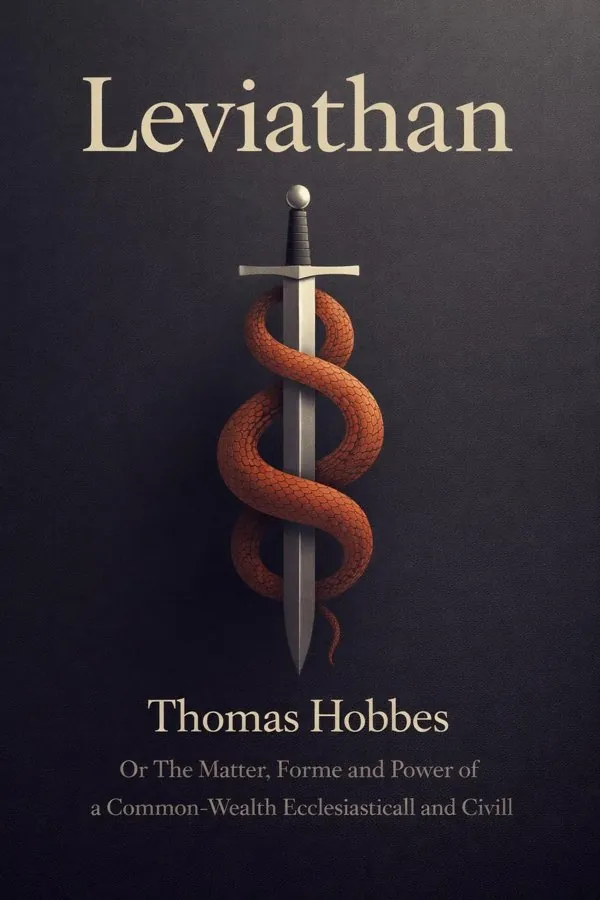
Leviathan: Or The Matter, Forme and Power of a Common-Wealth Ecclesiasticall and Civill: Summary & Key Insights
 10 min9 chaptersAudio available
What Is Leviathan: Or The Matter, Forme and Power of a Common-Wealth Ecclesiasticall and Civill About?
Leviathan: Or The Matter, Forme and Power of a Common-Wealth Ecclesiasticall and Civill by Thomas Hobbes is a politics book spanning 9 pages. Leviathan, written by English philosopher Thomas Hobbes during the English Civil War, presents a foundational argument for the necessity of an absolute sovereign to maintain peace and prevent civil disorder. Hobbes develops the concept of the social contract, asserting that individuals consent to surrender certain freedoms to a ruler in exchange for security and order. The work explores human nature, the origins of society, and the structure of legitimate government.
This FizzRead summary covers all 9 key chapters of Leviathan: Or The Matter, Forme and Power of a Common-Wealth Ecclesiasticall and Civill in approximately 10 minutes, distilling the most important ideas, arguments, and takeaways from Thomas Hobbes's work. Also available as an audio summary and Key Quotes Podcast.
Leviathan: Or The Matter, Forme and Power of a Common-Wealth Ecclesiasticall and Civill
Leviathan, written by English philosopher Thomas Hobbes during the English Civil War, presents a foundational argument for the necessity of an absolute sovereign to maintain peace and prevent civil disorder. Hobbes develops the concept of the social contract, asserting that individuals consent to surrender certain freedoms to a ruler in exchange for security and order. The work explores human nature, the origins of society, and the structure of legitimate government.
Who Should Read Leviathan: Or The Matter, Forme and Power of a Common-Wealth Ecclesiasticall and Civill?
This book is perfect for anyone interested in politics and looking to gain actionable insights in a short read. Whether you're a student, professional, or lifelong learner, the key ideas from Leviathan: Or The Matter, Forme and Power of a Common-Wealth Ecclesiasticall and Civill by Thomas Hobbes will help you think differently.
- ✓Readers who enjoy politics and want practical takeaways
- ✓Professionals looking to apply new ideas to their work and life
- ✓Anyone who wants the core insights of Leviathan: Or The Matter, Forme and Power of a Common-Wealth Ecclesiasticall and Civill in just 10 minutes
Want the full summary?
Get instant access to this book summary and 100K+ more with Fizz Moment.
Get Free SummaryAvailable on App Store • Free to download
Key Chapters
In beginning with man, I look first to the senses, for they are the windows through which the world enters the mind. All thought originates in experience; there is no innate idea, no vision without motion. When an external body presses upon our organs of sense, it sets in motion a chain — from physical impact to the internal motion in the brain. What we call perception is but the result of these invisible tremors. Memory is the lingering of this motion; imagination, the renewal of it within us even when the original object is gone. Thus every act of reason is a reckoning with the remnants of sensory experience.
This mechanical understanding of the mind leads to a profound truth: man is guided not by pure intellect but by the constant interplay of motion and reaction — by appetites and aversions that stem from the sensations of pleasure and pain. We speak of thinking as if it were detached from the body, but every thought arises from physical causes. Even language, through which we express ideas, is nothing more than a refined instrument of naming and recalling sensations. The art of reasoning itself — the ability to calculate consequences, to foresee and to plan — emerges from our need to secure what we desire and to avoid what we fear.
Understanding this structure of thought illuminates why man is restless by nature. Unlike beasts, who are governed by immediate satisfaction, man’s imagination extends beyond the present. He anticipates, he foresees, he fears. It is through this faculty that man becomes industrious, inventive, and ambitious, but also anxious and contentious. This chapter lays the groundwork for all that follows: for if our very thoughts are motions seeking resolution, it is no wonder that human societies must also seek equilibrium through laws and sovereign power.
The movements of the body give rise not only to perceptions but also to passions — the sparks that drive human behavior. Every passion is either an appetite or an aversion. Appetite is the motion toward something; aversion is the motion away. Between these two forces lies the whole drama of human life. From appetite spring desire, love, and hope; from aversion arise hatred, fear, and despair. Among all these motions, one stands supreme: the perpetual and restless drive for power. This is not a craving for domination in a vulgar sense but a natural motion toward securing the means to satisfy our desires continuously. Power is safety; its absence is vulnerability.
From this restlessness emerges competition, diffidence, and glory — three causes of conflict among men. Competition leads them to fight for gain, diffidence for safety, and glory for reputation. Here fear becomes a companion of reason. Fear — especially the fear of violent death — awakens in men the prudence to seek peace. It tempers the appetite for power and redirects it toward stability under authority.
Thus, I describe passions not to moralize but to mechanize the understanding of human conduct. Man is neither wicked nor virtuous by nature; he is moved by forces. Only when these impulses are brought under common regulation can there be peace. Without such regulation, passions collide endlessly — each man pursuing what appears good to him, each fearing what threatens him. The study of the passions reveals that to secure tranquility, men must create something that subdues these motions and binds them together harmoniously: a sovereign.
+ 7 more chapters — available in the FizzRead app
All Chapters in Leviathan: Or The Matter, Forme and Power of a Common-Wealth Ecclesiasticall and Civill
About the Author
Thomas Hobbes (1588–1679) was an English philosopher best known for his political thought. His works laid the groundwork for modern political philosophy, particularly through his theories on social contract and the nature of human behavior. Hobbes’s ideas influenced later thinkers such as Locke, Rousseau, and Kant.
Get This Summary in Your Preferred Format
Read or listen to the Leviathan: Or The Matter, Forme and Power of a Common-Wealth Ecclesiasticall and Civill summary by Thomas Hobbes anytime, anywhere. FizzRead offers multiple formats so you can learn on your terms — all free.
Available formats: App · Audio · PDF · EPUB — All included free with FizzRead
Download Leviathan: Or The Matter, Forme and Power of a Common-Wealth Ecclesiasticall and Civill PDF and EPUB Summary
Key Quotes from Leviathan: Or The Matter, Forme and Power of a Common-Wealth Ecclesiasticall and Civill
“In beginning with man, I look first to the senses, for they are the windows through which the world enters the mind.”
“The movements of the body give rise not only to perceptions but also to passions — the sparks that drive human behavior.”
Frequently Asked Questions about Leviathan: Or The Matter, Forme and Power of a Common-Wealth Ecclesiasticall and Civill
Leviathan: Or The Matter, Forme and Power of a Common-Wealth Ecclesiasticall and Civill by Thomas Hobbes is a politics book that explores key ideas across 9 chapters. Leviathan, written by English philosopher Thomas Hobbes during the English Civil War, presents a foundational argument for the necessity of an absolute sovereign to maintain peace and prevent civil disorder. Hobbes develops the concept of the social contract, asserting that individuals consent to surrender certain freedoms to a ruler in exchange for security and order. The work explores human nature, the origins of society, and the structure of legitimate government.
More by Thomas Hobbes
You Might Also Like
Antifa: The Anti-Fascist Handbook
Mark Bray
10 min
Attack from Within: How Disinformation Is Sabotaging America
Barbara McQuade
10 min
Coercion, Capital, and European States, AD 990–1992
Charles Tilly
10 min
Digital Democracy: Concepts, Methodologies, Tools, and Applications
Various Authors
10 min
Fascism
Stanley G. Payne
10 min
Fire And Fury: Inside The Trump White House
Michael Wolff
10 minBrowse by Category
Ready to read Leviathan: Or The Matter, Forme and Power of a Common-Wealth Ecclesiasticall and Civill?
Get the full summary and 100K+ more books with Fizz Moment.