
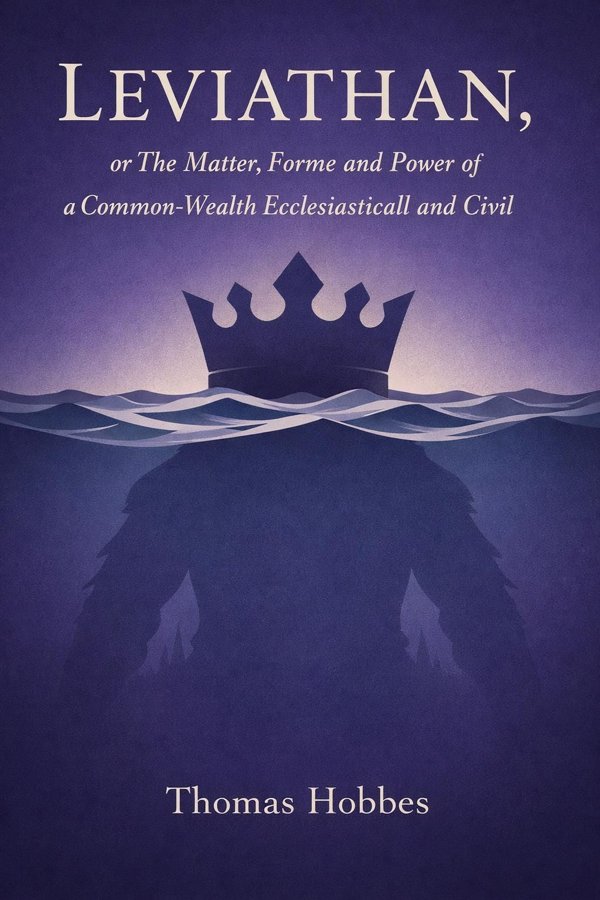
Leviathan, or The Matter, Forme and Power of a Common-Wealth Ecclesiasticall and Civil: Summary & Key Insights
 10 min9 chaptersAudio available
Key Takeaways from Leviathan, or The Matter, Forme and Power of a Common-Wealth Ecclesiasticall and Civil
A stable society cannot be built on comforting illusions about human goodness.
Peace feels natural only after institutions have made it ordinary.
Human beings are dangerous, but they are not doomed.
A government, in Hobbes’s view, is not a natural organism growing out of ancient custom; it is an artificial construction made by human agreement.
Divided authority sounds balanced, but Hobbes believes it often invites conflict.
What Is Leviathan, or The Matter, Forme and Power of a Common-Wealth Ecclesiasticall and Civil About?
Leviathan, or The Matter, Forme and Power of a Common-Wealth Ecclesiasticall and Civil by Thomas Hobbes is a western_phil book spanning 11 pages. First published in 1651 amid the wreckage of civil war, Thomas Hobbes’s Leviathan remains one of the most influential and controversial works in Western political philosophy. The book asks a stark question: what kind of authority is necessary to keep human beings from destroying one another? Hobbes begins not with ideal rulers or noble citizens, but with ordinary people moved by desire, fear, pride, and the instinct for self-preservation. From that unsentimental starting point, he builds a theory of politics in which peace requires a powerful common authority: the sovereign, or “Leviathan.” What makes the book endure is not only its defense of strong government, but its method. Hobbes treats politics as something that can be explained scientifically, by tracing social order back to human psychology. He also tackles religion, law, liberty, representation, and the relationship between private belief and public obedience. Whether one agrees with him or not, Hobbes changed the terms of political debate. Leviathan matters because it forces readers to confront a permanent problem of collective life: how much freedom must individuals yield in order to live securely with others?
This FizzRead summary covers all 9 key chapters of Leviathan, or The Matter, Forme and Power of a Common-Wealth Ecclesiasticall and Civil in approximately 10 minutes, distilling the most important ideas, arguments, and takeaways from Thomas Hobbes's work. Also available as an audio summary and Key Quotes Podcast.
Leviathan, or The Matter, Forme and Power of a Common-Wealth Ecclesiasticall and Civil
First published in 1651 amid the wreckage of civil war, Thomas Hobbes’s Leviathan remains one of the most influential and controversial works in Western political philosophy. The book asks a stark question: what kind of authority is necessary to keep human beings from destroying one another? Hobbes begins not with ideal rulers or noble citizens, but with ordinary people moved by desire, fear, pride, and the instinct for self-preservation. From that unsentimental starting point, he builds a theory of politics in which peace requires a powerful common authority: the sovereign, or “Leviathan.”
What makes the book endure is not only its defense of strong government, but its method. Hobbes treats politics as something that can be explained scientifically, by tracing social order back to human psychology. He also tackles religion, law, liberty, representation, and the relationship between private belief and public obedience. Whether one agrees with him or not, Hobbes changed the terms of political debate. Leviathan matters because it forces readers to confront a permanent problem of collective life: how much freedom must individuals yield in order to live securely with others?
Who Should Read Leviathan, or The Matter, Forme and Power of a Common-Wealth Ecclesiasticall and Civil?
This book is perfect for anyone interested in western_phil and looking to gain actionable insights in a short read. Whether you're a student, professional, or lifelong learner, the key ideas from Leviathan, or The Matter, Forme and Power of a Common-Wealth Ecclesiasticall and Civil by Thomas Hobbes will help you think differently.
- ✓Readers who enjoy western_phil and want practical takeaways
- ✓Professionals looking to apply new ideas to their work and life
- ✓Anyone who wants the core insights of Leviathan, or The Matter, Forme and Power of a Common-Wealth Ecclesiasticall and Civil in just 10 minutes
Want the full summary?
Get instant access to this book summary and 100K+ more with Fizz Moment.
Get Free SummaryAvailable on App Store • Free to download
Key Chapters
A stable society cannot be built on comforting illusions about human goodness. Hobbes begins with a provocative claim: if we want to understand government, we must first understand the human being. For him, people are not primarily guided by divine purpose or natural sociability, but by motion, appetite, aversion, imagination, and fear. We seek what pleases us, avoid what harms us, and constantly compare ourselves with others. Even reason, in Hobbes’s account, is less a source of moral elevation than a calculating faculty that helps us pursue our aims.
This matters because political institutions are made out of the same people they are meant to govern. If individuals are vulnerable, competitive, and eager for security, then political order must be designed with those realities in mind. Hobbes does not say humans are always evil; he says they are unreliable when left without restraint. We may cooperate, show kindness, and make promises, but these habits remain fragile unless backed by an authority strong enough to enforce peace.
You can see this logic in everyday settings. A workplace without clear roles, accountability, or consequences can quickly fall into confusion even when employees are talented and well-intentioned. A neighborhood may be friendly, but if disputes arise and no shared rules exist, suspicion spreads fast. Hobbes’s insight is that institutions matter precisely because human motives are mixed.
His psychological starting point also helps explain why moral appeals alone rarely settle political conflict. People interpret justice in self-serving ways, fear being exploited, and often prefer an unfair advantage over mutual vulnerability. Good political design must therefore account for ambition, insecurity, and distrust rather than pretend them away.
Actionable takeaway: when evaluating any organization, begin with a realistic view of human incentives, not an idealized one. Systems endure when they are built to manage conflict, not merely to hope it disappears.
Human beings are dangerous, but they are not doomed. Hobbes argues that reason can identify certain “laws of nature,” practical rules that show people how to escape destructive conflict. The first and most basic law is to seek peace when it can be had. The second follows from it: be willing, when others are too, to lay down some of your natural liberty and accept mutual limits. In short, peace requires restraint, and restraint requires reciprocity.
These laws are not moral commandments in a lofty spiritual sense. They are rational conclusions drawn from the desire to survive. If endless conflict threatens life, then reason tells us to prefer agreements that make safety possible. Hobbes therefore treats justice as something that emerges through covenant, not something fully available in the pre-political condition. Promises, contracts, and obligations become meaningful when people bind themselves to rules under a common authority.
This helps explain the structure of civilized life. Traffic laws work because everyone gives up the freedom to drive however they wish in exchange for predictability. Business contracts function because each party limits opportunism for mutual gain. Even friendship depends on informal versions of the same logic: trust grows where both sides accept constraints and expectations.
Still, Hobbes knows that reason alone is not enough. People may understand the benefits of peace and still defect when tempted. That is why natural laws point toward the need for political power. Rational insight prepares the way for civil order, but it does not secure it by itself.
One practical lesson is that cooperation improves when rules are framed not as abstract ideals but as mutually beneficial protections. People are more likely to support limits on their own freedom when they see how those limits reduce common danger.
Actionable takeaway: in any conflict, identify the minimum reciprocal restraints that would make trust rational for all parties, then build agreements around those shared interests.
Divided authority sounds balanced, but Hobbes believes it often invites conflict. Once a commonwealth is formed, the sovereign must possess sufficient and undivided power to preserve peace. That includes the authority to make laws, judge disputes, decide on war and peace, appoint officials, reward and punish, and regulate doctrines that affect public order. If these powers are split among rival centers, subjects will be pulled in competing directions and civil war becomes more likely.
Hobbes writes in the shadow of England’s political and religious turmoil, and his fear of fragmentation shapes the force of his argument. A state cannot endure if citizens owe ultimate obedience to multiple masters. If church and crown, parliament and king, militia and magistrate each claim final authority, conflict ceases to be an exception and becomes the system itself.
This claim remains relevant in less dramatic settings. In organizations, confusion about who has final authority often leads to sabotage, delay, and blame-shifting. A company with overlapping chains of command wastes energy in internal struggles. A government where agencies, courts, regional powers, and executive leaders openly undermine one another can lose legitimacy, even if each body has formal justification for its role.
Hobbes is not defending arbitrary cruelty for its own sake. His core concern is functionality: authority that cannot decide cannot protect. Critics rightly worry that concentrated power can become oppressive, but Hobbes insists that the first political evil is not tyranny; it is collapse into violent disorder.
The modern reader need not accept absolute sovereignty to appreciate the underlying principle. Peace depends on clear supremacy somewhere within the legal order. Constitutional systems solve this differently than Hobbes did, but they still require recognized final procedures for settling disputes.
Actionable takeaway: where authority is contested, clarify who has the legitimate power to make final decisions before conflict escalates into institutional breakdown.
Freedom is not the absence of all restraint; often it exists because restraint has been organized. Hobbes defines liberty in a strikingly physical way: the absence of external impediments to motion. In political life, this means subjects are free where the law is silent. Civil law does not eliminate liberty altogether; it structures the field within which safe action becomes possible.
This idea overturns the common assumption that more state power always means less freedom. Hobbes argues that without law, liberty is insecure because every person remains exposed to the unpredictable force of others. Under a functioning commonwealth, subjects surrender some natural freedoms, but gain the far more valuable freedom to live, trade, travel, speak in ordinary matters, and plan for the future without constant fear. Ordered liberty is narrower than total license, but far more usable.
At the same time, Hobbes preserves one crucial limit: no one is bound to kill himself, maim himself, or refrain from self-defense when directly threatened. Because the foundational motive for political society is self-preservation, subjects retain certain inalienable impulses. This creates an interesting tension in Hobbes’s theory. He defends strong obedience, yet admits that fear for one’s own life can override commands.
In modern terms, think of how building codes, contract law, and criminal law restrict behavior while making ordinary life more secure. Most people willingly accept these limits because they expand practical freedom. You can open a business, raise a family, or enter agreements precisely because rules reduce uncertainty.
Hobbes therefore invites us to ask not whether law restricts, but what kind of liberty it makes possible. The best test of a political order is whether its constraints reduce arbitrary violence and create reliable space for action.
Actionable takeaway: judge rules by whether they convert dangerous license into durable, usable freedom rather than by whether they remove all constraint.
A sovereign may hold ultimate authority, but no state survives on abstract power alone. Hobbes devotes significant attention to “systems” and public ministers—the subordinate bodies, offices, and agents through which a commonwealth actually operates. This is one of the book’s most practical insights: political order depends not just on who rules, but on the administrative machinery that carries decisions into daily life.
Systems can be lawful and beneficial, such as courts, councils, municipal bodies, or chartered associations, when they remain oriented toward the commonwealth’s stability. They become dangerous when they evolve into rival power centers claiming independent loyalty. Public ministers likewise matter because law without execution is only paper. Judges, military officers, tax collectors, diplomats, and local officials translate sovereign command into real coordination.
This is deeply relevant today. Citizens often imagine politics as elections and speeches, but the lived reality of government is bureaucratic capacity. A state that cannot collect revenue, enforce contracts, maintain records, transmit orders, or administer justice is weak no matter how grand its constitution sounds. The same principle applies in companies and nonprofits: strategy fails if there are no competent middle layers to implement it.
Hobbes also warns against opaque and unaccountable associations. When private organizations begin to command stronger allegiance than public authority, social cohesion can weaken. His concern may sound severe, but it points to a modern issue: fragmented institutions can undermine public trust if they create competing domains of obedience.
The larger lesson is that durable order requires both legitimacy at the top and capacity throughout the system. Sovereignty must be embodied in offices, procedures, and enforceable routines.
Actionable takeaway: when assessing whether an institution is truly effective, look beyond leadership and examine the quality, loyalty, and competence of the structures that carry decisions into practice.
The fiercest political conflicts are often intensified by competing claims to sacred authority. Hobbes therefore turns from civil government to religion, arguing that ecclesiastical power must not stand as an independent jurisdiction over subjects. In his view, a Christian commonwealth can exist only if public religious teaching is subordinated to the sovereign’s authority in civil matters. Otherwise, priests and preachers may mobilize obedience against the state and reopen the path to civil war.
This argument emerges from a century scarred by religious conflict. Hobbes saw how doctrines about divine law, prophecy, excommunication, and salvation could be weaponized to challenge political order. He does not reject religion outright; rather, he seeks to contain its destabilizing political uses. The sovereign should regulate public worship, authorize doctrine for civic purposes, and prevent clerical institutions from becoming alternative governments.
For many readers, this is among the most controversial parts of Leviathan. It can sound like a reduction of faith to state management. Yet Hobbes’s deeper concern is intelligible: when individuals are told they owe absolute obedience to both civil law and an independent spiritual authority, conflict becomes nearly inevitable if the two commands diverge.
The issue remains alive today in debates over church and state, religious exemptions, public education, sectarian law, and political movements that claim transcendent legitimacy. Hobbes’s warning is not that religion is false, but that divided sovereignty is dangerous when ultimate loyalties collide.
He also discusses the “Kingdom of God by Nature” and the “Kingdom of Darkness,” distinguishing true religion from superstition, manipulation, and fear-based clerical domination. In his eyes, obscurity in doctrine often becomes a tool of power.
Actionable takeaway: protect freedom of belief, but be cautious whenever any institution claims authority that can nullify the basic legal order shared by all citizens.
Bad politics often survives by bad metaphysics. In Leviathan’s final movement, Hobbes attacks what he calls the “Kingdom of Darkness”: the web of superstition, scholastic jargon, manipulative theology, and inherited confusions that keep people intellectually dependent and politically combustible. He believes many social disorders persist not because they are rationally persuasive, but because they are wrapped in fear, mystery, and reverence for authority that no one dares examine.
This is an epistemological argument as much as a political one. Hobbes wants clear definitions, disciplined reasoning, and public language that reduces confusion. When words such as liberty, law, spirit, authority, and justice are used vaguely, demagogues and zealots can bend them to partisan ends. False doctrines then become engines of real conflict. In this sense, Leviathan is not only a theory of sovereignty; it is also a campaign against intellectual disorder.
Modern readers can see parallels everywhere. Conspiracy theories, algorithmic misinformation, pseudo-legal rhetoric, and ideological slogans often flourish where people lack shared standards of evidence and interpretation. Confused language makes polarized politics easier. Once citizens inhabit incompatible realities, common rule becomes harder to sustain.
Hobbes’s remedy is sobering rather than romantic. He does not trust spontaneous public wisdom to sort truth from error. He places heavy emphasis on authoritative interpretation and disciplined education. One may resist his concentration of interpretive power while still appreciating his central insight: social peace depends partly on conceptual clarity.
At a personal level, the lesson is to distrust grand claims that gain force from obscurity rather than evidence. Intellectual humility and careful definition are civic virtues, not merely academic ones.
Actionable takeaway: when political language becomes vague, mystical, or emotionally manipulative, slow down, define terms, and ask who benefits from the confusion.
All Chapters in Leviathan, or The Matter, Forme and Power of a Common-Wealth Ecclesiasticall and Civil
About the Author
Thomas Hobbes (1588–1679) was an English philosopher whose work helped shape modern political thought. Born in Westport, near Malmesbury, he was educated at Oxford and later worked as a tutor and intellectual companion to the Cavendish family. Hobbes wrote on philosophy, politics, language, mathematics, and human nature, but he is most famous for Leviathan (1651). Writing during the turmoil of the English Civil War, he developed a political theory centered on fear, self-preservation, and the need for a strong sovereign authority to prevent social collapse. Hobbes is one of the central figures in social contract theory, though his version is more skeptical and authoritarian than those of later thinkers like Locke or Rousseau. His influence extends across political philosophy, legal theory, secular thought, and debates about the nature of the state.
Get This Summary in Your Preferred Format
Read or listen to the Leviathan, or The Matter, Forme and Power of a Common-Wealth Ecclesiasticall and Civil summary by Thomas Hobbes anytime, anywhere. FizzRead offers multiple formats so you can learn on your terms — all free.
Available formats: App · Audio · PDF · EPUB — All included free with FizzRead
Download Leviathan, or The Matter, Forme and Power of a Common-Wealth Ecclesiasticall and Civil PDF and EPUB Summary
Key Quotes from Leviathan, or The Matter, Forme and Power of a Common-Wealth Ecclesiasticall and Civil
“A stable society cannot be built on comforting illusions about human goodness.”
“Peace feels natural only after institutions have made it ordinary.”
“Human beings are dangerous, but they are not doomed.”
“A government, in Hobbes’s view, is not a natural organism growing out of ancient custom; it is an artificial construction made by human agreement.”
“Divided authority sounds balanced, but Hobbes believes it often invites conflict.”
Frequently Asked Questions about Leviathan, or The Matter, Forme and Power of a Common-Wealth Ecclesiasticall and Civil
Leviathan, or The Matter, Forme and Power of a Common-Wealth Ecclesiasticall and Civil by Thomas Hobbes is a western_phil book that explores key ideas across 9 chapters. First published in 1651 amid the wreckage of civil war, Thomas Hobbes’s Leviathan remains one of the most influential and controversial works in Western political philosophy. The book asks a stark question: what kind of authority is necessary to keep human beings from destroying one another? Hobbes begins not with ideal rulers or noble citizens, but with ordinary people moved by desire, fear, pride, and the instinct for self-preservation. From that unsentimental starting point, he builds a theory of politics in which peace requires a powerful common authority: the sovereign, or “Leviathan.” What makes the book endure is not only its defense of strong government, but its method. Hobbes treats politics as something that can be explained scientifically, by tracing social order back to human psychology. He also tackles religion, law, liberty, representation, and the relationship between private belief and public obedience. Whether one agrees with him or not, Hobbes changed the terms of political debate. Leviathan matters because it forces readers to confront a permanent problem of collective life: how much freedom must individuals yield in order to live securely with others?
More by Thomas Hobbes
You Might Also Like
A Little History of Philosophy
Nigel Warburton
10 min
Areopagitica
John Milton
10 min
How To Think Like A Philosopher: Essential Principles For Clear Thinking
Peter Cave
10 min
Language, Truth and Logic
A. J. Ayer
10 min
The Age of Reason
Thomas Paine
10 min
The Essays
Michel De Montaigne
10 minBrowse by Category
Ready to read Leviathan, or The Matter, Forme and Power of a Common-Wealth Ecclesiasticall and Civil?
Get the full summary and 100K+ more books with Fizz Moment.