
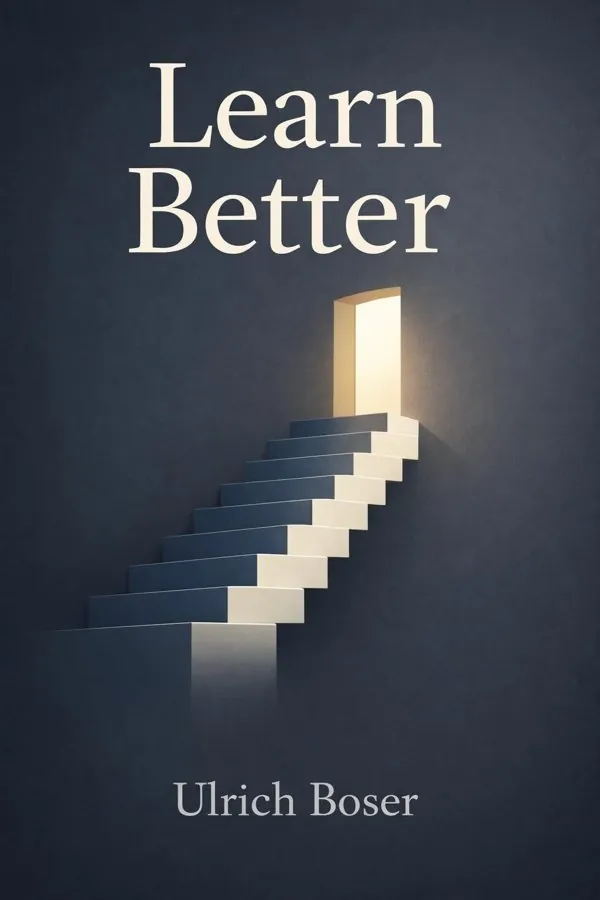
Learn Better: Mastering the Skills for Success in Life, Business, and School, or, How to Become an Expert in Just About Anything: Summary & Key Insights
by Ulrich Boser
 10 min9 chaptersAudio available
Key Takeaways from Learn Better: Mastering the Skills for Success in Life, Business, and School, or, How to Become an Expert in Just About Anything
One of the most damaging ideas about learning is that it happens automatically if we spend enough time around information.
Real learning begins when you stop receiving information and start transforming it.
New ideas rarely stick when they float alone.
Improvement depends less on avoiding errors than on learning from them.
Learning accelerates when people become aware of how they learn.
What Is Learn Better: Mastering the Skills for Success in Life, Business, and School, or, How to Become an Expert in Just About Anything About?
Learn Better: Mastering the Skills for Success in Life, Business, and School, or, How to Become an Expert in Just About Anything by Ulrich Boser is a education book spanning 9 pages. Learning is often treated like a talent: some people supposedly “have it,” while others simply struggle. In Learn Better, Ulrich Boser dismantles that belief and replaces it with a far more empowering idea: learning is a skill, and like any skill, it can be improved with the right methods. Drawing from cognitive psychology, neuroscience, education research, and real-world case studies, Boser shows why many common study habits fail and what actually helps people remember, understand, and apply knowledge over time. Instead of promising shortcuts or gimmicks, he offers a science-based guide to building expertise through active engagement, reflection, feedback, and deliberate practice. The book matters because modern life constantly demands adaptation—whether you are mastering a new software tool, learning a language, improving at work, or helping a child study more effectively. Boser writes with the clarity of a journalist and the rigor of a researcher, making complex findings accessible and practical. The result is a deeply useful book for students, professionals, teachers, and anyone who wants to become a better learner in a world that rewards continuous growth.
This FizzRead summary covers all 9 key chapters of Learn Better: Mastering the Skills for Success in Life, Business, and School, or, How to Become an Expert in Just About Anything in approximately 10 minutes, distilling the most important ideas, arguments, and takeaways from Ulrich Boser's work. Also available as an audio summary and Key Quotes Podcast.
Learn Better: Mastering the Skills for Success in Life, Business, and School, or, How to Become an Expert in Just About Anything
Learning is often treated like a talent: some people supposedly “have it,” while others simply struggle. In Learn Better, Ulrich Boser dismantles that belief and replaces it with a far more empowering idea: learning is a skill, and like any skill, it can be improved with the right methods. Drawing from cognitive psychology, neuroscience, education research, and real-world case studies, Boser shows why many common study habits fail and what actually helps people remember, understand, and apply knowledge over time. Instead of promising shortcuts or gimmicks, he offers a science-based guide to building expertise through active engagement, reflection, feedback, and deliberate practice. The book matters because modern life constantly demands adaptation—whether you are mastering a new software tool, learning a language, improving at work, or helping a child study more effectively. Boser writes with the clarity of a journalist and the rigor of a researcher, making complex findings accessible and practical. The result is a deeply useful book for students, professionals, teachers, and anyone who wants to become a better learner in a world that rewards continuous growth.
Who Should Read Learn Better: Mastering the Skills for Success in Life, Business, and School, or, How to Become an Expert in Just About Anything?
This book is perfect for anyone interested in education and looking to gain actionable insights in a short read. Whether you're a student, professional, or lifelong learner, the key ideas from Learn Better: Mastering the Skills for Success in Life, Business, and School, or, How to Become an Expert in Just About Anything by Ulrich Boser will help you think differently.
- ✓Readers who enjoy education and want practical takeaways
- ✓Professionals looking to apply new ideas to their work and life
- ✓Anyone who wants the core insights of Learn Better: Mastering the Skills for Success in Life, Business, and School, or, How to Become an Expert in Just About Anything in just 10 minutes
Want the full summary?
Get instant access to this book summary and 100K+ more with Fizz Moment.
Get Free SummaryAvailable on App Store • Free to download
Key Chapters
One of the most damaging ideas about learning is that it happens automatically if we spend enough time around information. Boser argues that this belief is not just wrong; it actively prevents progress. Many people reread chapters, highlight passages, or repeat facts over and over, assuming that familiarity equals mastery. But research in learning science shows that passive review often creates an illusion of competence. We feel comfortable with the material because we have seen it before, yet we cannot explain it, use it, or recall it later.
Boser challenges another myth as well: that intelligence is mostly fixed. If people believe ability is innate, they often avoid difficulty because struggle feels like proof of inadequacy. In reality, struggle is often part of real learning. The brain changes through effortful practice, correction, and repeated retrieval. This reframes difficulty from a sign of weakness into evidence that deeper processing is happening.
Consider two students preparing for an exam. One rereads notes three times and feels prepared because the material looks familiar. The other closes the notebook and tries to recall the key ideas from memory, discovering gaps and misconceptions. The second student may feel less confident in the moment, but is usually learning more effectively. The same principle applies in work settings: a manager who reads a training manual once is far less prepared than one who applies the concepts in simulated decisions.
The practical lesson is simple but powerful: stop confusing exposure with learning. Replace passive review with strategies that force your mind to work. Actionable takeaway: the next time you study or train, spend less time rereading and more time testing yourself, explaining ideas aloud, and identifying what you still cannot do.
Real learning begins when you stop receiving information and start transforming it. Boser emphasizes that active learning is not merely being busy; it means mentally engaging with material in ways that deepen understanding. Asking questions, summarizing in your own words, generating examples, and explaining concepts are all forms of active processing. These methods work because they require the brain to organize, interpret, and reconstruct knowledge rather than simply recognize it.
A central idea here is self-explanation. When learners pause to ask, “Why does this make sense?” or “How does this step follow from the previous one?” they uncover weak spots in understanding. A math student who explains each step in solving an equation is more likely to grasp the underlying logic than one who mechanically copies procedures. A new employee learning a workflow can improve faster by narrating why each action matters, instead of memorizing the sequence blindly.
Active learning also makes study time more efficient. Passive methods often feel easier, but ease can be deceptive. More difficult strategies such as recall, elaboration, and questioning create stronger memory traces and more flexible understanding. This is especially important when knowledge needs to be applied in unfamiliar situations.
Boser’s message is that learning is something we do, not something that happens to us. Whether reading a book, attending a lecture, or joining a workshop, the goal should be to interact with the ideas. Turn headings into questions, predict what comes next, pause to summarize, and connect ideas to experience.
Actionable takeaway: for every learning session, choose one active technique—such as self-quizzing, teaching the concept to someone else, or writing a short explanation from memory—and make it a nonnegotiable part of your routine.
New ideas rarely stick when they float alone. Boser shows that durable learning depends on connection: linking fresh information to what we already know, organizing it into meaningful patterns, and seeing relationships across concepts. Knowledge is not a pile of isolated facts; it is a network. The stronger and richer that network becomes, the easier it is to remember and use what we learn.
This insight helps explain why experts often seem to learn faster than beginners. Experts do not simply have more facts. They possess organized mental frameworks that allow them to place new information quickly into a larger structure. A novice cook may memorize a recipe step by step, while an experienced chef understands flavor balance, heat control, and ingredient behavior. Because of those connections, the chef can adapt rather than merely follow instructions.
Boser highlights that one of the best ways to create these connections is through elaboration. Instead of asking only, “What is this?” learners should ask, “What does this relate to? How is it similar or different from something I already understand?” A student studying the American Revolution might connect it to broader themes of power, taxation, and political legitimacy. A salesperson learning a new product might compare it with competitors’ offerings and customer pain points.
Visual tools can help. Concept maps, comparison charts, and analogies make invisible relationships visible. Even simple habits like grouping ideas into categories or writing examples from daily life can strengthen the web of understanding.
The deeper point is that memory improves when meaning improves. Information becomes easier to retrieve when it is attached to multiple cues and contexts.
Actionable takeaway: whenever you encounter something new, deliberately connect it to at least two things you already know—an earlier concept, a real-life example, or a contrasting case—to turn loose facts into usable knowledge.
Improvement depends less on avoiding errors than on learning from them. Boser argues that feedback is one of the most powerful drivers of growth because it reveals the gap between what we intended and what we actually did. Without feedback, learners often keep repeating the same mistakes, mistaking effort for progress. With timely and specific feedback, they can adjust, refine, and move closer to mastery.
Not all feedback is equally useful. Generic praise like “good job” may feel pleasant, but it offers little guidance. Effective feedback is clear, actionable, and tied to performance. A writing teacher who says, “Your argument is interesting, but your evidence in paragraph three is too vague,” gives the learner something concrete to improve. A tennis coach who points out that a player’s grip is causing weak backhands provides a direct path to correction.
Boser also notes that feedback works best when learners are prepared to receive it. If criticism feels like a verdict on identity, people become defensive. But if learning is viewed as iterative, feedback becomes information rather than insult. This mindset shift matters in schools, workplaces, and personal development. A manager learning presentation skills improves faster when reviewing recordings and asking for specific critique than when relying on vague impressions.
Mistakes are especially valuable because they expose misconceptions. A wrong answer can be more instructive than a lucky correct one if the learner examines why it happened. In this sense, error is not the opposite of learning; it is often the engine of it.
Actionable takeaway: build regular feedback loops into your learning. After any important attempt—an essay, pitch, practice session, or test—ask one question: “What is the single biggest change that would improve my performance next time?” Then apply that change immediately.
Learning accelerates when people become aware of how they learn. Boser highlights reflection and metacognition—the ability to think about one’s own thinking—as essential but often neglected tools. Strong learners do not just absorb content; they monitor their understanding, notice confusion, evaluate strategies, and make adjustments. In other words, they act like coaches for their own minds.
This matters because many learners are poor judges of what they actually know. Material that feels easy to read can create false confidence, while more effortful techniques may feel less effective even when they produce better long-term results. Reflection helps separate feeling from reality. After studying, a reflective learner asks: What do I truly understand? What am I still guessing at? Which methods helped me most? Where did I waste time?
Boser suggests that reflection can be built into daily routines. Students can write short learning journals after class. Professionals can debrief after meetings, presentations, or training sessions. A programmer learning a new language might pause after solving a problem and note which concepts came naturally and which required repeated searching. Over time, these small acts of self-observation reveal patterns.
Metacognition also improves planning. If you know that you tend to overestimate preparation, you can rely more on practice tests. If you notice that fatigue hurts your concentration, you can schedule demanding work earlier in the day. These are not abstract insights; they are practical adjustments that compound over time.
Reflection turns experience into improvement. Without it, we may repeat activities endlessly without getting better. With it, we become strategic, adaptive, and more honest about our progress.
Actionable takeaway: end each learning session with three quick questions—What did I learn? What remains unclear? What will I do differently next time?—and use your answers to shape the next session.
Practice does not guarantee improvement; the right kind of practice does. Boser draws on the idea of deliberate practice to show that expertise grows through focused, structured effort aimed at specific weaknesses. Simply doing something repeatedly can reinforce bad habits just as easily as good ones. Smart practice is challenging, goal-directed, and informed by feedback.
One hallmark of effective practice is breaking complex skills into components. A musician does not improve by only playing songs from beginning to end. She isolates difficult passages, slows them down, and works on precision. A public speaker does not merely give more talks; he practices openings, transitions, pacing, and audience engagement separately. This targeted approach prevents time from being wasted on what is already comfortable.
Boser also emphasizes spacing and retrieval. A single long cram session may produce short-term gains, but learning lasts longer when practice is spread over time and includes repeated recall. A language learner who reviews vocabulary across several weeks and uses it in conversation will retain more than someone who memorizes a list the night before. Interleaving—mixing related topics or problem types—can further improve discrimination and flexible use of knowledge.
Crucially, smart practice often feels harder than mindless repetition. That difficulty is not a flaw. It signals that the learner is stretching. The challenge must remain manageable, but genuine growth usually occurs just beyond the edge of current ability.
The broader point is that experts are built through intentional design, not sheer volume of effort. Time matters, but how that time is structured matters more.
Actionable takeaway: before your next practice session, define one subskill to improve, create a drill that targets it, and track your performance instead of simply measuring time spent.
We often imagine learning as a purely intellectual process, but Boser shows that emotion and motivation strongly influence what we notice, remember, and persist through. Attention is selective, and emotion helps determine where that attention goes. If learners feel curious, capable, and engaged, effort becomes easier to sustain. If they feel anxious, bored, or defeated, even good instruction can fail to stick.
Motivation is not just a matter of willpower. It is shaped by context, goals, and beliefs. Learners are more likely to persist when they understand why the material matters, when they experience small wins, and when progress feels possible. A student who sees algebra as meaningless memorization may disengage quickly, while one who understands its connection to engineering, finance, or problem-solving has a stronger reason to invest effort. Similarly, a worker learning data analysis is more motivated if the skill clearly improves job performance and career options.
Emotion also affects memory. Experiences tied to surprise, relevance, challenge, or personal meaning are often easier to recall. Teachers and trainers can use stories, puzzles, real-world applications, and purposeful goals to make learning more vivid. Learners themselves can increase motivation by setting specific targets, tracking progress, and celebrating incremental gains.
Boser does not suggest that every learning task must be fun. Some parts of mastery are repetitive and difficult. But emotional climate still matters. Confidence should come from preparation, not empty reassurance; interest should be cultivated through relevance, not entertainment alone.
Actionable takeaway: before starting a new learning goal, write down why it matters to you personally, define a small milestone you can reach within a week, and use that early success to build momentum.
Knowledge is only powerful when it can travel. Boser argues that the ultimate test of learning is transfer: the ability to apply what you know in new situations, unfamiliar contexts, and real-world problems. Memorizing information for a test or repeating a process in a routine setting is not enough. True understanding shows itself when people adapt, improvise, and solve problems beyond the original lesson.
Transfer is difficult because surface features can distract us. A learner may know a principle in one context but fail to recognize it in another. For example, someone who understands percentages in a classroom exercise may struggle to apply the same reasoning to discounts, loan rates, or business metrics. Boser explains that transfer improves when learners focus on underlying structures, not just examples. They need to grasp the principle beneath the procedure.
Variation helps. If people practice skills across different contexts, they are more likely to abstract the core idea. A medical student who sees the same diagnostic principle across multiple patient cases becomes better at recognizing it later. A manager learning negotiation improves more by practicing with different personalities, stakes, and constraints than by rehearsing a single script.
Reflection also supports transfer. After learning something, ask: Where else could this apply? What is the deeper rule here? How would this look in a different field? These questions train the mind to search for patterns beyond the immediate task.
Boser’s broader point is that learning should not end with retention. It should lead to versatility. The most valuable education prepares people not only to remember but also to adapt.
Actionable takeaway: after mastering any concept or skill, generate two new contexts where it might apply and practice using it there, so your knowledge becomes flexible rather than trapped in one setting.
The most important promise of Learn Better is not that there is a single miracle technique, but that effective learning can be designed. Boser brings together insights about memory, attention, feedback, motivation, practice, and reflection into a coherent system for long-term growth. Learning improves when these elements work together: active engagement deepens processing, feedback corrects errors, reflection improves strategy, and deliberate practice strengthens performance over time.
This integrated approach matters because learners often chase isolated tips. They may hear that quizzing helps, or that sleep matters, or that feedback is useful, but fail to build a repeatable process. Boser’s contribution is showing how the pieces connect. For example, a learner preparing for a certification exam might begin by mapping core concepts, study through retrieval practice, test understanding by teaching the material, use mistakes to identify weak areas, schedule spaced review, and reflect weekly on what is and is not working. That is not a hack; it is a learning system.
The same framework applies far beyond school. Entrepreneurs can use it to learn markets, managers can use it to build leadership skills, and hobbyists can use it to master instruments, languages, or sports. In every case, progress becomes more reliable when it is intentional and evidence-based.
Boser ultimately gives readers a more hopeful and demanding view of human potential. We are not locked into our current abilities, but improvement requires better methods, not just more effort. Learning well is both a science and a practice.
Actionable takeaway: create a personal learning routine that includes four parts every week—active study, retrieval, feedback, and reflection—so improvement becomes a system rather than an occasional burst of motivation.
All Chapters in Learn Better: Mastering the Skills for Success in Life, Business, and School, or, How to Become an Expert in Just About Anything
About the Author
Ulrich Boser is an American author, researcher, and education specialist focused on how people learn and how institutions can improve learning outcomes. He is the founder of The Learning Agency, an organization that works at the intersection of education research, innovation, and practice. Boser has written extensively about schools, cognitive science, and social policy, and his work has appeared in major national publications. Known for combining rigorous reporting with accessible explanations, he helps broad audiences understand complex research findings and apply them in practical ways. In Learn Better, he brings together insights from psychology, neuroscience, and education to show that effective learning is not a mysterious gift but a skill that can be developed. His work has made him a respected voice in evidence-based education and lifelong learning.
Get This Summary in Your Preferred Format
Read or listen to the Learn Better: Mastering the Skills for Success in Life, Business, and School, or, How to Become an Expert in Just About Anything summary by Ulrich Boser anytime, anywhere. FizzRead offers multiple formats so you can learn on your terms — all free.
Available formats: App · Audio · PDF · EPUB — All included free with FizzRead
Download Learn Better: Mastering the Skills for Success in Life, Business, and School, or, How to Become an Expert in Just About Anything PDF and EPUB Summary
Key Quotes from Learn Better: Mastering the Skills for Success in Life, Business, and School, or, How to Become an Expert in Just About Anything
“One of the most damaging ideas about learning is that it happens automatically if we spend enough time around information.”
“Real learning begins when you stop receiving information and start transforming it.”
“New ideas rarely stick when they float alone.”
“Improvement depends less on avoiding errors than on learning from them.”
“Learning accelerates when people become aware of how they learn.”
Frequently Asked Questions about Learn Better: Mastering the Skills for Success in Life, Business, and School, or, How to Become an Expert in Just About Anything
Learn Better: Mastering the Skills for Success in Life, Business, and School, or, How to Become an Expert in Just About Anything by Ulrich Boser is a education book that explores key ideas across 9 chapters. Learning is often treated like a talent: some people supposedly “have it,” while others simply struggle. In Learn Better, Ulrich Boser dismantles that belief and replaces it with a far more empowering idea: learning is a skill, and like any skill, it can be improved with the right methods. Drawing from cognitive psychology, neuroscience, education research, and real-world case studies, Boser shows why many common study habits fail and what actually helps people remember, understand, and apply knowledge over time. Instead of promising shortcuts or gimmicks, he offers a science-based guide to building expertise through active engagement, reflection, feedback, and deliberate practice. The book matters because modern life constantly demands adaptation—whether you are mastering a new software tool, learning a language, improving at work, or helping a child study more effectively. Boser writes with the clarity of a journalist and the rigor of a researcher, making complex findings accessible and practical. The result is a deeply useful book for students, professionals, teachers, and anyone who wants to become a better learner in a world that rewards continuous growth.
You Might Also Like

Bedtime Biography: Florence Nightingale
Isabel Thomas
10 min
Introduction To Museum Studies
Howard H. Hoyt
10 min
A Mind for Numbers: How to Excel at Math and Science (Even If You Flunked Algebra)
Barbara Oakley
10 min
AI for Educators: Learning Strategies, Teacher Empowerment, and the Future of Education
Matt Miller
10 min
Animation For Beginners
Morr Meroz
10 min
Artificial Intelligence for Learning
Donald Clark
10 minBrowse by Category
Ready to read Learn Better: Mastering the Skills for Success in Life, Business, and School, or, How to Become an Expert in Just About Anything?
Get the full summary and 100K+ more books with Fizz Moment.