
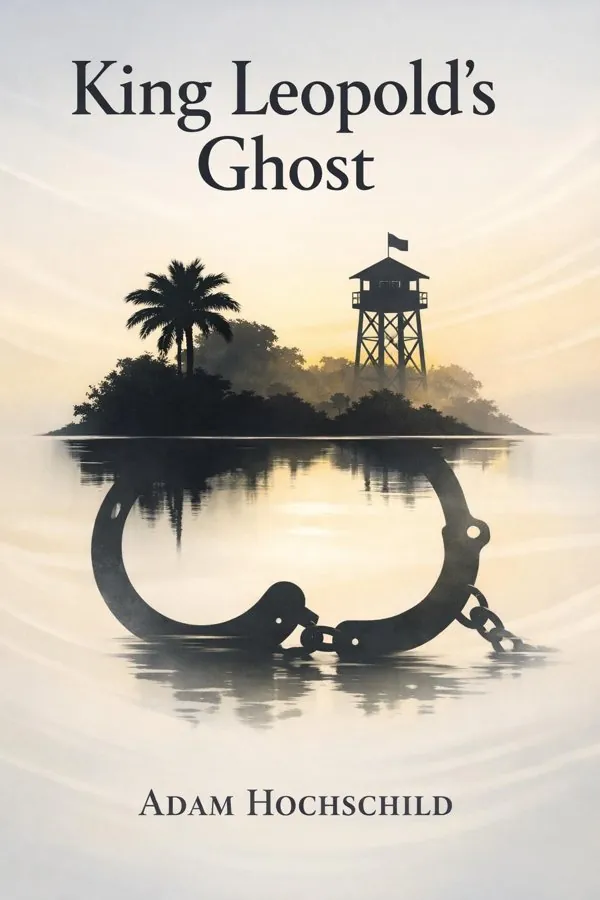
King Leopold's Ghost: A Story of Greed, Terror, and Heroism in Colonial Africa: Summary & Key Insights
 10 min5 chapters
What Is King Leopold's Ghost: A Story of Greed, Terror, and Heroism in Colonial Africa About?
King Leopold's Ghost: A Story of Greed, Terror, and Heroism in Colonial Africa by Adam Hochschild is a world_history book spanning 5 pages. King Leopold's Ghost is a historical narrative that exposes the brutal exploitation and atrocities committed in the Congo Free State under King Leopold II of Belgium. The book intertwines the stories of European imperialism, African suffering, and the courageous individuals who fought to reveal the truth. Hochschild meticulously reconstructs the events that led to one of the most devastating humanitarian crises of the late 19th and early 20th centuries.
This FizzRead summary covers all 5 key chapters of King Leopold's Ghost: A Story of Greed, Terror, and Heroism in Colonial Africa in approximately 10 minutes, distilling the most important ideas, arguments, and takeaways from Adam Hochschild's work.
King Leopold's Ghost: A Story of Greed, Terror, and Heroism in Colonial Africa
King Leopold's Ghost is a historical narrative that exposes the brutal exploitation and atrocities committed in the Congo Free State under King Leopold II of Belgium. The book intertwines the stories of European imperialism, African suffering, and the courageous individuals who fought to reveal the truth. Hochschild meticulously reconstructs the events that led to one of the most devastating humanitarian crises of the late 19th and early 20th centuries.
Who Should Read King Leopold's Ghost: A Story of Greed, Terror, and Heroism in Colonial Africa?
This book is perfect for anyone interested in world_history and looking to gain actionable insights in a short read. Whether you're a student, professional, or lifelong learner, the key ideas from King Leopold's Ghost: A Story of Greed, Terror, and Heroism in Colonial Africa by Adam Hochschild will help you think differently.
- ✓Readers who enjoy world_history and want practical takeaways
- ✓Professionals looking to apply new ideas to their work and life
- ✓Anyone who wants the core insights of King Leopold's Ghost: A Story of Greed, Terror, and Heroism in Colonial Africa in just 10 minutes
Want the full summary?
Get instant access to this book summary and 100K+ more with Fizz Moment.
Get Free SummaryAvailable on App Store • Free to download
Key Chapters
Leopold II was not the first European monarch to dream of empire, but his brand of ambition was of another order—cold, calculating, and cloaked in moral rhetoric. Belgium was a small country, newly formed and without colonies, yet its king yearned to stand among the great imperial powers of his time. He spoke endlessly of civilization, of bringing Christianity and commerce to Africa, but beneath his words lay a hunger for personal dominion. His advisers tried to temper his dreams; his ministers hesitated at the costs. So Leopold looked for a way to make empire a private enterprise.
He studied the tactics of the age’s great expansionists—Britain, France, Germany—and saw an opportunity in the unexplored heart of Africa. There, maps still bore vast white spaces labeled as terra incognita. Leopold followed the international debates on exploration and the abolition of slavery, recognizing that humanitarian rhetoric was currency. He would create not a colony, but a humanitarian ‘free state,’ and cloak his greed beneath the banner of progress.
Through a network of front organizations—the African International Association and its subsidiaries—he staged a philanthropic crusade. In truth, these were vehicles for acquisition. He used charm, diplomacy, and deceit: convincing European powers that his aims were altruistic while secretly directing his agent, Henry Morton Stanley, to seize land and control trade routes. In this chapter of history, everything pivoted on language—on the manipulation of ideals to mask appetite. Leopold’s ambition was imperialism packaged as virtue, and it succeeded brilliantly because the world wanted to believe him.
The Berlin Conference of 1884–1885 was where Leopold’s dream acquired legality. Convened under Bismarck’s auspices, it was ostensibly designed to regulate European colonial claims in Africa and to advance anti-slavery efforts. In reality, it was a forum for dividing a continent. Leopold played his hand masterfully, presenting himself as a humanitarian whose interests lay in opening the heart of Africa to free trade and Christian mission. He flooded the conference with maps and memoranda, showing the 'International African Association' as a neutral body committed to science and goodwill.
Diplomatic astuteness met the appetite of nations hungry for territory. France, Germany, and Britain saw no threat in granting him stewardship of a remote inland zone. The agreements ratified there granted Leopold personal ownership of an empire eighty times the size of Belgium, under the fiction of the 'Congo Free State.' It was not the Belgian state that ruled the Congo—it was Leopold himself, as sole proprietor.
What emerged from Berlin was a monument to diplomatic hypocrisy. Under the guise of freedom, a vast system of coercion was about to be born. The conference minutes spoke of moral responsibilities; the reality soon would be chains, whips, and the rubber quotas enforced by terror. It is in these origins we see how international politics can mask atrocity with legal documents signed in gold and ink, while millions of lives wait beneath the surface to be extinguished.
+ 3 more chapters — available in the FizzRead app
All Chapters in King Leopold's Ghost: A Story of Greed, Terror, and Heroism in Colonial Africa
About the Author
Adam Hochschild is an American author, journalist, and historian known for his works on social justice and human rights. He co-founded Mother Jones magazine and has written several acclaimed books on history and moral conscience, including 'Bury the Chains' and 'To End All Wars'.
Get This Summary in Your Preferred Format
Read or listen to the King Leopold's Ghost: A Story of Greed, Terror, and Heroism in Colonial Africa summary by Adam Hochschild anytime, anywhere. FizzRead offers multiple formats so you can learn on your terms — all free.
Available formats: App · Audio · PDF · EPUB — All included free with FizzRead
Download King Leopold's Ghost: A Story of Greed, Terror, and Heroism in Colonial Africa PDF and EPUB Summary
Key Quotes from King Leopold's Ghost: A Story of Greed, Terror, and Heroism in Colonial Africa
“Leopold II was not the first European monarch to dream of empire, but his brand of ambition was of another order—cold, calculating, and cloaked in moral rhetoric.”
“The Berlin Conference of 1884–1885 was where Leopold’s dream acquired legality.”
Frequently Asked Questions about King Leopold's Ghost: A Story of Greed, Terror, and Heroism in Colonial Africa
King Leopold's Ghost: A Story of Greed, Terror, and Heroism in Colonial Africa by Adam Hochschild is a world_history book that explores key ideas across 5 chapters. King Leopold's Ghost is a historical narrative that exposes the brutal exploitation and atrocities committed in the Congo Free State under King Leopold II of Belgium. The book intertwines the stories of European imperialism, African suffering, and the courageous individuals who fought to reveal the truth. Hochschild meticulously reconstructs the events that led to one of the most devastating humanitarian crises of the late 19th and early 20th centuries.
More by Adam Hochschild

You Might Also Like
The Age of Capital
Eric Hobsbawm
10 min
The Gulag Archipelago
Aleksandr Solzhenitsyn
10 min
Jerusalem: The Biography
Simon Sebag Montefiore
10 min
The Anglo-Saxons
James Campbell
10 min
The Boer War
Thomas Pakenham
10 min
The Industrial Revolutionaries: The Making of the Modern World 1776–1914
Gavin Weightman
10 minBrowse by Category
Ready to read King Leopold's Ghost: A Story of Greed, Terror, and Heroism in Colonial Africa?
Get the full summary and 100K+ more books with Fizz Moment.