
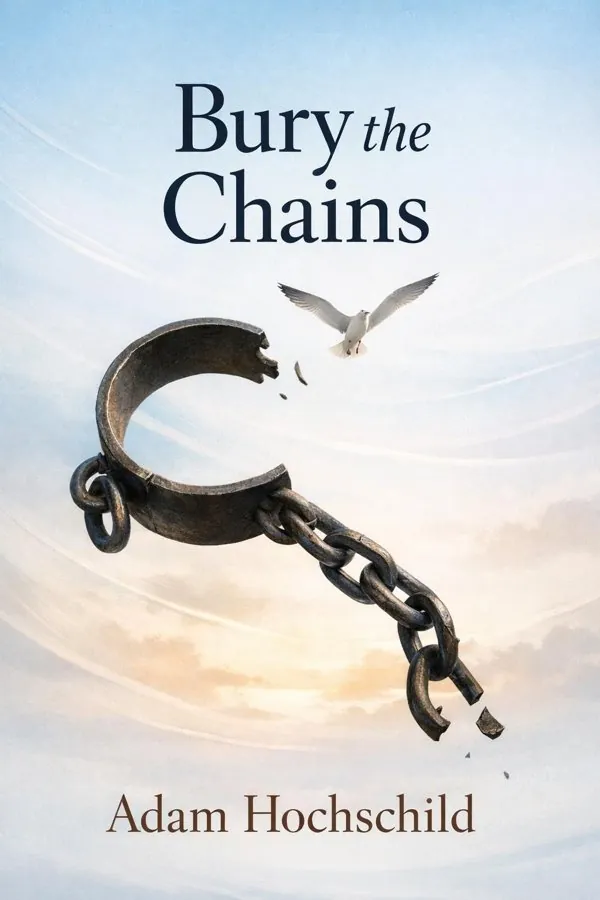
Bury the Chains: Prophets and Rebels in the Fight to Free an Empire's Slaves: Summary & Key Insights
 10 min8 chaptersAudio available
What Is Bury the Chains: Prophets and Rebels in the Fight to Free an Empire's Slaves About?
Bury the Chains: Prophets and Rebels in the Fight to Free an Empire's Slaves by Adam Hochschild is a world_history book spanning 8 pages. A narrative history of the late 18th- and early 19th-century British abolitionist movement, this book recounts how a small group of activists, writers, and reformers launched one of the first great human rights campaigns in history, leading to the abolition of the slave trade and ultimately slavery in the British Empire.
This FizzRead summary covers all 8 key chapters of Bury the Chains: Prophets and Rebels in the Fight to Free an Empire's Slaves in approximately 10 minutes, distilling the most important ideas, arguments, and takeaways from Adam Hochschild's work. Also available as an audio summary and Key Quotes Podcast.
Bury the Chains: Prophets and Rebels in the Fight to Free an Empire's Slaves
A narrative history of the late 18th- and early 19th-century British abolitionist movement, this book recounts how a small group of activists, writers, and reformers launched one of the first great human rights campaigns in history, leading to the abolition of the slave trade and ultimately slavery in the British Empire.
Who Should Read Bury the Chains: Prophets and Rebels in the Fight to Free an Empire's Slaves?
This book is perfect for anyone interested in world_history and looking to gain actionable insights in a short read. Whether you're a student, professional, or lifelong learner, the key ideas from Bury the Chains: Prophets and Rebels in the Fight to Free an Empire's Slaves by Adam Hochschild will help you think differently.
- ✓Readers who enjoy world_history and want practical takeaways
- ✓Professionals looking to apply new ideas to their work and life
- ✓Anyone who wants the core insights of Bury the Chains: Prophets and Rebels in the Fight to Free an Empire's Slaves in just 10 minutes
Want the full summary?
Get instant access to this book summary and 100K+ more with Fizz Moment.
Get Free SummaryAvailable on App Store • Free to download
Key Chapters
Before the cause of abolition had a name, there were quiet murmurs among groups whose faith taught them that conscience stands above profit. The Quakers were the first to see that the slave ship violated something sacred in all creation. In their communities, moral purity meant direct engagement with the truth, no matter how unpleasant. They began to forbid their members from owning slaves, an act that cost them friends and wealth but gave birth to principle.
Theirs was a vision of equality radical for its time. The late eighteenth-century British landscape teemed with bankers, traders, and aristocrats celebrating imperial expansion, crediting their prosperity to colonies powered by enslaved bodies. Yet, among the Quakers—and later some Evangelical Anglicans—the word 'brother' began to carry a new weight. Faith transformed into civic virtue. For these early dissenters, moral clarity was not a luxury but a discipline. In their gatherings, they discussed scripture and pressed each other toward action. Out of this ferment came the spiritual groundwork for abolition.
These movements were small, but their purity of purpose prepared the terrain for what would become one of the first organized humanitarian crusades in modern history. They taught Britain that faith could challenge empire, and they passed that conviction to the young dreamers and scholars who would take the next step: public confrontation.
In 1785, a young Cambridge student named Thomas Clarkson sat down to write a Latin essay on whether slavery was lawful according to natural law. The question transformed his life. As he researched, he read description after description of suffering aboard slave ships and in Caribbean plantations. When he finished his essay, he felt as if the world had shifted beneath him. On a ride home from Cambridge, he dismounted his horse and asked himself whether his knowledge would mean anything if he did not act. That moment of conviction marked the beginning of a mission that would consume decades.
Clarkson’s brilliance lay in the practical courage of his investigation. He became, in effect, the abolition movement’s first field reporter, traversing ports, talking to sailors, gathering shackles, branding irons, and even diagrams to show Parliament the inhumanity hidden behind trade statistics. His empathy translated into evidence, and his evidence into activism. He understood that public opinion needed more than sermons—it needed proof.
Every discovery he made strengthened the network of moral reformers, convincing skeptical Britons that slavery was not distant but immediate, embodied in the sugar on their tables. His essays and testimony gave the movement scientific and moral authority. In Clarkson’s painstaking labor, we see how conscience must wear the boots of perseverance, for truth alone is never enough: it must be documented, carried, and repeated until the world listens.
+ 6 more chapters — available in the FizzRead app
All Chapters in Bury the Chains: Prophets and Rebels in the Fight to Free an Empire's Slaves
About the Author
Adam Hochschild is an American author, journalist, and historian known for his works on social justice and human rights. His books often explore moral courage and activism, including 'King Leopold’s Ghost' and 'To End All Wars.'
Get This Summary in Your Preferred Format
Read or listen to the Bury the Chains: Prophets and Rebels in the Fight to Free an Empire's Slaves summary by Adam Hochschild anytime, anywhere. FizzRead offers multiple formats so you can learn on your terms — all free.
Available formats: App · Audio · PDF · EPUB — All included free with FizzRead
Download Bury the Chains: Prophets and Rebels in the Fight to Free an Empire's Slaves PDF and EPUB Summary
Key Quotes from Bury the Chains: Prophets and Rebels in the Fight to Free an Empire's Slaves
“Before the cause of abolition had a name, there were quiet murmurs among groups whose faith taught them that conscience stands above profit.”
“In 1785, a young Cambridge student named Thomas Clarkson sat down to write a Latin essay on whether slavery was lawful according to natural law.”
Frequently Asked Questions about Bury the Chains: Prophets and Rebels in the Fight to Free an Empire's Slaves
Bury the Chains: Prophets and Rebels in the Fight to Free an Empire's Slaves by Adam Hochschild is a world_history book that explores key ideas across 8 chapters. A narrative history of the late 18th- and early 19th-century British abolitionist movement, this book recounts how a small group of activists, writers, and reformers launched one of the first great human rights campaigns in history, leading to the abolition of the slave trade and ultimately slavery in the British Empire.
More by Adam Hochschild
You Might Also Like
The Age of Capital
Eric Hobsbawm
10 min
The Gulag Archipelago
Aleksandr Solzhenitsyn
10 min
Jerusalem: The Biography
Simon Sebag Montefiore
10 min
The Anglo-Saxons
James Campbell
10 min
The Boer War
Thomas Pakenham
10 min
The Industrial Revolutionaries: The Making of the Modern World 1776–1914
Gavin Weightman
10 minBrowse by Category
Ready to read Bury the Chains: Prophets and Rebels in the Fight to Free an Empire's Slaves?
Get the full summary and 100K+ more books with Fizz Moment.