
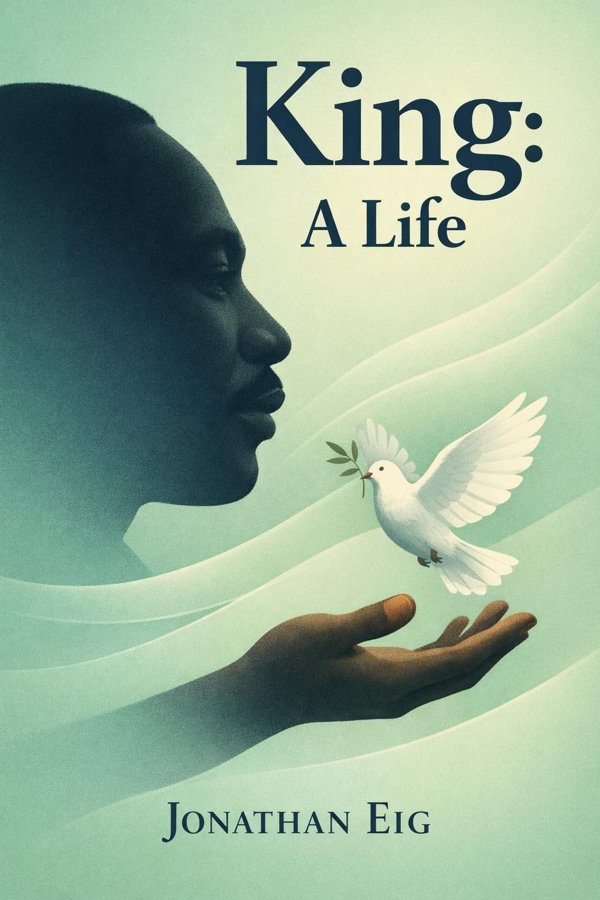
King: A Life: Summary & Key Insights
by Jonathan Eig
 10 min9 chaptersAudio available
What Is King: A Life About?
King: A Life by Jonathan Eig is a biographies book spanning 9 pages. A comprehensive biography of Martin Luther King Jr., this book by Jonathan Eig draws on newly declassified FBI files, personal letters, and interviews to present a vivid and human portrait of the civil rights leader. It explores King's moral courage, strategic brilliance, and personal struggles, offering a nuanced understanding of his life and legacy.
This FizzRead summary covers all 9 key chapters of King: A Life in approximately 10 minutes, distilling the most important ideas, arguments, and takeaways from Jonathan Eig's work. Also available as an audio summary and Key Quotes Podcast.
King: A Life
A comprehensive biography of Martin Luther King Jr., this book by Jonathan Eig draws on newly declassified FBI files, personal letters, and interviews to present a vivid and human portrait of the civil rights leader. It explores King's moral courage, strategic brilliance, and personal struggles, offering a nuanced understanding of his life and legacy.
Who Should Read King: A Life?
This book is perfect for anyone interested in biographies and looking to gain actionable insights in a short read. Whether you're a student, professional, or lifelong learner, the key ideas from King: A Life by Jonathan Eig will help you think differently.
- ✓Readers who enjoy biographies and want practical takeaways
- ✓Professionals looking to apply new ideas to their work and life
- ✓Anyone who wants the core insights of King: A Life in just 10 minutes
Want the full summary?
Get instant access to this book summary and 100K+ more with Fizz Moment.
Get Free SummaryAvailable on App Store • Free to download
Key Chapters
Martin Luther King Jr. was born into a world already shaped by faith and struggle. In Atlanta, Georgia, his father, Martin Luther King Sr., stood as a formidable preacher and social activist, and his mother, Alberta Williams King, offered grace and discipline equal in measure. Their household was not wealthy, but it was rich in purpose. The Kings believed that moral education began at the dinner table, that words could move mountains, and that dignity was not to be negotiated. From childhood, young Martin saw how race defined boundaries but also how faith could challenge those boundaries.
He watched his father stand firm against indignities—refusing to accept racist treatment even in small acts of commerce—and learned that resistance could coexist with respectability. These early experiences planted the seeds of rebellion in him, though they were nourished in a soil of compassion and spiritual calling. Atlanta’s Black middle class offered a glimpse of both achievement and limitation. King’s home life surrounded him with books and sermons, yet the world beyond reminded him daily of injustice. The tension between these worlds became the crucible of his consciousness.
He grew up amid music, prayer, and debate, but what truly defined his formative years was the idea that faith was never static—it had to be practiced, tested, and proven in the face of cruelty. The lessons of his father’s boldness and his mother’s calm courage would echo throughout his life, shaping a leader able to match moral conviction with emotional depth.
When King entered Morehouse College, he was still finding himself—unconvinced that ministry was his calling, and uncertain of how philosophy could marry spirituality. Under the guidance of mentors like Benjamin Mays, King discovered the transformative power of moral leadership rooted in intellect. Mays challenged him to think deeply about the world’s moral failings and to imagine the pulpit not as a platform for salvation alone but as a stage for social awakening.
Those years shaped King’s sense of reasoning and rhetoric. At Crozer Theological Seminary, he moved beyond inherited faith toward a philosophy of action. He studied Reinhold Niebuhr’s realism, Mahatma Gandhi’s nonviolence, and the ethics of love taught by Jesus. His mind became a laboratory for justice—experimenting with ideas that would later blossom into the Civil Rights Movement’s ethical foundation.
Boston University brought a synthesis of faith and philosophy. There, he met Coretta Scott, whose intellect and activism complemented his own. Their courtship was a union of idealism—a partnership grounded in shared discipline and shared dreams. Through his education, King evolved from preacher’s son to prophetic thinker, learning that love without justice is sentiment, and justice without love is tyranny. By the time he earned his doctorate, his thought was a melting pot of theology, social theory, and defiance, ready to ignite the moral imagination of a nation.
+ 7 more chapters — available in the FizzRead app
All Chapters in King: A Life
About the Author
Jonathan Eig is an American journalist and biographer known for his deeply researched works on major historical figures. His previous books include biographies of Muhammad Ali, Lou Gehrig, and Al Capone. Eig’s writing combines investigative rigor with narrative storytelling, earning him critical acclaim and multiple literary awards.
Get This Summary in Your Preferred Format
Read or listen to the King: A Life summary by Jonathan Eig anytime, anywhere. FizzRead offers multiple formats so you can learn on your terms — all free.
Available formats: App · Audio · PDF · EPUB — All included free with FizzRead
Download King: A Life PDF and EPUB Summary
Key Quotes from King: A Life
“was born into a world already shaped by faith and struggle.”
“When King entered Morehouse College, he was still finding himself—unconvinced that ministry was his calling, and uncertain of how philosophy could marry spirituality.”
Frequently Asked Questions about King: A Life
King: A Life by Jonathan Eig is a biographies book that explores key ideas across 9 chapters. A comprehensive biography of Martin Luther King Jr., this book by Jonathan Eig draws on newly declassified FBI files, personal letters, and interviews to present a vivid and human portrait of the civil rights leader. It explores King's moral courage, strategic brilliance, and personal struggles, offering a nuanced understanding of his life and legacy.
More by Jonathan Eig


You Might Also Like

An American Marriage
Tayari Jones
10 min
Benjamin Franklin: An American Life
Walter Isaacson
10 min
I Know Why The Caged Bird Sings
Maya Angelou
10 min
Long Walk to Freedom
Nelson Mandela
10 min
Persepolis
Marjane Satrapi
10 min
Surely You're Joking, Mr. Feynman!
Richard P. Feynman
10 minBrowse by Category
Ready to read King: A Life?
Get the full summary and 100K+ more books with Fizz Moment.