
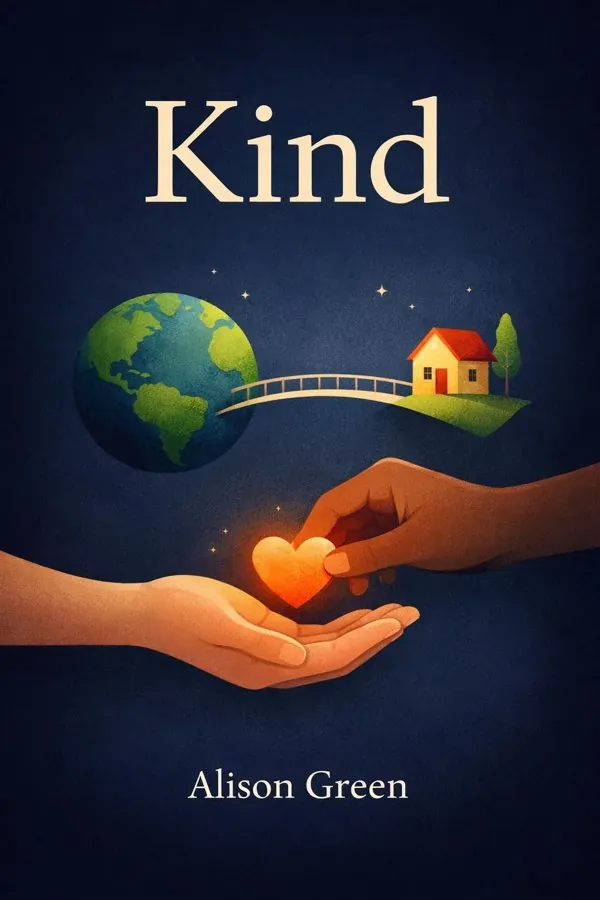
Kind: Summary & Key Insights
by Alison Green
 10 min8 chaptersAudio available
Key Takeaways from Kind
The most powerful forms of kindness are often the smallest ones, because they happen often enough to shape who we become.
Belonging does not happen automatically; it is created when someone decides to make room for another person.
Many adults teach children to use kind words, but Kind goes further by suggesting that kindness also begins with listening.
A child’s moral world expands when they learn that kindness is not only for people.
Kindness becomes especially meaningful when people work together, because cooperation turns good intentions into shared action.
What Is Kind About?
Kind by Alison Green is a education book spanning 7 pages. Kind by Alison Green is a warm, visually rich picture book that invites children to imagine what the world could look like if kindness guided everyday life. Rather than treating kindness as a grand heroic act, the book brings it down to a child’s level: sharing, listening, welcoming someone new, caring for animals, helping a friend, and speaking gently. Its message is simple, but its emotional reach is wide. By showing many different children, families, and experiences, the book reminds young readers that kindness belongs everywhere and to everyone. What makes Kind especially powerful is its collaborative design. Featuring artwork by nearly forty illustrators, the book becomes a celebration of diversity not only in its message but also in its form. Each page offers a fresh visual perspective, reinforcing the idea that there are many ways to be kind and many ways to belong. Alison Green, an experienced children’s author and editor, brings a clear understanding of how picture books shape early values. This is a book that matters because it helps children see empathy not as an abstract lesson, but as something they can practice today, in school, at home, and in the wider world.
This FizzRead summary covers all 8 key chapters of Kind in approximately 10 minutes, distilling the most important ideas, arguments, and takeaways from Alison Green's work. Also available as an audio summary and Key Quotes Podcast.
Kind
Kind by Alison Green is a warm, visually rich picture book that invites children to imagine what the world could look like if kindness guided everyday life. Rather than treating kindness as a grand heroic act, the book brings it down to a child’s level: sharing, listening, welcoming someone new, caring for animals, helping a friend, and speaking gently. Its message is simple, but its emotional reach is wide. By showing many different children, families, and experiences, the book reminds young readers that kindness belongs everywhere and to everyone.
What makes Kind especially powerful is its collaborative design. Featuring artwork by nearly forty illustrators, the book becomes a celebration of diversity not only in its message but also in its form. Each page offers a fresh visual perspective, reinforcing the idea that there are many ways to be kind and many ways to belong. Alison Green, an experienced children’s author and editor, brings a clear understanding of how picture books shape early values. This is a book that matters because it helps children see empathy not as an abstract lesson, but as something they can practice today, in school, at home, and in the wider world.
Who Should Read Kind?
This book is perfect for anyone interested in education and looking to gain actionable insights in a short read. Whether you're a student, professional, or lifelong learner, the key ideas from Kind by Alison Green will help you think differently.
- ✓Readers who enjoy education and want practical takeaways
- ✓Professionals looking to apply new ideas to their work and life
- ✓Anyone who wants the core insights of Kind in just 10 minutes
Want the full summary?
Get instant access to this book summary and 100K+ more with Fizz Moment.
Get Free SummaryAvailable on App Store • Free to download
Key Chapters
The most powerful forms of kindness are often the smallest ones, because they happen often enough to shape who we become. Kind begins with the simple truth that children do not need extraordinary opportunities to be caring human beings. They can practice kindness in the daily rhythm of ordinary life: sharing crayons, waiting their turn, helping clean up, offering a smile, or checking on someone who seems upset. These gestures may look modest to adults, but to children, they are the building blocks of empathy, friendship, and trust.
Alison Green presents kindness not as a one-time moral achievement but as a habit. That distinction matters. A child who learns to notice others, pause before acting, and think about how their choices affect people around them is developing a social and emotional skill that can last a lifetime. In classrooms, this might mean inviting a quieter classmate into a game. At home, it might mean helping a sibling, thanking a parent, or being gentle when someone is tired. On the playground, it can be as simple as making space for everyone.
The book also shows that kindness is active, not passive. It is not only about being “nice” in a vague way. It is about doing something that makes another person’s experience easier, safer, or happier. This helps children understand that kind behavior is visible and practical.
A useful way to apply this idea is to create a daily kindness ritual. Parents and teachers can ask children one question each day: “What kind thing did you do today?” Over time, this trains attention toward positive action.
Actionable takeaway: Encourage children to choose one small act of kindness each day and reflect on how it affected someone else.
Belonging does not happen automatically; it is created when someone decides to make room for another person. One of the most important messages in Kind is that welcoming others is itself an act of kindness. The book highlights children meeting new classmates, including those from different cultures, backgrounds, or abilities, and choosing to reach out rather than stay inside familiar circles. This matters because many children know what it feels like to be new, uncertain, or left out, even if they cannot always name that feeling.
Green’s approach is gentle but significant: kindness is not limited to people who look, speak, or live like us. In fact, kindness becomes most meaningful when it crosses those boundaries. A child may invite someone to sit with them at lunch, explain the rules of a game to someone unfamiliar with it, or ask a curious and respectful question about another person’s traditions. These are not only social gestures. They help build communities where difference is not feared, but welcomed.
The book’s diverse illustrations strengthen this idea by showing many kinds of families, faces, and daily experiences. Young readers absorb an important lesson: everyone deserves respect, and inclusion is something children can actively practice. Teachers can reinforce this by using classroom activities that celebrate names, stories, languages, and family traditions. Parents can model welcome by speaking positively about difference and encouraging curiosity without judgment.
When children learn to welcome others, they also develop confidence, compassion, and social courage. They begin to understand that they can be the person who makes someone else feel less alone.
Actionable takeaway: Teach children one simple habit of inclusion: notice who is alone, then invite them in.
Many adults teach children to use kind words, but Kind goes further by suggesting that kindness also begins with listening. To truly be kind, a child must learn to notice how someone else feels and make space for that feeling. This is where empathy starts. It is not only saying “be nice,” but asking, “What might this person be experiencing right now?” That shift turns kindness from politeness into genuine understanding.
Children often feel big emotions before they know how to explain them. A friend might become quiet, angry, tearful, or withdrawn. In those moments, kindness can look like sitting nearby, asking if they are okay, listening without interrupting, or simply staying present. Green’s message helps children understand that they do not always need perfect words. Sometimes care is shown through attention, patience, and gentleness.
This lesson applies in classrooms and homes alike. A teacher can encourage students to notice body language and tone of voice. A parent can help a child name emotions by asking, “How do you think your friend felt when that happened?” Stories like Kind make emotional literacy accessible by connecting it to everyday scenes children recognize. Over time, children begin to understand that everyone has invisible feelings, and kind behavior includes respecting those inner experiences.
There is also an important boundary lesson here: empathy does not mean fixing everything. Sometimes the kindest response is to listen, comfort, or get help from an adult. This teaches children responsibility without overwhelming them.
Practical exercises can make this idea real. Families can role-play common moments, such as comforting someone who lost a game or welcoming a child who feels nervous on the first day.
Actionable takeaway: Help children practice one empathy question regularly: “How do you think they felt, and what could you do to help?”
A child’s moral world expands when they learn that kindness is not only for people. Kind gently widens the circle of care to include animals, nature, and shared spaces. This is a valuable lesson because it teaches children that compassion is a way of relating to the world as a whole. A kind child does not only speak gently to friends; they also learn to handle living things with care, avoid unnecessary harm, and respect the environment they depend on.
In practice, this can look very simple. Feeding a pet responsibly, being gentle with insects, watering plants, picking up litter, or not wasting food all become expressions of kindness. These acts show children that their choices matter even when no one is watching. They also help connect personal behavior with broader responsibility. Caring for the environment is not presented as a heavy political issue, but as a natural extension of empathy.
This perspective is particularly powerful for young readers because it turns kindness into a worldview. The child begins to see that the world is shared. Parks, classrooms, playgrounds, and neighborhoods all function better when people treat them with care. Parents and teachers can support this by linking routine actions to values: recycling becomes a way of being thoughtful, conserving water becomes an act of respect, and protecting animals becomes a form of compassion.
Books that connect emotional development with environmental care help children understand that responsibility is relational. We are not separate from the world around us. We affect it, and it affects us.
Actionable takeaway: Invite children to choose one weekly act of care for the natural world, such as watering a plant, picking up litter, or being extra gentle with an animal.
Kindness becomes especially meaningful when people work together, because cooperation turns good intentions into shared action. In Kind, children are not shown only as isolated helpers doing private good deeds. They are also part of groups, classrooms, games, and communities where kindness means taking turns, solving problems fairly, helping others contribute, and remembering that everyone matters. This is an essential lesson for young readers because many of their hardest social experiences happen in group settings.
Teamwork asks children to balance their own wishes with the needs of others. That can be difficult. A child may want to lead every game, speak first, or keep the best materials. Green’s message gently redirects that instinct by showing that cooperation is a form of kindness. Waiting, sharing responsibility, encouraging others, and celebrating someone else’s success all help create a more joyful group experience.
In schools, this can be practiced through collaborative art, paired reading, or cleaning up together after an activity. At home, siblings can be encouraged to complete small tasks as a team rather than as rivals. Adults can emphasize language such as “How can we help each other?” instead of only praising individual achievement. This helps children see that being kind does not make them smaller; it makes the group stronger.
Another important point is that cooperation teaches fairness. Kindness is not always giving everyone exactly what they want. Sometimes it means finding a solution that respects all participants. That skill prepares children for friendships, classrooms, and eventually workplaces and communities.
Actionable takeaway: Give children regular opportunities to complete one shared task together, then discuss what kind teamwork looked like in action.
It is easy to be kind when everything feels comfortable. The real test of character comes when someone is upset, excluded, embarrassed, or struggling. One of the strongest insights in Kind is that difficult moments are where kindness has its deepest effect. A child who drops their lunch, loses a game, forgets an answer, or feels different may remember one kind response for a very long time. Green helps children recognize that compassion matters most when another person is vulnerable.
This is an important emotional lesson because children often witness pain before they know how to respond to it. They may see teasing, disappointment, loneliness, or frustration. Without guidance, they might laugh nervously, stay silent, or walk away. The book offers another path: pause, notice, and respond with care. That might mean helping pick something up, saying “It’s okay,” sitting beside someone, or telling an adult when support is needed.
Kindness in hard moments also includes self-control. A child may be tempted to join in exclusion, repeat an unkind joke, or ignore someone else’s discomfort because doing so feels socially safer. Green’s vision encourages moral courage instead. Being kind sometimes means doing the right thing even when it is not the easiest thing.
Parents and teachers can deepen this lesson by talking about real-life social situations. Asking “What could you do if someone is left out?” helps children plan for moments that can otherwise feel confusing. This preparation builds confidence and compassion.
Actionable takeaway: Teach children a simple response for difficult moments: notice the problem, offer help, and ask an adult if more support is needed.
Children do not become kind only by being told rules; they become kind by imagining possibilities. Kind invites readers to picture what they might do in different situations, and this imaginative step is crucial. Before a child shares, comforts, includes, or helps, they often need to mentally rehearse the action. Picture books are powerful because they create that rehearsal space. They let children see examples and then quietly ask, “What would you do?”
This is why Green’s book works so well. It does not lecture heavily or reduce kindness to a list of instructions. Instead, it opens a door. Through varied scenes and illustrations, children are invited to think creatively about how kindness can look in many forms. One child may imagine helping a nervous classmate. Another may think about caring for a pet or cheering up a sibling. The message is broad enough to spark personal ownership.
Imagination also supports moral confidence. When children picture themselves doing something kind, they are more likely to act that way later. Adults can build on this by asking open-ended questions: “What could you say to someone new?” “How might you help if a friend feels sad?” “What would kindness look like on the playground today?” These questions turn reading into preparation for real life.
Creative follow-up activities work especially well here. Children can draw a “kindness map” of their day, write one sentence about a helpful action they want to try, or act out scenarios with toys or classmates. Such activities transform an abstract value into an intentional practice.
Actionable takeaway: After reading, ask children to imagine one specific kind action they could take tomorrow and help them follow through.
A book about kindness becomes more convincing when children can see themselves inside it. One of Kind’s unique strengths is its use of nearly forty illustrators, creating a vibrant and varied visual world. This artistic choice is not merely decorative. It reinforces the book’s core message that kindness belongs across cultures, appearances, family structures, and lived experiences. Diversity is not treated as an extra topic attached to the main lesson; it is woven into the story’s very fabric.
For young readers, representation matters deeply. When children see different skin tones, clothing styles, homes, abilities, and communities shown with warmth and dignity, they absorb the idea that every person deserves care and respect. Equally important, they learn that kindness is not limited to helping people who seem familiar. Compassion stretches outward. It notices difference without turning it into distance.
The multiple illustration styles also communicate a subtle but meaningful truth: there is no single way to see the world. Just as artists interpret kindness differently, children may express kindness in different ways too. One child may be outspoken and welcoming, another quiet and attentive. Both can be kind. This flexibility helps prevent moral teaching from becoming rigid or narrow.
Teachers and caregivers can use the artwork as a conversation starter. Asking children what they notice about the people, places, and emotions on each page encourages observation and respect. It also helps them connect visual diversity with human dignity.
Actionable takeaway: Use the book’s images to talk with children about difference in a positive way, and ask how kindness can look across many kinds of lives.
All Chapters in Kind
About the Author
Alison Green is a British children’s author and editor whose work often centers on empathy, kindness, and social understanding. She is known for creating books that help young readers explore feelings, relationships, and the importance of caring for others in everyday life. Green has a strong editorial sensibility, which is evident in the clarity and accessibility of her storytelling. Her books are often valued by parents and educators because they combine warmth, simplicity, and meaningful emotional lessons without becoming heavy-handed. In Kind, she brings these strengths together in a particularly effective way, offering children a gentle but memorable invitation to imagine a more compassionate world. Her work reflects a deep understanding of how picture books can shape values early and powerfully.
Get This Summary in Your Preferred Format
Read or listen to the Kind summary by Alison Green anytime, anywhere. FizzRead offers multiple formats so you can learn on your terms — all free.
Available formats: App · Audio · PDF · EPUB — All included free with FizzRead
Download Kind PDF and EPUB Summary
Key Quotes from Kind
“The most powerful forms of kindness are often the smallest ones, because they happen often enough to shape who we become.”
“Belonging does not happen automatically; it is created when someone decides to make room for another person.”
“Many adults teach children to use kind words, but Kind goes further by suggesting that kindness also begins with listening.”
“A child’s moral world expands when they learn that kindness is not only for people.”
“Kindness becomes especially meaningful when people work together, because cooperation turns good intentions into shared action.”
Frequently Asked Questions about Kind
Kind by Alison Green is a education book that explores key ideas across 8 chapters. Kind by Alison Green is a warm, visually rich picture book that invites children to imagine what the world could look like if kindness guided everyday life. Rather than treating kindness as a grand heroic act, the book brings it down to a child’s level: sharing, listening, welcoming someone new, caring for animals, helping a friend, and speaking gently. Its message is simple, but its emotional reach is wide. By showing many different children, families, and experiences, the book reminds young readers that kindness belongs everywhere and to everyone. What makes Kind especially powerful is its collaborative design. Featuring artwork by nearly forty illustrators, the book becomes a celebration of diversity not only in its message but also in its form. Each page offers a fresh visual perspective, reinforcing the idea that there are many ways to be kind and many ways to belong. Alison Green, an experienced children’s author and editor, brings a clear understanding of how picture books shape early values. This is a book that matters because it helps children see empathy not as an abstract lesson, but as something they can practice today, in school, at home, and in the wider world.
You Might Also Like

Bedtime Biography: Florence Nightingale
Isabel Thomas
10 min
Introduction To Museum Studies
Howard H. Hoyt
10 min
A Mind for Numbers: How to Excel at Math and Science (Even If You Flunked Algebra)
Barbara Oakley
10 min
AI for Educators: Learning Strategies, Teacher Empowerment, and the Future of Education
Matt Miller
10 min
Animation For Beginners
Morr Meroz
10 min
Artificial Intelligence for Learning
Donald Clark
10 minBrowse by Category
Ready to read Kind?
Get the full summary and 100K+ more books with Fizz Moment.