
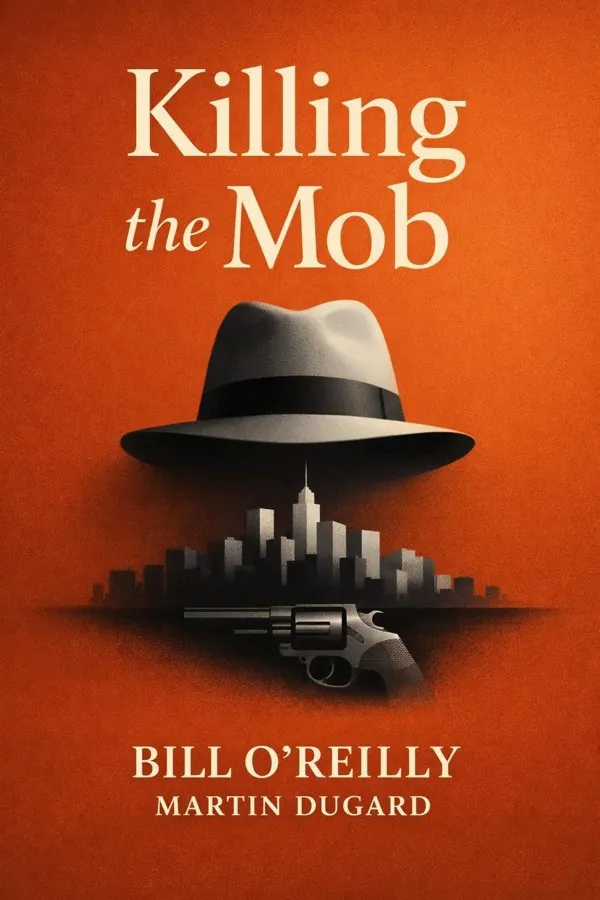
Killing the Mob: The Fight Against Organized Crime in America: Summary & Key Insights
by Bill O'Reilly, Martin Dugard
 10 min9 chaptersAudio available
Key Takeaways from Killing the Mob: The Fight Against Organized Crime in America
Illegal markets often become most powerful when ordinary demand remains strong.
Crime thrives where money, migration, and weak oversight collide.
Violence may win territory, but corruption sustains empires.
Institutions often fail first by refusing to name the problem.
History often becomes easier to grasp through the people who embody it.
What Is Killing the Mob: The Fight Against Organized Crime in America About?
Killing the Mob: The Fight Against Organized Crime in America by Bill O'Reilly, Martin Dugard is a world_history book spanning 9 pages. Organized crime did not simply lurk in the shadows of American history—it helped shape politics, labor, entertainment, policing, and public imagination for decades. In Killing the Mob, Bill O'Reilly and Martin Dugard trace the rise of the American Mafia from the bootlegging era through its domination of major cities and industries, and finally to the federal campaigns that weakened its power. The book moves through the lives of infamous figures such as Al Capone, Lucky Luciano, Meyer Lansky, Sam Giancana, and John Gotti, while also spotlighting the investigators, prosecutors, and politicians who tried to bring them down. What makes this book compelling is its fast-paced narrative style and its focus on the collision between criminal power and state power. O'Reilly and Dugard present organized crime not as glamorous mythology, but as a deeply embedded system of violence, intimidation, and corruption. Their account matters because it shows how criminal empires grow when institutions are weak, fragmented, or compromised—and how difficult it is to dismantle them once they become culturally normalized. Backed by the authors' experience in narrative history and mass-market nonfiction, the book offers an accessible overview of a brutal but influential chapter in modern America.
This FizzRead summary covers all 9 key chapters of Killing the Mob: The Fight Against Organized Crime in America in approximately 10 minutes, distilling the most important ideas, arguments, and takeaways from Bill O'Reilly, Martin Dugard's work. Also available as an audio summary and Key Quotes Podcast.
Killing the Mob: The Fight Against Organized Crime in America
Organized crime did not simply lurk in the shadows of American history—it helped shape politics, labor, entertainment, policing, and public imagination for decades. In Killing the Mob, Bill O'Reilly and Martin Dugard trace the rise of the American Mafia from the bootlegging era through its domination of major cities and industries, and finally to the federal campaigns that weakened its power. The book moves through the lives of infamous figures such as Al Capone, Lucky Luciano, Meyer Lansky, Sam Giancana, and John Gotti, while also spotlighting the investigators, prosecutors, and politicians who tried to bring them down.
What makes this book compelling is its fast-paced narrative style and its focus on the collision between criminal power and state power. O'Reilly and Dugard present organized crime not as glamorous mythology, but as a deeply embedded system of violence, intimidation, and corruption. Their account matters because it shows how criminal empires grow when institutions are weak, fragmented, or compromised—and how difficult it is to dismantle them once they become culturally normalized. Backed by the authors' experience in narrative history and mass-market nonfiction, the book offers an accessible overview of a brutal but influential chapter in modern America.
Who Should Read Killing the Mob: The Fight Against Organized Crime in America?
This book is perfect for anyone interested in world_history and looking to gain actionable insights in a short read. Whether you're a student, professional, or lifelong learner, the key ideas from Killing the Mob: The Fight Against Organized Crime in America by Bill O'Reilly, Martin Dugard will help you think differently.
- ✓Readers who enjoy world_history and want practical takeaways
- ✓Professionals looking to apply new ideas to their work and life
- ✓Anyone who wants the core insights of Killing the Mob: The Fight Against Organized Crime in America in just 10 minutes
Want the full summary?
Get instant access to this book summary and 100K+ more with Fizz Moment.
Get Free SummaryAvailable on App Store • Free to download
Key Chapters
Illegal markets often become most powerful when ordinary demand remains strong. That is the central lesson of the Mafia's explosive growth during Prohibition. When the United States banned the manufacture and sale of alcohol in 1920, lawmakers imagined they were solving a social problem. Instead, they created one of the greatest economic opportunities in criminal history. Americans still wanted to drink, and organized gangs stepped in to supply what the law had forbidden.
Italian-American mobsters, along with Jewish and Irish criminal groups, built sophisticated bootlegging networks that transported liquor, bribed police, controlled speakeasies, and used violence to eliminate competitors. Prohibition did more than enrich criminals; it taught them how to organize. They learned logistics, political corruption, money laundering, and territorial discipline. Figures like Al Capone became famous not just because they were ruthless, but because they operated like illegal CEOs, managing distribution systems and labor forces on a national scale.
The book shows that this era was the Mafia's training ground. Once crime syndicates discovered how much money could be made through coordination, intimidation, and bribery, they expanded into gambling, prostitution, unions, and racketeering. Prohibition did not invent organized crime, but it industrialized it.
A practical modern application is clear: when policymakers outlaw something that millions still demand, they must also anticipate who will fill the vacuum. Whether the issue is narcotics, cybercrime, or black-market goods, demand creates opportunity. The takeaway is to look beyond moral legislation and ask a harder question: what systems and incentives might that law unintentionally create?
Crime thrives where money, migration, and weak oversight collide. In Killing the Mob, the great American city is not just a backdrop—it is the engine of Mafia expansion. New York, Chicago, and later Las Vegas became ideal environments for organized crime because they concentrated wealth, political machines, immigrant neighborhoods, labor unrest, and commercial opportunity in one place.
In New York, rival gangs evolved into structured crime families that divided territory and established rules of operation. In Chicago, Al Capone turned the city into a laboratory of violent enforcement, using assassinations, intimidation, and corruption to dominate the bootlegging trade. Las Vegas offered a different model: here the mob discovered that crime could wear a tuxedo. Casinos allowed gangsters to skim profits, launder money, and build a façade of legitimacy while maintaining underworld ties.
The authors demonstrate that cities were vulnerable because institutions were fragmented. Local police could be bribed, politicians could be bought, and neighborhoods often relied on mob-connected figures for jobs, protection, or favors. Organized crime inserted itself into everyday civic life, blurring the line between criminality and governance.
This idea has enduring relevance. Any concentrated system—whether a city, an industry, or a digital platform—can be captured when oversight is divided and incentives reward silence. If no one agency sees the whole picture, corruption flourishes in the gaps.
The actionable takeaway is to pay attention to systems, not just villains. When evaluating corruption in any organization, ask where power is concentrated, who benefits from disorder, and which blind spots allow illicit networks to operate almost like public institutions.
Violence may win territory, but corruption sustains empires. One of the book's strongest themes is that organized crime endured not merely because gangsters were feared, but because they were connected. The Mafia learned early that bribing officials, influencing labor leaders, and cultivating political allies could be more profitable than open warfare. A mob boss with the right judge, union contact, police captain, or city politician possessed far more durable power than one with guns alone.
The book explores how organized crime penetrated labor unions, waterfront operations, trucking, construction, and local government. Through extortion and racketeering, mob figures gained control over contracts, shipping routes, and job assignments. Unions were especially valuable because they sat at the junction of labor, commerce, and politics. Whoever controlled the union could slow a port, halt a building project, or enrich allies through pension funds and kickbacks.
This arrangement reveals something important: corruption is rarely random. It is relational. The mob offered money, intimidation, and problem-solving. In return, insiders offered protection, information, and access. Such exchanges allowed criminal activity to hide behind legal institutions.
Modern readers can apply this insight to corporate fraud, political patronage, or procurement scandals. Corrupt systems usually depend on networks of mutual benefit, not isolated bad actors. That means accountability must extend beyond the visible frontman to the lawyers, administrators, financiers, and public officials who enable the machine.
The takeaway is to examine incentives around every scandal. Ask not only who committed the crime, but who looked away, who profited quietly, and which respectable institutions gave criminal behavior room to survive.
Institutions often fail first by refusing to name the problem. For years, federal authorities were slow to acknowledge the scale and structure of organized crime. J. Edgar Hoover's FBI, despite its resources and public image, initially devoted limited attention to the Mafia. The bureau focused more heavily on bank robbers, communists, and headline-friendly threats, while local corruption allowed mob networks to deepen their roots.
Killing the Mob highlights this delay as a crucial turning point. By the time the FBI and federal prosecutors fully engaged, crime families had entrenched themselves in multiple sectors of American life. Yet once the federal government shifted strategy, the balance began to change. Wiretaps, surveillance, financial investigation, witness testimony, and coordinated prosecutions gave law enforcement tools local agencies often lacked. Federal power mattered because the mob's operations crossed city and state lines; fragmented policing could not match a national criminal network.
The authors show that law enforcement victories were not instant or clean. Cases could collapse, witnesses could vanish, and corruption could sabotage investigations. Still, the federal reckoning changed the story from tolerance to sustained pressure. Over time, the state became more patient, more informed, and more willing to pursue conspiracy cases instead of only isolated crimes.
The broader application is that complex threats require institutions willing to adapt. Whether dealing with organized crime, financial fraud, or transnational cybercrime, authorities must identify patterns early and share intelligence across jurisdictions.
The actionable takeaway is simple: when a problem looks too coordinated to be local, do not rely on local fixes alone. Effective response requires naming the network, mapping its reach, and matching its scale with an equally coordinated strategy.
History often becomes easier to grasp through the people who embody it. In this book, mobsters like Al Capone, Sam Giancana, and Carlo Gambino are not treated merely as colorful villains; they represent different stages in the Mafia's evolution. Capone symbolizes the age of open brutality and public notoriety, when gangsters could become national celebrities while waging bloody territorial wars. His reign showed how crime could exploit modern media, urban disorder, and mass consumer demand.
Sam Giancana represents a more politically entangled phase of organized crime. He moved through circles where underworld operations touched intelligence rumors, celebrity culture, and high-level influence. His career reflects how the Mafia adapted beyond street violence into a web of hidden leverage. Carlo Gambino, by contrast, exemplifies the quiet strategist. Less flamboyant than Capone or Giancana, he built strength through caution, patience, and organizational control. Under leaders like Gambino, the mob became less theatrical and more corporate.
The value of these portraits lies in the pattern they reveal. Criminal leadership changes style according to risk. Some bosses dominate through fear and publicity; others through invisibility and discipline. The mob survived for so long because it was capable of both.
This lesson applies beyond organized crime. In business, politics, and institutions, dangerous operators are not always the loudest. Some build influence by staying underestimated, delegating ruthlessly, and avoiding spectacle.
The takeaway is to study leadership styles, not just reputations. If you want to understand how a powerful organization functions—legal or illegal—look at how its leaders balance visibility, discipline, loyalty, and control.
Glamour is one of corruption's most effective disguises. A striking idea in Killing the Mob is that organized crime became harder for many Americans to condemn once it attached itself to entertainment, nightlife, and luxury. Las Vegas in particular transformed the mob's public image. Instead of alleyway killings and bootleg warehouses, the new face of criminal enterprise included bright casino floors, famous performers, elegant hotels, and a fantasy of endless prosperity.
The book shows how mob-linked investors and bosses used casinos to skim cash before profits were officially recorded, launder money, and appear as legitimate businessmen. Hollywood and pop culture further softened public perception. Gangsters could seem charismatic, stylish, and even admirable. That myth hid the reality that behind the glamour were beatings, extortion, fraud, and murders. The elegance of the setting did not change the brutality of the system.
This is an important historical reminder because illicit influence often seeks legitimacy through association. Criminal money enters real estate, entertainment, sports, nightlife, or philanthropy because prestige protects. Once wealth is admired, people stop asking where it came from. The same pattern can be seen today when dubious fortunes buy social respectability or political access.
A useful application is to separate appearance from structure. A polished brand, celebrity endorsement, or luxury environment should never substitute for transparency and accountability. Prestige can distract people from exploitation just as effectively as fear can silence them.
The actionable takeaway is to be skeptical of glamour around power. When success looks too effortless or too protected, ask what hidden systems, coercive relationships, or opaque finances make that image possible.
Political will can transform a known problem into a national campaign. The Mafia had long been recognized as dangerous, but under Attorney General Robert Kennedy, the federal government's response became more relentless and systematic. Killing the Mob presents the Kennedy era as a major escalation in the struggle between the state and organized crime. Robert Kennedy pursued mob figures with unusual intensity, expanding investigations, increasing prosecutions, and turning organized crime into a visible federal priority.
This shift mattered because law enforcement is not only about tools; it is also about priorities. Once the Department of Justice committed attention, resources, and public pressure to anti-mob efforts, investigations gained momentum. Witnesses were pursued more aggressively, tax cases were supplemented with broader conspiracy strategies, and the government signaled that criminal empires would no longer be treated as untouchable local fixtures.
The book also captures the irony and complexity of the period. Rumors and controversies linking political power, labor unions, and mob intermediaries reveal how entangled American institutions had become. This ambiguity makes the anti-mob crusade more dramatic, not less. It shows that reform is often launched from within systems already touched by compromise.
For modern readers, the lesson is that leadership attention can reshape bureaucratic behavior. Problems that seem permanent often persist because no one at the top insists on changing them. Once clear priorities are set and measured, even entrenched systems can begin to move.
The takeaway is to respect the force of focused leadership. In any organization, if misconduct is tolerated as background noise, it grows. If leaders make it a measurable priority, culture and enforcement start to shift.
Powerful criminal systems rarely collapse in a single dramatic moment; they erode through pressure, adaptation, and internal decay. One of the book's most important arguments is that the Mafia's decline in the late twentieth century did not mean a clean ending. Federal prosecutions, the Racketeer Influenced and Corrupt Organizations Act, surveillance, informants, and public exposure weakened traditional crime families significantly. Leadership was disrupted, secrecy was broken, and the code of silence became harder to enforce.
But the mob did not simply disappear. It changed form. Some families shrank. Others shifted toward lower-profile activities. New criminal groups and transnational networks also emerged, taking advantage of markets the old Mafia no longer dominated. In that sense, the story is not just about the fall of one underworld empire; it is about the transformation of organized crime itself.
The authors suggest that institutions learned painful lessons over time. Better coordination, stronger laws, and more sophisticated prosecutions mattered. Yet criminal enterprise remains adaptive. Whenever one lucrative route closes, another opens. This is why nostalgia for the so-called old mob is misguided. Even when one structure fades, the incentives that created it remain alive.
This insight applies broadly: solving a visible problem is not the same as removing its root conditions. Corruption, illicit markets, and coercive networks evolve in response to enforcement.
The actionable takeaway is to think in terms of resilience, not victory laps. If a harmful system seems weakened, the next question should be: what replaces it, where will it migrate, and how can institutions prepare before the new version becomes entrenched?
A society reveals its anxieties through the criminals it romanticizes. Killing the Mob repeatedly pushes against the popular tendency to treat Mafia history as stylish entertainment. Films, television, and folklore have turned mobsters into icons of masculinity, loyalty, ambition, and rebellion. While these stories can be artistically powerful, they often strip away the human cost: murdered rivals, terrified witnesses, manipulated workers, corrupted public offices, and neighborhoods shaped by fear.
The book's deeper contribution is its insistence that organized crime is not just a series of colorful personalities. It is a social force that exploited communities, undermined trust, and fed on institutional weakness. Cultural fascination can obscure this damage. When audiences focus only on charisma, strategy, or cinematic code-of-honor narratives, they begin to confuse intimidation with strength and criminal hierarchy with discipline.
This matters beyond Mafia history. Modern culture often packages destructive behavior as brilliance when it arrives in dramatic form. Fraudsters become innovators, ruthless executives become antiheroes, and public corruption becomes gossip instead of civic injury. The mob story teaches how easily style can erase ethics.
A practical application is to consume crime narratives with a double lens: appreciate storytelling, but ask what realities are being softened or omitted. Whose suffering is invisible? Which institutions were weakened? What ordinary people paid the price?
The takeaway is to challenge glamour with consequence. The next time a criminal figure is presented as fascinating or admirable, pause and reconstruct the hidden ledger: who was exploited, who was silenced, and what public trust was destroyed in the making of that legend?
All Chapters in Killing the Mob: The Fight Against Organized Crime in America
About the Authors
Bill O'Reilly is an American journalist, television host, and bestselling author known for combining current affairs sensibilities with highly accessible popular history. He became especially prominent through his successful Killing series, which explores major figures and events in American and world history for general readers. Martin Dugard is an American author and historian recognized for narrative nonfiction that brings historical episodes to life through vivid storytelling and strong pacing. He has written widely on exploration, warfare, and political history. Together, O'Reilly and Dugard have built a large readership by producing fast-moving historical books that emphasize dramatic scenes, memorable personalities, and broad historical significance. Their collaboration on Killing the Mob continues that approach, presenting the history of organized crime in America in a vivid, engaging, and approachable style.
Get This Summary in Your Preferred Format
Read or listen to the Killing the Mob: The Fight Against Organized Crime in America summary by Bill O'Reilly, Martin Dugard anytime, anywhere. FizzRead offers multiple formats so you can learn on your terms — all free.
Available formats: App · Audio · PDF · EPUB — All included free with FizzRead
Download Killing the Mob: The Fight Against Organized Crime in America PDF and EPUB Summary
Key Quotes from Killing the Mob: The Fight Against Organized Crime in America
“Illegal markets often become most powerful when ordinary demand remains strong.”
“Crime thrives where money, migration, and weak oversight collide.”
“Violence may win territory, but corruption sustains empires.”
“Institutions often fail first by refusing to name the problem.”
“History often becomes easier to grasp through the people who embody it.”
Frequently Asked Questions about Killing the Mob: The Fight Against Organized Crime in America
Killing the Mob: The Fight Against Organized Crime in America by Bill O'Reilly, Martin Dugard is a world_history book that explores key ideas across 9 chapters. Organized crime did not simply lurk in the shadows of American history—it helped shape politics, labor, entertainment, policing, and public imagination for decades. In Killing the Mob, Bill O'Reilly and Martin Dugard trace the rise of the American Mafia from the bootlegging era through its domination of major cities and industries, and finally to the federal campaigns that weakened its power. The book moves through the lives of infamous figures such as Al Capone, Lucky Luciano, Meyer Lansky, Sam Giancana, and John Gotti, while also spotlighting the investigators, prosecutors, and politicians who tried to bring them down. What makes this book compelling is its fast-paced narrative style and its focus on the collision between criminal power and state power. O'Reilly and Dugard present organized crime not as glamorous mythology, but as a deeply embedded system of violence, intimidation, and corruption. Their account matters because it shows how criminal empires grow when institutions are weak, fragmented, or compromised—and how difficult it is to dismantle them once they become culturally normalized. Backed by the authors' experience in narrative history and mass-market nonfiction, the book offers an accessible overview of a brutal but influential chapter in modern America.
More by Bill O'Reilly, Martin Dugard
You Might Also Like
The Age of Capital
Eric Hobsbawm
10 min
The Gulag Archipelago
Aleksandr Solzhenitsyn
10 min
Jerusalem: The Biography
Simon Sebag Montefiore
10 min
The Anglo-Saxons
James Campbell
10 min
The Boer War
Thomas Pakenham
10 min
The Industrial Revolutionaries: The Making of the Modern World 1776–1914
Gavin Weightman
10 minBrowse by Category
Ready to read Killing the Mob: The Fight Against Organized Crime in America?
Get the full summary and 100K+ more books with Fizz Moment.