
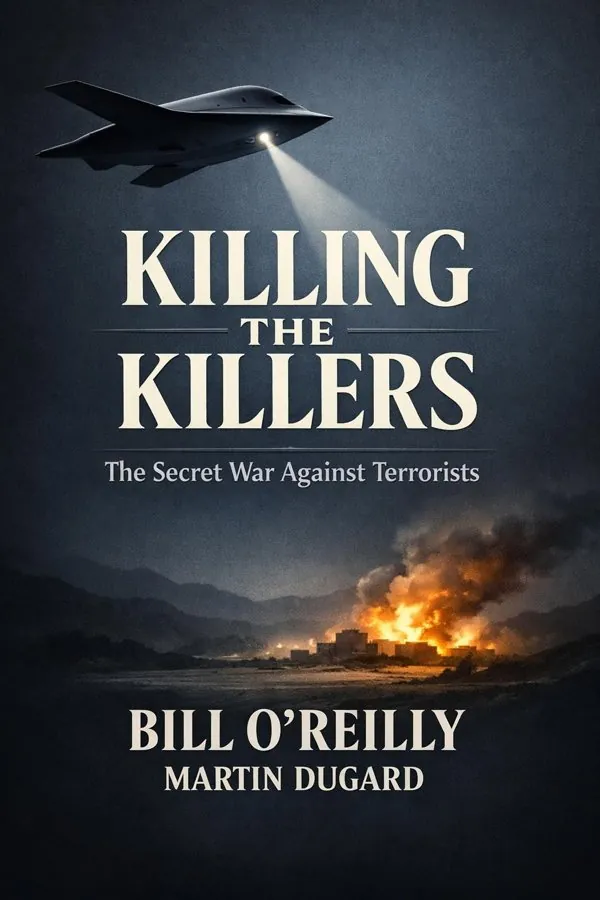
Killing the Killers: The Secret War Against Terrorists: Summary & Key Insights
by Bill O'Reilly, Martin Dugard
 10 min9 chaptersAudio available
Key Takeaways from Killing the Killers: The Secret War Against Terrorists
History can change in a morning, and when it does, every nation must decide how it will respond.
Some enemies are dangerous not only because of what they do, but because of what they symbolize.
Power in modern conflict often belongs to the side that can move quietly, decide quickly, and strike precisely.
Technology can extend power, but it cannot eliminate moral responsibility.
Chaos creates opportunity, and few movements exploited chaos more effectively than ISIS.
What Is Killing the Killers: The Secret War Against Terrorists About?
Killing the Killers: The Secret War Against Terrorists by Bill O'Reilly, Martin Dugard is a war_military book spanning 6 pages. Killing the Killers: The Secret War Against Terrorists is a fast-paced work of narrative nonfiction that traces the hidden campaign waged by the United States and its allies against jihadist terrorism after September 11, 2001. Bill O'Reilly and Martin Dugard move from the shock of 9/11 to the pursuit of Osama bin Laden, the rise of ISIS, drone strikes, intelligence breakthroughs, and the special operations missions that reshaped modern warfare. Rather than presenting the conflict as a simple series of battlefield victories, the book shows it as a long, morally difficult struggle fought through surveillance, covert action, presidential judgment, and split-second military execution. What makes the book matter is its focus on how contemporary war actually works: not through formal declarations and front lines, but through intelligence networks, targeted raids, and decisions made in secrecy with global consequences. O'Reilly, a bestselling popular historian and journalist, and Dugard, an accomplished narrative historian, bring these events to life with urgency and accessibility. The result is an engaging account of how democracies confront enemies who hide in shadows, exploit ideology, and adapt faster than traditional institutions expect.
This FizzRead summary covers all 9 key chapters of Killing the Killers: The Secret War Against Terrorists in approximately 10 minutes, distilling the most important ideas, arguments, and takeaways from Bill O'Reilly, Martin Dugard's work. Also available as an audio summary and Key Quotes Podcast.
Killing the Killers: The Secret War Against Terrorists
Killing the Killers: The Secret War Against Terrorists is a fast-paced work of narrative nonfiction that traces the hidden campaign waged by the United States and its allies against jihadist terrorism after September 11, 2001. Bill O'Reilly and Martin Dugard move from the shock of 9/11 to the pursuit of Osama bin Laden, the rise of ISIS, drone strikes, intelligence breakthroughs, and the special operations missions that reshaped modern warfare. Rather than presenting the conflict as a simple series of battlefield victories, the book shows it as a long, morally difficult struggle fought through surveillance, covert action, presidential judgment, and split-second military execution.
What makes the book matter is its focus on how contemporary war actually works: not through formal declarations and front lines, but through intelligence networks, targeted raids, and decisions made in secrecy with global consequences. O'Reilly, a bestselling popular historian and journalist, and Dugard, an accomplished narrative historian, bring these events to life with urgency and accessibility. The result is an engaging account of how democracies confront enemies who hide in shadows, exploit ideology, and adapt faster than traditional institutions expect.
Who Should Read Killing the Killers: The Secret War Against Terrorists?
This book is perfect for anyone interested in war_military and looking to gain actionable insights in a short read. Whether you're a student, professional, or lifelong learner, the key ideas from Killing the Killers: The Secret War Against Terrorists by Bill O'Reilly, Martin Dugard will help you think differently.
- ✓Readers who enjoy war_military and want practical takeaways
- ✓Professionals looking to apply new ideas to their work and life
- ✓Anyone who wants the core insights of Killing the Killers: The Secret War Against Terrorists in just 10 minutes
Want the full summary?
Get instant access to this book summary and 100K+ more with Fizz Moment.
Get Free SummaryAvailable on App Store • Free to download
Key Chapters
History can change in a morning, and when it does, every nation must decide how it will respond. Killing the Killers begins with the September 11 attacks, not simply as a tragedy, but as the moment the United States realized it was facing an enemy unlike any it had fought before. Nineteen hijackers armed with ideology, training, and patience inflicted mass civilian casualties on American soil and exposed the limits of conventional defense systems. The old frameworks of deterrence, borders, and battlefield engagement no longer seemed sufficient.
The book shows how 9/11 triggered the birth of the global war on terror, a campaign defined by speed, intelligence-sharing, covert missions, and international reach. Instead of fighting a traditional army, America pursued decentralized networks spread across Afghanistan, Pakistan, Iraq, Syria, and beyond. This required a shift in strategy: military force had to be combined with surveillance, financial tracking, alliance-building, and the ability to strike quickly against hidden targets.
A practical lesson emerges for readers in any field: when the threat changes shape, old systems must adapt. Governments, companies, and individuals often fail when they respond to new problems with outdated assumptions. The attacks revealed the cost of underestimating a determined, asymmetric opponent.
The book also highlights how fear, urgency, and public pressure influenced policy in those early years. Leaders had to make decisions without perfect information, balancing security with law, speed with accuracy, and force with legitimacy.
Actionable takeaway: when confronting a new kind of risk, start by redefining the problem clearly. Do not assume yesterday's methods can solve today's threat.
Some enemies are dangerous not only because of what they do, but because of what they symbolize. Osama bin Laden became the central target of the post-9/11 campaign because he was both the operational leader of al-Qaeda and the living embodiment of anti-American jihad. In Killing the Killers, O'Reilly and Dugard describe the years-long effort to track him down as a study in persistence, patience, and the accumulation of tiny clues.
The search was not a dramatic straight line. It involved dead ends, intercepted messages, informants, courier tracking, intelligence disagreements, and political pressure. The book emphasizes that bin Laden did not simply vanish; he survived because he understood secrecy, compartmentalization, and trust. The breakthrough came not from a single spectacular discovery but from disciplined analysis of the network around him, especially the role of trusted couriers who linked him to the outside world.
This narrative offers a broader lesson in problem-solving. Big breakthroughs often come from sustained attention to small patterns. Investigators did not find bin Laden by waiting for luck; they created the conditions for luck by collecting details, reexamining assumptions, and following weak signals others might dismiss.
The final raid on Abbottabad becomes more than a military success. It represents the payoff of integrating intelligence work with operational excellence. Analysts, surveillance teams, military planners, and political leaders all had to align for the mission to succeed.
Actionable takeaway: when pursuing a difficult objective, focus on the network around the problem, not only the problem itself. Patterns at the edges often reveal what the center is hiding.
Power in modern conflict often belongs to the side that can move quietly, decide quickly, and strike precisely. One of the book's most important themes is the growing centrality of elite military units and covert operators in the war against terrorism. From Navy SEALs to Delta Force and CIA paramilitary teams, the campaign against terrorist leaders depended less on mass troop formations and more on highly trained professionals executing narrowly defined missions with extraordinary discipline.
Killing the Killers presents these operators not as action-movie caricatures but as the tip of a massive institutional spear. Behind every raid stood months of planning, intelligence fusion, aircraft coordination, contingency mapping, and legal review. The visible operation might last minutes, but its success depended on invisible preparation. This is an important corrective to simplistic ideas about military heroism. Courage matters, but so do systems, rehearsal, logistics, and trust.
The book also shows why special operations became so influential. Terrorist groups dispersed their leadership, embedded in civilian areas, and avoided conventional combat. Large invasions could disrupt them, but precision missions were often more effective at removing key figures without creating broader escalation.
Readers can apply this principle beyond warfare. In business, medicine, law enforcement, and crisis response, small expert teams can outperform larger bureaucracies when the mission is specific, time-sensitive, and high stakes. But expertise only works when paired with preparation.
Actionable takeaway: build elite capability for your highest-risk tasks. Do not rely on general capacity alone when success depends on precision, speed, and trust under pressure.
Technology can extend power, but it cannot eliminate moral responsibility. The book's treatment of drone warfare captures one of the defining tensions of the post-9/11 era: the ability to strike terrorist targets remotely with unprecedented precision, while still confronting serious ethical, legal, and strategic questions. Drones made it possible to monitor suspects for long periods, confirm patterns of behavior, and launch attacks without risking American pilots or deploying ground troops. In purely tactical terms, they were revolutionary.
Yet Killing the Killers does not present targeted killing as a clean or uncomplicated solution. Remote strikes reduce danger for one side, but they also raise concerns about civilian casualties, intelligence errors, sovereignty, accountability, and the psychological distance between decision-maker and battlefield. A strike can remove a dangerous leader and still produce unintended consequences if the wrong person is identified or if local populations interpret the attack as unjust.
This is one of the book's most valuable insights: superior tools do not remove the need for superior judgment. Every advance in capability must be matched by stronger standards of verification, oversight, and strategic clarity. If technology makes action easier, it also makes restraint more important.
The same lesson applies outside military contexts. In finance, medicine, AI, or law enforcement, tools that increase speed and reach also magnify the cost of error. Efficiency is not the same as wisdom.
Actionable takeaway: whenever a tool gives you more power at lower immediate risk, slow down and strengthen your decision process. The easier action becomes, the more carefully consequences must be considered.
Chaos creates opportunity, and few movements exploited chaos more effectively than ISIS. In the book, the emergence of the Islamic State illustrates how terrorist organizations evolve when state authority collapses, sectarian conflict deepens, and propaganda meets ambition. ISIS was not merely another militant group. It fused terrorism, territorial control, digital recruitment, apocalyptic ideology, and theatrical brutality into a model that shocked the world. It recruited globally, governed locally, and marketed violence as both spectacle and mission.
O'Reilly and Dugard show how ISIS expanded rapidly across Iraq and Syria by exploiting political failures, weak institutions, and regional instability. It understood that modern insurgency is fought not just with rifles and bombs, but with videos, symbols, and stories. By projecting strength online, it attracted recruits far beyond the Middle East and inspired attacks by people who had never visited its territory.
Its eventual collapse also offers an important lesson. Even brutal and fast-rising movements can be rolled back when sustained military pressure, local partnerships, intelligence work, and leadership decapitation operate together. Territory can be retaken, revenue streams disrupted, and command structures broken. Still, the ideology does not disappear as quickly as the map changes.
For readers, this chapter highlights the danger of ignoring institutional breakdown. Extremism often thrives where legitimacy, security, and opportunity are absent. Preventing future threats requires more than killing leaders; it requires reducing the conditions in which movements like ISIS can grow.
Actionable takeaway: when analyzing any dangerous movement, study the vacuum that enabled it. Defeating a threat requires attacking both the organization and the environment that sustains it.
Wars are no longer fought only where soldiers stand; they are fought where information travels. A major theme in Killing the Killers is that modern counterterrorism depends on technology as much as firepower. Satellites, intercepted communications, biometric databases, surveillance platforms, cyber tools, and pattern analysis all help governments identify networks that would otherwise remain invisible. In this world, intelligence is not a supporting function. It is often the battlefield itself.
The book demonstrates how the secret war relied on connecting fragments: a phone number, a courier route, a financial transaction, a facial image, a digital message, a suspicious travel pattern. Individually, these details meant little. Combined, they created actionable insight. This is one reason terrorist groups continually adapted by limiting electronic communication, using couriers, and exploiting ungoverned spaces. They understood that data could kill.
But technological advantage has limits. Information overload can mislead just as easily as ignorance. More data does not automatically produce better decisions; it can create false confidence, bureaucratic paralysis, or missed signals buried in noise. The real skill lies in interpretation, prioritization, and the ability to convert information into timely action.
This applies directly to modern life. Organizations today collect enormous amounts of data, yet many still struggle to make sound decisions. The lesson is simple: the value of information depends on disciplined analysis and clear objectives.
Actionable takeaway: do not confuse access to data with understanding. Build systems that turn information into decisions, and decisions into coordinated action.
Leadership is tested most severely when every available option carries real cost. One of the book's strongest through-lines is the burden placed on American presidents during the secret war against terrorism. Whether authorizing raids, approving drone strikes, expanding surveillance, or weighing the political consequences of action versus inaction, presidents had to make choices in conditions of uncertainty where lives, law, and national credibility were all at stake.
Killing the Killers portrays these decisions as deeply consequential and often lonely. Intelligence is never perfect. Advisers disagree. Military success can produce diplomatic fallout. Delay can preserve caution or enable catastrophe. A president may be judged for acting too aggressively or for not acting quickly enough, sometimes by the same critics. The raid that killed bin Laden is the clearest example: if it had failed, the political and strategic damage would have been immense.
What makes this theme meaningful is that it reframes leadership away from slogans and toward responsibility. Good leadership is not about appearing decisive at all times. It is about knowing when to trust experts, when to challenge assumptions, and when to accept the irreducible uncertainty that accompanies high-stakes choices.
Readers can use this lesson in any leadership role. Decisions under pressure should not be romanticized. They require preparation, dissent, contingency planning, and the willingness to own consequences.
Actionable takeaway: when a decision carries serious risk, create a process that surfaces disagreement, clarifies assumptions, and defines the consequences of both action and inaction before you choose.
The most important battle is often the one the public never sees. Across the book, intelligence agencies and analysts play a central role in dismantling terrorist plots, locating leaders, and enabling military missions. Counterterrorism success depends on quietly understanding people, places, routines, finances, communications, ideology, and relationships long before a raid or strike occurs. Without intelligence, force becomes guesswork.
O'Reilly and Dugard show that the secret war was sustained by painstaking, often unglamorous labor: translating intercepts, building source networks, vetting claims, cross-checking reports, and resisting the temptation to act on weak evidence. Human intelligence and technical intelligence each had strengths and limitations. Informants could lie or misunderstand. Signals intelligence could reveal patterns but not always intent. Only by combining methods could agencies gain confidence in their assessments.
This insight matters because it underscores a broader truth: prevention is usually invisible. When intelligence works, the public may never know what was stopped. That can make it difficult to appreciate the value of patient analysis compared with dramatic visible action. Yet the most effective counterterrorism strategy is often the one that prevents an attack entirely.
In everyday contexts, this resembles preparation, due diligence, and early-warning systems. Whether you are managing a project, investing, or protecting an organization, careful background work can prevent expensive mistakes later.
Actionable takeaway: invest more in early detection than late reaction. The best crisis response often happens before the crisis fully forms.
Killing one leader can change history, but it rarely ends the struggle. One of the book's most sobering conclusions is that the war against terrorism does not produce neat, permanent victories. Terrorist networks fragment, regenerate, rebrand, and migrate. A commander may die, a caliphate may collapse, a camp may be destroyed, yet the ideology, grievances, and recruitment channels can survive. Tactical victories are real, but finality is elusive.
This is why the book resists triumphalism. The deaths of bin Laden and other high-value targets mattered enormously. They disrupted operations, damaged morale, and demonstrated reach. But the broader conflict continued because terrorism is not only an organization problem; it is also a systems problem. It feeds on instability, narrative, propaganda, local conflict, and digital connection. That means success must be measured not just by enemies eliminated, but by attacks prevented, alliances maintained, institutions strengthened, and successor threats contained.
There is a practical wisdom here for readers: many hard problems are recurring rather than solvable once and for all. Cybersecurity, public health, fraud prevention, and organizational culture all require ongoing vigilance. You do not "win" one time and stop paying attention.
The book ultimately suggests that realism is more useful than certainty. Democracies must be prepared for long contests against adaptive threats, while avoiding the illusion that one operation, one law, or one technology will settle the matter forever.
Actionable takeaway: treat complex threats as enduring management challenges, not one-time battles. Build resilience, review your assumptions regularly, and prepare for adaptation on both sides.
All Chapters in Killing the Killers: The Secret War Against Terrorists
About the Authors
Bill O'Reilly is an American journalist, television host, political commentator, and bestselling author best known for his enormously popular 'Killing' series, which brings major historical events and figures to a broad readership through dramatic nonfiction storytelling. Before becoming an author, he built a high-profile media career in broadcast journalism and commentary. Martin Dugard is a respected nonfiction writer and historian known for narrative history, adventure writing, and collaborative historical works. As O'Reilly's longtime co-author, Dugard has helped craft a series of commercially successful books that combine research, pace, and accessibility. Together, they specialize in turning complex historical and political subjects into vivid, fast-moving accounts for general audiences, including their examination of the post-9/11 campaign in Killing the Killers.
Get This Summary in Your Preferred Format
Read or listen to the Killing the Killers: The Secret War Against Terrorists summary by Bill O'Reilly, Martin Dugard anytime, anywhere. FizzRead offers multiple formats so you can learn on your terms — all free.
Available formats: App · Audio · PDF · EPUB — All included free with FizzRead
Download Killing the Killers: The Secret War Against Terrorists PDF and EPUB Summary
Key Quotes from Killing the Killers: The Secret War Against Terrorists
“History can change in a morning, and when it does, every nation must decide how it will respond.”
“Some enemies are dangerous not only because of what they do, but because of what they symbolize.”
“Power in modern conflict often belongs to the side that can move quietly, decide quickly, and strike precisely.”
“Technology can extend power, but it cannot eliminate moral responsibility.”
“Chaos creates opportunity, and few movements exploited chaos more effectively than ISIS.”
Frequently Asked Questions about Killing the Killers: The Secret War Against Terrorists
Killing the Killers: The Secret War Against Terrorists by Bill O'Reilly, Martin Dugard is a war_military book that explores key ideas across 9 chapters. Killing the Killers: The Secret War Against Terrorists is a fast-paced work of narrative nonfiction that traces the hidden campaign waged by the United States and its allies against jihadist terrorism after September 11, 2001. Bill O'Reilly and Martin Dugard move from the shock of 9/11 to the pursuit of Osama bin Laden, the rise of ISIS, drone strikes, intelligence breakthroughs, and the special operations missions that reshaped modern warfare. Rather than presenting the conflict as a simple series of battlefield victories, the book shows it as a long, morally difficult struggle fought through surveillance, covert action, presidential judgment, and split-second military execution. What makes the book matter is its focus on how contemporary war actually works: not through formal declarations and front lines, but through intelligence networks, targeted raids, and decisions made in secrecy with global consequences. O'Reilly, a bestselling popular historian and journalist, and Dugard, an accomplished narrative historian, bring these events to life with urgency and accessibility. The result is an engaging account of how democracies confront enemies who hide in shadows, exploit ideology, and adapt faster than traditional institutions expect.
More by Bill O'Reilly, Martin Dugard
You Might Also Like
Patriot
Andrew Britton
10 min
War
John Hersey
10 min
An Army at Dawn: The War in North Africa, 1942–1943
Rick Atkinson
10 min
Brave New War: The Next Stage of Terrorism and the End of Globalization
John Robb
10 min
Catch-22
Joseph Heller
10 min
Command and Control: Nuclear Weapons, the Damascus Accident, and the Illusion of Safety
Eric Schlosser
10 minBrowse by Category
Ready to read Killing the Killers: The Secret War Against Terrorists?
Get the full summary and 100K+ more books with Fizz Moment.