
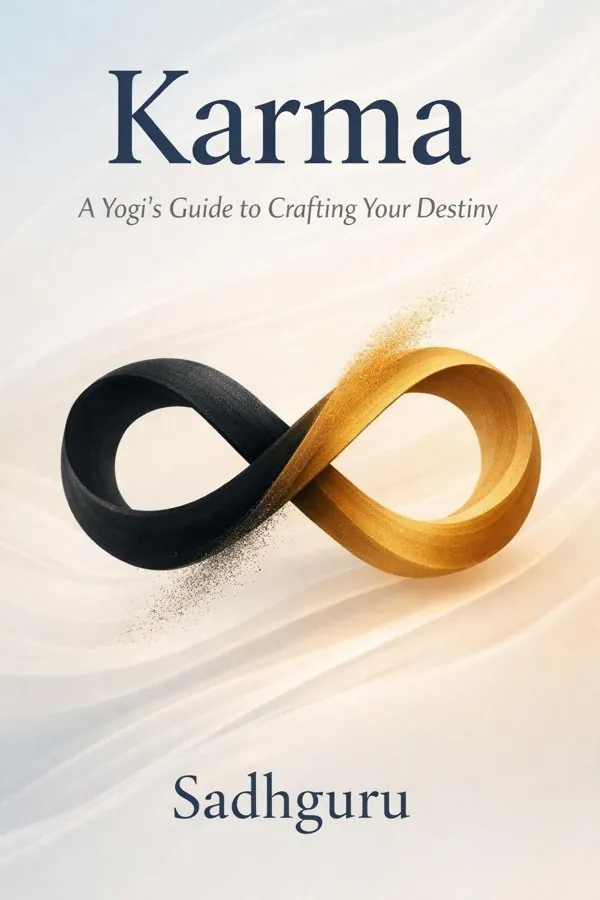
Karma: A Yogi's Guide to Crafting Your Destiny: Summary & Key Insights
by Sadhguru
 10 min7 chaptersAudio available
What Is Karma: A Yogi's Guide to Crafting Your Destiny About?
Karma: A Yogi's Guide to Crafting Your Destiny by Sadhguru is a eastern_wisdom book spanning 7 pages. In this book, Sadhguru explores the concept of karma not as a system of reward and punishment but as a mechanism of action and consequence that shapes human experience. He explains how understanding and mastering one’s karma can lead to freedom and conscious living, offering practical insights for transforming life through awareness and responsibility.
This FizzRead summary covers all 7 key chapters of Karma: A Yogi's Guide to Crafting Your Destiny in approximately 10 minutes, distilling the most important ideas, arguments, and takeaways from Sadhguru's work. Also available as an audio summary and Key Quotes Podcast.
Karma: A Yogi's Guide to Crafting Your Destiny
In this book, Sadhguru explores the concept of karma not as a system of reward and punishment but as a mechanism of action and consequence that shapes human experience. He explains how understanding and mastering one’s karma can lead to freedom and conscious living, offering practical insights for transforming life through awareness and responsibility.
Who Should Read Karma: A Yogi's Guide to Crafting Your Destiny?
This book is perfect for anyone interested in eastern_wisdom and looking to gain actionable insights in a short read. Whether you're a student, professional, or lifelong learner, the key ideas from Karma: A Yogi's Guide to Crafting Your Destiny by Sadhguru will help you think differently.
- ✓Readers who enjoy eastern_wisdom and want practical takeaways
- ✓Professionals looking to apply new ideas to their work and life
- ✓Anyone who wants the core insights of Karma: A Yogi's Guide to Crafting Your Destiny in just 10 minutes
Want the full summary?
Get instant access to this book summary and 100K+ more with Fizz Moment.
Get Free SummaryAvailable on App Store • Free to download
Key Chapters
To begin dismantling misconceptions, I invite you to see karma as a process, not a punishment. In the yogic view, karma literally means ‘action,’ but this action encompasses more than what you do with your body. Every thought you entertain, every emotion you generate, every intention you hold—they are all actions of subtle dimensions. Each leaves an imprint on your energy system, just as footprints remain on wet sand. These imprints, in turn, shape the trajectory of your future experiences.
The popular notion that karma comes from some invisible celestial accountant judging your moral worthiness is not only inaccurate—it weakens you. It disconnects you from your own agency. Karma is not moral law but natural law, akin to gravity. If you understand gravity, you can use it to your advantage; if you ignore it, you might fall off a cliff. Similarly, when you become conscious of karma, you begin to align with the very principles that underlie the unfolding of life.
Our culture often treats karma as a justification for complacency—'It is my karma,' people say when life is painful, as though the story is already written. But karma is not fate. It is memory in action, not prophecy. Just as a computer runs on stored data, so too your system runs on karmic memory accumulated through lifetimes. Yet you are not that data. The yogic path exists precisely to free you from the compulsions memory imposes.
Understanding karma as the mechanics of action also means realizing that every moment is fertile ground for transformation. You are not condemned by what you have done, because karma responds to awareness. The moment you act consciously rather than compulsively, new possibilities open. Life becomes pliable again. This is why in yoga, we emphasize awareness—not morality, not repentance, but the vibrant precision of consciousness that makes every action lucid and complete in itself.
Most human beings live reactively. They are constantly responding to life’s stimuli out of habit, not choice. In this state of mechanical living, karmic patterns run the show. The true function of yoga is to bring your unconscious into consciousness, for only then can you stop manufacturing karma unconsciously.
Think of your mind as a storehouse of impressions. Every reaction, every emotional entanglement adds another layer to your karmic archive. When you act without awareness, these layers pile up, shaping your perception of reality. Over time, perception becomes projection—you don’t see life as it is, but only as your karma allows you to. Liberation means piercing through this conditioning so you can respond to each moment afresh.
So how do you shift from unconscious to conscious creation? The first step is to observe yourself. Not in judgment, but in clarity. Watch how your body moves, how your mind thinks, how your emotions surge. This witnessing brings distance between you and your tendencies. When you are identified with the thought, you are lost in karma; when you see the thought, a space opens. In that space, freedom begins.
In yogic terminology, this transition is the journey from compulsiveness to consciousness. Compulsive action keeps generating karma; conscious action dissolves it. For example, imagine you are angry. Reaction means shouting, hurting, creating waves of new karma tied to anger. Consciousness means recognizing anger as energy—then choosing how to use it. In that moment, you cease to be a slave of karma and become its master.
As you begin to live with heightened awareness, even your simplest activities—walking, talking, eating—become opportunities for liberation. Life is no longer an endless repetition but a creative act performed consciously. The more conscious you are, the less residue each action leaves behind. Eventually, you arrive at what we call a karma-free state—not because you have stopped living, but because your living has become total, unbinding, and complete in every breath.
+ 5 more chapters — available in the FizzRead app
All Chapters in Karma: A Yogi's Guide to Crafting Your Destiny
About the Author
Get This Summary in Your Preferred Format
Read or listen to the Karma: A Yogi's Guide to Crafting Your Destiny summary by Sadhguru anytime, anywhere. FizzRead offers multiple formats so you can learn on your terms — all free.
Available formats: App · Audio · PDF · EPUB — All included free with FizzRead
Download Karma: A Yogi's Guide to Crafting Your Destiny PDF and EPUB Summary
Key Quotes from Karma: A Yogi's Guide to Crafting Your Destiny
“To begin dismantling misconceptions, I invite you to see karma as a process, not a punishment.”
“They are constantly responding to life’s stimuli out of habit, not choice.”
Frequently Asked Questions about Karma: A Yogi's Guide to Crafting Your Destiny
Karma: A Yogi's Guide to Crafting Your Destiny by Sadhguru is a eastern_wisdom book that explores key ideas across 7 chapters. In this book, Sadhguru explores the concept of karma not as a system of reward and punishment but as a mechanism of action and consequence that shapes human experience. He explains how understanding and mastering one’s karma can lead to freedom and conscious living, offering practical insights for transforming life through awareness and responsibility.
More by Sadhguru
You Might Also Like
A New Earth
Eckhart Tolle
10 min
The Daily Stoic
Ryan Holiday, Stephen Hanselman
10 min
Buddhism: Plain and Simple
Steve Hagen
10 min
Enchiridion
Epictetus
10 min
The Book of Tea
Kakuzō Okakura
10 min
The Light We Give: How Sikh Wisdom Can Transform Your Life
Simran Jeet Singh
10 minBrowse by Category
Ready to read Karma: A Yogi's Guide to Crafting Your Destiny?
Get the full summary and 100K+ more books with Fizz Moment.