
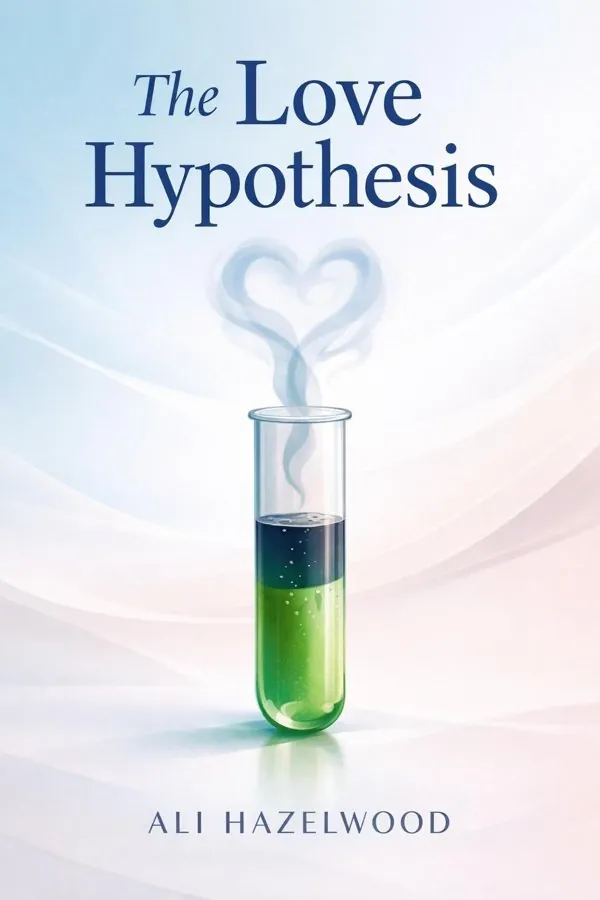
The Love Hypothesis: Summary & Key Insights
 10 min9 chaptersAudio available
Key Takeaways from The Love Hypothesis
People often distrust love not because they are cold, but because they have seen how fragile relationships can be under pressure.
Pretending to be close to someone can expose truths that genuine dating sometimes hides.
Love stories do not happen in a vacuum; they unfold inside systems that affect how people think, feel, and behave.
The people who seem most intimidating are often those we understand the least.
Falling for someone is often easier than admitting how much power they have to hurt you.
What Is The Love Hypothesis About?
The Love Hypothesis by Ali Hazelwood is a romance book published in 2021 spanning 5 pages. What happens when a relationship begins as a carefully staged experiment and ends up testing everything its participants thought they knew about trust, ambition, and love? Ali Hazelwood’s The Love Hypothesis is a smart, funny, emotionally satisfying romance set in the high-pressure world of academic science. The novel follows Olive Smith, a Stanford Ph.D. candidate who believes lasting relationships are largely a myth, and Adam Carlsen, a feared young professor with a formidable reputation. After an impulsive kiss sparks a fake-dating arrangement, their staged romance slowly evolves into something far more complicated and real. What makes the book resonate is not just its chemistry-filled love story, but its sharp understanding of insecurity, professional pressure, and the emotional cost of always trying to appear competent. Hazelwood brings unusual authority to this setting: as a scientist herself, she captures the rhythms of labs, conferences, funding anxieties, and gender dynamics in STEM with authenticity and wit. The result is a contemporary romantic comedy that feels both escapist and grounded. Beneath the banter and tension, The Love Hypothesis asks a surprisingly serious question: can even the most rational people learn to trust what they feel?
This FizzRead summary covers all 9 key chapters of The Love Hypothesis in approximately 10 minutes, distilling the most important ideas, arguments, and takeaways from Ali Hazelwood's work. Also available as an audio summary and Key Quotes Podcast.
The Love Hypothesis
What happens when a relationship begins as a carefully staged experiment and ends up testing everything its participants thought they knew about trust, ambition, and love? Ali Hazelwood’s The Love Hypothesis is a smart, funny, emotionally satisfying romance set in the high-pressure world of academic science. The novel follows Olive Smith, a Stanford Ph.D. candidate who believes lasting relationships are largely a myth, and Adam Carlsen, a feared young professor with a formidable reputation. After an impulsive kiss sparks a fake-dating arrangement, their staged romance slowly evolves into something far more complicated and real.
What makes the book resonate is not just its chemistry-filled love story, but its sharp understanding of insecurity, professional pressure, and the emotional cost of always trying to appear competent. Hazelwood brings unusual authority to this setting: as a scientist herself, she captures the rhythms of labs, conferences, funding anxieties, and gender dynamics in STEM with authenticity and wit. The result is a contemporary romantic comedy that feels both escapist and grounded. Beneath the banter and tension, The Love Hypothesis asks a surprisingly serious question: can even the most rational people learn to trust what they feel?
Who Should Read The Love Hypothesis?
This book is perfect for anyone interested in romance and looking to gain actionable insights in a short read. Whether you're a student, professional, or lifelong learner, the key ideas from The Love Hypothesis by Ali Hazelwood will help you think differently.
- ✓Readers who enjoy romance and want practical takeaways
- ✓Professionals looking to apply new ideas to their work and life
- ✓Anyone who wants the core insights of The Love Hypothesis in just 10 minutes
Want the full summary?
Get instant access to this book summary and 100K+ more with Fizz Moment.
Get Free SummaryAvailable on App Store • Free to download
Key Chapters
People often distrust love not because they are cold, but because they have seen how fragile relationships can be under pressure. Olive Smith begins the novel as a third-year Ph.D. student who has built her life around evidence, logic, and survival. In her world, academic schedules are punishing, careers are uncertain, and emotional stability can feel like a luxury. She does not reject romance out of cynicism alone; she rejects it because she believes it is impractical, unreliable, and likely to collapse when tested by reality.
That skepticism shapes the entire setup of the story. When Olive impulsively kisses Adam Carlsen to convince her best friend Anh that she has moved on and is happily dating, the moment is absurd, but it reveals something deeper. Olive would rather construct a believable narrative than face emotional complication directly. Her fake relationship begins as a defense mechanism, a way to manage another person’s perception while keeping herself emotionally protected.
This idea is highly relatable beyond romance. Many people treat vulnerability the same way Olive does: they create controlled situations, offer partial truths, or hide behind competence to avoid uncertainty. In careers, friendships, and family life, the urge to manage appearances can feel safer than genuine openness. But as the novel shows, emotional self-protection can also prevent real connection.
Olive’s early choices remind readers that our beliefs about love are often shaped by fear disguised as rationality. Her "hypothesis" is that love is unstable and not worth depending on. The story challenges that assumption by placing her in a situation she cannot fully control.
Actionable takeaway: Notice where you may be using logic or busyness to avoid vulnerability, and ask whether your conclusions are based on evidence—or on fear.
Pretending to be close to someone can expose truths that genuine dating sometimes hides. Once Olive and Adam agree to maintain the appearance of a relationship, they establish practical rules: public coffee dates, occasional displays of affection, and clear boundaries around Olive’s student status and Adam’s role as faculty. On paper, the arrangement seems manageable. It is meant to solve a social problem, not create emotional risk.
Yet fake dating works so well in romance because performance has a strange way of becoming practice. As Olive and Adam spend time together, they begin observing one another in situations that reveal character rather than image. Olive sees that Adam’s intimidating reputation hides a man who is attentive, ethical, and quietly generous. Adam, in turn, sees Olive’s intelligence, humor, and loyalty beneath her anxious self-protectiveness. Their arrangement may be false, but the care they begin to show each other is not.
This is one of the novel’s central insights: repeated acts of consideration create emotional intimacy, regardless of how those acts were initially framed. In real life, relationships are often built not on dramatic declarations but on consistency—checking in after a hard day, remembering important details, showing up when needed, respecting boundaries, and offering support without spectacle.
The fake-dating device also highlights how people communicate indirectly when direct honesty feels too dangerous. Olive and Adam can express affection under the cover of pretending, which allows feelings to emerge before either is ready to name them. That dynamic mirrors many real interactions where people test emotional safety through small gestures before revealing deeper attachment.
Actionable takeaway: Pay attention to consistent care rather than labels alone; repeated kindness often tells you more about a relationship than grand statements ever could.
Love stories do not happen in a vacuum; they unfold inside systems that affect how people think, feel, and behave. One of The Love Hypothesis’s greatest strengths is its portrayal of academia as both intellectually exciting and emotionally exhausting. Olive is not simply navigating attraction. She is also dealing with research demands, professional uncertainty, power imbalances, and the low-level anxiety that comes from trying to build a future in a highly competitive field.
The novel captures how graduate students often live with constant evaluation. Funding, publication, mentorship, and reputation can all influence the direction of a career. Under those conditions, emotional decisions feel weightier. A bad relationship is not just personally painful; it can derail focus, confidence, and work. That context helps explain Olive’s caution. She is not merely afraid of love; she is afraid of losing control in an environment where control already feels limited.
Hazelwood also uses the academic setting to explore gendered challenges in STEM. Olive’s experiences reflect broader realities many women in science face: being underestimated, navigating inappropriate behavior, and wondering whether talent alone is enough in systems that are not always fair. This makes the romance more meaningful, because emotional support is not presented as a distraction from ambition. Instead, the right relationship strengthens resilience.
Outside academia, the lesson still applies. Stressful environments often make people shrink emotionally. Professionals in medicine, law, business, education, or caregiving may recognize the same pattern: when life feels high stakes, vulnerability can seem inefficient. But connection can be stabilizing rather than disruptive when it is grounded in respect.
Actionable takeaway: Consider how your environment shapes your emotional decisions, and seek relationships that support your goals instead of forcing you to choose between ambition and intimacy.
The people who seem most intimidating are often those we understand the least. At the start of the novel, Adam Carlsen is known across campus as a brilliant but terrifying professor: exacting, blunt, and nearly impossible to impress. To Olive and many others, his reputation appears settled. He is the kind of man students fear and colleagues respect from a distance. But as the story unfolds, Hazelwood dismantles the reliability of that public image.
Through Olive’s increasing proximity to Adam, readers see the gap between reputation and reality. Adam is reserved, not cruel. He is direct, not careless. He has high standards, but those standards are tied to integrity rather than ego. Most importantly, he treats Olive with a level of attentiveness that reveals patience, protectiveness, and emotional depth. What once looked like hostility begins to read as social awkwardness, self-containment, and selective investment.
This theme matters because people often rely on shorthand judgments to navigate social and professional worlds. A person is "difficult," "cold," "too ambitious," or "unapproachable," and the label becomes a substitute for curiosity. But those assumptions can distort reality and limit connection. In workplaces, schools, and communities, many misunderstandings persist because people are known by their performance style rather than their actual values.
The novel does not suggest that every intimidating person is secretly wonderful, nor that reputations never matter. Instead, it reminds readers that real understanding requires context. We learn who someone is through patterns of behavior, especially when no one is watching or when there is nothing obvious to gain.
Actionable takeaway: Before finalizing your judgment about someone, look for repeated evidence of their values, not just the social story that surrounds them.
Falling for someone is often easier than admitting how much power they have to hurt you. As Olive and Adam grow closer, the central conflict shifts from external appearances to internal exposure. Their chemistry is obvious, but chemistry alone is not the real obstacle. The challenge is whether Olive can trust that what she feels is returned, and whether Adam can communicate rather than quietly endure his own feelings.
This is where The Love Hypothesis becomes more than a light romantic comedy. It explores the emotional labor required to be honest when honesty could lead to rejection, embarrassment, or loss. Olive is intelligent and observant, yet she repeatedly misreads her own worth in Adam’s eyes. Her insecurity is not irrational; it is rooted in a familiar human fear that admiration must be earned and that deep affection is somehow improbable. Adam’s restraint, meanwhile, shows how people can protect others while inadvertently creating distance.
The novel suggests that vulnerability is not a mood but a decision. It requires naming needs, clarifying intentions, and risking a changed dynamic. In everyday life, many relationships stall because both people wait for certainty before speaking. They want guarantees before disclosure. But genuine intimacy usually begins where certainty ends.
A practical example can be found in any close connection: instead of assuming a friend knows you need support, you ask; instead of interpreting silence as disinterest, you seek clarification; instead of hiding behind irony or busyness, you say what matters plainly. Emotional courage rarely feels elegant, but it creates the conditions for trust.
Actionable takeaway: When a relationship matters, replace mind-reading and assumptions with one honest conversation that states what you feel, need, or fear.
Romance feels more believable when it exists alongside moral choices, not apart from them. A major thread in The Love Hypothesis concerns scientific integrity and personal ethics. Olive’s professional world is not simply stressful; it also contains unequal power, questionable behavior, and the possibility that important opportunities can be shaped by people who misuse authority. These pressures force her to confront what she is willing to tolerate in order to advance.
Hazelwood uses this storyline to show that attraction should never come at the expense of self-respect. Adam’s appeal is not just that he is handsome or devoted. It is that he consistently acts with principle. He respects Olive’s boundaries, values her intellect, and supports her career without trying to control it. In contrast, the novel presents how manipulation and misconduct can hide behind professional prestige. This contrast deepens the romance by making character—not charisma—the true basis of trust.
The insight applies broadly. In work and relationships alike, integrity is revealed in moments when someone could exploit an advantage but chooses not to. A supportive mentor gives honest feedback without humiliation. A partner celebrates your opportunities instead of competing with them. A colleague protects fairness even when it is inconvenient. These actions build safety, and safety is one of the least glamorous but most essential components of love.
The book also reminds readers that ambition and ethics do not have to conflict. Olive wants to succeed as a scientist, but not by surrendering her standards. Her journey suggests that healthy love reinforces ethical clarity rather than muddying it.
Actionable takeaway: Evaluate people not just by affection or talent, but by how they handle power, boundaries, and fairness when the stakes are real.
Sometimes the most life-changing thing another person offers is not rescue, but evidence that your own view of yourself is incomplete. Olive spends much of the novel moving through the world with competence on the outside and deep self-doubt underneath. She is capable and hardworking, yet she often minimizes her own desirability, influence, and potential. This internal gap affects how she interprets nearly everything, especially Adam’s behavior.
What makes their relationship compelling is that Adam does not "fix" Olive. Instead, he sees her clearly and responds accordingly. He takes her work seriously, notices her emotional states, and treats her as someone worthy of care without demanding that she become more polished, confident, or effortless first. That kind of steady regard begins to challenge Olive’s assumptions about herself.
This dynamic reflects an important truth: healthy relationships can expand self-perception. When someone consistently responds to your intelligence, humor, kindness, or ambition as if those qualities are obvious and valuable, it becomes harder to maintain narratives of inadequacy. This is true in romance, but also in mentorship, friendship, and family life. Supportive people do not flatter indiscriminately; they reflect your strengths back to you with specificity and reliability.
However, the novel also avoids suggesting that validation alone is enough. Olive still has to revise her own beliefs. External care can open the door, but internal acceptance must follow. Readers may recognize this in their own lives: praise often bounces off when it contradicts a long-held self-image. Growth requires letting new evidence matter.
Actionable takeaway: Take seriously the observations of people who know you well and treat you with respect; they may be seeing strengths you have trained yourself to overlook.
One of the most refreshing aspects of The Love Hypothesis is its refusal to frame romance and ambition as opposing forces. Olive is not waiting to be saved from her career, and Adam is not attracted to her despite her intelligence. Their connection develops in a context where research, conferences, experiments, and professional aspirations remain central. The love story works precisely because both characters understand what meaningful work demands.
This matters because many narratives still imply that emotional fulfillment requires one person—usually the woman—to soften, shrink, or reorder her priorities. Hazelwood pushes against that pattern. Olive’s scientific identity is not decorative background; it is integral to who she is. Adam’s respect for her includes respect for her work, her goals, and the seriousness with which she approaches her field. Their relationship becomes stronger not when Olive abandons ambition, but when she stops assuming that love and ambition cannot coexist.
In practical life, this is a crucial standard for healthy partnership. A good relationship should make room for deadlines, growth, stress, and aspiration without turning those realities into resentment. That might look like celebrating a partner’s promotion, understanding demanding seasons at work, discussing relocation honestly, or helping each other protect time for meaningful goals. Compatibility is not just shared hobbies or attraction; it is the ability to honor what matters deeply to each other.
The novel suggests that love becomes sustainable when it is built around mutual recognition rather than possession. To be loved well is not to be asked to become smaller. It is to be encouraged to become more fully yourself.
Actionable takeaway: Choose relationships in which your goals are respected in practice, not just admired in theory.
At its core, The Love Hypothesis argues that love is not best understood as a perfect feeling, but as a willingness to trust what repeated evidence reveals. Olive begins the story trying to make life manageable through reason. She wants clear variables, predictable outcomes, and emotional distance. But love does not arrive in a way that fits her preferred method. It emerges through accumulation: gestures, attention, reliability, and the gradual collapse of her mistaken assumptions.
The title points to the novel’s central metaphor. A hypothesis is a testable idea, something proposed before enough evidence exists to confirm it. Olive’s private hypothesis is that relationships are unstable and not worth full investment. The story runs that hypothesis through lived experience. Again and again, Adam’s behavior contradicts her expectations. He shows up. He pays attention. He protects her dignity. He takes her seriously. Eventually, the weight of the evidence becomes impossible to ignore.
This pattern mirrors emotional life more than many people admit. We all carry private theories about ourselves and others: I am too much, people leave, ambition makes intimacy impossible, vulnerability is dangerous, love never lasts. These theories feel factual because they have often been reinforced by pain. But they are still hypotheses, not immutable laws. Sometimes they need to be tested against new experiences rather than defended at all costs.
By the end of the novel, love is not presented as irrational at all. It is simply a form of knowing that requires attention to evidence beyond fear. Trust grows where care is consistent and mutual.
Actionable takeaway: Identify one limiting belief you hold about relationships and ask what current evidence actually supports—or disproves—it.
All Chapters in The Love Hypothesis
About the Author
Ali Hazelwood is a bestselling author known for contemporary romance novels that blend humor, emotional intensity, and life in STEM fields. Originally from Italy, she has worked in science and academia, including in neuroscience, and that background informs the laboratory settings, research culture, and professional tensions that appear throughout her fiction. Hazelwood became widely known for writing "STEMinist" rom-coms featuring intelligent, ambitious women navigating both career challenges and complicated love lives. Her breakout novel, The Love Hypothesis, earned a large international readership for its sharp banter, fake-dating premise, and authentic academic backdrop. Across her work, Hazelwood explores themes of ambition, vulnerability, self-worth, and the possibility of meaningful love within demanding professional worlds.
Get This Summary in Your Preferred Format
Read or listen to the The Love Hypothesis summary by Ali Hazelwood anytime, anywhere. FizzRead offers multiple formats so you can learn on your terms — all free.
Available formats: App · Audio · PDF · EPUB — All included free with FizzRead
Download The Love Hypothesis PDF and EPUB Summary
Key Quotes from The Love Hypothesis
“People often distrust love not because they are cold, but because they have seen how fragile relationships can be under pressure.”
“Pretending to be close to someone can expose truths that genuine dating sometimes hides.”
“Love stories do not happen in a vacuum; they unfold inside systems that affect how people think, feel, and behave.”
“The people who seem most intimidating are often those we understand the least.”
“Falling for someone is often easier than admitting how much power they have to hurt you.”
Frequently Asked Questions about The Love Hypothesis
The Love Hypothesis by Ali Hazelwood is a romance book that explores key ideas across 9 chapters. What happens when a relationship begins as a carefully staged experiment and ends up testing everything its participants thought they knew about trust, ambition, and love? Ali Hazelwood’s The Love Hypothesis is a smart, funny, emotionally satisfying romance set in the high-pressure world of academic science. The novel follows Olive Smith, a Stanford Ph.D. candidate who believes lasting relationships are largely a myth, and Adam Carlsen, a feared young professor with a formidable reputation. After an impulsive kiss sparks a fake-dating arrangement, their staged romance slowly evolves into something far more complicated and real. What makes the book resonate is not just its chemistry-filled love story, but its sharp understanding of insecurity, professional pressure, and the emotional cost of always trying to appear competent. Hazelwood brings unusual authority to this setting: as a scientist herself, she captures the rhythms of labs, conferences, funding anxieties, and gender dynamics in STEM with authenticity and wit. The result is a contemporary romantic comedy that feels both escapist and grounded. Beneath the banter and tension, The Love Hypothesis asks a surprisingly serious question: can even the most rational people learn to trust what they feel?
Compare The Love Hypothesis




You Might Also Like


Browse by Category
Ready to read The Love Hypothesis?
Get the full summary and 100K+ more books with Fizz Moment.