
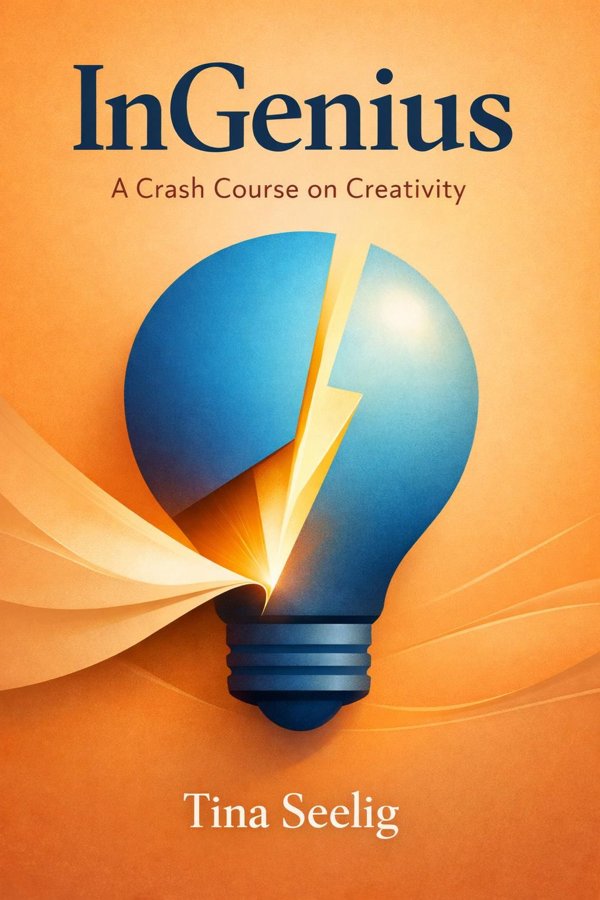
InGenius: A Crash Course on Creativity: Summary & Key Insights
by Tina Seelig
 10 min10 chaptersAudio available
What Is InGenius: A Crash Course on Creativity About?
InGenius: A Crash Course on Creativity by Tina Seelig is a creativity book spanning 10 pages. InGenius: A Crash Course on Creativity es un libro que explora cómo las personas pueden desarrollar y potenciar su creatividad en cualquier ámbito de la vida. Tina Seelig, profesora en la Universidad de Stanford, ofrece herramientas prácticas y ejemplos inspiradores para desbloquear el pensamiento innovador y convertir las ideas en acciones concretas. El texto combina teoría y ejercicios para ayudar a los lectores a comprender el proceso creativo y aplicarlo en su trabajo y proyectos personales.
This FizzRead summary covers all 10 key chapters of InGenius: A Crash Course on Creativity in approximately 10 minutes, distilling the most important ideas, arguments, and takeaways from Tina Seelig's work. Also available as an audio summary and Key Quotes Podcast.
InGenius: A Crash Course on Creativity
InGenius: A Crash Course on Creativity es un libro que explora cómo las personas pueden desarrollar y potenciar su creatividad en cualquier ámbito de la vida. Tina Seelig, profesora en la Universidad de Stanford, ofrece herramientas prácticas y ejemplos inspiradores para desbloquear el pensamiento innovador y convertir las ideas en acciones concretas. El texto combina teoría y ejercicios para ayudar a los lectores a comprender el proceso creativo y aplicarlo en su trabajo y proyectos personales.
Who Should Read InGenius: A Crash Course on Creativity?
This book is perfect for anyone interested in creativity and looking to gain actionable insights in a short read. Whether you're a student, professional, or lifelong learner, the key ideas from InGenius: A Crash Course on Creativity by Tina Seelig will help you think differently.
- ✓Readers who enjoy creativity and want practical takeaways
- ✓Professionals looking to apply new ideas to their work and life
- ✓Anyone who wants the core insights of InGenius: A Crash Course on Creativity in just 10 minutes
Want the full summary?
Get instant access to this book summary and 100K+ more with Fizz Moment.
Get Free SummaryAvailable on App Store • Free to download
Key Chapters
The heart of creativity lies in what I call the Innovation Engine—a dynamic model that captures six interconnected factors driving creative outcomes. Three of these elements are internal: knowledge, imagination, and attitude. The other three are external: resources, habitat, and culture. Together, they form a self-sustaining system where each component both fuels and is fueled by the others.
Knowledge provides the informational foundation—the library of facts, experiences, and observations that serve as the raw materials for new ideas. Imagination acts as a prism, refracting these materials into novel combinations. Attitude determines whether those combinations ever see the light of day, because without curiosity, confidence, and resilience, imagination remains confined inside. These inner elements interact continuously with the external ones. Resources represent the tools and materials we have access to. Habitat defines the physical and social environment—whether it encourages exploration or discourages risk. Culture, finally, encompasses the shared values and norms that create either fertile ground for creativity or barren terrain where innovation cannot take root.
When the Innovation Engine runs smoothly, imagination draws on knowledge, attitude pushes through barriers, and the external environment amplifies and refines what emerges. But when any part falters—say, when culture penalizes failure or habitat restricts experimentation—the flow breaks down. Understanding this interplay allows us to design conditions under which creativity thrives. The central insight is that creativity is not random; it’s structural. By deliberately cultivating each component, you can ignite a continuous cycle of innovation.
Every creative act begins with something known. This truth may sound paradoxical since creativity is so often associated with the new, but originality rarely emerges from emptiness; it rises from well-stocked minds. In teaching innovation, I emphasize that diverse experiences and broad knowledge act as the building blocks of imagination. The more extensive your exposure to ideas, disciplines, and cultures, the richer the palette from which you can paint.
Knowledge isn’t limited to academic learning—it includes sensory memories, emotional insights, and practical skills. A chef’s understanding of flavor chemistry can spark a business model for sustainable food innovation. A musician’s grasp of rhythm may translate into algorithms for data synchronization. The crossover between fields is where creativity truly ignites. The key, therefore, is curiosity—a continuous desire to learn not for the sake of information hoarding but for the joy of connecting concepts.
When you feed your Innovation Engine with new knowledge, you’re not merely accumulating facts—you’re expanding the realm of possibility. Each new idea becomes another potential link in the vast network of thought that underlies creative breakthroughs. The challenge is to actively seek variety: engage with art if you’re an engineer, study history if you’re a designer, converse with people whose perspectives differ from yours. This heterogeneity fuels the mind’s capacity to see connections others overlook. Knowledge is the creative foundation—it transforms the ordinary into extraordinary once imagination begins to play with the materials.
+ 8 more chapters — available in the FizzRead app
All Chapters in InGenius: A Crash Course on Creativity
About the Author
Tina Seelig es profesora de la Universidad de Stanford y directora ejecutiva del Stanford Technology Ventures Program. Es autora de varios libros sobre innovación y emprendimiento, y su trabajo se centra en enseñar creatividad, liderazgo y pensamiento empresarial a estudiantes y profesionales de todo el mundo.
Get This Summary in Your Preferred Format
Read or listen to the InGenius: A Crash Course on Creativity summary by Tina Seelig anytime, anywhere. FizzRead offers multiple formats so you can learn on your terms — all free.
Available formats: App · Audio · PDF · EPUB — All included free with FizzRead
Download InGenius: A Crash Course on Creativity PDF and EPUB Summary
Key Quotes from InGenius: A Crash Course on Creativity
“The heart of creativity lies in what I call the Innovation Engine—a dynamic model that captures six interconnected factors driving creative outcomes.”
“Every creative act begins with something known.”
Frequently Asked Questions about InGenius: A Crash Course on Creativity
InGenius: A Crash Course on Creativity by Tina Seelig is a creativity book that explores key ideas across 10 chapters. InGenius: A Crash Course on Creativity es un libro que explora cómo las personas pueden desarrollar y potenciar su creatividad en cualquier ámbito de la vida. Tina Seelig, profesora en la Universidad de Stanford, ofrece herramientas prácticas y ejemplos inspiradores para desbloquear el pensamiento innovador y convertir las ideas en acciones concretas. El texto combina teoría y ejercicios para ayudar a los lectores a comprender el proceso creativo y aplicarlo en su trabajo y proyectos personales.
More by Tina Seelig
You Might Also Like
Dimensions Of Creativity
Margaret A. Boden
10 min
How to Fly a Horse: The Secret History of Creation, Invention, and Discovery
Kevin Ashton
10 min
Imagine: How Creativity Works
Jonah Lehrer
10 min
The Accidental Creative: How to Be Brilliant at a Moment's Notice
Todd Henry
10 min
The Origins of Creativity
Edward O. Wilson
10 min
Wired to Create: Unraveling the Mysteries of the Creative Mind
Scott Barry Kaufman, Carolyn Gregoire
10 minBrowse by Category
Ready to read InGenius: A Crash Course on Creativity?
Get the full summary and 100K+ more books with Fizz Moment.