
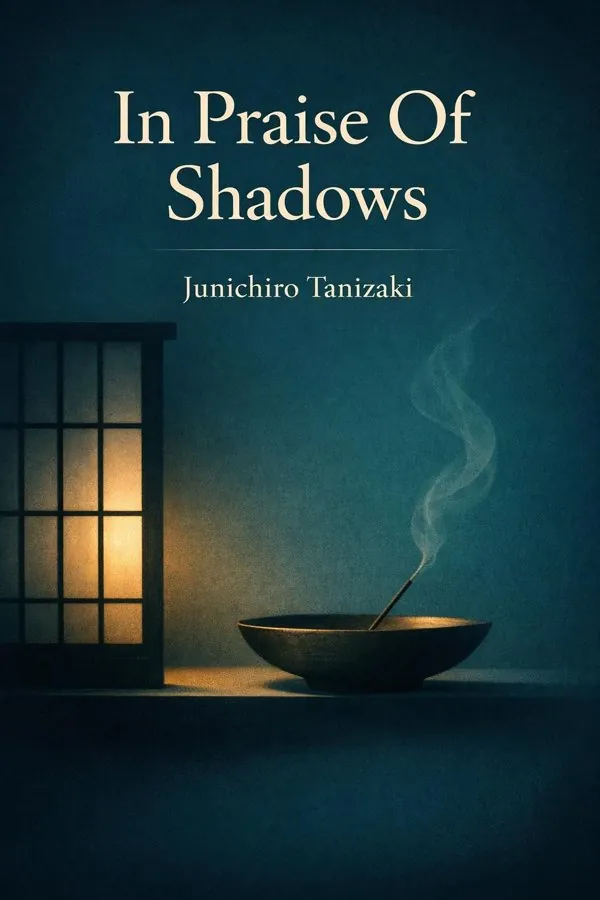
In Praise Of Shadows: Summary & Key Insights
 10 min9 chaptersAudio available
Key Takeaways from In Praise Of Shadows
Progress often seems unquestionably good until it destroys something too subtle to measure.
A room is never just a container for living; it silently teaches us how to feel.
What if the highest form of beauty is not gleam but depth?
One of Tanizaki’s most surprising insights is that even the toilet can be an aesthetic space.
Taste is never only on the tongue; it is shaped by atmosphere, vessel, and light.
What Is In Praise Of Shadows About?
In Praise Of Shadows by Junichiro Tanizaki is a eastern_wisdom book spanning 8 pages. In Praise Of Shadows is Junichiro Tanizaki’s luminous meditation on beauty, written paradoxically through an appreciation of dimness, silence, texture, and restraint. First published in 1933, this brief but influential essay reflects on what happens when a culture shaped by candlelight, paper screens, lacquerware, and wooden architecture encounters the brightness and efficiency of modern Western life. Tanizaki does not simply reject progress. Instead, he asks a deeper question: what kinds of beauty become invisible when everything is designed for clarity, speed, and illumination? Moving through homes, toilets, food, theater, writing, and everyday objects, he shows how traditional Japanese aesthetics value suggestion over display, patina over polish, and atmosphere over exposure. The essay matters because it offers more than nostalgia. It is a philosophy of perception, reminding us that environments shape consciousness and that subtlety is not a deficiency but a form of refinement. Tanizaki is uniquely qualified to make this argument: one of Japan’s greatest modern writers, he stood between tradition and modernization, observing with unusual sensitivity what was being gained and what was being lost.
This FizzRead summary covers all 9 key chapters of In Praise Of Shadows in approximately 10 minutes, distilling the most important ideas, arguments, and takeaways from Junichiro Tanizaki's work. Also available as an audio summary and Key Quotes Podcast.
In Praise Of Shadows
In Praise Of Shadows is Junichiro Tanizaki’s luminous meditation on beauty, written paradoxically through an appreciation of dimness, silence, texture, and restraint. First published in 1933, this brief but influential essay reflects on what happens when a culture shaped by candlelight, paper screens, lacquerware, and wooden architecture encounters the brightness and efficiency of modern Western life. Tanizaki does not simply reject progress. Instead, he asks a deeper question: what kinds of beauty become invisible when everything is designed for clarity, speed, and illumination? Moving through homes, toilets, food, theater, writing, and everyday objects, he shows how traditional Japanese aesthetics value suggestion over display, patina over polish, and atmosphere over exposure. The essay matters because it offers more than nostalgia. It is a philosophy of perception, reminding us that environments shape consciousness and that subtlety is not a deficiency but a form of refinement. Tanizaki is uniquely qualified to make this argument: one of Japan’s greatest modern writers, he stood between tradition and modernization, observing with unusual sensitivity what was being gained and what was being lost.
Who Should Read In Praise Of Shadows?
This book is perfect for anyone interested in eastern_wisdom and looking to gain actionable insights in a short read. Whether you're a student, professional, or lifelong learner, the key ideas from In Praise Of Shadows by Junichiro Tanizaki will help you think differently.
- ✓Readers who enjoy eastern_wisdom and want practical takeaways
- ✓Professionals looking to apply new ideas to their work and life
- ✓Anyone who wants the core insights of In Praise Of Shadows in just 10 minutes
Want the full summary?
Get instant access to this book summary and 100K+ more with Fizz Moment.
Get Free SummaryAvailable on App Store • Free to download
Key Chapters
Progress often seems unquestionably good until it destroys something too subtle to measure. That is the emotional and philosophical starting point of In Praise Of Shadows. Tanizaki writes during a period when Japan was rapidly adopting Western architecture, lighting, materials, and habits. Electric bulbs brightened interiors, glass replaced paper, and shiny surfaces took the place of muted textures. These changes brought convenience, but they also displaced an older aesthetic system built around shadow, stillness, and gradual revelation. His point is not that old Japan was perfect or that new technology is evil. Rather, modernization often assumes that brighter, cleaner, louder, and more efficient are automatically better. In doing so, it can flatten local sensibilities and erase forms of beauty that depend on darkness, age, slowness, and imperfection.
Tanizaki helps us see modernization not only as a technical shift but as a sensory and moral one. A room lit by a candle invites contemplation; the same room under harsh electric light may feel exposed and emotionally thinner. A lacquer bowl in dim light glows with depth; under direct light it can seem merely decorative. The issue is not utility alone but the kind of human experience an environment produces.
This insight remains highly relevant. Contemporary life is dominated by optimization: brighter screens, open offices, frictionless apps, constant visibility. Yet many people now seek softer lighting, analogue tools, quiet spaces, and slower routines because they intuitively feel what Tanizaki names. Not every gain in efficiency is a gain in meaning.
Actionable takeaway: examine one area of your life where convenience has replaced atmosphere, and ask what subtle value could be restored without rejecting modern life altogether.
A room is never just a container for living; it silently teaches us how to feel. Tanizaki’s reflections on traditional Japanese architecture show that design is not merely functional but psychological and spiritual. In a traditional room, light enters indirectly through paper screens, settling softly into corners rather than flooding the space. The result is not emptiness but depth. Shadows give walls, alcoves, and objects a quiet presence. Such interiors encourage calm attention because nothing shouts for notice.
He contrasts this with Western-style interiors that prize brightness, ornament, and full visibility. In such spaces, everything is immediately seen, and the mystery of gradual perception disappears. Traditional Japanese architecture instead values recession, intervals, and partially hidden surfaces. The tokonoma alcove, for example, frames a scroll or flower arrangement not under a spotlight but within a field of subdued light, allowing mood to matter as much as object.
The broader lesson is that architecture can cultivate a way of being. Soft transitions, filtered light, and natural materials tend to create modesty and reflection. Overlit, overfilled spaces can promote restlessness and visual fatigue. This is not limited to homes. Cafes, offices, and even digital interfaces can either soothe perception or overstimulate it.
In modern terms, you can apply Tanizaki’s insight by reconsidering how you use light and space. Replace a harsh ceiling light with layered lamps. Leave some wall space empty. Use materials that age gracefully rather than surfaces that always demand perfect cleanliness. Let certain objects emerge slowly rather than be instantly displayed.
Actionable takeaway: choose one room and redesign it for atmosphere instead of maximum visibility, using softer light, fewer distractions, and one focal point that benefits from quiet rather than exposure.
What if the highest form of beauty is not gleam but depth? Tanizaki repeatedly emphasizes that traditional Japanese aesthetics depend on materials whose character unfolds in subdued light. Lacquerware, aged wood, worn paper, tarnished metal, and darkened surfaces are not valued despite their irregularities but because of them. These materials absorb time. They collect traces of use, weather, smoke, touch, and memory. In shadow, they do not reveal themselves all at once. Instead, they shimmer, recede, and suggest hidden richness.
This idea opposes a modern preference for surfaces that look new, sterile, and uniformly polished. Industrial modernity tends to prize materials that reflect light sharply and remain visually unchanged. But Tanizaki argues that such surfaces can feel spiritually flat. A bowl that bears the softness of long use may offer more emotional resonance than one that looks factory-perfect. The beauty of patina lies in accumulated life.
The concept has practical implications beyond antiques or traditional homes. In fashion, a well-worn leather bag often feels more personal than a flawless synthetic one. In technology, devices are designed to hide aging, yet many people cherish notebooks, fountain pens, and furniture that become more beautiful with use. Even relationships resemble patina: depth comes through time, not freshness alone.
Tanizaki is also offering a critique of perfectionism. A culture obsessed with spotless surfaces may lose appreciation for maturity, wear, and quiet endurance. To value texture is to value history. It is to allow things to become themselves rather than remain in a showroom state forever.
Actionable takeaway: bring one object into your daily life that ages well with use, and practice appreciating how time can enrich rather than diminish beauty.
One of Tanizaki’s most surprising insights is that even the toilet can be an aesthetic space. This is not a joke or provocation. For him, the most ordinary corners of life reveal the deepest assumptions of a culture. Traditional Japanese toilets, often set slightly apart from the main house and connected to gardens, offered quiet, privacy, natural light, and a sense of seasonal awareness. In such a setting, even bodily necessity became part of a contemplative rhythm. The experience was humble, unglamorous, yet harmonious with nature.
Modern bathrooms, by contrast, often prioritize sanitation, brightness, plumbing efficiency, and ease of maintenance. These are genuine improvements, yet Tanizaki suggests that something experiential is lost when utility becomes the sole design principle. A room designed only to function may satisfy the body while neglecting the mind. He is interested in the atmosphere surrounding an act, not just the act itself.
His example broadens into a larger lesson: aesthetics should not be reserved for museums or formal living rooms. Everyday routines shape the texture of life more powerfully than occasional luxuries. A cup, hallway, sink, or bathroom can either deaden attention or quietly refine it. This is why hospitality, ritual, and domestic design matter. They turn necessity into experience.
In contemporary life, this can mean creating spaces of pause in overlooked areas: a bathroom with warm rather than clinical light, natural materials instead of purely industrial finishes, a small plant near a window, or reduced visual clutter. The point is not extravagance but dignity and calm.
Actionable takeaway: improve one overlooked daily-use space in your home so that it supports ease, privacy, and reflection instead of serving as a purely utilitarian zone.
Taste is never only on the tongue; it is shaped by atmosphere, vessel, and light. Tanizaki’s discussion of food and dining reveals how traditional Japanese cuisine is inseparable from presentation and environment. A soup in a lacquer bowl, a pale dish glimpsed in dim light, or a simple meal served in a quiet room acquires a different emotional and sensory power than the same food under bright electric glare. Shadows soften edges, deepen colors, and allow subtle textures to emerge with elegance. Dining becomes less an act of consumption and more an encounter with season, restraint, and form.
He suggests that Western lighting and tableware can work against this delicacy. Harsh brightness exposes everything equally, flattening nuance and removing the mystery that can heighten appetite and appreciation. Traditional Japanese food often emphasizes suggestion rather than spectacle. It is not designed to overwhelm but to harmonize with the room, the vessel, and the pace of eating.
This insight remains useful today, especially in a culture of distracted, rushed meals. We often eat while scrolling, under fluorescent lights, using disposable containers. Then we wonder why eating feels mechanical. Tanizaki reminds us that sensory attention changes experience. A meal can become more satisfying not by becoming more expensive but by becoming more intentional.
Simple applications are easy to imagine: use dishes with texture and weight, dim the light during dinner, remove digital distractions, and pay attention to contrast, seasonality, and arrangement. Even a modest meal can feel elevated when the setting honors it.
Actionable takeaway: once this week, create one slow meal with thoughtful lighting, proper serving ware, and no screens, and notice how environment changes the way the food tastes.
Not everything beautiful should be fully revealed. Tanizaki extends his praise of shadows into literature, theater, and visual art, arguing that suggestion often produces a deeper response than explicitness. Traditional Japanese aesthetics leave room for imagination. In a dim room, a painted screen, a Noh performance, or a written image can resonate more powerfully because it is partially veiled. What is obscured becomes active in the mind. The viewer or reader participates by completing the experience.
This differs from artistic traditions that seek maximum clarity, realism, or dramatic exposure. Tanizaki does not deny the power of those approaches, but he values an art that whispers rather than announces. In such a mode, atmosphere matters as much as information. Silence, pause, emptiness, and shadow are not absences to be corrected; they are compositional tools.
The same principle applies to writing. Good prose does not always explain every feeling. Sometimes it trusts implication. Likewise in conversation, style, and self-presentation, reserve can create depth. A person who says less but means more often leaves a stronger impression than one who constantly performs transparency.
In our age of oversharing and hyper-visibility, Tanizaki’s defense of suggestion feels radical. Social media encourages exposure, immediate legibility, and continuous disclosure. But mystery can protect dignity and enrich meaning. What is held back can become more potent than what is displayed.
Actionable takeaway: in your creative work or communication, experiment with removing one layer of overexplanation and let mood, pause, or implication do more of the work.
The question is not whether to use technology, but whether technology should dictate how beauty is experienced. Tanizaki is often mistaken for a pure traditionalist, yet his argument is subtler. He recognizes that modern tools solve practical problems. Electric lights illuminate, modern plumbing improves sanitation, and new materials can be efficient. His concern is what happens when technological logic becomes total. When convenience becomes the highest value, environments are redesigned around machines rather than around human perception.
He imagines, at times, what a distinctively Japanese modernity might have looked like if technologies had been adapted to traditional sensibilities instead of replacing them wholesale. Could lighting have been developed to preserve softness? Could interiors retain shadow while incorporating new comforts? Could modernization be selective rather than imitative? These questions remain urgent today.
Most contemporary technologies optimize for speed, brightness, notification, and control. Yet people increasingly seek low-stimulation design: e-readers without alerts, phones in grayscale mode, warm lighting, noise reduction, and software with calm interfaces. This mirrors Tanizaki’s core insight that tools should support the qualities of life we value instead of eroding them by default.
A balanced approach does not mean romanticizing inconvenience. It means integrating technology in ways that preserve concentration, atmosphere, and embodied experience. A lamp with adjustable warmth is better than a single harsh setting. A quiet appliance is better than a noisy one. A home office that limits visual clutter can be both modern and humane.
Actionable takeaway: identify one technology you use daily and modify its settings or context so it supports calm, focus, and sensory comfort rather than constant stimulation.
Aesthetic preference is never merely decorative; it expresses a worldview. Tanizaki’s praise of shadows ultimately points to a wider cultural philosophy in which ambiguity, transience, restraint, and incompleteness are not flaws but realities to be honored. In this sensibility, beauty often arises from what is understated, aged, seasonal, or partially hidden. Rather than conquering darkness, one dwells within it. Rather than perfecting surfaces, one allows quiet depth to emerge over time.
This outlook resonates with broader strands of Japanese thought, including an appreciation for impermanence, simplicity, and the emotional power of suggestion. Tanizaki does not systematize these ideas as a philosopher might, but his essay embodies them. He shows how a culture’s metaphysics can be felt in architecture, tableware, theater, and language. The preference for shadow is thus not an isolated taste; it reflects a way of inhabiting uncertainty with grace.
For modern readers, this philosophy offers a corrective to cultures built on exposure, certainty, domination, and endless improvement. It suggests that maturity may involve learning to perceive value in limits. A dim room can be enough. A half-spoken feeling can be profound. A weathered object can be complete without being new.
This is especially helpful in personal life. Many anxieties come from trying to eliminate every ambiguity and optimize every visible result. Tanizaki invites us to trust subtlety instead. Not all depth announces itself. Sometimes peace begins when we stop demanding total clarity.
Actionable takeaway: practice appreciating one form of incompleteness or ambiguity in your life today instead of rushing to brighten, fix, or fully explain it.
The deepest lesson of In Praise Of Shadows may be that beauty depends less on possessions than on trained perception. Tanizaki teaches readers how to notice. He slows our gaze so we can see the way light settles on lacquer, how a corner of a room holds silence, or why a subdued surface can feel richer than a glossy one. This is an education in attention. Without such sensitivity, shadows are merely darkness and subtlety appears empty. With it, the ordinary becomes profound.
This matters because modern life fragments attention. We are trained to scan, click, compare, and move on. Under such conditions, anything delicate becomes hard to perceive. The eye starts craving brightness and novelty because it no longer knows how to dwell. Tanizaki’s essay therefore functions almost like a spiritual exercise. It retrains the senses to value slowness, gradation, and atmosphere.
The practical implications are significant. You do not need a traditional Japanese house to practice this aesthetic. You can learn to observe morning light on a wall, the texture of ceramic over plastic, the silence of a library corner, or the calm created by leaving empty space in a room. Attention transforms experience before any major lifestyle change occurs.
In this sense, Tanizaki offers not only criticism but liberation. If beauty is tied to awareness, then anyone can begin cultivating it now. You can live more richly by seeing more finely. That is both an aesthetic and ethical discipline, because it resists the disposability and numbness of modern speed.
Actionable takeaway: spend five minutes each day noticing one quiet sensory detail you would normally overlook, and let that practice sharpen your appreciation for subtle beauty.
All Chapters in In Praise Of Shadows
About the Author
Junichiro Tanizaki (1886–1965) was one of the foremost writers of modern Japanese literature. Born in Tokyo, he came of age during a period of intense cultural transformation, when Japan was absorbing Western influences while reexamining its own traditions. This tension became a defining theme in his work. Tanizaki wrote novels, essays, and short stories marked by psychological depth, sensuality, and a refined attention to beauty, ritual, and desire. His major works include Naomi, Some Prefer Nettles, The Makioka Sisters, and The Key. Over time, he became especially known for exploring the contrast between modern life and older Japanese aesthetic values. In Praise Of Shadows remains one of his most celebrated essays, admired for its graceful defense of subtlety, atmosphere, and the beauty of the everyday.
Get This Summary in Your Preferred Format
Read or listen to the In Praise Of Shadows summary by Junichiro Tanizaki anytime, anywhere. FizzRead offers multiple formats so you can learn on your terms — all free.
Available formats: App · Audio · PDF · EPUB — All included free with FizzRead
Download In Praise Of Shadows PDF and EPUB Summary
Key Quotes from In Praise Of Shadows
“Progress often seems unquestionably good until it destroys something too subtle to measure.”
“A room is never just a container for living; it silently teaches us how to feel.”
“What if the highest form of beauty is not gleam but depth?”
“One of Tanizaki’s most surprising insights is that even the toilet can be an aesthetic space.”
“Taste is never only on the tongue; it is shaped by atmosphere, vessel, and light.”
Frequently Asked Questions about In Praise Of Shadows
In Praise Of Shadows by Junichiro Tanizaki is a eastern_wisdom book that explores key ideas across 9 chapters. In Praise Of Shadows is Junichiro Tanizaki’s luminous meditation on beauty, written paradoxically through an appreciation of dimness, silence, texture, and restraint. First published in 1933, this brief but influential essay reflects on what happens when a culture shaped by candlelight, paper screens, lacquerware, and wooden architecture encounters the brightness and efficiency of modern Western life. Tanizaki does not simply reject progress. Instead, he asks a deeper question: what kinds of beauty become invisible when everything is designed for clarity, speed, and illumination? Moving through homes, toilets, food, theater, writing, and everyday objects, he shows how traditional Japanese aesthetics value suggestion over display, patina over polish, and atmosphere over exposure. The essay matters because it offers more than nostalgia. It is a philosophy of perception, reminding us that environments shape consciousness and that subtlety is not a deficiency but a form of refinement. Tanizaki is uniquely qualified to make this argument: one of Japan’s greatest modern writers, he stood between tradition and modernization, observing with unusual sensitivity what was being gained and what was being lost.
More by Junichiro Tanizaki

You Might Also Like

A New Earth
Eckhart Tolle
10 min
The Daily Stoic
Ryan Holiday, Stephen Hanselman
10 min
Buddhism: Plain and Simple
Steve Hagen
10 min
Enchiridion
Epictetus
10 min
The Book of Tea
Kakuzō Okakura
10 min
The Light We Give: How Sikh Wisdom Can Transform Your Life
Simran Jeet Singh
10 minBrowse by Category
Ready to read In Praise Of Shadows?
Get the full summary and 100K+ more books with Fizz Moment.