
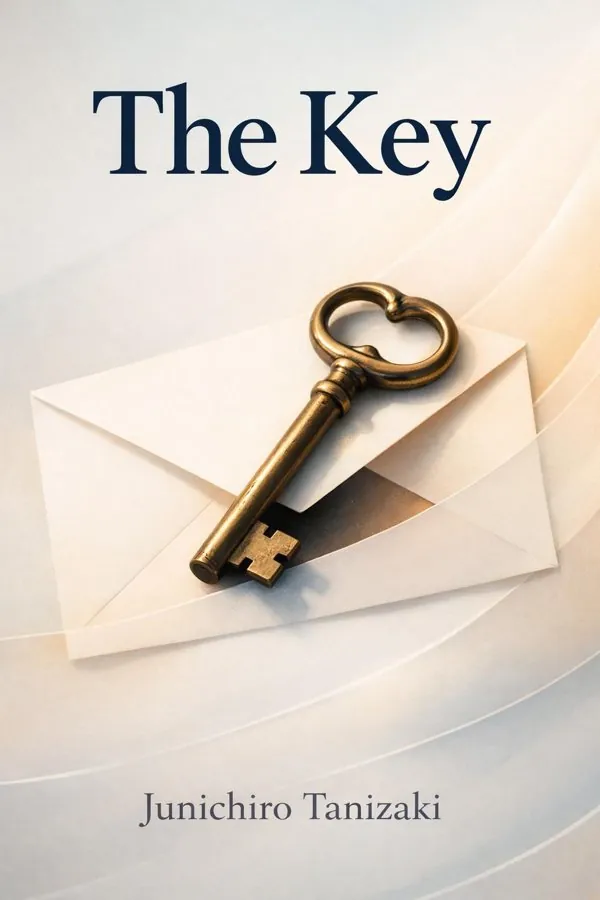
The Key: Summary & Key Insights
 10 min9 chapters
Key Takeaways from The Key
One of the novel’s most disturbing insights is that secrecy does not always destroy intimacy; sometimes it becomes the very method through which intimacy is created.
Tanizaki’s novel makes a blunt claim that many readers resist: desire is rarely innocent.
A diary seems like the ideal form for truth, yet The Key turns it into proof that self-expression is always partial.
One of the novel’s boldest themes is its refusal to treat middle age as a zone of emotional quiet.
In the novel, jealousy is not merely suffered; it is provoked, observed, and even used as a stimulus.
What Is The Key About?
The Key by Junichiro Tanizaki is a classics book. What happens when intimacy turns into performance, and desire becomes something people stage for one another rather than simply feel? Junichiro Tanizaki’s The Key is a daring, unsettling novel about marriage, erotic obsession, jealousy, aging, and the dangerous thrill of being seen. Told through the alternating diaries of a middle-aged husband and wife, the book slowly reveals a relationship built as much on concealment as confession. Each spouse writes private entries that may not be entirely private, and the result is a psychological contest in which truth, manipulation, fantasy, and self-deception become nearly impossible to separate. First published in 1956, The Key remains one of the most provocative classics of modern Japanese literature. Tanizaki, widely regarded as one of Japan’s greatest novelists, was a master of desire, power, and contradiction, and this novel distills those themes with remarkable precision. More than a scandalous story, The Key is a study of how people use language, secrecy, and performance to control one another and themselves. It matters because it exposes an enduring human tension: we long to be known, yet we often reveal ourselves only through masks.
This FizzRead summary covers all 9 key chapters of The Key in approximately 10 minutes, distilling the most important ideas, arguments, and takeaways from Junichiro Tanizaki's work.
The Key
What happens when intimacy turns into performance, and desire becomes something people stage for one another rather than simply feel? Junichiro Tanizaki’s The Key is a daring, unsettling novel about marriage, erotic obsession, jealousy, aging, and the dangerous thrill of being seen. Told through the alternating diaries of a middle-aged husband and wife, the book slowly reveals a relationship built as much on concealment as confession. Each spouse writes private entries that may not be entirely private, and the result is a psychological contest in which truth, manipulation, fantasy, and self-deception become nearly impossible to separate.
First published in 1956, The Key remains one of the most provocative classics of modern Japanese literature. Tanizaki, widely regarded as one of Japan’s greatest novelists, was a master of desire, power, and contradiction, and this novel distills those themes with remarkable precision. More than a scandalous story, The Key is a study of how people use language, secrecy, and performance to control one another and themselves. It matters because it exposes an enduring human tension: we long to be known, yet we often reveal ourselves only through masks.
Who Should Read The Key?
This book is perfect for anyone interested in classics and looking to gain actionable insights in a short read. Whether you're a student, professional, or lifelong learner, the key ideas from The Key by Junichiro Tanizaki will help you think differently.
- ✓Readers who enjoy classics and want practical takeaways
- ✓Professionals looking to apply new ideas to their work and life
- ✓Anyone who wants the core insights of The Key in just 10 minutes
Want the full summary?
Get instant access to this book summary and 100K+ more with Fizz Moment.
Get Free SummaryAvailable on App Store • Free to download
Key Chapters
One of the novel’s most disturbing insights is that secrecy does not always destroy intimacy; sometimes it becomes the very method through which intimacy is created. In The Key, the husband and wife keep diaries that appear private, yet both seem to suspect the other will read them. This turns confession into performance. Instead of speaking directly, they write what they want the other to discover, shaping desire through implication, omission, and suggestion.
Tanizaki uses this structure to show that many relationships are not built on transparent honesty but on selective revelation. People often say things indirectly because direct speech feels too risky, too vulnerable, or too final. In everyday life, this can look less dramatic than in the novel: a partner leaves emotional clues instead of asking openly for reassurance; someone posts carefully chosen messages online hoping a specific person will see them; a friend hints at resentment rather than naming it.
The power of the diary form lies in how it blurs authenticity and strategy. Are the characters confessing what they truly feel, or inventing versions of themselves to produce a reaction? Tanizaki suggests the answer is both. Human beings are rarely purely honest or purely deceptive. We reveal ourselves through the stories we tell, but those stories are almost always shaped by an audience, even an imagined one.
The practical lesson is uncomfortable but useful: if a relationship relies too heavily on indirect signals, fantasy can replace mutual understanding. Hidden communication may feel exciting, but it often increases misunderstanding and manipulation. Actionable takeaway: notice where you are hoping to be “found out” instead of clearly expressing what you want, and choose one important conversation this week to make direct rather than theatrical.
Tanizaki’s novel makes a blunt claim that many readers resist: desire is rarely innocent. In The Key, erotic attraction is tied to competition, jealousy, humiliation, and control. The husband does not simply want pleasure; he wants to provoke it, witness it, and direct it. The wife is not merely a passive participant either; she learns how perception itself can be used as power. Their marriage becomes a theater in which desire is sharpened by imbalance.
This idea matters because it challenges romantic myths. We often imagine love and desire as natural expressions of mutual feeling, but Tanizaki shows how often they are structured by who watches, who knows, who withholds, and who defines the terms. Even outside the novel’s intense circumstances, this pattern appears in ordinary relationships. A person may seek admiration more than connection. Another may provoke jealousy to feel secure. Someone might withhold affection not because feelings are absent, but because withholding creates leverage.
The Key does not argue that all desire is abusive. Rather, it insists that desire often contains hidden hierarchies. People want to be wanted, but they also want influence. They want surrender, but also safety. They want freedom, but may still seek control over how they are imagined.
Recognizing this can improve real relationships. It encourages people to ask not just, “What do I want?” but also, “What emotional position do I want to occupy?” Do I want closeness, or do I want proof that I matter? Do I want pleasure, or do I want power? Actionable takeaway: when strong attraction or jealousy arises, pause to identify the control dynamic beneath it before acting on impulse.
A diary seems like the ideal form for truth, yet The Key turns it into proof that self-expression is always partial. Each spouse records thoughts that appear intimate and revealing, but the two accounts never combine into a single stable reality. Instead, they expose the fragmented nature of identity itself. We do not possess one fixed self that can be perfectly described. We are contradictory, strategic, emotional, and constantly revising our own motives.
This is one of the novel’s deepest psychological achievements. The husband believes he understands his own desires, yet his writings reveal vanity, fear, and self-deception. The wife seems reserved, but her diary suggests a consciousness more active and ambiguous than her outward demeanor. Readers are forced to accept that no character can be reduced to a single interpretation.
That insight extends far beyond literature. In real life, people often assume that sincerity means completeness: if someone is honest, then they must be fully transparent. But honesty is usually limited by perspective. Someone may describe an event truthfully and still omit crucial emotional motives. A colleague may say they are “fine” because they themselves do not fully understand what troubles them. A family member may genuinely believe their memory of a conflict is accurate, even when it is selective.
Tanizaki invites readers to become more skeptical, but also more compassionate. If people are internally divided, then simple labels like honest, dishonest, faithful, manipulative, innocent, or guilty may never capture enough. Actionable takeaway: in your next conflict, resist the urge to decide instantly who is “right,” and instead ask what each person’s version reveals about their needs, fears, and blind spots.
One of the novel’s boldest themes is its refusal to treat middle age as a zone of emotional quiet. The husband in The Key is acutely aware of his aging body, physical limitations, and waning vitality, yet these do not extinguish desire. If anything, they sharpen it. Longing becomes more urgent because time feels finite. Sexuality is no longer a casual appetite; it becomes entangled with mortality, pride, and the fear of disappearing.
This is a striking corrective to cultural assumptions that passion belongs primarily to youth. Tanizaki portrays later-life desire not as embarrassing or irrelevant, but as psychologically potent. Aging brings vulnerability, but it also intensifies self-consciousness. The husband’s schemes and fixations are partly erotic, but they are also responses to decline. He wants evidence that he still matters, still affects others, still possesses force.
This theme remains relevant. Many people confronting aging focus only on loss: loss of beauty, energy, status, or possibility. But the emotional reality is more complex. Aging can heighten longing for recognition, novelty, intimacy, and legacy. Someone in midlife may make impulsive decisions not because they have become irrational, but because they suddenly feel time’s pressure. Others may cling to admiration, romance, or fantasy as defenses against invisibility.
The novel does not idealize this dynamic; it shows how fear of aging can distort judgment. Still, it asks readers to take later-life desire seriously. Rather than mocking or dismissing it, we can understand it as a profound human response to impermanence. Actionable takeaway: if you are facing a life transition linked to age, identify one longing beneath your anxiety and address it directly rather than disguising it through unhealthy behavior.
Most people think of jealousy as a feeling that erupts against one’s will, but The Key suggests something more unsettling: jealousy can be cultivated because it intensifies experience. In the novel, jealousy is not merely suffered; it is provoked, observed, and even used as a stimulus. It creates danger, urgency, and emotional heat in a marriage that might otherwise drift into habit.
This is an important distinction. Jealousy is often treated as proof of love, but Tanizaki reveals it as a complex emotional technology. People may invite jealousy because it confirms value. If someone else wants what I have, perhaps it matters more. If my partner reacts possessively, perhaps I am still desired. In modern life, this dynamic appears in subtler forms: flirtation designed to trigger a response, strategic ambiguity with an ex, social media posts intended to make a partner uneasy, or emotional withholding that turns affection into competition.
The problem is that jealousy rarely remains a controlled experiment. Once introduced, it can quickly reshape trust and perception. Neutral events begin to look suspicious. Communication becomes coded. Emotional energy shifts from connection to surveillance. What initially feels thrilling can turn corrosive.
Tanizaki’s brilliance lies in showing that people may know this and proceed anyway. They choose the risk because ordinary closeness feels insufficient. The lesson is not that relationships must be passionless to be safe. Rather, it is that intensity should not be confused with depth. Some forms of excitement are actually signs of relational instability.
Actionable takeaway: if you notice yourself or a partner using jealousy to test love, name the pattern openly and replace the test with a direct request for reassurance, attention, or renewed intimacy.
In The Key, writing is never a neutral act. The diaries record feelings, but they also generate them. By writing desires down, the characters refine, dramatize, and sometimes exaggerate them. Language does not simply reflect experience; it actively shapes it. A fantasy that might have remained fleeting becomes more vivid once articulated. A grievance hardens when repeated in narrative form. A self-image becomes stronger when rehearsed on the page.
This idea has powerful contemporary relevance. Many people use journals, messages, emails, and digital posts to process emotions. That can be healthy, but Tanizaki reminds us that expression also edits reality. The moment we tell a story about ourselves, we begin selecting details that fit a pattern. “I am neglected.” “I am irresistible.” “I am misunderstood.” These stories may contain truth, but they can also trap us.
Consider how this works in ordinary life. Someone writes repeatedly about being wronged and becomes more certain that reconciliation is impossible. Another crafts flirtatious messages and finds their own attraction intensifying through performance. A person keeps rereading old texts and deepens an attachment that might otherwise fade. Writing can be clarifying, but it can also become a feedback loop.
Tanizaki’s novel encourages readers to ask what their language is doing to their feelings. Are your words helping you understand your experience, or are they escalating it? Are you documenting reality, or rehearsing an identity you have become attached to?
Actionable takeaway: the next time you journal or send an emotionally charged message, reread it once to ask not only “Is this true?” but also “What kind of feeling will this version of the story strengthen in me or the other person?”
The Key offers a sobering picture of marriage as a bond that can contain startling degrees of separation. The husband and wife share a home, routines, and physical proximity, yet their inner lives remain partly inaccessible to each other. Their diaries reveal not just secrets but parallel worlds of interpretation. The same gesture, silence, or encounter carries different meanings in each account.
This is one of the novel’s enduring strengths: it dismantles the comforting idea that long partnership automatically produces complete mutual knowledge. Familiarity can create confidence, but not necessarily understanding. People in long relationships often rely on assumptions built years earlier, even as each person changes. One partner may think a silence means peace; the other experiences it as withdrawal. One believes they are preserving stability; the other feels trapped inside unspoken tension.
In practical terms, this happens all the time. Couples may coordinate schedules flawlessly while never discussing resentment. They may assume shared values without revisiting them. They may preserve an image of the relationship that prevents honest conversation about desire, disappointment, boredom, or fear. The danger is not only deception; it is emotional drift masked as normalcy.
Tanizaki’s novel dramatizes the extreme consequences of such hidden interiority, but the underlying lesson is universal. Closeness requires more than coexistence. It requires periodic reintroduction: Who are you now? What do you want now? What are you pretending not to feel?
Actionable takeaway: if you are in a long-term relationship, schedule a deliberate conversation about one topic you both usually avoid—desire, resentment, aging, insecurity, or fantasy—so hidden assumptions do not quietly become the relationship’s governing force.
A striking feature of The Key is how often seeing becomes a form of doing. The husband is fascinated not only by physical intimacy but by watching, imagining, and arranging scenes. Observation itself becomes erotic power. This is why voyeurism in the novel is not a side theme; it is central to the characters’ emotional world. To watch is to influence, to frame, to possess through attention.
Tanizaki uses this dynamic to explore a broader truth: spectators are never entirely detached. The act of observing changes what is observed, especially in intimate settings. When someone knows they are being watched, they may perform differently. When someone watches obsessively, they may mistake interpretation for knowledge. This applies far beyond sexuality. Social media encourages people to monitor others’ lives and then build emotional narratives from fragments. Workplace dynamics change when employees feel constantly evaluated. Even family roles can become theatrical when members anticipate how they will be judged.
In relationships, voyeuristic energy can appear as over-monitoring: checking a partner’s reactions, searching for hidden meanings, studying messages, or becoming more invested in how intimacy looks than how it feels. The observer may believe they are gaining control, but often they are becoming trapped in imagination and suspicion.
The Key shows that watching can be intoxicating precisely because it mixes distance with involvement. You are not fully exposed, yet you still feel powerful. But this power is unstable. It often replaces real contact with fantasy.
Actionable takeaway: when you find yourself repeatedly monitoring another person instead of engaging them directly, step back and ask what conversation, risk, or vulnerability you are avoiding by remaining only an observer.
The most important lesson of The Key may be that ambiguity is not a flaw to be solved but the core of human reality. Readers often want to determine who is telling the truth, who is more manipulative, and what exactly happened at crucial moments. Tanizaki refuses to provide complete certainty. The gaps between accounts are not puzzles with clean answers; they are the point.
This ambiguity mirrors how people actually experience one another. Motives are mixed. Memory is unreliable. Desire shifts. What looks like innocence may conceal strategy; what looks like manipulation may include genuine vulnerability. By denying the reader a final authoritative version, the novel trains us to live with uncertainty without collapsing into cynicism.
That is a valuable skill in real life. We often react to incomplete information by inventing certainty. We decide someone “meant” to hurt us, or that a relationship “is” secure, or that our own motives are pure. But human situations are rarely so settled. Better judgment comes from tolerating some uncertainty while still acting responsibly. In a disagreement, you may never know the full inner world of the other person, but you can still choose clarity, restraint, and honesty. In self-reflection, you may never uncover a single pure motive, but you can still notice patterns and make wiser choices.
Tanizaki’s ambiguity does not weaken the novel; it gives it staying power. The story continues to disturb readers because it refuses to let them stand outside complexity.
Actionable takeaway: the next time you face an emotionally charged uncertainty, resist the urge to force an immediate conclusion; gather more evidence, name multiple possible interpretations, and act according to your values rather than your most dramatic assumption.
All Chapters in The Key
About the Author
Junichiro Tanizaki was a major Japanese novelist and essayist, born in Tokyo in 1886 and widely regarded as one of the finest writers of modern Japanese literature. His work often explored beauty, desire, obsession, gender roles, and the tension between Western modernity and Japanese tradition. Over a long career, he produced influential novels such as Naomi, Some Prefer Nettles, The Makioka Sisters, and The Key, along with essays including the celebrated In Praise of Shadows. Tanizaki was especially admired for his psychological depth and his fearless treatment of erotic and morally ambiguous subjects. His writing remains internationally respected for its elegance, subtlety, and penetrating insight into human behavior. He died in 1965, leaving a body of work that continues to shape global literary conversation.
Get This Summary in Your Preferred Format
Read or listen to the The Key summary by Junichiro Tanizaki anytime, anywhere. FizzRead offers multiple formats so you can learn on your terms — all free.
Available formats: App · Audio · PDF · EPUB — All included free with FizzRead
Download The Key PDF and EPUB Summary
Key Quotes from The Key
“One of the novel’s most disturbing insights is that secrecy does not always destroy intimacy; sometimes it becomes the very method through which intimacy is created.”
“Tanizaki’s novel makes a blunt claim that many readers resist: desire is rarely innocent.”
“A diary seems like the ideal form for truth, yet The Key turns it into proof that self-expression is always partial.”
“One of the novel’s boldest themes is its refusal to treat middle age as a zone of emotional quiet.”
“Most people think of jealousy as a feeling that erupts against one’s will, but The Key suggests something more unsettling: jealousy can be cultivated because it intensifies experience.”
Frequently Asked Questions about The Key
The Key by Junichiro Tanizaki is a classics book that explores key ideas across 9 chapters. What happens when intimacy turns into performance, and desire becomes something people stage for one another rather than simply feel? Junichiro Tanizaki’s The Key is a daring, unsettling novel about marriage, erotic obsession, jealousy, aging, and the dangerous thrill of being seen. Told through the alternating diaries of a middle-aged husband and wife, the book slowly reveals a relationship built as much on concealment as confession. Each spouse writes private entries that may not be entirely private, and the result is a psychological contest in which truth, manipulation, fantasy, and self-deception become nearly impossible to separate. First published in 1956, The Key remains one of the most provocative classics of modern Japanese literature. Tanizaki, widely regarded as one of Japan’s greatest novelists, was a master of desire, power, and contradiction, and this novel distills those themes with remarkable precision. More than a scandalous story, The Key is a study of how people use language, secrecy, and performance to control one another and themselves. It matters because it exposes an enduring human tension: we long to be known, yet we often reveal ourselves only through masks.
More by Junichiro Tanizaki
You Might Also Like

Browse by Category
Ready to read The Key?
Get the full summary and 100K+ more books with Fizz Moment.