
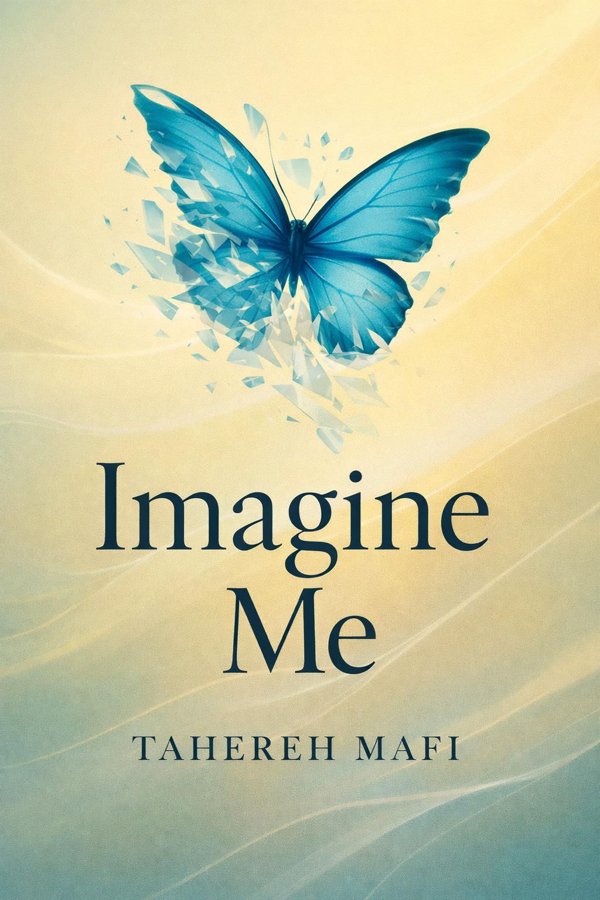
Imagine Me: Summary & Key Insights
by Tahereh Mafi
 10 min9 chaptersAudio available
Key Takeaways from Imagine Me
One of the most unsettling truths in life is that identity can feel stable right up until the moment it breaks apart.
Love becomes most revealing when the world around it is collapsing.
Systems of power become most dangerous when they convince people that control is natural.
Freedom is often imagined as escape, but Imagine Me argues that real freedom is integration.
Who controls memory often controls identity.
What Is Imagine Me About?
Imagine Me by Tahereh Mafi is a bestsellers book spanning 4 pages. Imagine Me is the explosive final novel in Tahereh Mafi’s bestselling Shatter Me series, a story that brings together dystopian rebellion, psychological unraveling, romance, and the lifelong search for identity. At the center is Juliette Ferrars—also known as Ella—who is no longer just fighting an oppressive regime. She is fighting for ownership of her own mind, memories, and future. As buried truths about her past emerge, Juliette must confront the terrifying possibility that much of what she believes about herself has been shaped by manipulation, trauma, and design. What follows is not simply a battle against external enemies, but a deeper struggle to become whole. The novel matters because it turns familiar dystopian stakes into something more intimate: a meditation on memory, power, and emotional survival. Mafi’s lyrical prose and emotionally charged character work give the story a distinct intensity, blending high-stakes action with inner conflict. As the creator of a globally beloved YA series, Mafi writes with authority about damaged people learning to reclaim themselves. Imagine Me serves as both a dramatic finale and a thoughtful reflection on love, freedom, and what it takes to choose your own life.
This FizzRead summary covers all 9 key chapters of Imagine Me in approximately 10 minutes, distilling the most important ideas, arguments, and takeaways from Tahereh Mafi's work. Also available as an audio summary and Key Quotes Podcast.
Imagine Me
Imagine Me is the explosive final novel in Tahereh Mafi’s bestselling Shatter Me series, a story that brings together dystopian rebellion, psychological unraveling, romance, and the lifelong search for identity. At the center is Juliette Ferrars—also known as Ella—who is no longer just fighting an oppressive regime. She is fighting for ownership of her own mind, memories, and future. As buried truths about her past emerge, Juliette must confront the terrifying possibility that much of what she believes about herself has been shaped by manipulation, trauma, and design. What follows is not simply a battle against external enemies, but a deeper struggle to become whole.
The novel matters because it turns familiar dystopian stakes into something more intimate: a meditation on memory, power, and emotional survival. Mafi’s lyrical prose and emotionally charged character work give the story a distinct intensity, blending high-stakes action with inner conflict. As the creator of a globally beloved YA series, Mafi writes with authority about damaged people learning to reclaim themselves. Imagine Me serves as both a dramatic finale and a thoughtful reflection on love, freedom, and what it takes to choose your own life.
Who Should Read Imagine Me?
This book is perfect for anyone interested in bestsellers and looking to gain actionable insights in a short read. Whether you're a student, professional, or lifelong learner, the key ideas from Imagine Me by Tahereh Mafi will help you think differently.
- ✓Readers who enjoy bestsellers and want practical takeaways
- ✓Professionals looking to apply new ideas to their work and life
- ✓Anyone who wants the core insights of Imagine Me in just 10 minutes
Want the full summary?
Get instant access to this book summary and 100K+ more with Fizz Moment.
Get Free SummaryAvailable on App Store • Free to download
Key Chapters
One of the most unsettling truths in life is that identity can feel stable right up until the moment it breaks apart. In Imagine Me, Juliette’s crisis is not just political or romantic—it is existential. She begins the novel in a state of psychological fragmentation, struggling under the weight of newly uncovered memories, conflicting loyalties, and the destabilizing revelation that her past has been hidden from her. The name Juliette itself becomes uncertain as Ella, her original identity, resurfaces. This creates one of the book’s central questions: if your memories have been manipulated, who are you really?
Mafi uses Juliette’s unraveling to show how trauma fractures self-perception. Juliette has long defined herself through fear, guilt, and the danger of her touch. But as the truth emerges, she must face the possibility that even these defining beliefs were shaped by outside forces. The result is a powerful portrait of a young woman caught between old narratives and a still-unwritten future.
This idea extends beyond fiction. Many people build identities around inherited labels: the responsible one, the difficult one, the strong one, the damaged one. When those labels are challenged, the process can feel disorienting rather than liberating. Growth often begins with confusion.
The novel suggests that identity is not a static fact waiting to be uncovered once and for all. It is something we reclaim, revise, and choose, especially after loss or manipulation. Juliette’s breakdown becomes the beginning of a more honest self-understanding.
Actionable takeaway: Notice one label or story you have accepted about yourself, and ask whether it truly comes from you—or from someone else’s version of who you should be.
Love becomes most revealing when the world around it is collapsing. In Imagine Me, the relationship between Juliette and Warner is not presented as a simple refuge from chaos; instead, it is tested by the very forces that shaped them both. Warner remains burdened by his lineage, especially the shadow of his father, Anderson, whose cruelty symbolizes the corruption at the heart of the Reestablishment. Juliette, meanwhile, is no longer sure she can trust her own mind. Their connection must survive secrets, distance, guilt, and the fear that the past may be stronger than choice.
What makes their bond compelling is that devotion here is not fantasy—it is labor. Warner cannot love Juliette by controlling her or rescuing her from every danger. He must learn patience, vulnerability, and restraint. Juliette cannot remain in the relationship by losing herself inside it. She must become strong enough to choose love freely, not cling to it as her only source of stability.
This makes the novel’s romance meaningful beyond fan appeal. It asks whether love can remain real when both people are wounded, when history intrudes, and when inherited damage threatens to repeat itself. Warner’s struggle is especially resonant: he is constantly confronting the possibility of becoming what he hates. Love, in this context, becomes a moral practice. It requires conscious rejection of old patterns.
In everyday life, relationships often reveal unresolved family legacies, fears of abandonment, and habits learned from unhealthy models. The book reminds readers that intimacy does not erase trauma; it exposes it. Healthy love is not built on perfection but on the willingness to show up honestly.
Actionable takeaway: In one important relationship, identify a pattern you may have inherited from past hurt, and replace it with one deliberate act of honesty or care.
Systems of power become most dangerous when they convince people that control is natural. A major thread in Imagine Me is the shocking truth behind the Reestablishment and the origins of the world that Juliette inhabits. What once seemed like a familiar dystopian regime grows into something even more sinister: a carefully engineered system that manipulates people at the level of memory, biology, and perception. The novel expands its scope by showing that oppression is not only maintained through visible violence, but also through hidden design.
This revelation matters because it reframes nearly everything that came before. Juliette’s abilities, her personal history, and the machinery of control surrounding her are all connected to larger structures of experimentation and domination. Individuals are turned into assets, identities become tools, and human lives are treated as programmable material. The Reestablishment is not just authoritarian—it is deeply dehumanizing because it seeks to define reality itself.
Mafi uses this concept to explore a fear that feels increasingly relevant: what happens when institutions know enough about people to shape behavior before they can resist it? In the book, manipulation is technological and political. In real life, it may look like surveillance, targeted influence, data-driven control, or emotionally coercive systems in families and workplaces. The exact mechanism changes; the principle remains the same.
By uncovering the truth, Juliette and her allies gain more than information. They recover the ability to name what has been done to them. That is the beginning of resistance. Clarity disrupts control.
Actionable takeaway: Examine one system in your life—social, digital, professional, or personal—and ask who benefits when you stay confused, passive, or dependent.
Freedom is often imagined as escape, but Imagine Me argues that real freedom is integration. By the final stages of Juliette’s journey, the question is no longer simply whether she can defeat an enemy. It is whether she can gather the broken pieces of herself and live as a whole person rather than a weapon, a victim, or an experiment. Becoming whole means accepting pain without being ruled by it, power without being consumed by it, and love without disappearing inside it.
This idea gives emotional weight to the novel’s conclusion. Juliette’s future is not meaningful because it promises a perfect world. It matters because she begins to act from agency instead of reaction. Throughout the series, others have named her, feared her, protected her, imprisoned her, or tried to use her. In this final installment, she moves toward self-definition. That shift from being acted upon to acting with intention is the deepest form of liberation the book offers.
The concept is valuable outside the story as well. Many people confuse freedom with the removal of pressure: once I leave this job, end this relationship, move cities, or solve this problem, then I will be free. But internal fragmentation can follow us anywhere. Lasting freedom often comes from alignment—when values, choices, and self-understanding begin to match.
Mafi does not portray wholeness as effortless. It emerges through grief, confrontation, trust, and courage. Juliette does not become less complex in order to heal; she becomes more fully herself.
Actionable takeaway: Choose one decision this week that reflects who you want to become, not just what you want to escape.
Who controls memory often controls identity. In Imagine Me, memory is not a passive record of the past but a contested space where truth, trauma, and manipulation collide. Juliette’s missing memories are not merely a mystery device; they are the emotional core of the novel. As pieces of her past return, she is forced to reevaluate relationships, motives, and even her own personality. The pain of this process lies in realizing that forgetting was never neutral. Something was taken from her, and with it, her ability to understand herself clearly.
The book’s treatment of memory highlights how deeply our lives depend on coherent narrative. We tell ourselves stories about where we came from, why we react the way we do, and what kind of people we are. When those stories are disrupted, we can feel destabilized, ashamed, or unmoored. Juliette’s struggle captures this vividly. She is not simply recovering facts; she is trying to rebuild continuity between past and present.
This resonates with real emotional life. Trauma survivors, for example, often experience memory not as a neat timeline but as fragments, gaps, and sensations. Even outside extreme circumstances, families and institutions shape memory by emphasizing certain truths and burying others. What is remembered publicly and what is kept hidden can determine how people interpret themselves.
In the novel, reclaiming memory is painful but necessary. The truth does not instantly heal Juliette, yet it gives her something more important: a stable ground from which to make decisions. Memory, then, becomes part of liberation.
Actionable takeaway: Reflect on one formative event you rarely revisit, and consider whether a fuller, more honest interpretation of it might change how you understand yourself today.
The book repeatedly suggests that power is not evil by itself, but power detached from empathy becomes destructive almost instantly. Imagine Me is filled with characters who possess influence, unusual abilities, military authority, or scientific knowledge. What separates the humane from the monstrous is not strength—it is the willingness to see other people as fully human. The Reestablishment fails this test entirely, treating individuals as data points, threats, or tools. Anderson embodies this cruelty, but the novel also warns that corruption can spread more quietly through fear, entitlement, and emotional numbness.
Juliette’s own arc illustrates the tension clearly. Her abilities are immense, and she has every reason to weaponize her pain. Yet the novel insists that her greatest strength is not destructive force. It is moral clarity, compassion, and the refusal to become what hurt her. Warner also becomes part of this theme, since he must prove that authority can be exercised with conscience rather than domination.
This insight applies beyond dystopian fiction. In workplaces, politics, friendships, and families, people may hold power because of position, money, charisma, expertise, or emotional leverage. The question is always the same: does that power create safety and dignity, or fear and dependency? Systems become violent when people stop imagining the inner life of those beneath them.
Mafi’s point is sharp: a world cannot be repaired merely by replacing one strong ruler with another. It changes only when power is redefined as responsibility rather than ownership.
Actionable takeaway: If you hold influence over others in any area of life, ask one simple question before acting: does this choice increase another person’s dignity, or diminish it?
Stories often celebrate the singular hero, but Imagine Me quietly argues that survival and change are collective achievements. Although Juliette stands at the center of the narrative, she does not reach the end through isolated strength. Her journey depends on allies, emotional witnesses, strategic partners, and people willing to fight for a future larger than themselves. Characters across the series contribute pieces of courage, information, loyalty, and perspective. This communal dimension matters because it counters the fantasy that one extraordinary person can save everyone alone.
The novel shows that resistance is messy precisely because communities are messy. People disagree, carry private wounds, make mistakes, and struggle to trust. Yet this complexity is not a weakness; it is the texture of real change. Bonds among the characters create resilience. When one person falters, another steps forward. When Juliette loses her footing psychologically, the presence of others becomes part of what keeps her tethered to purpose.
This is a useful corrective for readers living in a culture that prizes self-sufficiency. Personal strength is valuable, but there are limits to what any individual can carry. Whether the challenge is social injustice, grief, burnout, or major transition, healing and resistance both become more sustainable when shared.
Mafi also suggests that community is not just practical—it is identity-forming. We become more fully ourselves when we are seen, challenged, and supported by others who care whether we endure.
Actionable takeaway: Instead of facing one difficult problem entirely alone, identify one person or group you can invite into the process for support, accountability, or collaboration.
One reason the Shatter Me series has resonated so deeply is that it treats trauma as something that alters not only emotions, but perception itself. In Imagine Me, this remains central. Juliette’s confusion, fear, and sensory intensity affect how she interprets the world. The novel’s emotional atmosphere reflects a mind under pressure, making readers feel the instability of experience rather than merely observe it. This stylistic and thematic choice reminds us that trauma is not a backstory detail—it is an active force shaping thought, language, and decision-making.
Juliette’s internal disarray affects how she understands trust, danger, intimacy, and even time. This is part of what makes her journey compelling. She is not simply becoming stronger in a linear fashion; she is learning how to function while carrying psychological wounds that do not vanish on command. That struggle is more honest than many triumph narratives.
In practical terms, the novel offers readers a lens for understanding real people with more compassion. Someone shaped by trauma may seem reactive, withdrawn, hypervigilant, or inconsistent. These responses are not moral failures. They are often adaptations to environments where safety was unreliable. Healing, therefore, is not about becoming unaffected. It is about building enough security and self-awareness to respond rather than merely react.
Mafi’s portrayal does not romanticize damage, but it does insist that wounded people are still capable of love, leadership, and transformation.
Actionable takeaway: The next time you judge yourself or someone else for an intense reaction, pause and ask what protective function that response may have once served.
In a bleak world, hope can look naive—but Imagine Me presents hope as one of the hardest choices a person can make. The characters have ample evidence that cruelty is entrenched, that systems are resilient, and that personal pain does not disappear simply because one battle ends. Yet the novel moves toward possibility rather than surrender. This does not happen through blind optimism. It happens because key characters continue to act as if a more humane future is worth building, even when certainty is impossible.
That distinction matters. Fantasy says everything will work out because it should. Hope says I will keep choosing meaningful action even though I cannot guarantee the outcome. Juliette embodies this shift. By the end, hope is no longer a fragile feeling she waits to receive from others. It becomes a discipline: a pattern of choosing courage, truth, connection, and responsibility despite fear.
Readers can apply this insight to everyday life. When facing burnout, injustice, illness, or major uncertainty, many people assume hope means feeling positive all the time. In reality, hope often looks like much smaller acts—making the call, telling the truth, resting so you can continue, apologizing, planning, showing up again. It is active, not passive.
The novel’s conclusion earns its emotional impact because it understands that hope is most powerful when it has survived disillusionment. It is not innocence restored. It is commitment renewed.
Actionable takeaway: Define one small, concrete action that represents hope in your current circumstances, and do it before waiting to feel fully ready.
All Chapters in Imagine Me
About the Author
Tahereh Mafi is an Iranian-American author celebrated for her emotionally charged young adult fiction, especially the bestselling Shatter Me series. Known for her lyrical prose, vivid internal monologues, and character-driven storytelling, she has built a global readership drawn to her blend of romance, dystopian tension, and psychological depth. Born in Connecticut and based in California, Mafi has written both YA and middle grade books, often exploring identity, vulnerability, resilience, and the longing to belong. Her work stands out for its ability to combine high-concept speculative worlds with intimate emotional stakes. Through Shatter Me, she became one of the defining voices in contemporary YA fantasy and dystopian fiction, earning devoted fans for stories that are as heartfelt as they are dramatic.
Get This Summary in Your Preferred Format
Read or listen to the Imagine Me summary by Tahereh Mafi anytime, anywhere. FizzRead offers multiple formats so you can learn on your terms — all free.
Available formats: App · Audio · PDF · EPUB — All included free with FizzRead
Download Imagine Me PDF and EPUB Summary
Key Quotes from Imagine Me
“One of the most unsettling truths in life is that identity can feel stable right up until the moment it breaks apart.”
“Love becomes most revealing when the world around it is collapsing.”
“Systems of power become most dangerous when they convince people that control is natural.”
“Freedom is often imagined as escape, but Imagine Me argues that real freedom is integration.”
“Who controls memory often controls identity.”
Frequently Asked Questions about Imagine Me
Imagine Me by Tahereh Mafi is a bestsellers book that explores key ideas across 9 chapters. Imagine Me is the explosive final novel in Tahereh Mafi’s bestselling Shatter Me series, a story that brings together dystopian rebellion, psychological unraveling, romance, and the lifelong search for identity. At the center is Juliette Ferrars—also known as Ella—who is no longer just fighting an oppressive regime. She is fighting for ownership of her own mind, memories, and future. As buried truths about her past emerge, Juliette must confront the terrifying possibility that much of what she believes about herself has been shaped by manipulation, trauma, and design. What follows is not simply a battle against external enemies, but a deeper struggle to become whole. The novel matters because it turns familiar dystopian stakes into something more intimate: a meditation on memory, power, and emotional survival. Mafi’s lyrical prose and emotionally charged character work give the story a distinct intensity, blending high-stakes action with inner conflict. As the creator of a globally beloved YA series, Mafi writes with authority about damaged people learning to reclaim themselves. Imagine Me serves as both a dramatic finale and a thoughtful reflection on love, freedom, and what it takes to choose your own life.
More by Tahereh Mafi

You Might Also Like
The Godfather
Mario Puzo
10 min
The Handmaid's Tale
Margaret Atwood
10 min
The Hunger Games
Suzanne Collins
10 min
The Nightingale
Kristin Hannah
10 min
The Seven Husbands of Evelyn Hugo
Taylor Jenkins Reid
10 min
Backwater Justice
Fern Michaels
10 minBrowse by Category
Ready to read Imagine Me?
Get the full summary and 100K+ more books with Fizz Moment.