
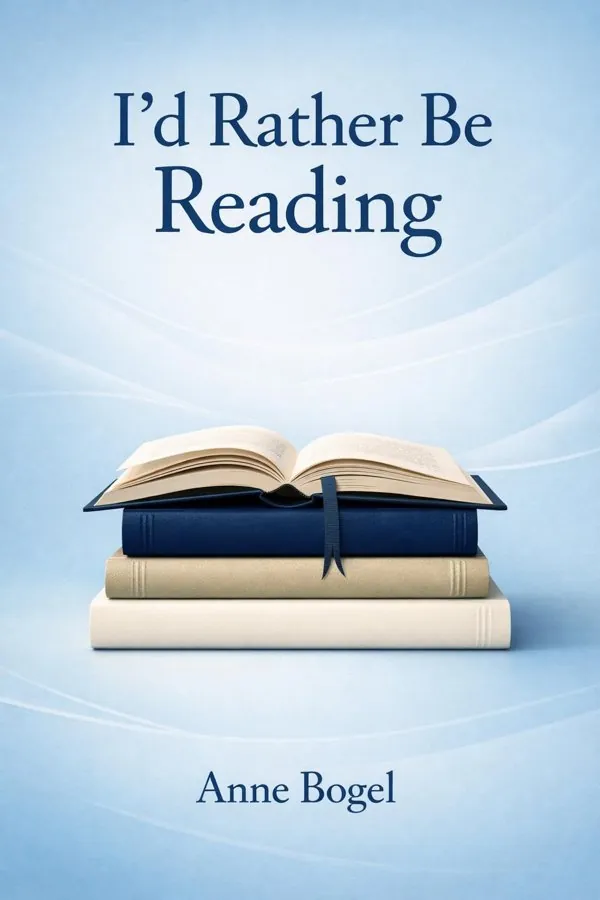
I'd Rather Be Reading: The Delights and Dilemmas of the Reading Life: Summary & Key Insights
by Anne Bogel
 10 min9 chaptersAudio available
Key Takeaways from I'd Rather Be Reading: The Delights and Dilemmas of the Reading Life
A reading life becomes richer when you stop trying to read like everyone else and begin noticing what genuinely draws you in.
Books do not simply tell stories; they preserve versions of ourselves.
A satisfying reading life is built less on grand ambition than on small, repeatable rituals.
For passionate readers, abundance can be both a pleasure and a problem.
Though reading is often solitary, its effects are profoundly social.
What Is I'd Rather Be Reading: The Delights and Dilemmas of the Reading Life About?
I'd Rather Be Reading: The Delights and Dilemmas of the Reading Life by Anne Bogel is a writing book spanning 8 pages. Anne Bogel’s I'd Rather Be Reading is a warm, witty, and deeply recognizable celebration of what it means to build a life around books. Rather than offering a strict how-to guide, Bogel gathers a series of personal essays about the pleasures, habits, frustrations, and quiet revelations that come with being a committed reader. She writes about the way books attach themselves to memory, the challenge of choosing what to read next, the comfort of rereading, and the surprising ways reading shapes identity, relationships, and emotional life. What makes the book matter is its ability to validate experiences many readers feel but rarely articulate: the guilt of unread stacks, the thrill of literary discovery, and the sense that books are not just entertainment but companions in living. Bogel brings authority to these reflections through years of thoughtful engagement with reading culture as the creator of Modern Mrs. Darcy and host of the podcast What Should I Read Next? The result is an inviting, intelligent book for anyone who has ever felt that reading is not merely a hobby, but a way of being in the world.
This FizzRead summary covers all 9 key chapters of I'd Rather Be Reading: The Delights and Dilemmas of the Reading Life in approximately 10 minutes, distilling the most important ideas, arguments, and takeaways from Anne Bogel's work. Also available as an audio summary and Key Quotes Podcast.
I'd Rather Be Reading: The Delights and Dilemmas of the Reading Life
Anne Bogel’s I'd Rather Be Reading is a warm, witty, and deeply recognizable celebration of what it means to build a life around books. Rather than offering a strict how-to guide, Bogel gathers a series of personal essays about the pleasures, habits, frustrations, and quiet revelations that come with being a committed reader. She writes about the way books attach themselves to memory, the challenge of choosing what to read next, the comfort of rereading, and the surprising ways reading shapes identity, relationships, and emotional life. What makes the book matter is its ability to validate experiences many readers feel but rarely articulate: the guilt of unread stacks, the thrill of literary discovery, and the sense that books are not just entertainment but companions in living. Bogel brings authority to these reflections through years of thoughtful engagement with reading culture as the creator of Modern Mrs. Darcy and host of the podcast What Should I Read Next? The result is an inviting, intelligent book for anyone who has ever felt that reading is not merely a hobby, but a way of being in the world.
Who Should Read I'd Rather Be Reading: The Delights and Dilemmas of the Reading Life?
This book is perfect for anyone interested in writing and looking to gain actionable insights in a short read. Whether you're a student, professional, or lifelong learner, the key ideas from I'd Rather Be Reading: The Delights and Dilemmas of the Reading Life by Anne Bogel will help you think differently.
- ✓Readers who enjoy writing and want practical takeaways
- ✓Professionals looking to apply new ideas to their work and life
- ✓Anyone who wants the core insights of I'd Rather Be Reading: The Delights and Dilemmas of the Reading Life in just 10 minutes
Want the full summary?
Get instant access to this book summary and 100K+ more with Fizz Moment.
Get Free SummaryAvailable on App Store • Free to download
Key Chapters
A reading life becomes richer when you stop trying to read like everyone else and begin noticing what genuinely draws you in. One of Anne Bogel’s most resonant ideas is that each reader develops a unique identity over time, shaped not only by taste but by experience, season of life, and emotional need. The books that formed you as a child, the genres you return to when stressed, and the stories that challenge your assumptions all become clues to the kind of reader you are.
Bogel suggests that reading identity is not static. A person who once devoured mysteries may later crave memoir, poetry, or history. This evolution is not inconsistency; it is growth. Understanding your reading identity helps you make better choices in a world overflowing with recommendations, bestseller lists, and cultural pressure. Instead of feeling guilty for not finishing acclaimed books that bore you, you can choose titles that align with your curiosity and values.
In practice, this means paying attention to patterns. Which books have you loved most in the past year? Which authors make you feel energized? Which reading environments help you focus? You might discover that you prefer character-driven fiction over plot-heavy thrillers, or essays over long novels during busy months. Keeping a simple reading journal can help reveal these preferences.
Bogel’s insight is freeing because it removes the need to perform literary sophistication. You do not need to read what impresses others; you need to read what deepens and delights you. Actionable takeaway: make a list of five books you loved and identify the common threads between them, then use those patterns to guide your next reading decisions.
Books do not simply tell stories; they preserve versions of ourselves. Bogel reflects on how certain titles become inseparable from the time, place, and emotional atmosphere in which we read them. A novel read during a difficult winter can forever carry the feeling of endurance. A beach read from a joyful vacation can become a portable memory of freedom and sunlight. In this way, books work like emotional anchors.
This idea matters because it explains why readers often feel attached to books beyond their literary quality. Sometimes a merely good book becomes beloved because it arrived at the right moment. The reverse is also true: a brilliant book may fail to move us if we encounter it when we are distracted, exhausted, or unreceptive. Bogel reminds us that reading is never a purely intellectual act. It is shaped by mood, circumstance, and memory.
Recognizing this can change how you build your personal library. Instead of treating books only as finished transactions, you can see them as markers of your life. Marginal notes, ticket stubs used as bookmarks, and worn covers become evidence of lived experience. Even digital readers can preserve highlights that later bring back forgotten seasons of thought.
Practically, readers can use this insight by becoming more intentional about recording reading memories. Note where you were, what was happening in your life, and how the book made you feel. This practice turns reading into a richer form of self-reflection and helps explain why some books matter so much.
Actionable takeaway: after finishing your next book, write down three contextual details about when you read it and one emotion you associate with it, so the memory of that reading experience stays alive.
A satisfying reading life is built less on grand ambition than on small, repeatable rituals. Bogel captures the familiar habits of avid readers: carrying a book everywhere, reading before bed, organizing stacks by mood, and protecting small pockets of time for immersion. These rituals may seem minor, but they create the conditions in which reading becomes a sustaining part of daily life rather than an occasional luxury.
The deeper point is that readers often thrive when they stop waiting for ideal circumstances. Many people imagine they would read more if they had uninterrupted weekends or fewer obligations. Bogel’s essays suggest otherwise. A strong reading life often grows through consistency: ten pages with coffee, an audiobook during a commute, twenty quiet minutes after lunch. Rituals reduce decision fatigue and make reading automatic.
These habits also carry emotional significance. A bedtime novel can signal rest. A Sunday afternoon essay can mark reflection. A visit to the library can become an act of renewal. Over time, such rituals help shape a home and schedule around what matters. They also make reading more resilient during stressful seasons, because the habit survives even when attention is strained.
A practical application is to pair reading with existing routines. Keep a book where you drink your morning tea. Download an audiobook for errands. Create a dedicated chair, lamp, or blanket that cues your mind to settle into reading. You do not need a perfect library; you need reliable signals that reading belongs in your life.
Actionable takeaway: choose one recurring daily moment, even just ten minutes long, and attach a reading ritual to it for the next two weeks.
For passionate readers, abundance can be both a pleasure and a problem. Bogel understands the peculiar anxiety behind the innocent question, “What should I read next?” In a world of endless choices, selecting the next book can feel oddly consequential. Choose well, and you enter a rewarding conversation; choose poorly, and precious reading time slips away.
Bogel’s insight is that this dilemma is not really about scarcity of options, but about mismatch. Readers struggle when they seek the wrong book for the wrong moment. The ideal next read depends on energy level, emotional state, attention span, and appetite. A dense historical biography may be excellent, but not after a draining workweek. A comfort reread might be exactly right during upheaval.
This perspective encourages readers to move beyond rigid reading lists. Instead of asking only what is critically acclaimed or newly released, ask what kind of reading experience you need right now. Do you want to be challenged, soothed, surprised, educated, or entertained? Matching books to seasons of life improves satisfaction and reduces abandonment.
A practical strategy is to build a flexible “to be read” system organized by mood or purpose: books for comfort, books for concentration, books for travel, books for learning, and books for quick wins. This makes the next choice easier because you are selecting from a relevant subset, not from all literature at once.
Bogel’s approach turns book selection into a thoughtful act of self-awareness instead of a source of pressure. Actionable takeaway: create a short personal reading menu with four categories based on mood, and place two or three books in each so your next pick feels natural rather than stressful.
Though reading is often solitary, its effects are profoundly social. Bogel explores how books create connection between friends, family members, book clubs, online communities, and even strangers who recognize a title in your hands. A shared book offers more than a topic of conversation; it creates a shared emotional and intellectual space in which people can compare responses, values, and memories.
This matters because many readers experience books as private refuge, yet some of their greatest pleasures emerge when that refuge opens outward. Recommending a book is a gesture of trust. Discussing one can deepen relationships because it reveals what moved, troubled, or surprised you. Even disagreement can be fruitful, showing how different lives produce different readings.
Bogel also highlights that reading together does not require formal analysis. It can be as simple as texting a friend mid-chapter, reading aloud with children, or borrowing from someone’s shelf. These interactions strengthen the sense that books are woven into ordinary life. They give reading continuity beyond the final page.
In practical terms, readers can cultivate this social dimension intentionally. Join a low-pressure book club, keep a running list of books to recommend to particular people, or ask more specific questions than “Did you like it?” Try “Which character stayed with you?” or “Was this the right book at the right time?” Such questions invite richer exchange.
Bogel’s point is not that every book must be discussed, but that sharing reading can multiply its meaning. Actionable takeaway: choose one recent book you enjoyed and recommend it to a specific person with a brief note explaining why it made you think of them.
One of reading’s quiet miracles is that it lets us inhabit minds and lives not our own. Bogel reflects on the transformative power of entering other people’s stories, whether through fiction, memoir, or essays. Books stretch moral imagination by allowing readers to experience unfamiliar circumstances from the inside. They do not just inform; they humanize.
This is especially important in a world that often rewards quick judgment and superficial understanding. Reading slows us down. It asks us to remain with complexity long enough to see motivations, contradictions, and vulnerabilities. A novel may reveal the fears behind a harsh decision. A memoir may complicate assumptions about class, culture, illness, or family. Through such encounters, readers become less certain that their own perspective is the only reasonable one.
Bogel does not present this as an abstract moral lesson. She roots it in the ordinary experience of being changed by a story. The effect may be subtle: more patience in conversation, more curiosity about someone different, more humility about what you do not know. Over time, these shifts matter. A reading life can become training in attention and compassion.
To apply this idea, diversify what you read. Alternate between familiar favorites and voices from different backgrounds, eras, and traditions. When a book unsettles you, resist the urge to dismiss it too quickly. Ask what the discomfort reveals about your own assumptions. Discussion with others can deepen this process by exposing blind spots in your interpretation.
Actionable takeaway: for your next three books, intentionally include one title written from a perspective or life experience significantly different from your own, and reflect on what it taught you about seeing the world differently.
To reread a book is to encounter both the text and your former self at once. Bogel values rereading not as a fallback for unadventurous readers, but as a meaningful way to measure personal change. A book that enchanted you at sixteen may feel naive at forty, or a once-overlooked character may suddenly become the emotional center of the story. The text may be the same, but you are not.
This makes rereading a powerful form of reflection. It reveals how experience alters interpretation. Parenthood, grief, work, love, aging, and disappointment all reshape what we notice on the page. Rereading can also offer comfort in uncertain times because known stories provide stability without emptiness; they often disclose new meanings precisely because life has become more complex.
Bogel’s insight helps counter the cultural pressure to maximize novelty. Many readers feel they should always be moving forward, consuming more titles, keeping up with trends. But rereading is not wasted time. It deepens relationship with a book and often strengthens memory in a way first readings cannot. It can also help recover one’s reading self after a slump.
Practical uses for rereading include revisiting formative books every few years, returning to beloved seasonal titles, or rereading one chapter from an old favorite before bed. You can compare old notes with new reactions and see how your questions have changed.
Rather than treating rereading as indulgent, Bogel invites readers to see it as interpretive growth. Actionable takeaway: choose one book that mattered to you in an earlier season of life and reread at least the opening chapters, paying close attention to what now feels different.
A book’s power often depends not only on what it says, but on when it finds you. Bogel beautifully captures the serendipity of encountering exactly the book you need in a particular season. Sometimes a title arrives as encouragement during uncertainty, as language for grief you could not name, or as permission to desire a different kind of life. The same book, read earlier or later, might have landed with far less force.
This idea encourages humility about reading judgments. When readers say a book changed their life, they often mean it met a hidden need. Timing creates receptivity. That is why recommendation is both generous and unpredictable: a book that transformed one person may leave another untouched. The mismatch is not failure; it is evidence that reading is relational and situational.
Bogel’s essays suggest that cultivating openness matters as much as planning. Wandering in libraries, browsing overlooked shelves, following a trusted friend’s unusual recommendation, or picking up a neglected book from your own stack can create opportunities for meaningful discovery. Serendipity favors readers who leave room for surprise.
Practically, this means holding your reading plans lightly. Allow space for impulse choices and emotional intuition. If a book keeps calling to you, pay attention. Likewise, if a supposedly perfect choice feels wrong, set it aside without guilt. The “right book” is not always the most prestigious; it is the one that meets your present need.
Actionable takeaway: leave one slot in your next month’s reading open for an unplanned pick chosen by instinct, browsing, or a spontaneous recommendation, and notice how that freedom affects your reading experience.
Many devoted readers carry an odd burden: guilt about what they are not reading. Bogel gently exposes this tension between pleasure and obligation. Readers may feel ashamed for abandoning books, preferring accessible genres, ignoring classics, or leaving towering to-be-read piles untouched. Yet guilt drains joy from an activity that should nourish the mind and spirit.
Her broader argument is that a healthy reading life requires permission. Permission to stop reading books that are not working. Permission to choose delight over duty sometimes. Permission to read slowly, seasonally, or eccentrically. This does not mean avoiding challenge or growth; it means rejecting performative reading driven solely by external expectations.
This idea is especially useful in an age of productivity culture, where even leisure can become competitive. Tracking apps, yearly goals, and social media recommendations can inspire, but they can also turn reading into self-surveillance. Bogel invites readers back to a more humane standard: read in ways that make your life larger, wiser, calmer, or more alive.
Applying this might mean creating a “did not finish” shelf without embarrassment, reducing reading goals to something realistic, or balancing demanding books with lighter ones. It may also mean refusing to apologize for loving romance, essays, fantasy, or children’s literature if those books genuinely sustain you.
At its best, reading is not a moral test but a meaningful practice. Actionable takeaway: identify one reading rule you have imposed on yourself that no longer serves you, and consciously replace it with a more generous principle.
All Chapters in I'd Rather Be Reading: The Delights and Dilemmas of the Reading Life
About the Author
Anne Bogel is an American author, blogger, and podcast host best known for her work on books, reading habits, and the literary life. She is the founder of Modern Mrs. Darcy, a widely read online platform where she shares book recommendations, reading reflections, and lifestyle insights. Bogel also hosts the popular podcast What Should I Read Next?, where she helps guests discover books that match their tastes, moods, and current life circumstances. Her work is valued for combining warmth, clarity, and practical literary insight without pretension. Across her writing and audio work, Bogel has become a trusted voice for readers seeking more intentional, enjoyable reading lives. She writes for people who see books not just as entertainment, but as companions in personal growth, self-understanding, and everyday pleasure.
Get This Summary in Your Preferred Format
Read or listen to the I'd Rather Be Reading: The Delights and Dilemmas of the Reading Life summary by Anne Bogel anytime, anywhere. FizzRead offers multiple formats so you can learn on your terms — all free.
Available formats: App · Audio · PDF · EPUB — All included free with FizzRead
Download I'd Rather Be Reading: The Delights and Dilemmas of the Reading Life PDF and EPUB Summary
Key Quotes from I'd Rather Be Reading: The Delights and Dilemmas of the Reading Life
“A reading life becomes richer when you stop trying to read like everyone else and begin noticing what genuinely draws you in.”
“Books do not simply tell stories; they preserve versions of ourselves.”
“A satisfying reading life is built less on grand ambition than on small, repeatable rituals.”
“For passionate readers, abundance can be both a pleasure and a problem.”
“Though reading is often solitary, its effects are profoundly social.”
Frequently Asked Questions about I'd Rather Be Reading: The Delights and Dilemmas of the Reading Life
I'd Rather Be Reading: The Delights and Dilemmas of the Reading Life by Anne Bogel is a writing book that explores key ideas across 9 chapters. Anne Bogel’s I'd Rather Be Reading is a warm, witty, and deeply recognizable celebration of what it means to build a life around books. Rather than offering a strict how-to guide, Bogel gathers a series of personal essays about the pleasures, habits, frustrations, and quiet revelations that come with being a committed reader. She writes about the way books attach themselves to memory, the challenge of choosing what to read next, the comfort of rereading, and the surprising ways reading shapes identity, relationships, and emotional life. What makes the book matter is its ability to validate experiences many readers feel but rarely articulate: the guilt of unread stacks, the thrill of literary discovery, and the sense that books are not just entertainment but companions in living. Bogel brings authority to these reflections through years of thoughtful engagement with reading culture as the creator of Modern Mrs. Darcy and host of the podcast What Should I Read Next? The result is an inviting, intelligent book for anyone who has ever felt that reading is not merely a hobby, but a way of being in the world.
More by Anne Bogel
You Might Also Like
The Art of Perspective
Christopher Castellani
10 min
Making a Point: The Persnickety Story of English Punctuation
David Crystal
10 min
The Elements Of Eloquence: How To Turn The Perfect English Phrase
Mark Forsyth
10 min
The Pocket Muse: Ideas and Inspirations for Writing
Monica Wood
10 min
A Little Book on Form: An Exploration into the Formal Imagination of Poetry
Robert Hass
10 min
Adventures In The Screen Trade: A Personal View Of Hollywood And Screenwriting
William Goldman
10 minBrowse by Category
Ready to read I'd Rather Be Reading: The Delights and Dilemmas of the Reading Life?
Get the full summary and 100K+ more books with Fizz Moment.