
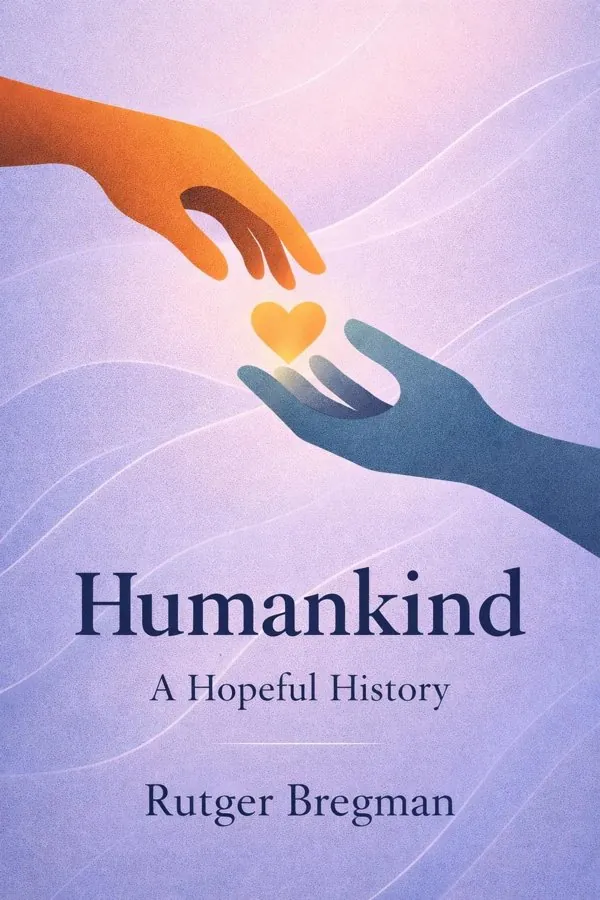
Humankind: A Hopeful History: Summary & Key Insights
 10 min10 chaptersAudio available
What Is Humankind: A Hopeful History About?
Humankind: A Hopeful History by Rutger Bregman is a civilization book spanning 10 pages. In this book, historian Rutger Bregman explores human nature and argues that most people are fundamentally good. Drawing on insights from history, psychology, biology, and economics, he shows that cooperation and empathy are the driving forces behind human progress. The work offers an optimistic perspective on humanity and calls for a rethinking of our worldview.
This FizzRead summary covers all 10 key chapters of Humankind: A Hopeful History in approximately 10 minutes, distilling the most important ideas, arguments, and takeaways from Rutger Bregman's work. Also available as an audio summary and Key Quotes Podcast.
Humankind: A Hopeful History
In this book, historian Rutger Bregman explores human nature and argues that most people are fundamentally good. Drawing on insights from history, psychology, biology, and economics, he shows that cooperation and empathy are the driving forces behind human progress. The work offers an optimistic perspective on humanity and calls for a rethinking of our worldview.
Who Should Read Humankind: A Hopeful History?
This book is perfect for anyone interested in civilization and looking to gain actionable insights in a short read. Whether you're a student, professional, or lifelong learner, the key ideas from Humankind: A Hopeful History by Rutger Bregman will help you think differently.
- ✓Readers who enjoy civilization and want practical takeaways
- ✓Professionals looking to apply new ideas to their work and life
- ✓Anyone who wants the core insights of Humankind: A Hopeful History in just 10 minutes
Want the full summary?
Get instant access to this book summary and 100K+ more with Fizz Moment.
Get Free SummaryAvailable on App Store • Free to download
Key Chapters
From the very beginning of moral philosophy, two archetypes have shaped the debate on human nature: Hobbes and Rousseau. Hobbes saw humanity as a species driven by fear and selfishness, constrained only by a powerful ruler. His infamous description of life as 'solitary, poor, nasty, brutish, and short' became the cornerstone for centuries of political realism. Rousseau, by contrast, envisioned a 'noble savage'—pure and good until corrupted by civilization itself.
I revisit this debate not to choose sides, but to show how both views can miss the richness of reality. The truth lies between and beyond them. Archaeological and anthropological research on early societies suggest that humans organized themselves around trust and equality. Our ancestors lived in small, cooperative groups, and the survival of each depended on the mutual respect of all. When researchers examined hunter-gatherer societies, they found little evidence of dominance or greed; instead, they discovered sharing, empathy, and collective decision-making.
This shift matters profoundly. Because when we accept Hobbes’s view, we begin to design institutions that assume our selfishness—governments based on surveillance, economies defined by competition, schools structured around punishment. When we trust Rousseau too blindly, we romanticize the past and fail to confront how power truly corrupts. The task is to understand that both contain truths: civilization can corrupt, but cooperation is not a product of civilization—it is its foundation.
To know where we come from is to rediscover who we are. Humanity’s story is not one of control but of connection. The more deeply we look into our history, the clearer it becomes that the instinct to collaborate, to empathize, to build together, has always been our defining trait.
If we look beyond philosophy into science, the evidence for human goodness becomes undeniable. Evolution has not favored the strongest or the most violent—it has favored the kind. Studies in evolutionary biology reveal that cooperation offers profound survival advantages. Groups that work together outlive those that fight among themselves. Infants display empathy long before they can speak, and mirror neurons fire instinctively when we witness the pain or joy of others.
Psychology confirms that most people are more generous than they expect others to be. When researchers conduct behavioral experiments—the famous prisoner’s dilemma, for example—trust freely given often yields mutual benefit. In real-world crises, strangers routinely help each other even when no reward awaits. Such instincts are not learned behaviors; they are part of our evolutionary design.
Sociology echoes these findings. Communities thrive on what scientists call 'strong reciprocity'—a willingness to cooperate and to punish selfishness without rational calculation. It turns out that we are wired for fairness. The heartbeat quickens at injustice not because we fear loss but because we recognize moral imbalance.
You might wonder why, then, our societies appear plagued by mistrust. The answer lies not in our biology but in our stories. When we tell ourselves that others cannot be trusted, we behave accordingly. A cynical worldview becomes a self-fulfilling prophecy. Through this book, I urge us to rewrite that narrative—not by ignoring wrongdoing but by grounding our decisions in the evidence of our innate goodness. Because science does not describe a humanity doomed to selfishness; it reveals a species born to collaborate.
+ 8 more chapters — available in the FizzRead app
All Chapters in Humankind: A Hopeful History
About the Author
Rutger Bregman (born 1988) is a Dutch historian and author known for his work on history, economics, and philosophy. He is a contributor to De Correspondent and has gained international recognition for his books, including 'Utopia for Realists' and 'Humankind: A Hopeful History.'
Get This Summary in Your Preferred Format
Read or listen to the Humankind: A Hopeful History summary by Rutger Bregman anytime, anywhere. FizzRead offers multiple formats so you can learn on your terms — all free.
Available formats: App · Audio · PDF · EPUB — All included free with FizzRead
Download Humankind: A Hopeful History PDF and EPUB Summary
Key Quotes from Humankind: A Hopeful History
“From the very beginning of moral philosophy, two archetypes have shaped the debate on human nature: Hobbes and Rousseau.”
“If we look beyond philosophy into science, the evidence for human goodness becomes undeniable.”
Frequently Asked Questions about Humankind: A Hopeful History
Humankind: A Hopeful History by Rutger Bregman is a civilization book that explores key ideas across 10 chapters. In this book, historian Rutger Bregman explores human nature and argues that most people are fundamentally good. Drawing on insights from history, psychology, biology, and economics, he shows that cooperation and empathy are the driving forces behind human progress. The work offers an optimistic perspective on humanity and calls for a rethinking of our worldview.
More by Rutger Bregman
You Might Also Like
The Structure of Scientific Revolutions
Thomas S. Kuhn
10 min
Genius
Harold Bloom
10 min
A Cultural History of the Medieval Age
Various Editors
10 min
A History of God: The 4,000-Year Quest of Judaism, Christianity and Islam
Karen Armstrong
10 min
A History of the World in 10½ Chapters
Julian Barnes
10 min
A Short History of Progress
Ronald Wright
10 minBrowse by Category
Ready to read Humankind: A Hopeful History?
Get the full summary and 100K+ more books with Fizz Moment.