
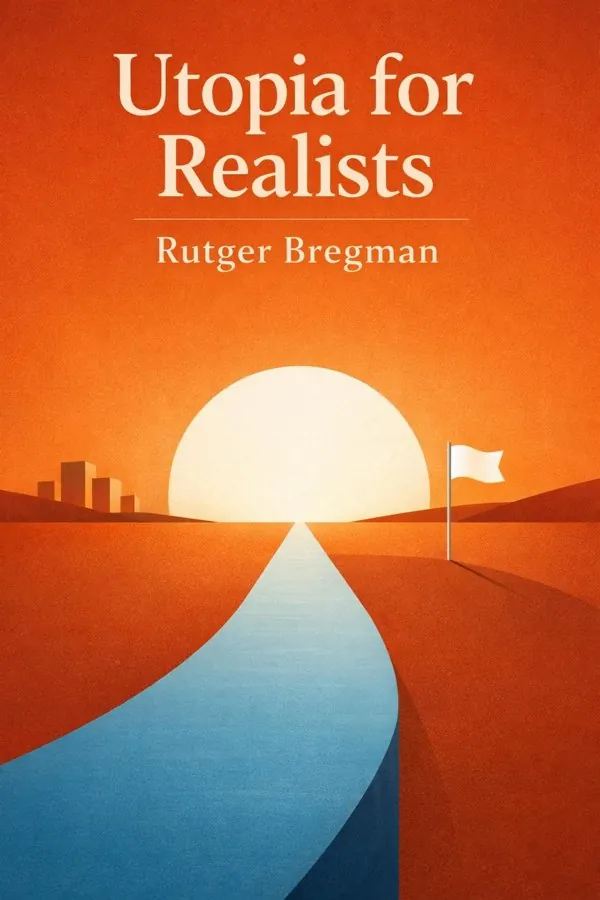
Utopia for Realists: How We Can Build the Ideal World: Summary & Key Insights
 10 min9 chaptersAudio available
Key Takeaways from Utopia for Realists: How We Can Build the Ideal World
One of history’s most consistent lessons is that yesterday’s absurdity often becomes today’s normality.
The most provocative claim in the book is that poverty persists not because society lacks resources, but because it lacks the will to distribute security directly.
At the heart of Bregman’s vision is universal basic income, or UBI: a regular, unconditional cash payment given to every citizen.
Modern societies are wealthier and more productive than any previous civilization, yet many people feel overworked, exhausted, and perpetually rushed.
A crucial distinction in Bregman’s argument is the difference between paid employment and socially valuable work.
What Is Utopia for Realists: How We Can Build the Ideal World About?
Utopia for Realists: How We Can Build the Ideal World by Rutger Bregman is a economics book spanning 8 pages. What if the ideas we dismiss as naive today become the common sense of tomorrow? In Utopia for Realists, Rutger Bregman challenges the narrow limits of modern political imagination and argues that some of the boldest proposals in public debate—universal basic income, a dramatically shorter workweek, and more open borders—are not fantasies, but practical responses to long-standing social and economic failures. Rather than asking readers to dream irresponsibly, he asks them to examine history: nearly every major social advance, from democracy to the end of child labor, was once ridiculed as impossible. Bregman writes with the range of a historian and the urgency of a reformer. Drawing on economic research, policy experiments, and case studies from around the world, he makes the case that poverty, overwork, and exclusion persist not because solutions are unavailable, but because our ambitions have shrunk. This book matters because it reopens questions many societies have stopped asking: What is work for? Why does poverty still exist amid abundance? And what would it take to build a society organized around human flourishing rather than mere survival? It is a provocative invitation to think bigger—and more concretely—about the future.
This FizzRead summary covers all 9 key chapters of Utopia for Realists: How We Can Build the Ideal World in approximately 10 minutes, distilling the most important ideas, arguments, and takeaways from Rutger Bregman's work. Also available as an audio summary and Key Quotes Podcast.
Utopia for Realists: How We Can Build the Ideal World
What if the ideas we dismiss as naive today become the common sense of tomorrow? In Utopia for Realists, Rutger Bregman challenges the narrow limits of modern political imagination and argues that some of the boldest proposals in public debate—universal basic income, a dramatically shorter workweek, and more open borders—are not fantasies, but practical responses to long-standing social and economic failures. Rather than asking readers to dream irresponsibly, he asks them to examine history: nearly every major social advance, from democracy to the end of child labor, was once ridiculed as impossible.
Bregman writes with the range of a historian and the urgency of a reformer. Drawing on economic research, policy experiments, and case studies from around the world, he makes the case that poverty, overwork, and exclusion persist not because solutions are unavailable, but because our ambitions have shrunk. This book matters because it reopens questions many societies have stopped asking: What is work for? Why does poverty still exist amid abundance? And what would it take to build a society organized around human flourishing rather than mere survival? It is a provocative invitation to think bigger—and more concretely—about the future.
Who Should Read Utopia for Realists: How We Can Build the Ideal World?
This book is perfect for anyone interested in economics and looking to gain actionable insights in a short read. Whether you're a student, professional, or lifelong learner, the key ideas from Utopia for Realists: How We Can Build the Ideal World by Rutger Bregman will help you think differently.
- ✓Readers who enjoy economics and want practical takeaways
- ✓Professionals looking to apply new ideas to their work and life
- ✓Anyone who wants the core insights of Utopia for Realists: How We Can Build the Ideal World in just 10 minutes
Want the full summary?
Get instant access to this book summary and 100K+ more with Fizz Moment.
Get Free SummaryAvailable on App Store • Free to download
Key Chapters
One of history’s most consistent lessons is that yesterday’s absurdity often becomes today’s normality. Bregman opens from this premise to show how badly we underestimate the power of ideas that initially sound unrealistic. Democracy was once seen as dangerous mob rule. The abolition of slavery was dismissed as economically impossible. Social protections such as public pensions, weekends, and labor laws were all attacked as reckless experiments before becoming pillars of civilized life. The point is not that every radical idea is wise, but that societies routinely confuse unfamiliarity with impossibility.
This historical perspective matters because it changes how we judge proposals in the present. Too often, debates about reform begin and end with what feels politically feasible right now. Bregman argues that this is a failure of imagination. Real progress usually starts with moral clarity and long-range thinking, not with cautious adjustments to the status quo. If people in the past had accepted the “realism” of their own era, many of the freedoms modern citizens enjoy would never have emerged.
In practical terms, this perspective invites readers to evaluate policies by their long-term social value rather than by their immediate acceptability. For example, ideas like universal basic income or shorter working hours may seem radical in current politics, yet they address problems that incremental reforms have failed to solve. Leaders, educators, and citizens can use historical memory as a tool: ask which present-day assumptions future generations may find cruel, shortsighted, or irrational.
The actionable takeaway is simple: whenever a proposal is dismissed as utopian, ask whether it is truly impossible—or merely ahead of its time.
The most provocative claim in the book is that poverty persists not because society lacks resources, but because it lacks the will to distribute security directly. Bregman rejects the idea that poverty is mainly caused by personal failure, poor character, or weak motivation. Instead, he presents poverty as a condition that drains mental bandwidth, narrows decision-making, and traps people in a cycle of stress and scarcity. In that sense, poverty is less a symptom of bad choices than a cause of them.
He supports this argument with research showing that scarcity itself reduces cognitive capacity. When people are constantly preoccupied with rent, food, debt, or emergencies, planning for the future becomes much harder. This helps explain why punitive welfare systems often fail: they assume people need more pressure, when what they really need is stability. Bregman points to evidence that providing people with money directly can improve health, educational outcomes, employment prospects, and overall well-being.
This insight has major practical implications. If poverty is a shortage of cash rather than a shortage of moral discipline, then anti-poverty policy should begin with giving people enough to live on. Programs such as cash transfers, housing support, and guaranteed income pilots often outperform bureaucratic systems that monitor and punish recipients. Even outside government, employers, schools, and nonprofits can apply the same principle by reducing scarcity-related stress instead of adding complexity.
The actionable takeaway: stop treating poverty as a personal defect to be corrected, and start treating it as a material problem that can be solved by providing economic security directly.
At the heart of Bregman’s vision is universal basic income, or UBI: a regular, unconditional cash payment given to every citizen. The power of this idea lies in its simplicity. Unlike means-tested welfare programs, UBI does not require recipients to prove hardship, navigate humiliating bureaucracy, or satisfy behavioral conditions. It begins from a more respectful assumption: people are generally capable of deciding what they need most.
Bregman argues that UBI is not merely an anti-poverty tool but a freedom-enhancing institution. A guaranteed income can allow people to leave abusive jobs, care for family members, pursue education, start businesses, or do creative and community work that the market undervalues. It can also reduce the administrative waste and stigma associated with fragmented welfare systems. In this sense, UBI is presented less as charity and more as a foundation for citizenship in a wealthy society.
The book discusses historical experiments and policy debates showing that direct cash support often produces better outcomes than critics expect. Contrary to the fear that people will stop contributing, many recipients use basic financial security to make better long-term decisions. A basic income can also help workers bargain for better pay and conditions, since survival no longer depends on accepting any job at any price.
For individuals, the appeal of UBI can be understood through everyday examples: a freelancer surviving between contracts, a parent reducing work hours to care for children, or a laid-off worker retraining without immediate desperation. The actionable takeaway is to evaluate social policy by one question: does it expand people’s real freedom to live meaningful lives? If not, it may be solving the wrong problem.
Modern societies are wealthier and more productive than any previous civilization, yet many people feel overworked, exhausted, and perpetually rushed. Bregman challenges the assumption that progress should lead to ever more production and consumption rather than more leisure. He revives an old promise of economic development: if technology makes us more productive, we should not simply produce more—we should also work less.
The idea of a much shorter workweek, even as bold as fifteen hours in the long run, forces readers to reconsider what economic success is for. If labor-saving innovation primarily increases profits while employees remain trapped in long schedules, then productivity gains are not translating into shared well-being. Bregman points out that earlier generations expected technology to dramatically reduce work hours. Instead, consumer culture, status competition, and unequal bargaining power helped preserve long working lives.
Practically, a shorter workweek can have multiple benefits. Employees often become more focused and productive when hours are reduced. Families gain time for caregiving and relationships. Communities benefit when people have more time for civic life, learning, and volunteering. Environmentally, less emphasis on constant output may also reduce wasteful consumption. Examples from companies and countries experimenting with four-day weeks suggest that lower hours do not automatically mean lower value.
This idea is relevant not only for policymakers but also for managers and workers. Teams can rethink unnecessary meetings, presenteeism, and the glorification of busyness. The actionable takeaway is to measure success not only by income or output, but by whether rising productivity buys people more time, health, and autonomy.
A crucial distinction in Bregman’s argument is the difference between paid employment and socially valuable work. Modern economies often treat a person’s job title and salary as proof of contribution, yet many forms of essential labor are unpaid, underpaid, or socially invisible. Childcare, elder care, volunteering, artistic creation, community organizing, and mutual aid all sustain society, even when markets do not reward them properly.
This insight helps explain why conventional labor statistics can be misleading. A system may boast high employment while still neglecting meaningful human needs. At the same time, some well-paid occupations may generate little genuine social benefit, especially when they are driven more by institutional complexity, financial engineering, or status signaling than by public value. Bregman pushes readers to ask not just whether people are working, but whether the work itself contributes to human flourishing.
The practical implications are significant. Policies such as UBI and reduced working hours become more compelling when we recognize that people need time and security to do valuable things outside the labor market. Parents caring for children, adults supporting aging relatives, or citizens participating in local civic life may be doing work every bit as important as what appears on a payroll. Organizations can also use this idea to redesign incentives so that meaningful contribution is rewarded, not just visible busyness.
On a personal level, this perspective invites reflection on career choices, burnout, and social expectations. The actionable takeaway is to broaden your definition of productive work: value contributions by the good they create, not only by the wages they command.
If one reform in the book seems even more politically explosive than basic income, it is Bregman’s defense of open borders. His argument begins with a stark observation: where a person is born remains one of the strongest predictors of lifetime opportunity. Talent is distributed widely across the world, but opportunity is not. Restrictive immigration systems trap millions of people in places where their skills cannot flourish, creating enormous waste on a global scale.
Bregman frames migration not only as a moral issue but also as an economic one. When workers can move to places where their productivity is much higher, the gains can be immense—for migrants themselves, for host societies, and often for families and communities in countries of origin through remittances and knowledge transfer. In this sense, borders function as barriers that preserve inequality by limiting one of the most powerful engines of prosperity: human mobility.
He does not deny that immigration raises practical questions about housing, integration, wages, and public services. But he challenges the reflex to treat these concerns as reasons for exclusion rather than as governance problems to be solved. History shows that societies can absorb newcomers when institutions, infrastructure, and political narratives support inclusion. Businesses, cities, and universities already benefit from diverse talent flows, demonstrating the value of openness.
For readers, the larger lesson is to question the moral and economic assumptions behind closed-border politics. The actionable takeaway is to evaluate immigration debates through a human-capacity lens: ask how many lives and contributions are being limited when mobility is denied.
A recurring theme in the book is that policymakers often prefer complicated systems that discipline the poor over simple systems that actually help them. This tendency comes from a deep mistrust of ordinary people. We worry that if support is unconditional, recipients will become lazy, irresponsible, or dependent. Bregman counters that this fear is frequently exaggerated and poorly supported by evidence.
Giving people cash may appear blunt, but it is often more effective than designing dense programs built around moral judgments. Bureaucracies spend enormous time deciding who deserves help, under what conditions, and with what surveillance. These systems are expensive, stigmatizing, and prone to error. By contrast, direct cash allows recipients to solve the problems they themselves understand best. One family may need rent money, another transportation, another childcare. No centralized rulebook can match local knowledge.
This principle extends beyond government welfare. Philanthropy, nonprofit aid, and disaster relief increasingly use direct cash because it preserves dignity and reduces waste. Even inside organizations, trust-based support can outperform rigid compliance structures. For example, giving employees flexible budgets or time autonomy often leads to better outcomes than controlling every decision from above.
Bregman is not arguing that all institutions should vanish or that incentives never matter. He is arguing that policy should begin with realism about human behavior: people generally respond well to trust, security, and room to make decisions. The actionable takeaway is to favor support systems that are simple, direct, and dignity-preserving over those designed primarily to police behavior.
One reason unjust systems endure is that people stop imagining alternatives. Bregman argues that realism, as commonly used in politics, often serves as a disguise for resignation. We are told to be pragmatic, moderate, and serious, but these terms can become excuses for defending arrangements that are plainly failing. In that environment, imagination is not escapism—it is a civic responsibility.
The book insists that better futures are built twice: first in thought, then in institutions. Without a compelling picture of what society could look like, politics becomes a matter of technical management rather than moral direction. Bregman wants readers to recover the courage to propose goals large enough to inspire action. That does not mean ignoring trade-offs or implementation challenges. It means beginning with a destination worth moving toward.
This mindset has practical applications in public life, leadership, and personal decision-making. Cities can imagine transport systems built around access rather than car dependency. Schools can imagine education aimed at curiosity rather than standardized sorting. Workplaces can imagine success measured by outcomes and well-being rather than hours logged. Social change movements, from civil rights to climate activism, have always depended on making the invisible future feel concrete and achievable.
For individuals, this chapter is an invitation to stop outsourcing possibility to experts and elites. Ask what a humane society would look like if basic security, time, and mobility were guaranteed more broadly. The actionable takeaway is to practice disciplined imagination: combine moral ambition with evidence, and refuse to let present constraints define permanent limits.
Although Utopia for Realists celebrates ambitious thinking, Bregman is not arguing for fantasy detached from policy design. A major strength of the book is its insistence that visionary goals must be paired with real-world experimentation, evidence, and institutional reform. The question is not whether bold ideas are risky; it is whether clinging to broken systems is even riskier.
For proposals like UBI, shorter workweeks, and greater freedom of movement, implementation matters. How would a basic income interact with existing welfare programs? How should tax systems fund it? What labor protections are needed if work hours are reduced? How can cities prepare for migration with investments in housing, schools, and integration? Bregman does not pretend these questions are trivial. Instead, he argues they are exactly the kinds of questions policymakers should be working on if they take human progress seriously.
This approach reflects a useful model for change: start with a clear moral horizon, test ideas through pilots, refine them with data, and build public support through results. Many reforms that now seem normal followed this path. Practical examples include local guaranteed-income experiments, trial four-day workweeks, and targeted immigration pathways that demonstrate benefits before larger expansion. The point is to create proof, not wait for perfect certainty.
Readers can apply this lesson in their own institutions. Rather than debating ideals abstractly forever, run small experiments: simplify aid, reduce meetings, grant more autonomy, measure outcomes. The actionable takeaway is to treat utopian thinking as a guide for practical experimentation—bold in vision, rigorous in execution.
All Chapters in Utopia for Realists: How We Can Build the Ideal World
About the Author
Rutger Bregman is a Dutch historian, author, and prominent public thinker whose work focuses on history, economics, inequality, and social progress. He is best known for translating big, often controversial ideas into accessible arguments for general readers, especially around topics such as universal basic income, the future of work, and institutional reform. Bregman gained international attention through his writing and high-profile public appearances, where he challenged political and business elites to think more boldly about fairness and prosperity. His articles and essays have appeared in major outlets including The Correspondent and The Guardian. Across his work, he consistently argues that many social problems persist not from lack of resources, but from lack of imagination, courage, and willingness to redesign outdated systems.
Get This Summary in Your Preferred Format
Read or listen to the Utopia for Realists: How We Can Build the Ideal World summary by Rutger Bregman anytime, anywhere. FizzRead offers multiple formats so you can learn on your terms — all free.
Available formats: App · Audio · PDF · EPUB — All included free with FizzRead
Download Utopia for Realists: How We Can Build the Ideal World PDF and EPUB Summary
Key Quotes from Utopia for Realists: How We Can Build the Ideal World
“One of history’s most consistent lessons is that yesterday’s absurdity often becomes today’s normality.”
“The most provocative claim in the book is that poverty persists not because society lacks resources, but because it lacks the will to distribute security directly.”
“At the heart of Bregman’s vision is universal basic income, or UBI: a regular, unconditional cash payment given to every citizen.”
“Modern societies are wealthier and more productive than any previous civilization, yet many people feel overworked, exhausted, and perpetually rushed.”
“A crucial distinction in Bregman’s argument is the difference between paid employment and socially valuable work.”
Frequently Asked Questions about Utopia for Realists: How We Can Build the Ideal World
Utopia for Realists: How We Can Build the Ideal World by Rutger Bregman is a economics book that explores key ideas across 9 chapters. What if the ideas we dismiss as naive today become the common sense of tomorrow? In Utopia for Realists, Rutger Bregman challenges the narrow limits of modern political imagination and argues that some of the boldest proposals in public debate—universal basic income, a dramatically shorter workweek, and more open borders—are not fantasies, but practical responses to long-standing social and economic failures. Rather than asking readers to dream irresponsibly, he asks them to examine history: nearly every major social advance, from democracy to the end of child labor, was once ridiculed as impossible. Bregman writes with the range of a historian and the urgency of a reformer. Drawing on economic research, policy experiments, and case studies from around the world, he makes the case that poverty, overwork, and exclusion persist not because solutions are unavailable, but because our ambitions have shrunk. This book matters because it reopens questions many societies have stopped asking: What is work for? Why does poverty still exist amid abundance? And what would it take to build a society organized around human flourishing rather than mere survival? It is a provocative invitation to think bigger—and more concretely—about the future.
More by Rutger Bregman

You Might Also Like

Business Adventures
John Brooks
10 min
Nudge
Richard H. Thaler, Cass R. Sunstein
10 min
The Hitchhiker"s Guide to the Galaxy
Douglas Adams
10 minThe Muqaddimah
Ibn Khaldun
10 minThe Outsiders
William N. Thorndike
10 min
A Little History of Economics
Niall Kishtainy
10 minBrowse by Category
Ready to read Utopia for Realists: How We Can Build the Ideal World?
Get the full summary and 100K+ more books with Fizz Moment.