
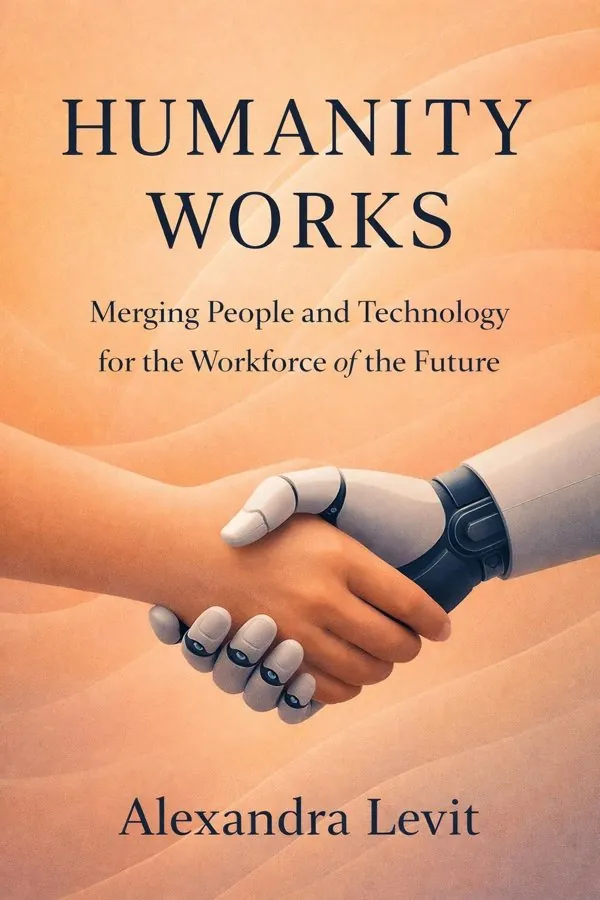
Humanity Works: Merging People and Technology for the Workforce of the Future: Summary & Key Insights
 10 min9 chaptersAudio available
Key Takeaways from Humanity Works: Merging People and Technology for the Workforce of the Future
The most important mistake people make about the future of work is assuming it belongs to some distant decade.
As machines become better at calculation, prediction, and repetition, the qualities that make us most human become more economically important.
Rigid hierarchies were designed for a slower, more predictable world.
Digital tools promise connection, but connection is not the same as collaboration.
In a world where tasks evolve faster than job titles, the old promise of career security through static expertise no longer holds.
What Is Humanity Works: Merging People and Technology for the Workforce of the Future About?
Humanity Works: Merging People and Technology for the Workforce of the Future by Alexandra Levit is a future_trends book spanning 9 pages. Humanity Works examines one of the defining questions of our era: as artificial intelligence, automation, data systems, and digital platforms reshape the economy, what role will human beings play at work? Alexandra Levit argues that the future is not a simple contest between people and machines. Instead, it is a redesign of work itself, where success depends on combining technological efficiency with distinctly human strengths such as judgment, empathy, ethics, creativity, and adaptability. The book matters because it moves beyond fear-driven headlines and simplistic predictions. Rather than asking which jobs will disappear, Levit asks how organizations, leaders, and workers can evolve in practical, intelligent ways. She explores changing organizational structures, reskilling, leadership, collaboration, and employee experience, offering a grounded view of how work is already changing. Levit brings strong authority to the topic as a workplace author, consultant, and advisor on future workforce trends. Her perspective blends research, business insight, and strategic realism, making Humanity Works a valuable guide for anyone trying to navigate the rapidly changing relationship between people and technology.
This FizzRead summary covers all 9 key chapters of Humanity Works: Merging People and Technology for the Workforce of the Future in approximately 10 minutes, distilling the most important ideas, arguments, and takeaways from Alexandra Levit's work. Also available as an audio summary and Key Quotes Podcast.
Humanity Works: Merging People and Technology for the Workforce of the Future
Humanity Works examines one of the defining questions of our era: as artificial intelligence, automation, data systems, and digital platforms reshape the economy, what role will human beings play at work? Alexandra Levit argues that the future is not a simple contest between people and machines. Instead, it is a redesign of work itself, where success depends on combining technological efficiency with distinctly human strengths such as judgment, empathy, ethics, creativity, and adaptability. The book matters because it moves beyond fear-driven headlines and simplistic predictions. Rather than asking which jobs will disappear, Levit asks how organizations, leaders, and workers can evolve in practical, intelligent ways. She explores changing organizational structures, reskilling, leadership, collaboration, and employee experience, offering a grounded view of how work is already changing. Levit brings strong authority to the topic as a workplace author, consultant, and advisor on future workforce trends. Her perspective blends research, business insight, and strategic realism, making Humanity Works a valuable guide for anyone trying to navigate the rapidly changing relationship between people and technology.
Who Should Read Humanity Works: Merging People and Technology for the Workforce of the Future?
This book is perfect for anyone interested in future_trends and looking to gain actionable insights in a short read. Whether you're a student, professional, or lifelong learner, the key ideas from Humanity Works: Merging People and Technology for the Workforce of the Future by Alexandra Levit will help you think differently.
- ✓Readers who enjoy future_trends and want practical takeaways
- ✓Professionals looking to apply new ideas to their work and life
- ✓Anyone who wants the core insights of Humanity Works: Merging People and Technology for the Workforce of the Future in just 10 minutes
Want the full summary?
Get instant access to this book summary and 100K+ more with Fizz Moment.
Get Free SummaryAvailable on App Store • Free to download
Key Chapters
The most important mistake people make about the future of work is assuming it belongs to some distant decade. Alexandra Levit makes it clear that the transformation is already underway, embedded in the tools, expectations, and business models shaping everyday work. Automation handles repetitive tasks, artificial intelligence supports decision-making, and digital platforms redefine how organizations hire, manage, and collaborate. The future of work is not an abstract prediction; it is the current reality unfolding unevenly across industries.
Levit encourages readers to stop thinking in terms of dramatic overnight replacement and start thinking in terms of gradual redesign. Jobs rarely disappear all at once. Instead, tasks within jobs change. A customer service role may now involve working alongside chatbots. A recruiter may use AI to screen candidates but still rely on human judgment to assess fit. A logistics manager may depend on predictive analytics while making final operational decisions based on context and experience.
This shift affects organizations as much as individuals. Businesses that treat technology as a side project risk falling behind, while those that align digital tools with strategic goals can become more agile and resilient. For workers, the implication is just as serious: career stability no longer comes from holding a single set of skills but from remaining relevant as tools and expectations evolve.
Levit's point is not to create anxiety, but urgency. The organizations and professionals who thrive will be those who recognize that adaptation cannot wait. Actionable takeaway: audit your current work today and identify which tasks are being automated, augmented, or newly created so you can prepare for change before it becomes disruptive.
As machines become better at calculation, prediction, and repetition, the qualities that make us most human become more economically important. This is the central insight of Humanity Works: technology does not erase the value of people; it changes where that value lies. Levit argues that human advantage rests in capabilities that are difficult to replicate with code alone, including empathy, ethical reasoning, imagination, relationship-building, contextual judgment, and the ability to navigate ambiguity.
A machine can analyze patterns in customer behavior, but it cannot truly understand emotional nuance in a difficult conversation. An algorithm may recommend efficient staffing levels, but it cannot weigh morale, trust, and cultural impact with the depth a skilled manager can. Creativity, too, becomes more meaningful when combined with technological capability. The best future professionals will not reject digital tools; they will use them to amplify uniquely human contributions.
This idea has direct implications for education, hiring, and career development. Employers should look beyond technical credentials and prioritize traits like collaboration, communication, adaptability, and discernment. Individuals should invest in strengthening the skills that help them interpret, question, persuade, care, and invent. Teams should be built not only for technical efficiency but for complementary thinking and emotional intelligence.
Levit does not suggest that human skills are soft in the sense of secondary. In a technology-driven economy, they are strategic assets. They create trust with customers, cohesion in teams, and responsible choices in uncertain situations. Actionable takeaway: identify three distinctly human strengths you bring to your work and deliberately build roles, projects, and learning plans that make those strengths more visible and valuable.
Rigid hierarchies were designed for a slower, more predictable world. Levit argues that in the digital era, organizations need structures that can respond quickly to changing markets, emerging technologies, and shifting workforce expectations. The traditional model of fixed job descriptions, long chains of command, and tightly controlled information flow is increasingly mismatched with the realities of modern work.
In its place, Levit highlights more fluid organizational designs. These may include cross-functional teams, project-based assignments, flatter management structures, and networks of full-time employees, contractors, freelancers, and technology systems working together. The goal is not disorder but responsiveness. A company launching a new product, for example, may need marketers, data scientists, designers, and operations specialists to collaborate rapidly rather than operate in isolated departments. Likewise, an organization facing sudden disruption benefits from decision-making that happens closer to the problem.
This evolution also changes what employees need from employers. People want clarity of purpose, but they also want room to move, learn, and contribute across boundaries. Organizations that support internal mobility and adaptive roles are often better able to retain talent and redeploy skills where they are most needed.
Levit is careful to note that flexibility requires discipline. Without clear communication, shared goals, and strong leadership, fluid structures can create confusion. The challenge is to combine agility with alignment. Actionable takeaway: review whether your team structure supports fast collaboration and skill mobility, then redesign one outdated process or reporting line that slows down effective work.
Digital tools promise connection, but connection is not the same as collaboration. Levit emphasizes that technology creates value only when it helps people work together more intelligently, not when it merely adds more platforms, notifications, and complexity. In the workplace of the future, technology should serve as an enabler of coordination, knowledge-sharing, and collective problem-solving.
Collaboration technology can take many forms: cloud-based workspaces, project management systems, video conferencing, digital whiteboards, communication channels, workflow automation, and AI tools that summarize information or surface insights. Used well, these systems reduce friction. A global team can coordinate across time zones. Remote employees can contribute meaningfully. Expertise can be documented and shared rather than trapped in silos. A manager can spend less time chasing status updates and more time coaching the team.
But Levit also points to the downside of poorly designed digital collaboration. Too many tools create fragmented communication. Constant connectivity can damage focus and increase burnout. A team may appear aligned online while actually suffering from misunderstanding, exclusion, or lack of accountability. Technology does not automatically produce trust, clarity, or engagement; people and processes still matter.
The most effective organizations pair collaboration tools with deliberate norms. They define which platforms are used for what purpose, how decisions are documented, when meetings are necessary, and how remote and in-person participants are included equally. Actionable takeaway: choose one collaboration tool your team already uses and improve the human system around it by setting clearer expectations for communication, ownership, and inclusion.
In a world where tasks evolve faster than job titles, the old promise of career security through static expertise no longer holds. Levit argues that reskilling and lifelong learning are now essential for both organizational survival and individual employability. The future belongs not to those who know the most today, but to those who can keep learning as work changes.
This does not mean everyone must become a programmer or data scientist. Levit's view is broader and more practical. Reskilling includes learning how to work with automation, interpret data, manage digital workflows, and adapt to new tools. It also includes strengthening human capabilities like critical thinking, communication, and decision-making in environments shaped by technology. For example, a finance professional may need to learn analytics platforms, while a healthcare worker may need to integrate telehealth systems into patient care.
Organizations have a major role to play. Employers can no longer expect to hire all needed capabilities from the outside. Talent shortages, technological speed, and changing business models make internal development a strategic necessity. Companies should create learning pathways, mentorship, rotational opportunities, and accessible training tied to actual work needs. Learning must become part of the culture, not a side benefit.
For individuals, reskilling starts with humility and initiative. Waiting until a role is threatened is often too late. The stronger approach is to regularly examine industry trends, identify adjacent skills, and build them before they become urgent. Actionable takeaway: create a personal reskilling plan by selecting one technology skill and one human skill you need for the next three years, then schedule specific steps to develop both.
The digital age does not reduce the need for leadership; it raises the standard for it. Levit argues that leading in a technology-rich environment requires more than operational oversight. Leaders must make sense of uncertainty, guide people through change, and ensure that technology adoption serves human and organizational goals rather than undermining them.
Traditional command-and-control leadership is less effective in fast-moving, knowledge-driven workplaces. Employees often possess specialized expertise, work across functions, and operate in hybrid or remote settings where direct supervision is limited. This means leaders must shift from controlling work to enabling it. They need to communicate a compelling vision, foster trust, encourage experimentation, and help teams navigate ambiguity without becoming paralyzed by it.
Levit also emphasizes digital fluency. Leaders do not need to master every system, but they must understand enough about data, automation, and AI to ask good questions and make responsible decisions. A leader who cannot evaluate the implications of algorithmic hiring, surveillance software, or workflow automation may unintentionally damage culture, ethics, or productivity.
At the same time, the human side of leadership becomes more important, not less. In periods of disruption, employees look for empathy, transparency, and psychological safety. They want honesty about change, opportunities to contribute, and confidence that they are being treated fairly. The best leaders combine strategic awareness with emotional intelligence. Actionable takeaway: assess your leadership style in one current change initiative and ask whether you are merely implementing technology or truly helping people adapt, trust, and perform within it.
A productive workforce is not created by technology alone. Levit argues that as work becomes more digitized, employee experience becomes a central competitive advantage. This includes how people feel about their work, how easily they can do it, whether they trust leadership, and whether they believe the organization supports their growth, well-being, and sense of purpose.
The future of work is often discussed in terms of systems and efficiency, but Levit reminds us that engagement is shaped by everyday reality. Does technology simplify tasks or create frustration? Do employees have flexibility, or are they digitally monitored in ways that erode trust? Are remote workers included, or are they treated as second-tier participants? Is communication transparent, or are people left guessing about how change affects them?
Organizations that design work around human needs often perform better over time. For instance, thoughtful hybrid policies can improve retention. Clear digital onboarding can help new hires become productive faster. Personalized learning platforms can increase development and mobility. Benefits that support mental health and work-life integration can reduce burnout and absenteeism. Employee experience is not a soft concern separate from business outcomes; it influences commitment, innovation, customer service, and resilience.
Levit's underlying message is that technology should make work more meaningful and manageable, not colder and more extractive. Companies that ignore this risk disengagement even if their digital systems look advanced on paper. Actionable takeaway: map one employee journey, such as onboarding or performance review, and redesign it to reduce friction, increase clarity, and better support the human experience of work.
One of the most urgent questions in the future of work is not what technology can do, but what it should do. Levit highlights the ethical and social implications of workplace technology, arguing that organizations must take responsibility for how they deploy systems that affect hiring, evaluation, productivity, privacy, and opportunity. Efficiency without ethics creates long-term risk.
Algorithms can streamline recruiting, but they may also replicate historical bias if trained on flawed data. Monitoring software can increase visibility into workflow, but it can also produce a culture of surveillance that damages trust and autonomy. Automation can improve productivity, yet it may displace workers without adequate support, widening inequality and undermining social stability. These are not technical problems alone; they are leadership and governance issues.
Levit urges organizations to think carefully about fairness, transparency, consent, and accountability. Employees should understand how technology is being used and how decisions are made. Leaders should evaluate whether a system's outputs are accurate, equitable, and aligned with organizational values. Human oversight remains essential, especially when technology influences high-stakes outcomes such as promotion, pay, scheduling, or hiring.
This ethical lens also matters for individuals. Workers need the confidence to question harmful systems and advocate for responsible implementation. The future of work should not be built solely around what is possible, but around what is humane. Actionable takeaway: before adopting any new workplace technology, ask four questions: Is it fair, transparent, necessary, and accountable, and who is responsible if it causes harm?
The future of work rewards preparation more than prediction. Levit argues that no organization or individual can know exactly how technology, labor markets, and business models will evolve, but waiting for certainty is a losing strategy. Those who prepare early build resilience, optionality, and confidence, while those who delay are forced into reactive decisions under pressure.
Preparation begins with mindset. Instead of asking whether change is coming, Levit suggests asking where change is already visible and what capabilities will matter next. A company might scan which roles are becoming more data-driven, which processes could be augmented by automation, and which skills are emerging across competitors. An individual might notice that their field increasingly values digital literacy, cross-functional collaboration, or entrepreneurial thinking.
From there, preparation becomes a series of practical moves: investing in learning, redesigning roles, updating leadership models, testing new tools, building adaptable teams, and creating scenarios for different futures. For example, a mid-sized company could pilot AI support tools in one department before a full rollout. A professional in a stable role could volunteer for a digital transformation project to gain exposure before such experience becomes mandatory.
Levit's broader contribution is her insistence that the future of work is not something that happens to us. It is something we shape through choices made today. Preparation does not eliminate uncertainty, but it turns uncertainty into an arena for advantage. Actionable takeaway: set aside time each quarter to review emerging trends in your industry and convert one insight into a concrete action for your role, team, or organization.
All Chapters in Humanity Works: Merging People and Technology for the Workforce of the Future
About the Author
Alexandra Levit is an American business author, consultant, and speaker specializing in career development, workplace trends, and the future of work. She has built a reputation for helping organizations and professionals understand how technology, demographic shifts, and changing business models are reshaping employment. Over the course of her career, she has written several books on work, leadership, and professional growth, and she has advised companies, educational institutions, and government organizations on talent strategy and workforce readiness. Levit is known for translating broad economic and technological changes into practical guidance that leaders and employees can actually use. In Humanity Works, she brings together her expertise in organizational change and career strategy to examine how people and technology can thrive together in the evolving workplace.
Get This Summary in Your Preferred Format
Read or listen to the Humanity Works: Merging People and Technology for the Workforce of the Future summary by Alexandra Levit anytime, anywhere. FizzRead offers multiple formats so you can learn on your terms — all free.
Available formats: App · Audio · PDF · EPUB — All included free with FizzRead
Download Humanity Works: Merging People and Technology for the Workforce of the Future PDF and EPUB Summary
Key Quotes from Humanity Works: Merging People and Technology for the Workforce of the Future
“The most important mistake people make about the future of work is assuming it belongs to some distant decade.”
“As machines become better at calculation, prediction, and repetition, the qualities that make us most human become more economically important.”
“Rigid hierarchies were designed for a slower, more predictable world.”
“Digital tools promise connection, but connection is not the same as collaboration.”
“In a world where tasks evolve faster than job titles, the old promise of career security through static expertise no longer holds.”
Frequently Asked Questions about Humanity Works: Merging People and Technology for the Workforce of the Future
Humanity Works: Merging People and Technology for the Workforce of the Future by Alexandra Levit is a future_trends book that explores key ideas across 9 chapters. Humanity Works examines one of the defining questions of our era: as artificial intelligence, automation, data systems, and digital platforms reshape the economy, what role will human beings play at work? Alexandra Levit argues that the future is not a simple contest between people and machines. Instead, it is a redesign of work itself, where success depends on combining technological efficiency with distinctly human strengths such as judgment, empathy, ethics, creativity, and adaptability. The book matters because it moves beyond fear-driven headlines and simplistic predictions. Rather than asking which jobs will disappear, Levit asks how organizations, leaders, and workers can evolve in practical, intelligent ways. She explores changing organizational structures, reskilling, leadership, collaboration, and employee experience, offering a grounded view of how work is already changing. Levit brings strong authority to the topic as a workplace author, consultant, and advisor on future workforce trends. Her perspective blends research, business insight, and strategic realism, making Humanity Works a valuable guide for anyone trying to navigate the rapidly changing relationship between people and technology.
You Might Also Like
Futureproof: 9 Rules for Humans in the Age of Automation
Kevin Roose
10 min
The Third Wave
Alvin Toffler
10 min
2030: How Today's Biggest Trends Will Collide and Reshape the Future of Everything
Mauro F. Guillén
10 min
A Very Human Future: Enriching Humanity in a Digitized World
Rohit Talwar, Steve Wells, Alexandra Whittington
10 min
AI 2041: Ten Visions for Our Future
Kai-Fu Lee, Chen Qiufan
10 min
Abundance: The Future Is Better Than You Think
Peter H. Diamandis, Steven Kotler
10 minBrowse by Category
Ready to read Humanity Works: Merging People and Technology for the Workforce of the Future?
Get the full summary and 100K+ more books with Fizz Moment.