
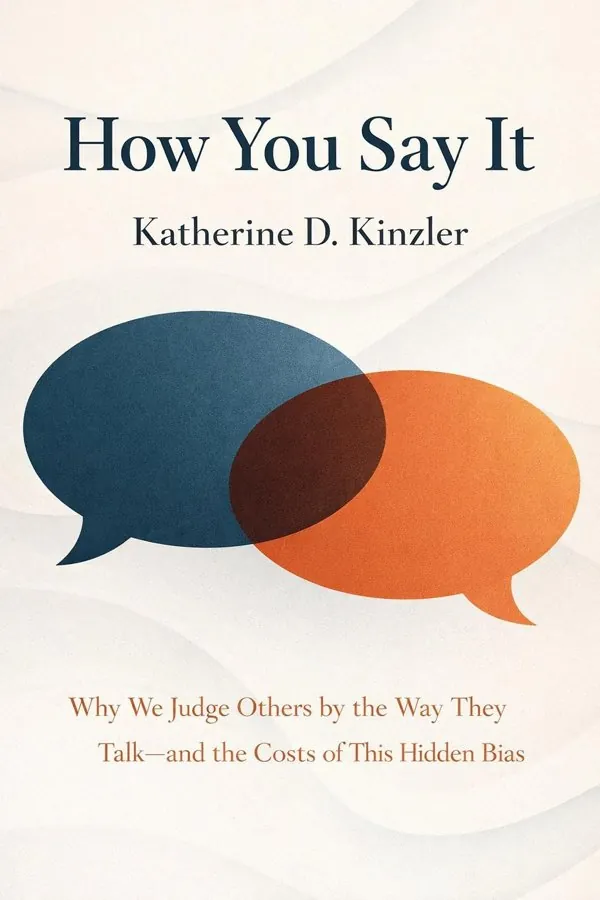
How You Say It: Why We Judge Others by the Way They Talk—and the Costs of This Hidden Bias: Summary & Key Insights
 10 min9 chaptersAudio available
What Is How You Say It: Why We Judge Others by the Way They Talk—and the Costs of This Hidden Bias About?
How You Say It: Why We Judge Others by the Way They Talk—and the Costs of This Hidden Bias by Katherine D. Kinzler is a cognition book spanning 9 pages. In this insightful work, psychologist Katherine D. Kinzler explores how the way we speak shapes social perception, identity, and bias. Drawing on research in psychology and linguistics, she reveals how accents and speech patterns influence judgments about intelligence, trustworthiness, and belonging, uncovering the hidden social costs of linguistic prejudice.
This FizzRead summary covers all 9 key chapters of How You Say It: Why We Judge Others by the Way They Talk—and the Costs of This Hidden Bias in approximately 10 minutes, distilling the most important ideas, arguments, and takeaways from Katherine D. Kinzler's work. Also available as an audio summary and Key Quotes Podcast.
How You Say It: Why We Judge Others by the Way They Talk—and the Costs of This Hidden Bias
In this insightful work, psychologist Katherine D. Kinzler explores how the way we speak shapes social perception, identity, and bias. Drawing on research in psychology and linguistics, she reveals how accents and speech patterns influence judgments about intelligence, trustworthiness, and belonging, uncovering the hidden social costs of linguistic prejudice.
Who Should Read How You Say It: Why We Judge Others by the Way They Talk—and the Costs of This Hidden Bias?
This book is perfect for anyone interested in cognition and looking to gain actionable insights in a short read. Whether you're a student, professional, or lifelong learner, the key ideas from How You Say It: Why We Judge Others by the Way They Talk—and the Costs of This Hidden Bias by Katherine D. Kinzler will help you think differently.
- ✓Readers who enjoy cognition and want practical takeaways
- ✓Professionals looking to apply new ideas to their work and life
- ✓Anyone who wants the core insights of How You Say It: Why We Judge Others by the Way They Talk—and the Costs of This Hidden Bias in just 10 minutes
Want the full summary?
Get instant access to this book summary and 100K+ more with Fizz Moment.
Get Free SummaryAvailable on App Store • Free to download
Key Chapters
One of the most revealing insights from developmental psychology is that babies are astonishingly quick to notice who sounds like them and who doesn’t. In experiments, when infants hear two speakers — one speaking their native language and one speaking a foreign tongue — they will reliably prefer the familiar voice. When given a chance to observe people interacting, young children choose playmates who speak their language or accent over those who do not. This bias emerges before concepts of ethnicity or geography take hold.
Through these early preferences, language becomes a template for social knowledge. A child’s linguistic world is a map of belonging. Their choices are not born of hatred or intent but of an innate drive toward predictability and comfort. Yet these early patterns quietly evolve into social biases that persist into adulthood, coloring perceptions of competence, friendliness, even moral character.
The striking part is how subtle environmental reinforcement maintains these patterns. Parents, schools, and media constantly supply cues about which kinds of speech are valued. Certain accents are portrayed as sophisticated; others as comic or coarse. By absorbing these subtleties, children learn not just how to speak but how to rank speakers. It is a process so natural that it seems harmless — until we recognize that it forms the psychological basis of lifelong discrimination.
To study linguistic bias is to confront its invisibility. Unlike race or gender, accent is fluid; people can consciously modify it, yet cannot escape its judgments. The developmental evidence shows that linguistic bias takes root before children learn the social narrative that typically explains prejudice. This suggests that education about diversity must include not only visual representation but auditory awareness — helping children hear difference without hierarchy.
+ 7 more chapters — available in the FizzRead app
All Chapters in How You Say It: Why We Judge Others by the Way They Talk—and the Costs of This Hidden Bias
About the Author
Katherine D. Kinzler is a professor of psychology at the University of Chicago, known for her research on language and social cognition. Her work examines how speech and accent affect social relationships and perceptions from early childhood through adulthood.
Get This Summary in Your Preferred Format
Read or listen to the How You Say It: Why We Judge Others by the Way They Talk—and the Costs of This Hidden Bias summary by Katherine D. Kinzler anytime, anywhere. FizzRead offers multiple formats so you can learn on your terms — all free.
Available formats: App · Audio · PDF · EPUB — All included free with FizzRead
Download How You Say It: Why We Judge Others by the Way They Talk—and the Costs of This Hidden Bias PDF and EPUB Summary
Key Quotes from How You Say It: Why We Judge Others by the Way They Talk—and the Costs of This Hidden Bias
“Language is far more than a system for transmitting information; it is a social code, a badge of identity, a constant announcement of who belongs to whom.”
“One of the most revealing insights from developmental psychology is that babies are astonishingly quick to notice who sounds like them and who doesn’t.”
Frequently Asked Questions about How You Say It: Why We Judge Others by the Way They Talk—and the Costs of This Hidden Bias
How You Say It: Why We Judge Others by the Way They Talk—and the Costs of This Hidden Bias by Katherine D. Kinzler is a cognition book that explores key ideas across 9 chapters. In this insightful work, psychologist Katherine D. Kinzler explores how the way we speak shapes social perception, identity, and bias. Drawing on research in psychology and linguistics, she reveals how accents and speech patterns influence judgments about intelligence, trustworthiness, and belonging, uncovering the hidden social costs of linguistic prejudice.
You Might Also Like
A Field Guide to Lies: Critical Thinking in the Information Age
Daniel J. Levitin
10 min
A Theory of Cognitive Dissonance
Leon Festinger
10 min
Black-And-White Thinking: The Burden of a Binary Brain in a Complex World
Kevin Dutton
10 min
Born Liars: Why We Can’t Live Without Deceit
Ian Leslie
10 min
Collective Illusions: Conformity, Complicity, and the Science of Why We Make Bad Decisions
Todd Rose
10 min
Concrete Mathematics: A Foundation for Computer Science
Ronald L. Graham, Donald E. Knuth, Oren Patashnik
10 minBrowse by Category
Ready to read How You Say It: Why We Judge Others by the Way They Talk—and the Costs of This Hidden Bias?
Get the full summary and 100K+ more books with Fizz Moment.