
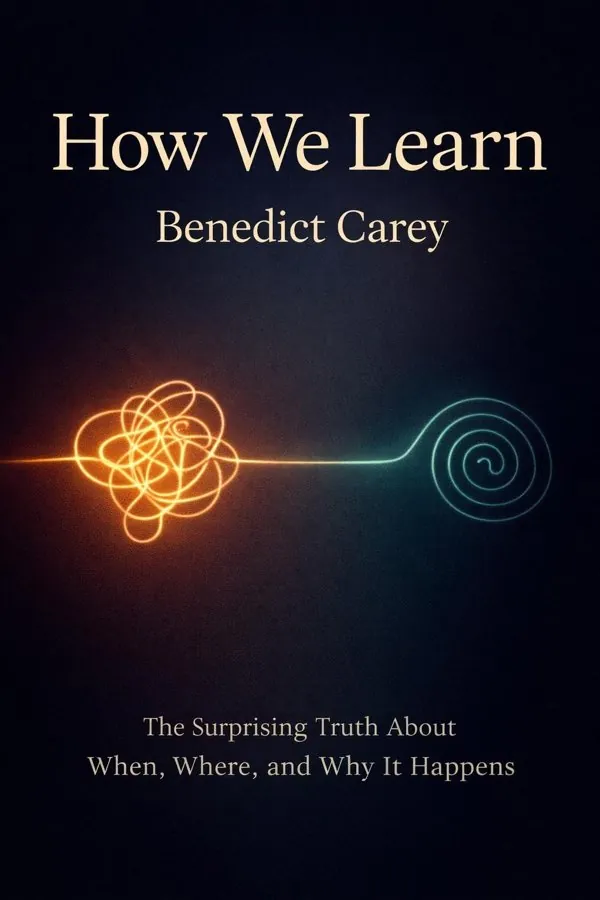
How We Learn: The Surprising Truth About When, Where, and Why It Happens: Summary & Key Insights
 10 min12 chaptersAudio available
What Is How We Learn: The Surprising Truth About When, Where, and Why It Happens About?
How We Learn: The Surprising Truth About When, Where, and Why It Happens by Benedict Carey is a cognition book spanning 12 pages. In this book, science writer Benedict Carey explores the cognitive and psychological mechanisms behind learning. Drawing on research from neuroscience, psychology, and education, Carey reveals how memory, forgetting, sleep, and even distraction play crucial roles in how we absorb and retain information. He challenges conventional study habits and offers evidence-based strategies to make learning more effective and enjoyable.
This FizzRead summary covers all 12 key chapters of How We Learn: The Surprising Truth About When, Where, and Why It Happens in approximately 10 minutes, distilling the most important ideas, arguments, and takeaways from Benedict Carey's work. Also available as an audio summary and Key Quotes Podcast.
How We Learn: The Surprising Truth About When, Where, and Why It Happens
In this book, science writer Benedict Carey explores the cognitive and psychological mechanisms behind learning. Drawing on research from neuroscience, psychology, and education, Carey reveals how memory, forgetting, sleep, and even distraction play crucial roles in how we absorb and retain information. He challenges conventional study habits and offers evidence-based strategies to make learning more effective and enjoyable.
Who Should Read How We Learn: The Surprising Truth About When, Where, and Why It Happens?
This book is perfect for anyone interested in cognition and looking to gain actionable insights in a short read. Whether you're a student, professional, or lifelong learner, the key ideas from How We Learn: The Surprising Truth About When, Where, and Why It Happens by Benedict Carey will help you think differently.
- ✓Readers who enjoy cognition and want practical takeaways
- ✓Professionals looking to apply new ideas to their work and life
- ✓Anyone who wants the core insights of How We Learn: The Surprising Truth About When, Where, and Why It Happens in just 10 minutes
Want the full summary?
Get instant access to this book summary and 100K+ more with Fizz Moment.
Get Free SummaryAvailable on App Store • Free to download
Key Chapters
For centuries, forgetting was treated as learning’s opposite — a failure of the mind to hold on. But the emerging research tells another story: forgetting is essential to how memory works. The brain, I explain, is not a computer that stores information exactly as it was input. It’s a living network that constantly prunes, reorganizes, and renews its connections. The act of forgetting is the mind’s way of prioritizing — distinguishing meaningful patterns from noise.
When we revisit knowledge after it begins to fade, the effort needed to recall it strengthens that memory. This is known as the “forgetting curve” and it’s not a flaw but a blueprint for smarter studying. Allowing some forgetting makes retrieval more demanding, and that difficulty cements learning. I share examples from experimental psychology, where students who allowed intervals between study sessions—long enough to forget a little—actually remembered more in the long term. The takeaway is that forgetting isn’t a lapse; it’s an invitation. It signals the ideal moment to relearn, when the brain’s plasticity is at its peak.
Closely tied to forgetting is the spacing effect: the discovery that learning spread out over time — even irregularly — vastly outperforms cramming. In the book, I describe how neuroscientists have tracked how memories stabilize during the gaps between study sessions. The brain uses downtime not to rest, but to consolidate. In experiments, students who broke study into short sessions across several days, rather than one marathon night, not only retained more but understood relationships between ideas more deeply.
Spacing turns learning into a layered process. Each return to the material is an encounter with slightly altered memory traces. This variability forces the mind to reconstruct knowledge, not merely repeat it. I recount my own experiences watching students test this in classrooms: the discomfort of returning to half-forgotten notes soon transforms into confidence. Spacing feels inefficient because you’re not seeing immediate progress, but beneath the surface, the brain is engaged in its most powerful work — solidifying durable knowledge.
+ 10 more chapters — available in the FizzRead app
All Chapters in How We Learn: The Surprising Truth About When, Where, and Why It Happens
About the Author
Benedict Carey is an American science journalist known for his work with The New York Times, where he covers psychology and neuroscience. He has written extensively on topics related to learning, memory, and mental health, combining scientific insight with accessible storytelling.
Get This Summary in Your Preferred Format
Read or listen to the How We Learn: The Surprising Truth About When, Where, and Why It Happens summary by Benedict Carey anytime, anywhere. FizzRead offers multiple formats so you can learn on your terms — all free.
Available formats: App · Audio · PDF · EPUB — All included free with FizzRead
Download How We Learn: The Surprising Truth About When, Where, and Why It Happens PDF and EPUB Summary
Key Quotes from How We Learn: The Surprising Truth About When, Where, and Why It Happens
“For centuries, forgetting was treated as learning’s opposite — a failure of the mind to hold on.”
“Closely tied to forgetting is the spacing effect: the discovery that learning spread out over time — even irregularly — vastly outperforms cramming.”
Frequently Asked Questions about How We Learn: The Surprising Truth About When, Where, and Why It Happens
How We Learn: The Surprising Truth About When, Where, and Why It Happens by Benedict Carey is a cognition book that explores key ideas across 12 chapters. In this book, science writer Benedict Carey explores the cognitive and psychological mechanisms behind learning. Drawing on research from neuroscience, psychology, and education, Carey reveals how memory, forgetting, sleep, and even distraction play crucial roles in how we absorb and retain information. He challenges conventional study habits and offers evidence-based strategies to make learning more effective and enjoyable.
You Might Also Like
A Field Guide to Lies: Critical Thinking in the Information Age
Daniel J. Levitin
10 min
A Theory of Cognitive Dissonance
Leon Festinger
10 min
Black-And-White Thinking: The Burden of a Binary Brain in a Complex World
Kevin Dutton
10 min
Born Liars: Why We Can’t Live Without Deceit
Ian Leslie
10 min
Collective Illusions: Conformity, Complicity, and the Science of Why We Make Bad Decisions
Todd Rose
10 min
Concrete Mathematics: A Foundation for Computer Science
Ronald L. Graham, Donald E. Knuth, Oren Patashnik
10 minBrowse by Category
Ready to read How We Learn: The Surprising Truth About When, Where, and Why It Happens?
Get the full summary and 100K+ more books with Fizz Moment.