
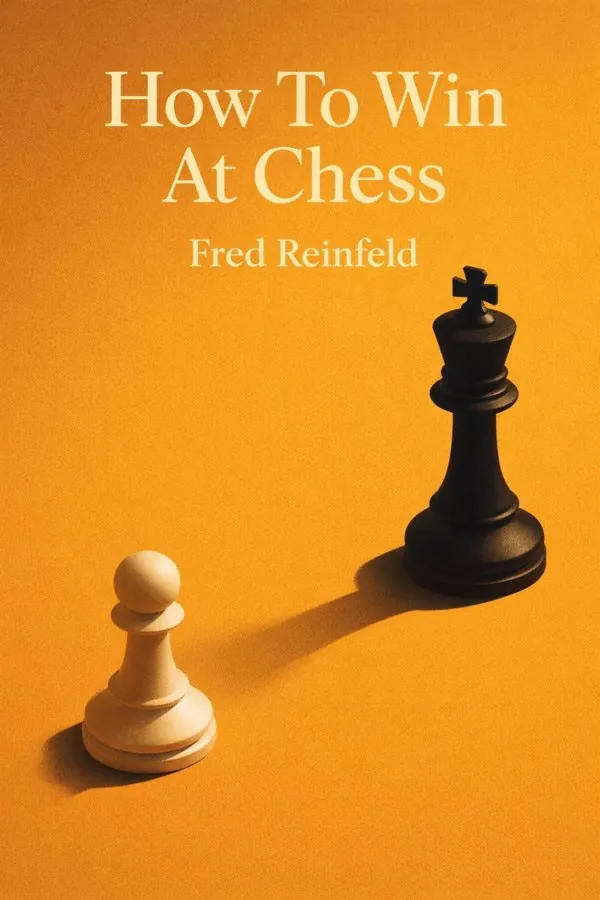
How To Win At Chess: Summary & Key Insights
 10 min9 chaptersAudio available
Key Takeaways from How To Win At Chess
Reinfeld starts from the foundation, explaining that each piece has a distinct character, value, and purpose.
Many players lose the opening before they realize they are doing anything wrong, not because they forgot theory, but because they ignored principles.
Chess games are often decided not by grand strategic visions but by short sequences hiding in plain sight.
When the opening ends, many players drift because they know moves but not plans.
Strong players often win not because they find spectacular combinations, but because they recognize and exploit small weaknesses with patience.
What Is How To Win At Chess About?
How To Win At Chess by Fred Reinfeld is a education book spanning 5 pages. How To Win At Chess is a practical, confidence-building guide to playing better chess by mastering the game’s core ideas rather than drowning in memorized variations. Fred Reinfeld explains chess as a game of logic, pattern recognition, and disciplined thinking, showing readers how strong play grows from understanding piece activity, king safety, tactical awareness, and simple planning. Instead of treating chess as an elite mystery, he presents it as a skill anyone can improve through study and practice. That approach is what makes the book enduringly useful. Beginners learn the rules, values, and purposes behind each piece, while improving players gain a clearer sense of how to handle openings, convert middlegame advantages, defend difficult positions, and play endgames with confidence. Reinfeld’s lessons are direct, accessible, and rooted in practical play, making the book especially valuable for readers who want improvement they can feel over the board. Reinfeld was one of the most influential popular chess authors of the twentieth century. His gift was turning complex strategic and tactical ideas into plain, memorable instruction, and this book stands as a strong example of that teaching power.
This FizzRead summary covers all 9 key chapters of How To Win At Chess in approximately 10 minutes, distilling the most important ideas, arguments, and takeaways from Fred Reinfeld's work. Also available as an audio summary and Key Quotes Podcast.
How To Win At Chess
How To Win At Chess is a practical, confidence-building guide to playing better chess by mastering the game’s core ideas rather than drowning in memorized variations. Fred Reinfeld explains chess as a game of logic, pattern recognition, and disciplined thinking, showing readers how strong play grows from understanding piece activity, king safety, tactical awareness, and simple planning. Instead of treating chess as an elite mystery, he presents it as a skill anyone can improve through study and practice.
That approach is what makes the book enduringly useful. Beginners learn the rules, values, and purposes behind each piece, while improving players gain a clearer sense of how to handle openings, convert middlegame advantages, defend difficult positions, and play endgames with confidence. Reinfeld’s lessons are direct, accessible, and rooted in practical play, making the book especially valuable for readers who want improvement they can feel over the board.
Reinfeld was one of the most influential popular chess authors of the twentieth century. His gift was turning complex strategic and tactical ideas into plain, memorable instruction, and this book stands as a strong example of that teaching power.
Who Should Read How To Win At Chess?
This book is perfect for anyone interested in education and looking to gain actionable insights in a short read. Whether you're a student, professional, or lifelong learner, the key ideas from How To Win At Chess by Fred Reinfeld will help you think differently.
- ✓Readers who enjoy education and want practical takeaways
- ✓Professionals looking to apply new ideas to their work and life
- ✓Anyone who wants the core insights of How To Win At Chess in just 10 minutes
Want the full summary?
Get instant access to this book summary and 100K+ more with Fizz Moment.
Get Free SummaryAvailable on App Store • Free to download
Key Chapters
Every chess improvement journey begins with a deceptively simple truth: if you do not fully understand what your pieces can do, you cannot fully understand what your position demands. Reinfeld starts from the foundation, explaining that each piece has a distinct character, value, and purpose. Pawns seem modest, yet they shape space, create weaknesses, and can one day promote into the strongest piece on the board. Knights thrive in closed positions and attack in surprising jumps. Bishops grow stronger on open diagonals. Rooks excel on open files and the seventh rank. The queen is powerful, but vulnerable if brought out too early. The king, though often sheltered, becomes a fighting piece in the endgame.
Piece value matters, but Reinfeld also teaches that value is not mechanical. A bishop may be worth more than a knight in an open position, while a knight may dominate in a blocked structure. A rook behind a passed pawn may become more important than a nominally equal minor piece. Understanding these relationships helps players avoid common beginner mistakes, such as trading active pieces for passive ones simply because the arithmetic looks equal.
Practical play improves when you ask better questions. Before every move, consider: Which of my pieces is strongest? Which is doing nothing? Which enemy piece is most dangerous? For example, if your rook sits trapped behind unmoved pawns while your knight has a strong outpost in the center, your plan should support the knight and activate the rook rather than making random pawn moves.
The first step to winning is not brilliance but clarity. Actionable takeaway: study each piece not just by its legal move, but by its ideal role, and in every game aim to improve your worst-placed piece.
Many players lose the opening before they realize they are doing anything wrong, not because they forgot theory, but because they ignored principles. Reinfeld’s message is refreshing: the opening is not a quiz on memorized moves but a test of good judgment. The essential goals are simple—control the center, develop your pieces efficiently, and make your king safe. If you keep these aims in mind, you can navigate many positions without needing encyclopedic knowledge.
Control of the center matters because central squares give your pieces mobility and influence. A knight on f3 helps, but a knight on e5 often dominates. Development matters because undeveloped pieces are useless spectators. King safety matters because an exposed king turns every enemy move into a potential threat. Reinfeld warns against familiar opening sins: moving the same piece repeatedly without reason, bringing out the queen too early, grabbing pawns while neglecting development, and delaying castling in search of flashy attacks.
A practical example is the beginner’s temptation to launch the queen out for early threats. It may win a pawn against careless opposition, but against accurate play it often becomes a target, forcing repeated queen moves while the opponent develops naturally. The result is a position where one side has active pieces and the other has a wandering queen and no coordination.
Reinfeld’s broader lesson is that a sound opening builds a platform for the middlegame. You do not need to know the name of every opening variation to play well. You need to understand why strong opening moves are strong. Actionable takeaway: in your next games, judge your opening success by three checks—Did I fight for the center? Did I develop quickly? Did I secure my king?
Chess games are often decided not by grand strategic visions but by short sequences hiding in plain sight. Reinfeld emphasizes that tactical awareness is one of the fastest ways to improve because tactics arise from concrete features in the position: loose pieces, exposed kings, overloaded defenders, weak back ranks, and vulnerable lines. Players who train themselves to spot these motifs begin converting opportunities that others miss.
Core tactical patterns include forks, pins, skewers, discovered attacks, double attacks, deflections, and mating nets. Reinfeld presents these not as abstract puzzles but as natural consequences of piece placement. A knight fork becomes possible when heavy pieces sit on vulnerable squares. A pin works because one piece cannot legally or safely move. A back-rank mate appears when a king has no escape squares due to its own pawns.
What makes this especially practical is his insistence that tactical success depends on preparation. A combination rarely appears by magic. It becomes possible because one side developed pieces harmoniously while the other left weaknesses unattended. For example, a rook sacrifice on the seventh rank may only work because the opposing king lacks defenders and a bishop controls a critical diagonal. In that sense, tactics are the visible payoff of sound positional play.
Reinfeld also encourages defensive alertness. Before making your move, ask what your opponent threatens. Many combinations succeed only because one player moved automatically. Even strong ideas fail if they overlook a simple tactical refutation.
You do not need to calculate endlessly at every turn. You need to build the habit of checking forcing moves: checks, captures, and threats for both sides. Actionable takeaway: before every move, scan the board for tactical motifs and ask, “What is hanging, what is pinned, and what forcing sequence exists here?”
When the opening ends, many players drift because they know moves but not plans. Reinfeld helps solve that problem by showing that middlegame strategy begins with reading the position. A good plan is not a fantasy imposed on the board; it grows from structural facts such as pawn weaknesses, open files, strong squares, lead in development, and king safety. Once you identify these features, your moves gain direction.
A key principle is that each position contains both assets and liabilities. An isolated pawn may be weak in the long run, but it can also provide open lines and active piece play. Doubled pawns may be ugly, but they may open a file for a rook. A bishop pair may promise long-term power, especially in open positions. Reinfeld teaches readers to stop making random improving moves and instead connect piece activity to a coherent objective.
For instance, if your opponent has a backward pawn on a half-open file, your plan may be to place a rook on that file, blockade the pawn, exchange defending pieces, and increase pressure. If you hold more space on the kingside, your plan may involve advancing pawns only after your pieces are ready to support the attack. If you have a knight outpost on d5, preserving it may matter more than grabbing a side pawn.
The middlegame also requires flexibility. Plans must adapt to the opponent’s resources. Reinfeld’s practical strength as a teacher lies in showing that strategy is not vague philosophy; it is a sequence of useful priorities built from the position’s demands.
Many amateur errors come from attacking on one wing while being weak in the center, or trading the wrong pieces and losing control of key squares. Actionable takeaway: in every middlegame, identify one weakness to attack, one strong square to occupy, and one piece to improve before choosing your plan.
Strong players often win not because they find spectacular combinations, but because they recognize and exploit small weaknesses with patience. Reinfeld gives special attention to the role of weak pawns, exposed kings, vulnerable squares, and poorly placed pieces. These defects may seem minor at first, yet over time they restrict mobility, invite pressure, and create tactical opportunities.
A backward pawn on an open file can tie pieces down to defense. An isolated pawn can become a target in the endgame. Dark-square weaknesses around a castled king can transform a quiet position into a mating attack. A knight without support may become a tactical liability rather than an active attacker. Reinfeld teaches that chess punishment is often cumulative: one weakness leads to passivity, passivity leads to congestion, and congestion leads to collapse.
He also explains the defensive side of the equation. Recognizing your own weaknesses early allows you to reduce their impact. Sometimes that means exchanging into a favorable structure, placing a piece in front of a weak pawn, or creating counterplay before the opponent can organize pressure. Defense is not just passive resistance. It is the art of making your opponent’s target less meaningful or harder to attack.
Imagine you have an isolated queen’s pawn. If you simply defend it passively, your position may suffocate. But if you use the open lines it creates to activate rooks and bishops, the weakness may be compensated by dynamic chances. Reinfeld repeatedly stresses this balance: weaknesses matter, but their practical importance depends on piece activity and timing.
Winning chess often comes from asking where the long-term cracks lie. Actionable takeaway: after the opening, identify both sides’ weakest pawn, weakest square, and least active piece, then base your plan on increasing pressure or reducing vulnerability.
One of Reinfeld’s most useful lessons is that good chess is not only about attacking well but about surviving pressure intelligently. Many players collapse in difficult positions because they mistake defense for resignation. Reinfeld argues the opposite: resilient defense often turns a bad position into a drawable one, and an equal one into a winning one if the attacker overreaches.
Effective defense begins with calm evaluation. Is the threat immediate or merely suggestive? Can it be met by direct prevention, by exchanging attacking pieces, by improving king safety, or by creating a counter-threat that distracts the opponent? These questions prevent panic. Often the best defensive move is not dramatic. It may be a quiet retreat, a consolidating pawn move, or the exchange of a dangerous attacking bishop.
Counterplay is especially important. If you only react, the opponent can improve freely. But if you create threats elsewhere, you force calculation and compromise. For example, if your king is under pressure on the kingside, active play in the center may open lines against the opposing king or queen. If a weak pawn is under attack, pushing a passed pawn on the other side of the board may shift attention and change the evaluation entirely.
Reinfeld also warns against false heroics. Not every position can be saved by launching a reckless attack. Practical defense means finding the move that gives the opponent the hardest problem, not the move that looks boldest.
This mindset helps players avoid one of the most common amateur habits: giving up psychologically before the position is truly lost. Many games are decided by the second mistake, not the first. Actionable takeaway: when under pressure, pause and list three defensive resources—block, exchange, or counterattack—before making your move.
The endgame reveals whether a player truly understands chess. Reinfeld treats this phase not as a dry appendix but as the moment when clear technique and sound judgment become decisive. With fewer pieces on the board, every pawn, square, and tempo matters more. Players who were careless earlier can no longer hide behind complexity. Endgames reward those who know basic principles and punish those who rely only on tactics.
One of the most important ideas is king activity. In the middlegame, the king usually seeks shelter; in the endgame, it becomes a fighting unit. Marching the king toward the center, supporting passed pawns, and invading weak squares are often the keys to victory. Reinfeld also emphasizes the power of passed pawns, opposition in king-and-pawn endings, and rook activity in rook endings. A rook behind a passed pawn, for example, is often placed ideally whether the pawn belongs to you or your opponent.
Simplicity matters here. If you are ahead materially, your task is usually to eliminate counterplay and convert with clean technique. That may mean trading into a winning king-and-pawn ending rather than preserving extra pieces for vanity. If you are worse, the goal is practical resistance: activate the king, place the rook actively, and seek drawing mechanisms rather than passive defense.
A common amateur mistake is to treat the endgame casually after surviving the middlegame battle. Yet many advantages disappear through impatience. Reinfeld’s instruction reminds readers that winning a superior position still requires method.
The endgame is where discipline becomes visible. Actionable takeaway: learn a core set of endgame principles—activate the king, push passed pawns wisely, and keep rooks active—then apply them before calculating long variations.
Players often imagine that strong chess means finding deep, original plans, but Reinfeld repeatedly brings the reader back to a humbler and more reliable habit: calculate forcing moves first. Checks, captures, and direct threats shape the immediate reality of every position. If you ignore them, your strategic dreams may collapse in one move. If you examine them carefully, many good decisions become clearer.
This discipline sharpens both attack and defense. Suppose you are considering a slow build-up on the queenside. Before committing, ask whether either side has a check that changes everything, a capture that wins material, or a tactical threat that demands response. In many practical games, the right move is not the most elegant plan but the move that resolves the tactical tension first.
Reinfeld’s instructional style encourages manageable calculation. You do not need to search endlessly through every legal move. Start with the forcing ones because they limit your opponent’s options and make variations easier to evaluate. This is especially valuable for club players, who often either move too quickly or calculate aimlessly without structure.
Consider a position where your opponent’s king is exposed and your bishop points toward it. Instead of making a general improving move, calculate checks first. A discovered check or sacrifice may exist. Conversely, if your own queen is lined up against your king, check whether a pin or skewer is looming before launching an attack elsewhere.
Strategic understanding is essential, but tactical verification keeps strategy honest. Actionable takeaway: before selecting any move, spend a brief moment calculating all serious checks, captures, and threats for both sides, and only then compare strategic options.
Perhaps the most encouraging lesson in How To Win At Chess is that improvement is not reserved for naturally gifted players. Reinfeld presents chess strength as the product of disciplined habits: studying patterns, reviewing mistakes, practicing basic endings, and learning to think consistently during games. This makes progress feel attainable, because it depends less on inspiration than on routine.
He implicitly teaches a method of self-improvement. First, learn essential principles so your moves have purpose. Second, train tactical awareness through repeated exposure to common motifs. Third, review your own games honestly, especially the losses. Most players improve faster by understanding why they blundered, drifted, or misjudged a trade than by collecting random opening lines. Fourth, build practical judgment by playing with attention rather than speed alone.
A useful example is post-game review. After a loss, instead of saying “I got outplayed,” ask sharper questions: Where did I neglect development? What weakness did my opponent exploit? Did I miss a tactical shot? Did I trade into a bad endgame? These questions transform disappointment into training data. Over time, recurring mistakes become visible.
Reinfeld also values simplicity in improvement. You do not need an enormous chess library to become stronger. A solid grasp of openings principles, tactical motifs, strategic planning, and basic endgames will carry you far. The player who applies these steadily will usually outperform the player who knows many fragments but lacks method.
In this sense, the book’s deepest message is empowering: good chess is learnable. Actionable takeaway: create a simple training routine that includes tactical practice, review of your recent games, and one endgame principle per week, then measure progress by fewer repeated mistakes.
All Chapters in How To Win At Chess
About the Author
Fred Reinfeld (1910–1964) was an American chess player, editor, and hugely influential chess writer whose books introduced generations of readers to the game. A strong competitive player in his own right, he was also one of the most prolific popular chess authors of the twentieth century. Reinfeld had a rare gift for explanation: he could take strategic ideas, tactical themes, and endgame principles that seemed intimidating and present them in direct, engaging prose for ordinary players. His works helped make chess more accessible in the United States at a time when instructional material for general audiences was still developing. Because of his clarity, practicality, and teaching instinct, Reinfeld remains a respected name in beginner and club-level chess education.
Get This Summary in Your Preferred Format
Read or listen to the How To Win At Chess summary by Fred Reinfeld anytime, anywhere. FizzRead offers multiple formats so you can learn on your terms — all free.
Available formats: App · Audio · PDF · EPUB — All included free with FizzRead
Download How To Win At Chess PDF and EPUB Summary
Key Quotes from How To Win At Chess
“Every chess improvement journey begins with a deceptively simple truth: if you do not fully understand what your pieces can do, you cannot fully understand what your position demands.”
“Many players lose the opening before they realize they are doing anything wrong, not because they forgot theory, but because they ignored principles.”
“Chess games are often decided not by grand strategic visions but by short sequences hiding in plain sight.”
“When the opening ends, many players drift because they know moves but not plans.”
“Strong players often win not because they find spectacular combinations, but because they recognize and exploit small weaknesses with patience.”
Frequently Asked Questions about How To Win At Chess
How To Win At Chess by Fred Reinfeld is a education book that explores key ideas across 9 chapters. How To Win At Chess is a practical, confidence-building guide to playing better chess by mastering the game’s core ideas rather than drowning in memorized variations. Fred Reinfeld explains chess as a game of logic, pattern recognition, and disciplined thinking, showing readers how strong play grows from understanding piece activity, king safety, tactical awareness, and simple planning. Instead of treating chess as an elite mystery, he presents it as a skill anyone can improve through study and practice. That approach is what makes the book enduringly useful. Beginners learn the rules, values, and purposes behind each piece, while improving players gain a clearer sense of how to handle openings, convert middlegame advantages, defend difficult positions, and play endgames with confidence. Reinfeld’s lessons are direct, accessible, and rooted in practical play, making the book especially valuable for readers who want improvement they can feel over the board. Reinfeld was one of the most influential popular chess authors of the twentieth century. His gift was turning complex strategic and tactical ideas into plain, memorable instruction, and this book stands as a strong example of that teaching power.
You Might Also Like

Bedtime Biography: Florence Nightingale
Isabel Thomas
10 min
Introduction To Museum Studies
Howard H. Hoyt
10 min
A Mind for Numbers: How to Excel at Math and Science (Even If You Flunked Algebra)
Barbara Oakley
10 min
AI for Educators: Learning Strategies, Teacher Empowerment, and the Future of Education
Matt Miller
10 min
Animation For Beginners
Morr Meroz
10 min
Artificial Intelligence for Learning
Donald Clark
10 minBrowse by Category
Ready to read How To Win At Chess?
Get the full summary and 100K+ more books with Fizz Moment.