
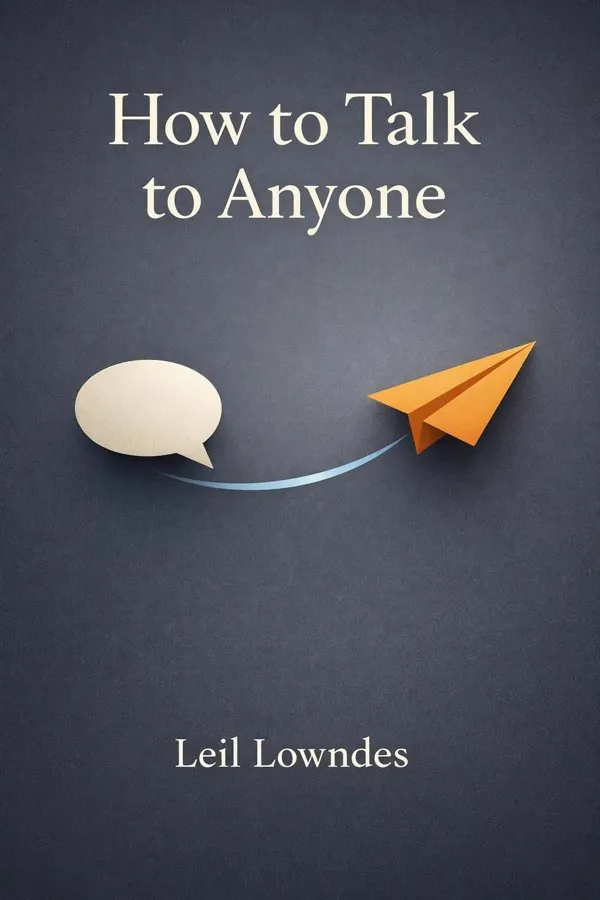
How to Talk to Anyone: Summary & Key Insights
by Leil Lowndes
 10 min10 chaptersAudio available
Key Takeaways from How to Talk to Anyone
Before you speak, people are already deciding who you are.
Many people dismiss small talk as empty chatter, but Lowndes reframes it as the bridge to trust.
Good communicators know that conversation has levels.
Much of communication happens silently.
People are drawn to those who make them feel heard.
What Is How to Talk to Anyone About?
How to Talk to Anyone by Leil Lowndes is a self-help book published in 2003 spanning 10 pages. Some people seem to move through social situations with effortless charm. They know how to make a strong first impression, keep conversations flowing, and leave others feeling seen, valued, and intrigued. In How to Talk to Anyone, Leil Lowndes argues that this kind of social success is not a mysterious gift reserved for the naturally outgoing. It is a learnable set of behaviors, habits, and communication techniques that anyone can practice. Drawing on her work as a communication expert and speaker, Lowndes offers 92 practical strategies for improving the way we speak, listen, connect, and influence others in both personal and professional settings. The book matters because communication affects nearly every part of life: friendships, romance, networking, leadership, teamwork, and opportunity. Rather than focusing on abstract theory, Lowndes gives readers concrete tools they can use immediately, from body language cues and listening habits to conversation openers and confidence-building methods. The result is a highly actionable guide to becoming warmer, more memorable, and more effective with people in everyday life.
This FizzRead summary covers all 10 key chapters of How to Talk to Anyone in approximately 10 minutes, distilling the most important ideas, arguments, and takeaways from Leil Lowndes's work. Also available as an audio summary and Key Quotes Podcast.
How to Talk to Anyone
Some people seem to move through social situations with effortless charm. They know how to make a strong first impression, keep conversations flowing, and leave others feeling seen, valued, and intrigued. In How to Talk to Anyone, Leil Lowndes argues that this kind of social success is not a mysterious gift reserved for the naturally outgoing. It is a learnable set of behaviors, habits, and communication techniques that anyone can practice. Drawing on her work as a communication expert and speaker, Lowndes offers 92 practical strategies for improving the way we speak, listen, connect, and influence others in both personal and professional settings. The book matters because communication affects nearly every part of life: friendships, romance, networking, leadership, teamwork, and opportunity. Rather than focusing on abstract theory, Lowndes gives readers concrete tools they can use immediately, from body language cues and listening habits to conversation openers and confidence-building methods. The result is a highly actionable guide to becoming warmer, more memorable, and more effective with people in everyday life.
Who Should Read How to Talk to Anyone?
This book is perfect for anyone interested in self-help and looking to gain actionable insights in a short read. Whether you're a student, professional, or lifelong learner, the key ideas from How to Talk to Anyone by Leil Lowndes will help you think differently.
- ✓Readers who enjoy self-help and want practical takeaways
- ✓Professionals looking to apply new ideas to their work and life
- ✓Anyone who wants the core insights of How to Talk to Anyone in just 10 minutes
Want the full summary?
Get instant access to this book summary and 100K+ more with Fizz Moment.
Get Free SummaryAvailable on App Store • Free to download
Key Chapters
Before you speak, people are already deciding who you are. That is one of the central insights of How to Talk to Anyone: social success often begins in the first few seconds, when posture, facial expression, eye contact, and timing create an instant emotional impression. Lowndes explains that first impressions are not superficial details to ignore; they are signals that tell others whether you are confident, warm, trustworthy, nervous, distracted, or self-absorbed. Because people often interpret these signals automatically, small adjustments can have large effects.
Lowndes emphasizes techniques that make you appear present and engaged from the outset. A genuine smile, calm eye contact, and unhurried movement communicate security and openness. She encourages readers to avoid rushing, fidgeting, or scanning the room while greeting someone, because those habits suggest anxiety or lack of interest. Instead, she recommends giving others the feeling that they matter in that moment. Even a simple hello becomes more powerful when it is paired with full attention.
In practice, this matters everywhere: meeting a hiring manager, joining a party, greeting a new client, or being introduced to a friend’s family. Imagine two people entering a room. One looks tense, glances around, and offers a distracted handshake. The other pauses, smiles, meets the other person’s eyes, and speaks with calm energy. The difference in social impact is immediate.
Actionable takeaway: treat the first 10 seconds of every interaction as crucial. Slow down, smile warmly, make direct eye contact, and give the other person your complete attention.
Many people dismiss small talk as empty chatter, but Lowndes reframes it as the bridge to trust. Most meaningful relationships do not begin with deep revelations; they begin with brief, low-risk conversation that allows people to test comfort, chemistry, and mutual interest. Small talk is not the opposite of real connection. It is the entry point to it.
The book teaches that successful small talk depends less on cleverness and more on ease. Instead of pressuring yourself to be fascinating, your goal is to help the other person feel comfortable speaking. Questions about the setting, shared circumstances, current events, work, interests, or recent experiences can all open a natural exchange. Lowndes advises readers to avoid dull, mechanical phrasing and instead make observations that invite a response. For example, rather than saying, “So, what do you do?” you might say, “How do you know the host?” or “What has been the highlight of your week so far?”
She also points out that good small talk grows by following threads. If someone mentions travel, ask where they most enjoyed going. If they mention a hobby, ask how they got started. This creates rhythm and shows interest without forcing intensity too quickly.
In everyday life, small talk helps at networking events, first dates, office meetings, waiting rooms, school functions, and casual social settings. People often remember less about what was said than how easy they felt talking to you.
Actionable takeaway: stop treating small talk as a performance. Start with a simple observation or open question, then follow the most interesting thread with genuine curiosity.
Good communicators know that conversation has levels. One of Lowndes’s most useful lessons is that connection deepens when you know how to guide talk from surface topics to more personal, memorable territory. This does not mean interrogating people or forcing emotional intimacy. It means recognizing the right moment to shift from polite exchange into dialogue that reveals values, stories, and personality.
Lowndes suggests that this transition often happens through attentive listening and selective self-disclosure. When someone mentions an experience, challenge, preference, or opinion, that is an opportunity to invite a deeper response. Questions like “What got you interested in that?” or “What was that experience like for you?” encourage a person to move beyond facts and into meaning. At the same time, sharing something modest but real about yourself can make the interaction feel reciprocal rather than one-sided.
The key is pacing. If the conversation is new, stay light. As comfort increases, ask more reflective questions. For example, after discussing someone’s job, you might ask what part of it they find most rewarding. After discussing travel, you might ask which place changed their perspective. These kinds of questions create emotional substance without becoming intrusive.
This matters because memorable relationships rarely form around generic exchanges. They form when people feel recognized as individuals. In work settings, deeper dialogue builds trust. In friendships and dating, it creates closeness. In leadership, it strengthens loyalty.
Actionable takeaway: listen for emotional openings in casual conversation, then ask one thoughtful follow-up question that helps the other person say something more personal and meaningful.
Much of communication happens silently. Lowndes repeatedly shows that posture, gestures, eye behavior, facial expression, and even physical orientation can amplify or undermine what you say. You may think you are expressing friendliness, confidence, or attention, but your body might be signaling impatience, insecurity, or disinterest. Learning to align nonverbal cues with your intentions is one of the fastest ways to improve social effectiveness.
A major theme in the book is presence. People feel respected when your body tells them you are with them, not merely near them. Turning fully toward someone, uncrossing your arms, nodding naturally, and maintaining relaxed eye contact all communicate interest. By contrast, checking your phone, shifting your gaze over their shoulder, or angling your body toward the exit suggests that your mind is elsewhere.
Lowndes also highlights the role of composure. Controlled movement tends to read as confidence, while abrupt motion often reads as nervousness. Even how you enter a room or take a seat influences perception. Someone who appears calm and grounded is generally seen as more credible and socially attractive.
Applications are everywhere: presenting in a meeting, attending a dinner, interviewing, flirting, managing a disagreement, or greeting a stranger. If your words say, “I’m glad to be here,” but your body seems tense and closed, people will trust the body first.
Actionable takeaway: during your next conversation, focus on three nonverbal habits: face the person directly, keep your movements calm, and maintain warm eye contact long enough to show real attention.
Confidence in conversation is not just a matter of what you say; it is how calmly, clearly, and deliberately you say it. Lowndes teaches that confident speaking comes from combining vocal control with social awareness. A person who rushes, overexplains, apologizes excessively, or speaks too softly may know exactly what they mean, but their delivery weakens the message. By contrast, measured speech conveys certainty and authority.
The book encourages readers to pay attention to tone, pace, and brevity. Speaking too quickly can signal anxiety, while speaking too slowly may seem uncertain or unnatural. Lowndes recommends aiming for a relaxed, steady rhythm that allows your words to land. She also stresses the importance of avoiding filler language and self-diminishing habits such as beginning every statement with “I’m not sure, but…” or “This may be a stupid idea…” Such phrases train others to discount you before your main point even arrives.
At the same time, confidence should not become coldness. Warmth matters. People respond best to communicators who sound secure without sounding arrogant. That means combining clarity with friendliness, especially in disagreements or high-pressure moments. In a meeting, for example, you might say, “I see the logic in that approach, but I’d like to suggest an alternative,” instead of attacking the other idea or shrinking from your own.
Whether you are interviewing, dating, networking, leading, or handling conflict, your voice shapes your credibility.
Actionable takeaway: choose one speech habit to improve this week: slow your pace, reduce filler words, or replace apologetic openings with direct, confident statements.
Many people think of networking as a transactional activity: exchange names, pass out contact information, and hope something useful happens later. Lowndes offers a more effective view. Successful networking is about making people feel valued and remembered, not about trying to extract immediate advantage. When approached with generosity and attention, networking becomes simply the art of building genuine professional relationships.
A key lesson is to focus on quality of connection, not quantity of contacts. Instead of trying to meet everyone in the room, invest in meaningful conversations with a few people. Learn something specific about them, remember their interests, and follow up in a way that reflects real attention. This might mean sending a brief note mentioning a topic you discussed, sharing a relevant article, or reconnecting when an opportunity related to their goals appears.
Lowndes also notes that effective networkers understand status dynamics without becoming fake. They know how to speak respectfully to influential people while also treating everyone else with equal courtesy. This matters because assistants, junior colleagues, and peers are often the people who remember your character most accurately. Social intelligence means recognizing that every interaction counts.
In practical terms, networking skills help at conferences, workplace events, interviews, community gatherings, and digital communication follow-ups. Long-term opportunities often come not from aggressive self-promotion but from being the person others trust, like, and recall positively.
Actionable takeaway: at your next event, aim to create two memorable connections. Ask thoughtful questions, note one personal detail about each person, and send a short follow-up message within 48 hours.
Anyone can seem socially skilled when everything is easy. The real test comes when conversations become awkward, tense, critical, or emotionally charged. Lowndes teaches that handling difficult moments with calmness and dignity is one of the clearest marks of communication mastery. Whether you are facing a rude remark, uncomfortable silence, criticism, or disagreement, your composure shapes how others see you.
One of her core ideas is that overreacting usually makes a difficult situation worse. Instead of matching another person’s intensity, skilled communicators slow the interaction down. They acknowledge what was said, choose their words carefully, and avoid letting ego dictate the response. For example, if someone interrupts or challenges you in a meeting, responding with defensive anger may damage your authority. A more effective reply might be, “Let me finish the point, and then I’d be glad to hear your perspective.”
Lowndes also emphasizes tact. Not every truth needs to be delivered bluntly, and not every conflict deserves escalation. Sometimes the most strategic response is redirection, humor, brevity, or selective silence. Social strength is not about winning every exchange. It is about preserving respect, momentum, and self-command.
This skill is invaluable in families, offices, friendships, customer interactions, and leadership roles. People often remember not the conflict itself, but who stayed grounded during it.
Actionable takeaway: when tension rises, pause before responding. Lower your pace, keep your tone steady, and choose a reply that protects both your point and your composure.
A strong conversation can open a door, but only consistency keeps it open. Lowndes reminds readers that communication is not just about making an immediate impression; it is about building trust over time. Relationships deepen when people feel that your warmth, attention, and respect are not situational tricks, but reliable qualities.
This means remembering details, following through, expressing appreciation, and staying attuned to what matters to the other person. If someone tells you about an upcoming presentation, asking later how it went shows uncommon attentiveness. If a colleague contributes helpful work, acknowledging it builds goodwill. If a friend shares a challenge, checking in later reinforces emotional trust. These small acts create a pattern: you are someone who notices, remembers, and cares.
Lowndes’s broader message is that likability is sustained by emotional consistency. Many people know how to be charming once; fewer know how to remain thoughtful over months and years. In both personal and professional life, reliability often outweighs brilliance. People trust those whose words and behavior align over time.
This applies to friendships, marriages, mentorships, teams, clients, and communities. Lasting relationships are usually built less on dramatic gestures than on repeated moments of consideration and respect.
Actionable takeaway: strengthen one relationship this week by following up on something specific the other person previously mentioned. Show that you remember their life, not just their name.
Technical ability may open doors, but communication often determines how far you go once inside. Lowndes shows that in business, people are constantly evaluating more than competence. They assess confidence, clarity, leadership presence, emotional intelligence, and the ability to connect with others. Those who communicate well are more likely to influence decisions, build alliances, resolve friction, and earn trust.
The book’s techniques apply directly to workplace situations: leading meetings, negotiating, presenting ideas, handling clients, motivating teams, and navigating office politics. A manager who listens carefully before giving direction often gets more loyalty than one who simply issues commands. A salesperson who makes a client feel understood is more persuasive than one who recites features. A colleague who speaks clearly and respectfully in meetings is more likely to be seen as leadership material.
Lowndes also underscores the importance of tailoring communication to the audience. Senior leaders may value brevity and strategic framing. Team members may need clarity, empathy, and encouragement. Clients may need reassurance and responsiveness. The most effective professionals do not use one style for every situation; they adapt while remaining authentic.
This is why the book remains useful beyond social charm. It is fundamentally about influence through human understanding. Business success is not built on information alone, but on how information is delivered and received.
Actionable takeaway: identify one upcoming professional interaction and prepare not just your message, but your delivery: how you will open, how you will listen, and how you will make the other person feel respected.
All Chapters in How to Talk to Anyone
About the Author
Leil Lowndes is an American communication expert, author, and speaker best known for her work on social skills, interpersonal influence, and relationship-building. She built her reputation by turning complex ideas about human behavior into practical advice that readers can apply immediately in everyday interactions. Her writing focuses on topics such as conversation, confidence, networking, attraction, and nonverbal communication, often using memorable tips and clear examples rather than abstract theory. Lowndes is the author of several books in the self-help and personal development space, with How to Talk to Anyone becoming her most widely recognized title. Her work appeals to readers who want concrete tools for improving both personal and professional relationships through stronger communication.
Get This Summary in Your Preferred Format
Read or listen to the How to Talk to Anyone summary by Leil Lowndes anytime, anywhere. FizzRead offers multiple formats so you can learn on your terms — all free.
Available formats: App · Audio · PDF · EPUB — All included free with FizzRead
Download How to Talk to Anyone PDF and EPUB Summary
Key Quotes from How to Talk to Anyone
“Before you speak, people are already deciding who you are.”
“Many people dismiss small talk as empty chatter, but Lowndes reframes it as the bridge to trust.”
“Good communicators know that conversation has levels.”
“Lowndes repeatedly shows that posture, gestures, eye behavior, facial expression, and even physical orientation can amplify or undermine what you say.”
“People are drawn to those who make them feel heard.”
Frequently Asked Questions about How to Talk to Anyone
How to Talk to Anyone by Leil Lowndes is a self-help book that explores key ideas across 10 chapters. Some people seem to move through social situations with effortless charm. They know how to make a strong first impression, keep conversations flowing, and leave others feeling seen, valued, and intrigued. In How to Talk to Anyone, Leil Lowndes argues that this kind of social success is not a mysterious gift reserved for the naturally outgoing. It is a learnable set of behaviors, habits, and communication techniques that anyone can practice. Drawing on her work as a communication expert and speaker, Lowndes offers 92 practical strategies for improving the way we speak, listen, connect, and influence others in both personal and professional settings. The book matters because communication affects nearly every part of life: friendships, romance, networking, leadership, teamwork, and opportunity. Rather than focusing on abstract theory, Lowndes gives readers concrete tools they can use immediately, from body language cues and listening habits to conversation openers and confidence-building methods. The result is a highly actionable guide to becoming warmer, more memorable, and more effective with people in everyday life.
More by Leil Lowndes
You Might Also Like





Featured In
Browse by Category
Ready to read How to Talk to Anyone?
Get the full summary and 100K+ more books with Fizz Moment.