
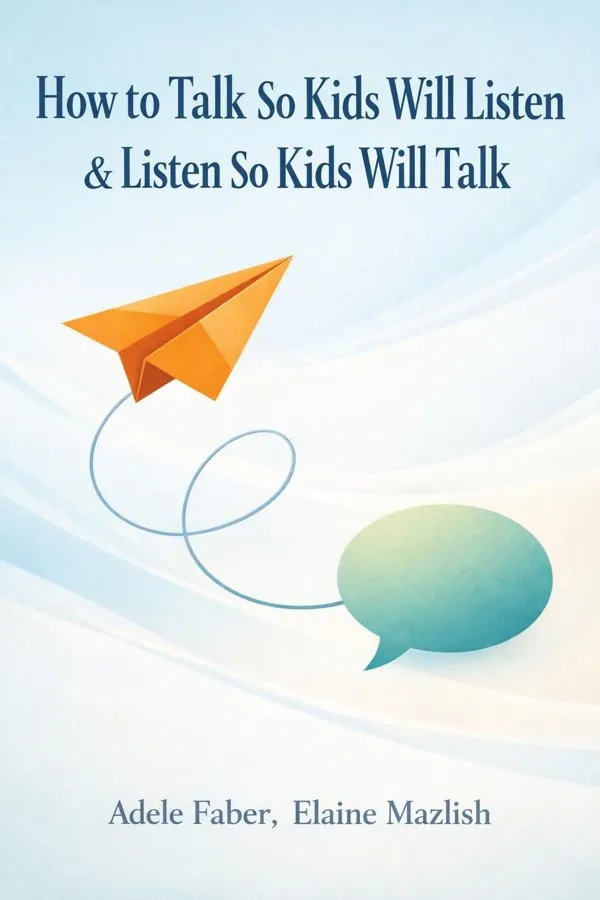
How to Talk So Kids Will Listen & Listen So Kids Will Talk: Summary & Key Insights
by Adele Faber, Elaine Mazlish
 10 min8 chaptersAudio available
What Is How to Talk So Kids Will Listen & Listen So Kids Will Talk About?
How to Talk So Kids Will Listen & Listen So Kids Will Talk by Adele Faber, Elaine Mazlish is a parenting book spanning 8 pages. This classic parenting guide offers practical communication strategies to help parents and children cooperate more effectively. Through real-life examples and exercises, it teaches how to express feelings without blame, engage children's cooperation, and resolve conflicts peacefully. The book emphasizes empathy, respect, and problem-solving to build stronger parent-child relationships.
This FizzRead summary covers all 8 key chapters of How to Talk So Kids Will Listen & Listen So Kids Will Talk in approximately 10 minutes, distilling the most important ideas, arguments, and takeaways from Adele Faber, Elaine Mazlish's work. Also available as an audio summary and Key Quotes Podcast.
How to Talk So Kids Will Listen & Listen So Kids Will Talk
This classic parenting guide offers practical communication strategies to help parents and children cooperate more effectively. Through real-life examples and exercises, it teaches how to express feelings without blame, engage children's cooperation, and resolve conflicts peacefully. The book emphasizes empathy, respect, and problem-solving to build stronger parent-child relationships.
Who Should Read How to Talk So Kids Will Listen & Listen So Kids Will Talk?
This book is perfect for anyone interested in parenting and looking to gain actionable insights in a short read. Whether you're a student, professional, or lifelong learner, the key ideas from How to Talk So Kids Will Listen & Listen So Kids Will Talk by Adele Faber, Elaine Mazlish will help you think differently.
- ✓Readers who enjoy parenting and want practical takeaways
- ✓Professionals looking to apply new ideas to their work and life
- ✓Anyone who wants the core insights of How to Talk So Kids Will Listen & Listen So Kids Will Talk in just 10 minutes
Want the full summary?
Get instant access to this book summary and 100K+ more with Fizz Moment.
Get Free SummaryAvailable on App Store • Free to download
Key Chapters
Every feeling a child expresses—whether anger, sadness, fear, or disappointment—is a call for understanding. Too often, adults respond with logic or correction instead of empathy. When a child cries because a playmate took their toy, we rush to soothe or distract: “Don’t cry, you have other toys.” But when we deny the feeling, the emotion doesn’t vanish; it burrows deeper. Our first lesson to parents is this: acknowledge the feeling before addressing the situation.
We teach emotional validation as the foundation of communication. When you reflect back your child’s feelings—“That must be really frustrating for you”—you signal acceptance. You tell them their emotions aren’t shameful or wrong. This acknowledgment releases tension and restores their capacity to think. We observed countless transformations in our workshops once parents learned this skill. A mother who once fought daily battles with her stubborn son discovered that simply naming his frustration helped him calm himself and reconsider his choices.
To help children deal with feelings is to offer a mirror. We do not solve their pain for them—we honor it. And in that honoring, we allow them to regain composure and problem-solve on their own. It’s in this small act of empathy that the seeds of emotional resilience begin to grow.
Once feelings are acknowledged, parents face the next challenge: how to get children to cooperate without resorting to threats, punishment, or endless nagging. Traditional commands—“Clean your room now!”—often spark resistance. In our workshops, we found that description works far better than accusation. For example, instead of saying, “You’re so messy,” describe the problem: “There are toys on the floor that someone might trip over.” When we dare to replace criticism with clear observation, children think rather than defend.
We advocate speaking to children as collaborators, not subordinates. Cooperation arises when parents invite rather than impose. Phrasing instruction as choice-driven—“Would you like to start with your toys or your clothes?”—gives a sense of agency while maintaining the parent’s leadership. When children feel respected, compliance becomes voluntary, not coerced.
This shift from obedience to cooperation transforms the emotional climate of the home. The parent becomes a guide rather than an enforcer, and rules evolve into shared understandings. The heart of cooperation lies not in control, but in partnership.
+ 6 more chapters — available in the FizzRead app
All Chapters in How to Talk So Kids Will Listen & Listen So Kids Will Talk
About the Authors
Adele Faber and Elaine Mazlish are internationally acclaimed experts on communication between adults and children. Both studied with child psychologist Dr. Haim Ginott and have co-authored several bestselling books on parenting and education, including 'Siblings Without Rivalry' and 'How to Talk So Teens Will Listen & Listen So Teens Will Talk.'
Get This Summary in Your Preferred Format
Read or listen to the How to Talk So Kids Will Listen & Listen So Kids Will Talk summary by Adele Faber, Elaine Mazlish anytime, anywhere. FizzRead offers multiple formats so you can learn on your terms — all free.
Available formats: App · Audio · PDF · EPUB — All included free with FizzRead
Download How to Talk So Kids Will Listen & Listen So Kids Will Talk PDF and EPUB Summary
Key Quotes from How to Talk So Kids Will Listen & Listen So Kids Will Talk
“Every feeling a child expresses—whether anger, sadness, fear, or disappointment—is a call for understanding.”
“Once feelings are acknowledged, parents face the next challenge: how to get children to cooperate without resorting to threats, punishment, or endless nagging.”
Frequently Asked Questions about How to Talk So Kids Will Listen & Listen So Kids Will Talk
How to Talk So Kids Will Listen & Listen So Kids Will Talk by Adele Faber, Elaine Mazlish is a parenting book that explores key ideas across 8 chapters. This classic parenting guide offers practical communication strategies to help parents and children cooperate more effectively. Through real-life examples and exercises, it teaches how to express feelings without blame, engage children's cooperation, and resolve conflicts peacefully. The book emphasizes empathy, respect, and problem-solving to build stronger parent-child relationships.
You Might Also Like
Never Enough
Jennifer Breheny Wallace
10 min
Bluey: Sleepytime
Joe Brumm
10 min
In My Heart: A Book of Feelings
Jo Witek
10 min
Love From The Crayons
Drew Daywalt, Oliver Jeffers
10 min
Pete The Cat: Big Easter Adventure
James Dean, Kimberly Dean
10 min
Smart Money Smart Kids: Raising the Next Generation to Win with Money
Dave Ramsey, Rachel Cruze
10 minBrowse by Category
Ready to read How to Talk So Kids Will Listen & Listen So Kids Will Talk?
Get the full summary and 100K+ more books with Fizz Moment.