
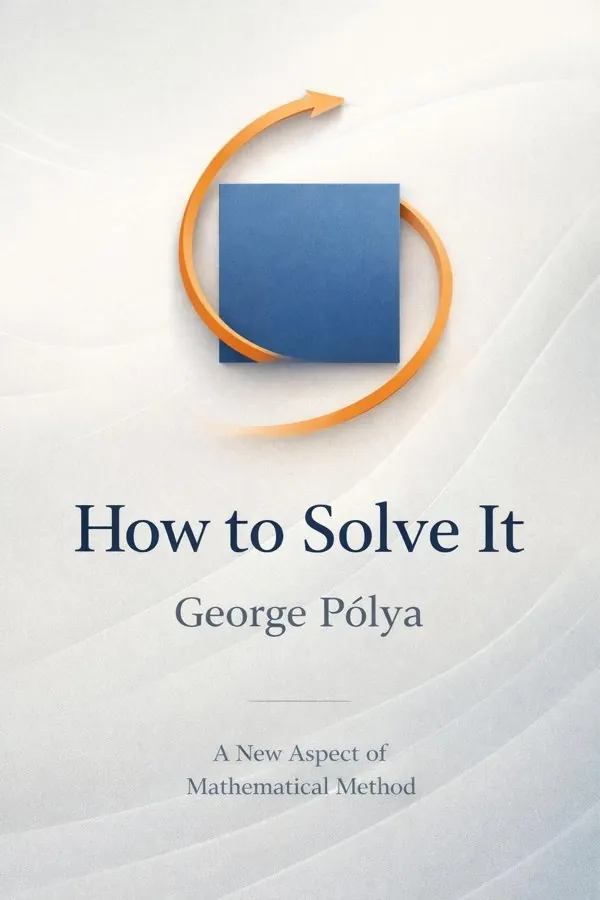
How to Solve It: A New Aspect of Mathematical Method: Summary & Key Insights
by George Pólya
 10 min11 chaptersAudio available
What Is How to Solve It: A New Aspect of Mathematical Method About?
How to Solve It: A New Aspect of Mathematical Method by George Pólya is a education book spanning 11 pages. This classic work by mathematician George Pólya presents a systematic approach to problem-solving in mathematics. It introduces heuristic methods and strategies that guide students and teachers in tackling mathematical problems creatively and effectively. The book emphasizes understanding the problem, devising a plan, carrying out the plan, and reviewing the solution process.
This FizzRead summary covers all 11 key chapters of How to Solve It: A New Aspect of Mathematical Method in approximately 10 minutes, distilling the most important ideas, arguments, and takeaways from George Pólya's work. Also available as an audio summary and Key Quotes Podcast.
How to Solve It: A New Aspect of Mathematical Method
This classic work by mathematician George Pólya presents a systematic approach to problem-solving in mathematics. It introduces heuristic methods and strategies that guide students and teachers in tackling mathematical problems creatively and effectively. The book emphasizes understanding the problem, devising a plan, carrying out the plan, and reviewing the solution process.
Who Should Read How to Solve It: A New Aspect of Mathematical Method?
This book is perfect for anyone interested in education and looking to gain actionable insights in a short read. Whether you're a student, professional, or lifelong learner, the key ideas from How to Solve It: A New Aspect of Mathematical Method by George Pólya will help you think differently.
- ✓Readers who enjoy education and want practical takeaways
- ✓Professionals looking to apply new ideas to their work and life
- ✓Anyone who wants the core insights of How to Solve It: A New Aspect of Mathematical Method in just 10 minutes
Want the full summary?
Get instant access to this book summary and 100K+ more with Fizz Moment.
Get Free SummaryAvailable on App Store • Free to download
Key Chapters
Solving a problem is an intellectual journey that mirrors all creative acts of thought. The four-step process I propose—understanding the problem, devising a plan, carrying out the plan, and looking back—represents the map for that journey. Each step is distinct, yet interconnected, and together they form a habit of reasoning that can be cultivated and refined over time.
The first step, understanding the problem, means grasping exactly what the question asks. This is where most errors originate: not in faulty computation, but in misunderstanding the conditions. I urge you to slow down and ask yourself: What is known? What is unknown? What are the data and constraints? Can you restate the problem in your own words? Once the nature of the problem is clear, the second step—devising a plan—becomes possible. Here we begin the search for connections. Does a similar problem remind you how it was solved? Can you apply an analogy, construct an auxiliary problem, or reformulate the conditions to simplify them? Strategy is creative—it arises from seeing relationships between problems.
In carrying out the plan, execution demands care and discipline. Each step of your reasoning must follow logically, yet you must remain flexible. Sometimes the plan fails. Then you revisit your assumptions, adjust your approach, and continue. Rigorous verification at this stage ensures that your reasoning is sound and consistent.
Finally comes the step too often neglected: looking back. This means not only checking your result but reflecting on the process that produced it. Could the result be deduced more simply? Does your solution suggest new avenues of inquiry? When you look back, you transform a single solved problem into experience—and experience is the foundation of intuition. The next time you encounter a related challenge, those reflections will guide you naturally toward efficiency and insight.
The four-step method is not mechanical; it is human. It mirrors how all thinkers—from mathematicians to inventors, from scientists to artists—proceed from confusion to understanding. My aim is that you practice this sequence often enough that it becomes second nature, a rhythm of reason that accompanies you throughout your intellectual life.
Understanding means seeing clearly what is asked, what is given, and what must be found. Many students, in their impatience to start calculating, neglect this essential foundation. Yet without comprehension, all computation is futile. I often begin by urging them to read the problem slowly, to think of it as a story whose characters—the unknowns, the data, and the conditions—must all be understood.
When you meet a new problem, ask yourself: What is the unknown? Which quantities are given? How do these quantities relate to each other? Can you represent the relationships algebraically, geometrically, or verbally? Occasionally, a sketch or diagram reveals what words alone may hide. You might even attempt a simpler version of the problem—if the original seems complex, reducing it helps to reveal its structure. This stage of questioning brings clarity and invites intuition.
Even in advanced mathematics, understanding precedes reasoning. I remember countless times when adjusting my interpretation of a problem—rephrasing it, visualizing it differently—transformed confusion into insight. That transformation always begins in genuine comprehension. Therefore, cultivate the habit of restating problems in your own words and testing your understanding through examples. If you can explain what the problem asks clearly, you are already halfway toward its solution.
+ 9 more chapters — available in the FizzRead app
All Chapters in How to Solve It: A New Aspect of Mathematical Method
About the Author
George Pólya (1887–1985) was a Hungarian mathematician known for his contributions to problem-solving, probability, and combinatorics. He taught at ETH Zurich and later at Stanford University, influencing generations of mathematicians and educators through his clear and practical approach to mathematical thinking.
Get This Summary in Your Preferred Format
Read or listen to the How to Solve It: A New Aspect of Mathematical Method summary by George Pólya anytime, anywhere. FizzRead offers multiple formats so you can learn on your terms — all free.
Available formats: App · Audio · PDF · EPUB — All included free with FizzRead
Download How to Solve It: A New Aspect of Mathematical Method PDF and EPUB Summary
Key Quotes from How to Solve It: A New Aspect of Mathematical Method
“Solving a problem is an intellectual journey that mirrors all creative acts of thought.”
“Understanding means seeing clearly what is asked, what is given, and what must be found.”
Frequently Asked Questions about How to Solve It: A New Aspect of Mathematical Method
How to Solve It: A New Aspect of Mathematical Method by George Pólya is a education book that explores key ideas across 11 chapters. This classic work by mathematician George Pólya presents a systematic approach to problem-solving in mathematics. It introduces heuristic methods and strategies that guide students and teachers in tackling mathematical problems creatively and effectively. The book emphasizes understanding the problem, devising a plan, carrying out the plan, and reviewing the solution process.
You Might Also Like

Bedtime Biography: Florence Nightingale
Isabel Thomas
10 min
Introduction To Museum Studies
Howard H. Hoyt
10 min
A Mind for Numbers: How to Excel at Math and Science (Even If You Flunked Algebra)
Barbara Oakley
10 min
AI for Educators: Learning Strategies, Teacher Empowerment, and the Future of Education
Matt Miller
10 min
Animation For Beginners
Morr Meroz
10 min
Artificial Intelligence for Learning
Donald Clark
10 minBrowse by Category
Ready to read How to Solve It: A New Aspect of Mathematical Method?
Get the full summary and 100K+ more books with Fizz Moment.