
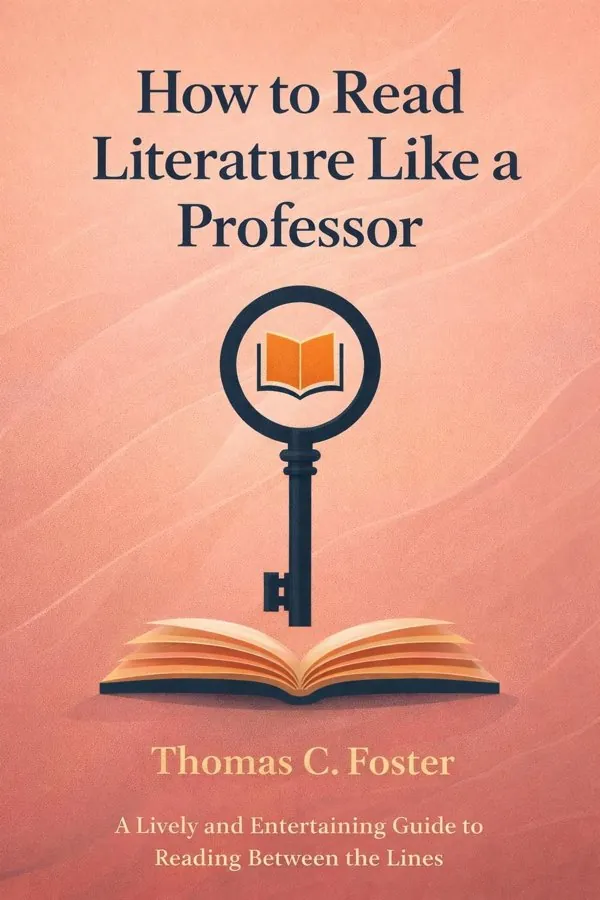
How to Read Literature Like a Professor: A Lively and Entertaining Guide to Reading Between the Lines: Summary & Key Insights
 10 min11 chaptersAudio available
What Is How to Read Literature Like a Professor: A Lively and Entertaining Guide to Reading Between the Lines About?
How to Read Literature Like a Professor: A Lively and Entertaining Guide to Reading Between the Lines by Thomas C. Foster is a education book spanning 11 pages. A witty and accessible guide to literary analysis, this book helps readers uncover the deeper meanings behind novels, poems, and plays. Thomas C. Foster explains how recurring symbols, archetypes, and narrative patterns shape literature, making it easier for readers to appreciate and interpret classic and modern works alike.
This FizzRead summary covers all 11 key chapters of How to Read Literature Like a Professor: A Lively and Entertaining Guide to Reading Between the Lines in approximately 10 minutes, distilling the most important ideas, arguments, and takeaways from Thomas C. Foster's work. Also available as an audio summary and Key Quotes Podcast.
How to Read Literature Like a Professor: A Lively and Entertaining Guide to Reading Between the Lines
A witty and accessible guide to literary analysis, this book helps readers uncover the deeper meanings behind novels, poems, and plays. Thomas C. Foster explains how recurring symbols, archetypes, and narrative patterns shape literature, making it easier for readers to appreciate and interpret classic and modern works alike.
Who Should Read How to Read Literature Like a Professor: A Lively and Entertaining Guide to Reading Between the Lines?
This book is perfect for anyone interested in education and looking to gain actionable insights in a short read. Whether you're a student, professional, or lifelong learner, the key ideas from How to Read Literature Like a Professor: A Lively and Entertaining Guide to Reading Between the Lines by Thomas C. Foster will help you think differently.
- ✓Readers who enjoy education and want practical takeaways
- ✓Professionals looking to apply new ideas to their work and life
- ✓Anyone who wants the core insights of How to Read Literature Like a Professor: A Lively and Entertaining Guide to Reading Between the Lines in just 10 minutes
Want the full summary?
Get instant access to this book summary and 100K+ more with Fizz Moment.
Get Free SummaryAvailable on App Store • Free to download
Key Chapters
I begin with the pattern that lies at the heart of nearly all storytelling: the quest. On the surface, it’s simple—someone sets out to achieve something. But underneath, every quest narrative carries five essential elements: a quester, a place to go, a stated reason for going, challenges along the way, and a real reason—usually self-discovery. The trick is that the quester rarely knows the true purpose of their journey. They think they’re going to fetch a grail, rescue a captive, or complete a job. But what they find is transformation.
Think of stories like *The Odyssey* or *The Lord of the Rings.* Odysseus believes he’s simply trying to return home, but along the way he learns what home means, how pride works, and what endurance really costs. Frodo thinks he’s meant to destroy a ring, but he discovers the limits of power and the necessity of friendship. Recognizing quest patterns opens new dimensions to any tale, because you begin to see that movement through space is always a metaphor for movement through the self. Once you grasp that, you will stop seeing stories as random and begin seeing them as moral and psychological journeys.
Let’s talk about meals. When characters sit down to eat together, it’s almost never just about the food. A shared meal in literature is an act of communion—it signals connection, trust, or sometimes betrayal. To eat with another person means to share humanity. That’s why meals gone wrong are so powerful; they mark divisions as much as unions.
Consider the Last Supper, the archetypal meal of Western storytelling. Its echoes appear everywhere because it captures a human truth: that the act of breaking bread together is bound up in community. In literature, paying attention to how and when people eat—who’s invited, who’s left out, how the atmosphere feels—can reveal hidden relationships and conflicts. So the next time a novelist lingers over dinner, don’t think, 'Why are we still at the table?' Think, 'What truth is being shared or violated here?' Communion can heal or divide—but it always signifies something deeper than nourishment.
+ 9 more chapters — available in the FizzRead app
All Chapters in How to Read Literature Like a Professor: A Lively and Entertaining Guide to Reading Between the Lines
About the Author
Thomas C. Foster is an American professor of English at the University of Michigan–Flint, known for his engaging teaching style and accessible books on literary analysis. His works aim to make the study of literature enjoyable and understandable for general readers.
Get This Summary in Your Preferred Format
Read or listen to the How to Read Literature Like a Professor: A Lively and Entertaining Guide to Reading Between the Lines summary by Thomas C. Foster anytime, anywhere. FizzRead offers multiple formats so you can learn on your terms — all free.
Available formats: App · Audio · PDF · EPUB — All included free with FizzRead
Download How to Read Literature Like a Professor: A Lively and Entertaining Guide to Reading Between the Lines PDF and EPUB Summary
Key Quotes from How to Read Literature Like a Professor: A Lively and Entertaining Guide to Reading Between the Lines
“I begin with the pattern that lies at the heart of nearly all storytelling: the quest.”
“When characters sit down to eat together, it’s almost never just about the food.”
Frequently Asked Questions about How to Read Literature Like a Professor: A Lively and Entertaining Guide to Reading Between the Lines
How to Read Literature Like a Professor: A Lively and Entertaining Guide to Reading Between the Lines by Thomas C. Foster is a education book that explores key ideas across 11 chapters. A witty and accessible guide to literary analysis, this book helps readers uncover the deeper meanings behind novels, poems, and plays. Thomas C. Foster explains how recurring symbols, archetypes, and narrative patterns shape literature, making it easier for readers to appreciate and interpret classic and modern works alike.
You Might Also Like
Bedtime Biography: Florence Nightingale
Isabel Thomas
10 min
Introduction To Museum Studies
Howard H. Hoyt
10 min
A Mind for Numbers: How to Excel at Math and Science (Even If You Flunked Algebra)
Barbara Oakley
10 min
AI for Educators: Learning Strategies, Teacher Empowerment, and the Future of Education
Matt Miller
10 min
Animation For Beginners
Morr Meroz
10 min
Artificial Intelligence for Learning
Donald Clark
10 minBrowse by Category
Ready to read How to Read Literature Like a Professor: A Lively and Entertaining Guide to Reading Between the Lines?
Get the full summary and 100K+ more books with Fizz Moment.