
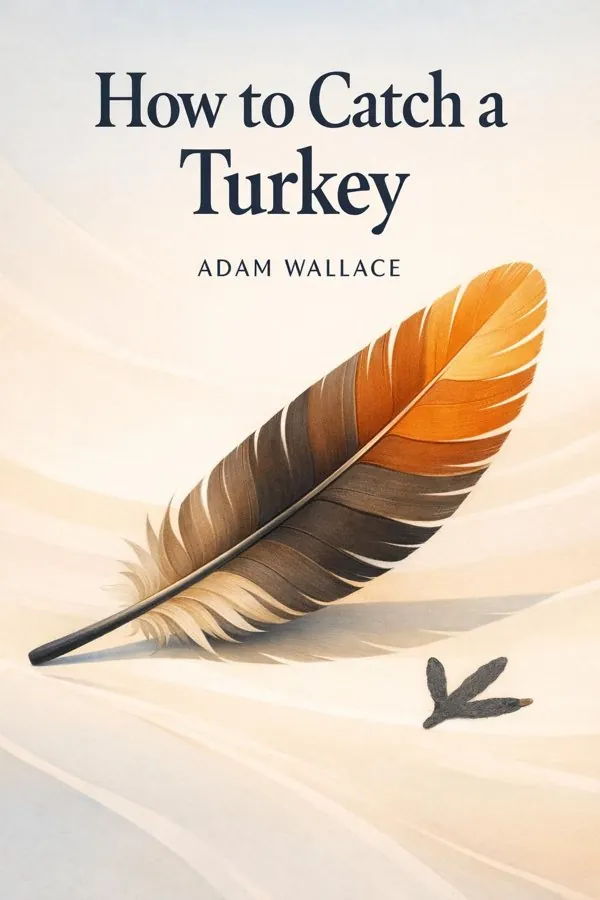
How to Catch a Turkey: Summary & Key Insights
by Adam Wallace
 10 min9 chaptersAudio available
Key Takeaways from How to Catch a Turkey
Big moments often become memorable not because everything goes as planned, but because something unexpected forces everyone to think on their feet.
A community reveals itself most clearly when a shared celebration is at risk.
The fastest way to shrink a problem is to stop treating it as yours alone.
Creativity often appears first as a wild idea that might not work at all.
A strong story needs a worthy opponent, and in How to Catch a Turkey, the runaway bird is far more than a passive object of pursuit.
What Is How to Catch a Turkey About?
How to Catch a Turkey by Adam Wallace is a bestsellers book spanning 4 pages. What happens when a school’s Thanksgiving play is about to begin, the costumes are ready, the children are excited, and the star turkey suddenly makes a daring escape? Adam Wallace turns that cheerful disaster into a fast, funny, and memorable adventure in How to Catch a Turkey. Part of his bestselling How to Catch series, this picture book blends bouncy rhymes, lively pacing, and playful problem-solving into a story that instantly pulls young readers in. At its heart, the book follows a group of determined kids as they race through their school, inventing one silly trap after another to catch a clever turkey before the big performance falls apart. What makes the book matter is not just its humor, but the way it celebrates creativity, resilience, and teamwork. The children do not give up when their ideas fail; instead, they adapt, collaborate, and keep trying. That makes the story both entertaining and quietly instructive for young readers learning how to handle mistakes and work with others. Wallace is especially well suited to tell this kind of story. Known for his energetic rhyming books and imaginative child-centered adventures, he has built a reputation for making reading feel like play while still leaving children with ideas that stick.
This FizzRead summary covers all 9 key chapters of How to Catch a Turkey in approximately 10 minutes, distilling the most important ideas, arguments, and takeaways from Adam Wallace's work. Also available as an audio summary and Key Quotes Podcast.
How to Catch a Turkey
What happens when a school’s Thanksgiving play is about to begin, the costumes are ready, the children are excited, and the star turkey suddenly makes a daring escape? Adam Wallace turns that cheerful disaster into a fast, funny, and memorable adventure in How to Catch a Turkey. Part of his bestselling How to Catch series, this picture book blends bouncy rhymes, lively pacing, and playful problem-solving into a story that instantly pulls young readers in. At its heart, the book follows a group of determined kids as they race through their school, inventing one silly trap after another to catch a clever turkey before the big performance falls apart.
What makes the book matter is not just its humor, but the way it celebrates creativity, resilience, and teamwork. The children do not give up when their ideas fail; instead, they adapt, collaborate, and keep trying. That makes the story both entertaining and quietly instructive for young readers learning how to handle mistakes and work with others. Wallace is especially well suited to tell this kind of story. Known for his energetic rhyming books and imaginative child-centered adventures, he has built a reputation for making reading feel like play while still leaving children with ideas that stick.
Who Should Read How to Catch a Turkey?
This book is perfect for anyone interested in bestsellers and looking to gain actionable insights in a short read. Whether you're a student, professional, or lifelong learner, the key ideas from How to Catch a Turkey by Adam Wallace will help you think differently.
- ✓Readers who enjoy bestsellers and want practical takeaways
- ✓Professionals looking to apply new ideas to their work and life
- ✓Anyone who wants the core insights of How to Catch a Turkey in just 10 minutes
Want the full summary?
Get instant access to this book summary and 100K+ more with Fizz Moment.
Get Free SummaryAvailable on App Store • Free to download
Key Chapters
Big moments often become memorable not because everything goes as planned, but because something unexpected forces everyone to think on their feet. That idea powers the opening of How to Catch a Turkey, where a school is buzzing with anticipation for its Thanksgiving play. Teachers are organizing, children are rehearsing, costumes are ready, and the atmosphere feels festive and full of nervous excitement. This cheerful sense of preparation matters because it gives readers a familiar structure: a school event, a shared goal, and a deadline everyone understands. Then the central disruption arrives. The turkey, who is supposed to play a key role in the event, escapes, turning a routine school celebration into a comic emergency.
This setup works so well because children instantly recognize the emotional stakes. Even if they have never been in a Thanksgiving play, they understand the fear of a special event going wrong at the last minute. Wallace uses that tension not to create anxiety, but to launch fun. The escape transforms the school from a place of order into a playground of possibility. Hallways, classrooms, and stage spaces become part of the chase, and the story invites readers to imagine ordinary places as settings for extraordinary adventures.
For adults, this opening also shows why picture books can be powerful teaching tools. A simple plot problem creates room to discuss preparation, responsibility, and how quickly plans can change. Teachers might use the beginning of the story to ask students how they would react if an important class event suddenly fell apart. Parents can use it to talk about staying calm when surprises happen.
The opening reminds us that excitement and chaos often travel together. Instead of resisting the unexpected, the book treats it as the beginning of invention. Actionable takeaway: when plans go wrong, frame the problem as the start of a creative challenge rather than the end of the event.
A community reveals itself most clearly when a shared celebration is at risk. In How to Catch a Turkey, the school’s Thanksgiving play is more than a backdrop; it is the reason everyone cares so deeply about the runaway bird. The event represents teamwork, tradition, and the joy of putting on something special together. Students are not simply preparing lines and costumes. They are participating in a communal ritual that gives them a sense of belonging. When the turkey escapes before the curtain rises, the problem becomes symbolic: if the bird cannot be found, the whole group may feel disappointed, and the work everyone has put in could seem wasted.
Wallace turns this high-energy moment into a child-sized version of crisis management. The school setting is especially effective because it is structured and busy at the same time. There are adults trying to keep order, children full of ideas, and spaces that are both familiar and suddenly unpredictable. The turkey’s escape breaks routine, but it also reveals just how lively and imaginative the environment already is. A hallway is no longer just a hallway; it is a chase route. A classroom is no longer just a room; it is a possible trap zone. The play, once a performance for an audience, becomes a behind-the-scenes adventure.
This section of the story also teaches an important lesson about expectations. Children often feel pressure to make special events perfect. Wallace gently suggests that imperfections can create the most memorable stories. Anyone who has seen a school concert microphone fail or a costume tear knows that mishaps often become what people laugh about later.
In practical terms, adults can use this idea to help children build emotional flexibility. Before a recital, game, or presentation, remind them that success does not require perfection. What matters is how people respond together. Actionable takeaway: teach children to value shared effort over flawless outcomes, especially during important events.
The fastest way to shrink a problem is to stop treating it as yours alone. One of the most appealing parts of How to Catch a Turkey is the moment the children realize they cannot solve the situation by watching from the sidelines. Once the turkey begins racing through the school, the students unite around a common purpose: catch the bird before the play begins. Wallace captures the thrill of collective action in a way young readers can easily understand. Instead of one hero dominating the story, the chase becomes a group effort filled with suggestions, experiments, and shared excitement.
This matters because many children’s stories celebrate individual cleverness, but this one gives equal value to collaboration. The children combine ideas, energy, and courage. Some may imagine traps, others may help carry them out, and all contribute to the momentum. The result is not a lecture about teamwork; it is a playful demonstration of it. Readers see that big tasks become more manageable when everyone contributes something.
The book also reflects a truth children experience in classrooms every day: group problem-solving can be messy. People talk over one another, plans fail, and not every idea is brilliant. Yet the story presents that messiness as normal rather than discouraging. Teamwork is not shown as smooth and polished. It is lively, noisy, and full of trial and error.
In real life, this idea can be applied in schools and homes through simple cooperative tasks. Teachers might ask students to design their own pretend turkey-catching plan in teams, practicing how to listen and combine suggestions. Families could use the story as a prompt for games that require planning together, such as scavenger hunts or building challenges.
The deeper lesson is that cooperation gives children confidence. When they act together, they feel capable of handling something bigger than any one of them could manage alone. Actionable takeaway: encourage children to tackle playful challenges in groups so they learn that shared effort often beats solo struggle.
Creativity often appears first as a wild idea that might not work at all. That spirit drives the middle of How to Catch a Turkey, where the children begin inventing ways to trap the runaway bird. Their plans are imaginative, exaggerated, and funny, which is exactly why they appeal so strongly to young readers. Wallace understands that children love to imagine improbable solutions, especially when those solutions involve gadgets, bait, or sneaky setups. The fun comes not only from the chase itself, but from watching the children think.
Importantly, the story treats imaginative planning as valuable even when the plans fail. In many settings, children can become hesitant to share ideas because they fear being wrong. Here, the opposite is true. The process of coming up with strategies becomes part of the adventure. A plan that misfires is still exciting because it reveals effort, hope, and personality. This makes the book quietly empowering. It tells readers that having ideas is worthwhile, even when those ideas need revision.
This theme has practical applications far beyond the story. Parents and teachers can use the book to reinforce brainstorming as a skill. For example, when a child faces a problem such as organizing homework time or figuring out how to clean a messy room, adults can say, “Let’s think of three silly ideas and three serious ones.” That approach lowers pressure and makes problem-solving feel playful rather than heavy.
The turkey-catching attempts also show that action matters. The children do not stay stuck in discussion forever. They test their ideas, observe the result, and move on. That cycle mirrors real innovation: imagine, try, fail, adjust, repeat.
By presenting invention as fun and failure as part of the process, Wallace gives children a healthy model of experimentation. Actionable takeaway: praise children not just for correct answers, but for generating and testing creative ideas.
A strong story needs a worthy opponent, and in How to Catch a Turkey, the runaway bird is far more than a passive object of pursuit. The turkey is clever, quick, and always one step ahead, which turns the chase into a true contest rather than a simple retrieval mission. Every time the children think they have found the perfect solution, the turkey slips away, proving that determination alone is not enough. This raises the comedy, but it also deepens the story’s central lesson: not every problem can be solved on the first attempt.
The turkey’s intelligence matters because it keeps the children humble and adaptive. If the first trap worked, the story would end before readers had a chance to enjoy the process of problem-solving. Instead, each failure teaches the children something. They learn that a clever challenge demands observation, patience, and flexibility. In a child-friendly way, Wallace introduces the idea that obstacles can change shape and that good solutions often come after several wrong ones.
This dynamic mirrors real experiences children have with difficult tasks. A math problem that seemed easy becomes confusing. A craft project falls apart. A plan for a game does not work once everyone starts playing. The turkey symbolizes any challenge that refuses to cooperate. By laughing at the chase, readers also absorb a healthy attitude toward frustration.
Adults can help children apply this lesson by naming setbacks as information rather than defeat. If a child’s approach does not work, instead of saying, “That failed,” try, “Now we know one thing that doesn’t work.” That language keeps curiosity alive. The turkey’s repeated escapes model exactly this mindset: each mistake reveals something useful.
The book makes resilience entertaining by giving children an opponent worth respecting. Actionable takeaway: teach children to treat setbacks as clues that improve the next attempt, not signs that they should quit.
Children learn best when mistakes are stripped of shame and filled with possibility. One of the quiet strengths of How to Catch a Turkey is how often things go wrong without the story ever feeling discouraging. Traps fail. Plans unravel. The turkey darts away. Yet the tone remains joyful and energetic. Wallace uses rhyme and humor to transform failure into part of the entertainment. Instead of pausing the action, each unsuccessful attempt accelerates it. That makes the book emotionally safe for young readers, especially those who are still learning how to cope with frustration.
This is an important contribution because many children become perfectionistic early. They may avoid drawing if they cannot draw “well,” or hesitate to read aloud if they fear mistakes. Stories like this gently retrain that instinct. The children in the book are not embarrassed into silence by their failed plans. They simply try another idea. Failure is normalized as a natural step in the adventure.
In educational settings, this theme can be especially powerful. A teacher might read the book before a STEM challenge, then ask students to notice how many attempts it took the children to make progress. Families can reinforce the same lesson through language. If a child spills ingredients while baking or builds a block tower that collapses, adults can respond with humor and curiosity instead of criticism.
The story also shows that laughter can reduce the emotional weight of mistakes. When children laugh, they stay engaged. They are less likely to shut down and more likely to keep exploring. Wallace understands this instinctively. The chaos is funny, and that humor becomes a tool for resilience.
The larger message is simple but powerful: mistakes are not interruptions to learning. They are how learning happens. Actionable takeaway: create spaces where children can make low-stakes mistakes, laugh, and try again without fear of judgment.
The way a story sounds can be just as important as what it says. Adam Wallace’s signature use of rhyming text gives How to Catch a Turkey much of its momentum, making the chase feel musical, quick, and easy to follow. For young readers, rhyme is more than decoration. It creates anticipation, strengthens memory, and makes reading aloud more engaging for adults and children alike. Each line pulls the next one forward, which is especially helpful in a fast-paced story where excitement depends on timing.
This playful language serves several purposes. First, it keeps the tone light. Even when the children are racing to solve a problem, the rhymes signal that the story is meant to delight rather than stress. Second, it supports early literacy. Predictable sound patterns help children notice word endings, hear language structure, and develop phonological awareness. A child listening closely may begin to guess the next rhyming word, which turns reading into participation.
The repetition in the story also reinforces its key message. Catching the turkey is not a one-step event; it is an ongoing sequence of attempts. The recurring rhythm mirrors that repeated effort. In this way, the book’s form supports its content. Persistence is not just described; it is felt through the story’s pattern.
At home or in classrooms, adults can extend this benefit by pausing during read-alouds and inviting children to predict rhyming words or invent their own silly trap verses. That turns the book into an interactive literacy activity. Children can also be encouraged to make up additional pages: “How else might we try to catch the turkey?”
Wallace shows that language learning does not have to feel instructional to be effective. When words bounce, children lean in. Actionable takeaway: use rhyming books to build reading confidence, and invite children to join the rhythm by predicting, repeating, and creating their own lines.
Young children often read pictures before they fully read words, which means illustration is not an accessory in a picture book; it is part of the storytelling engine. In How to Catch a Turkey, the bright, energetic artwork expands the humor and helps readers track the escalating chaos of the chase. Expressions, movement, background details, and the turkey’s body language all add layers that text alone could not deliver. A child can understand the panic, excitement, and silliness of the scene simply by following the visual action.
This matters because visual storytelling supports a wide range of readers. Pre-readers can engage with the plot by observing what is happening on each page. Early readers gain confidence because the pictures help them decode context. More fluent readers enjoy noticing small visual jokes that reward attention. The illustrations therefore create multiple entry points, making the book accessible and appealing across ages.
The art also strengthens the story’s pacing. Quick movements, exaggerated reactions, and crowded scenes make the chase feel immediate. The school becomes a living stage, with every corner offering another chance for comic disaster. Importantly, the illustrations help soften the tension of repeated failure. A trap that does not work can still feel satisfying if the visual payoff is funny enough.
Adults can use this feature to encourage visual literacy. Ask children what clues the pictures give about how characters feel. Pause on a page and ask what might happen next based only on the illustration. This helps children practice inference, sequencing, and emotional recognition.
The bigger lesson is that reading is not just about processing text. It is also about noticing, interpreting, and connecting visual information. Wallace’s story succeeds partly because its images invite children to become active observers. Actionable takeaway: when reading picture books, spend as much time discussing the illustrations as the words to deepen comprehension and enjoyment.
Success does not always mean restoring the original plan exactly as it was. In the final movement of How to Catch a Turkey, the children’s persistence and teamwork lead the story toward resolution, but the true victory is broader than simply grabbing the bird. By the end, the school community has been reshaped by the adventure. The chase has tested cooperation, sparked laughter, and turned a straightforward play into a more memorable event. The story suggests that when people adapt together, the outcome may differ from what they first imagined, yet still feel deeply satisfying.
This is one of the book’s most useful lessons for children. Many young readers assume that success means things must return neatly to normal. Wallace offers a gentler and more realistic idea: sometimes success means responding well, learning something, and moving forward with a new version of the plan. The Thanksgiving play may take a new turn, but it is enriched rather than ruined by what happened.
This theme can be applied in many real-world situations. A classroom project may look different after a materials shortage. A family holiday may change because of weather, illness, or travel problems. Children benefit from seeing that altered plans are not necessarily failed plans. When adults model flexibility, children learn that joy can survive disruption.
The ending also reinforces the social reward of collaboration. The children do not just solve a logistical problem. They share ownership of the experience. The triumph belongs to the group, which makes it more meaningful and more believable.
Ultimately, the conclusion of the book leaves readers with a warm sense that effort, imagination, and togetherness matter more than exact control. A holiday event becomes unforgettable because people met chaos with creativity. Actionable takeaway: help children reflect after challenges by asking not only, “Did it work?” but also, “What did we learn, and how did we help each other?”
All Chapters in How to Catch a Turkey
About the Author
Adam Wallace is an Australian author known for writing humorous, imaginative books for children that make reading feel energetic and fun. He is best recognized for the bestselling How to Catch series, a collection of playful picture books built around wild chases, clever creatures, and inventive traps. His signature style combines lively rhyme, fast pacing, and child-friendly comedy, making his books popular choices for parents, teachers, and librarians looking for engaging read-alouds. Wallace has a talent for creating stories that entertain young readers while also encouraging creativity, perseverance, and teamwork. Through his work, he has become a familiar and trusted voice in modern children’s literature, especially for families who enjoy seasonal stories and books that spark laughter as well as imagination.
Get This Summary in Your Preferred Format
Read or listen to the How to Catch a Turkey summary by Adam Wallace anytime, anywhere. FizzRead offers multiple formats so you can learn on your terms — all free.
Available formats: App · Audio · PDF · EPUB — All included free with FizzRead
Download How to Catch a Turkey PDF and EPUB Summary
Key Quotes from How to Catch a Turkey
“Big moments often become memorable not because everything goes as planned, but because something unexpected forces everyone to think on their feet.”
“A community reveals itself most clearly when a shared celebration is at risk.”
“The fastest way to shrink a problem is to stop treating it as yours alone.”
“Creativity often appears first as a wild idea that might not work at all.”
“A strong story needs a worthy opponent, and in How to Catch a Turkey, the runaway bird is far more than a passive object of pursuit.”
Frequently Asked Questions about How to Catch a Turkey
How to Catch a Turkey by Adam Wallace is a bestsellers book that explores key ideas across 9 chapters. What happens when a school’s Thanksgiving play is about to begin, the costumes are ready, the children are excited, and the star turkey suddenly makes a daring escape? Adam Wallace turns that cheerful disaster into a fast, funny, and memorable adventure in How to Catch a Turkey. Part of his bestselling How to Catch series, this picture book blends bouncy rhymes, lively pacing, and playful problem-solving into a story that instantly pulls young readers in. At its heart, the book follows a group of determined kids as they race through their school, inventing one silly trap after another to catch a clever turkey before the big performance falls apart. What makes the book matter is not just its humor, but the way it celebrates creativity, resilience, and teamwork. The children do not give up when their ideas fail; instead, they adapt, collaborate, and keep trying. That makes the story both entertaining and quietly instructive for young readers learning how to handle mistakes and work with others. Wallace is especially well suited to tell this kind of story. Known for his energetic rhyming books and imaginative child-centered adventures, he has built a reputation for making reading feel like play while still leaving children with ideas that stick.
More by Adam Wallace

You Might Also Like
The Godfather
Mario Puzo
10 min
The Handmaid's Tale
Margaret Atwood
10 min
The Hunger Games
Suzanne Collins
10 min
The Nightingale
Kristin Hannah
10 min
The Seven Husbands of Evelyn Hugo
Taylor Jenkins Reid
10 min
Backwater Justice
Fern Michaels
10 minBrowse by Category
Ready to read How to Catch a Turkey?
Get the full summary and 100K+ more books with Fizz Moment.