
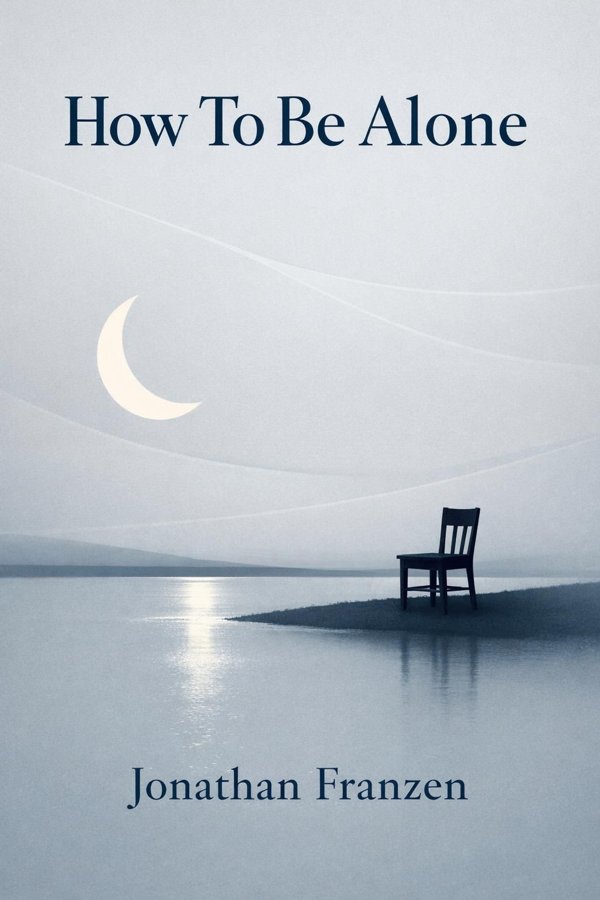
How To Be Alone: Summary & Key Insights
 10 min9 chaptersAudio available
Key Takeaways from How To Be Alone
Nothing exposes the precariousness of the self more brutally than watching memory disappear.
A culture that treats privacy as suspicious eventually loses the conditions required for genuine individuality.
When a culture becomes obsessed with speed, utility, and entertainment, art must repeatedly justify its existence.
To read deeply is already to go into exile from the dominant habits of modern life.
We often talk about technology as a neutral tool, but its deepest effects are cultural and emotional.
What Is How To Be Alone About?
How To Be Alone by Jonathan Franzen is a writing book spanning 11 pages. What does it mean to protect your inner life in a world that constantly demands access, reaction, and noise? In How To Be Alone, Jonathan Franzen wrestles with that question through a wide-ranging collection of essays on family, literature, privacy, technology, culture, and the uneasy place of the serious writer in modern society. Part memoir, part cultural criticism, and part literary reflection, the book explores how loneliness, attention, and individuality are shaped by the systems around us. Franzen writes with unusual authority because he is not merely commenting from a distance. As one of the most influential American novelists and essayists of his generation, he draws from lived experience: his father’s illness, his own literary ambitions, his observations about media culture, and his persistent concern for what contemporary life does to reading and thinking. These essays reveal a mind trying to understand how a person can remain morally and intellectually independent amid distraction and conformity. The result is a sharp, often deeply personal book that matters because its central concerns feel even more urgent now: how to preserve privacy, how to read seriously, and how to live with enough solitude to know who you are.
This FizzRead summary covers all 9 key chapters of How To Be Alone in approximately 10 minutes, distilling the most important ideas, arguments, and takeaways from Jonathan Franzen's work. Also available as an audio summary and Key Quotes Podcast.
How To Be Alone
What does it mean to protect your inner life in a world that constantly demands access, reaction, and noise? In How To Be Alone, Jonathan Franzen wrestles with that question through a wide-ranging collection of essays on family, literature, privacy, technology, culture, and the uneasy place of the serious writer in modern society. Part memoir, part cultural criticism, and part literary reflection, the book explores how loneliness, attention, and individuality are shaped by the systems around us.
Franzen writes with unusual authority because he is not merely commenting from a distance. As one of the most influential American novelists and essayists of his generation, he draws from lived experience: his father’s illness, his own literary ambitions, his observations about media culture, and his persistent concern for what contemporary life does to reading and thinking. These essays reveal a mind trying to understand how a person can remain morally and intellectually independent amid distraction and conformity.
The result is a sharp, often deeply personal book that matters because its central concerns feel even more urgent now: how to preserve privacy, how to read seriously, and how to live with enough solitude to know who you are.
Who Should Read How To Be Alone?
This book is perfect for anyone interested in writing and looking to gain actionable insights in a short read. Whether you're a student, professional, or lifelong learner, the key ideas from How To Be Alone by Jonathan Franzen will help you think differently.
- ✓Readers who enjoy writing and want practical takeaways
- ✓Professionals looking to apply new ideas to their work and life
- ✓Anyone who wants the core insights of How To Be Alone in just 10 minutes
Want the full summary?
Get instant access to this book summary and 100K+ more with Fizz Moment.
Get Free SummaryAvailable on App Store • Free to download
Key Chapters
Nothing exposes the precariousness of the self more brutally than watching memory disappear. In “My Father’s Brain,” Franzen begins with his father’s decline into Alzheimer’s disease, turning a private family ordeal into a meditation on identity, control, and helpless love. The essay is not only about illness; it is about what happens when the structures that make a person recognizable begin to erode. Intelligence, habit, speech, and authority slowly give way, and the family is forced to confront how much of a life depends on the brain’s invisible order.
Franzen’s account is powerful because he refuses sentimentality. He captures both grief and irritation, both tenderness and emotional distance. That honesty matters. Family suffering is rarely noble in a clean, cinematic way. It is repetitive, awkward, exhausting, and morally confusing. In describing his father’s deterioration, Franzen also reveals his own complicated struggle to understand his parents and himself. The essay becomes a study in how illness strips away old roles: the father who once represented certainty becomes vulnerable, and the son must reckon with unresolved feelings.
The broader insight is that solitude often begins in loss. When someone close to us changes beyond recognition, we are pushed inward. We are forced to ask what remains when competence, status, and language are gone. In practical terms, the essay invites readers to approach family decline with more realism and humility. If you are caring for an aging parent, the lesson is not to seek perfect emotional clarity. Instead, allow room for mixed feelings, document memories while you can, and accept that love may express itself through presence rather than eloquence.
Actionable takeaway: Have one meaningful conversation, record, letter, or memory-preserving act with an older family member now, before time makes it impossible.
A culture that treats privacy as suspicious eventually loses the conditions required for genuine individuality. In “Imperial Bedroom,” Franzen examines the shrinking space for private life in a society increasingly driven by surveillance, confession, exhibition, and technological intrusion. The bedroom in his title is symbolic: it represents the last room of the self, a place where one is not performing, not marketable, and not available for public consumption.
Franzen argues that privacy is not merely a personal preference or a luxury for the shy. It is a democratic and psychological necessity. Without protected inward space, people become easier to manipulate. They begin to live according to what can be displayed, approved, and monitored. Even before the full rise of social media, Franzen saw a culture drifting toward self-exposure and entertainment as default modes of existence. His warning now feels remarkably prophetic.
The essay asks readers to reconsider common assumptions. More communication is not always deeper connection. More visibility is not always authenticity. In fact, the constant invitation to reveal oneself can flatten personality, because private reflection is where contradictory thoughts mature and values take shape. Consider how often people now interrupt experience to document it, or turn uncertainty into content before understanding it. Privacy protects the unfinished self.
Practically, this idea applies to reading habits, digital life, and relationships. You do not need to share every opinion, track every metric, or remain permanently reachable. To preserve a self that is more than a public profile, you need zones of nonperformance: walks without devices, journals not meant for publication, conversations not turned into posts, and time in which nobody can interrupt you.
Actionable takeaway: Create one recurring daily period, even just 30 minutes, in which you are unreachable and unobserved, and treat it as essential rather than optional.
When a culture becomes obsessed with speed, utility, and entertainment, art must repeatedly justify its existence. In “Why Bother?” Franzen confronts a question that haunts many writers and readers alike: why devote oneself to difficult fiction when the world seems to reward spectacle, convenience, and distraction? His answer is neither naïve nor purely aesthetic. He argues that literature matters because it preserves forms of truth and feeling that mass culture tends to simplify or erase.
Franzen describes his own crisis of confidence as a novelist, including his fear that the social novel had lost its audience and relevance. Yet this personal uncertainty leads to a broader defense of literary seriousness. Fiction, at its best, allows readers to encounter complexity without reducing it to slogans. It enlarges empathy not by preaching but by immersing us in consciousness unlike our own. It also resists the logic of instant consumption. A demanding novel asks for patience, interpretation, and surrender, all of which are increasingly rare capacities.
The brilliance of the essay lies in its refusal to pretend that literature automatically changes society in visible ways. Franzen instead makes a subtler claim: books matter because they create intimate, durable bonds between writer and reader. Even if fiction does not command the center of public culture, it can transform the inner lives of individuals. That is not a minor achievement; it may be the highest one art can offer.
For readers, this means resisting the pressure to judge books by productivity metrics or immediate applicability. A novel does not need to optimize your life to enrich it. For writers, it means writing toward emotional and moral honesty, not trend alignment. The audience for serious work may be smaller than mass entertainment’s, but its impact can be deeper.
Actionable takeaway: Commit to reading one challenging literary work slowly, without multitasking, and notice how sustained attention changes your thinking.
To read deeply is already to go into exile from the dominant habits of modern life. In “The Reader in Exile,” Franzen explores the strange loneliness of being a serious reader in a culture increasingly organized against concentrated attention. Reading requires silence, patience, interiority, and a willingness to be alone with language. Those qualities often place readers at odds with environments built for interruption, stimulation, and immediate reaction.
Franzen suggests that readers have become exiles not because books disappeared, but because the social prestige and everyday rhythm that once supported reading have weakened. The modern reader must actively defend a practice that no longer feels culturally central. This exile, however, is not only loss. It is also a form of freedom. To read is to step outside consensus, advertising pressure, algorithmic nudging, and the demand to be constantly available. It is one of the last ordinary acts through which a person can inhabit another tempo of mind.
The essay speaks directly to anyone who has found reading harder in the age of alerts and screens. The problem is not simply lack of discipline; it is environmental design. If your day is built around fragmented attention, deep reading will feel unnatural. Franzen’s point is that protecting reading is less about heroic willpower than about building supportive conditions. A chair by a window, a phone in another room, a scheduled reading hour, or a small reading group can all help restore seriousness to the act.
Readers can also reframe solitude as privilege rather than punishment. Being “out of the loop” for an evening may mean being more fully in contact with your own mind. Exile from noise can become residence in depth.
Actionable takeaway: Build a regular reading ritual in a fixed place and time, with no digital interruptions, so reading becomes a habitat instead of a leftover activity.
We often talk about technology as a neutral tool, but its deepest effects are cultural and emotional. In essays such as “Lost in the Mail” and “Control Units,” Franzen reflects on systems of communication and regulation that appear practical on the surface yet quietly reshape daily life. Whether discussing the postal service, prisons, bureaucracy, or technological mediation, he is interested in what gets standardized, depersonalized, and hidden when efficiency becomes the dominant value.
Franzen notices that modern systems promise frictionless exchange while often producing alienation. Mail once carried a sense of individuality and physical trace; newer forms of communication increase speed but can reduce texture and permanence. Likewise, institutions designed around control may become morally numb, because distance makes human consequences easier to ignore. This is one of Franzen’s recurring insights: when processes become abstract, sympathy can weaken.
The practical relevance of this idea is broad. In work life, automated systems save time but can make people feel unseen. In personal life, instant messaging keeps us connected but may not satisfy our need for attention and presence. In civic life, policies created from afar can obscure the lived experience of those affected by them. Franzen does not argue for rejecting technology outright. Rather, he asks us to remain alert to what each system rewards and what it erodes.
A useful application is to choose communication forms more intentionally. Some messages should be sent quickly; others deserve a phone call, a handwritten note, or a face-to-face conversation. Not every exchange benefits from maximum speed. Slower forms can carry more care, memory, and accountability.
Actionable takeaway: This week, replace one purely convenient communication with a more personal one, such as a call, letter, or in-person conversation, and observe the difference in quality.
We do not think in a vacuum; our environments teach us how to feel, notice, and belong. In essays like “First City” and “Meet Me in St. Louis,” Franzen explores the relationship between place, memory, and identity. Cities, suburbs, family homes, and regions are never just backdrops in his work. They are emotional landscapes that organize aspiration, shame, nostalgia, and self-understanding.
Franzen is especially good at showing how a place can become both intimate and estranging. The city that formed you may later feel provincial; the hometown you wanted to escape may remain central to your emotional vocabulary. Returning to familiar places often reveals not only how those places have changed, but how much of your former self is still stored in them. Geography becomes biography.
This matters because many people underestimate how strongly setting affects mental life. A noisy, status-driven environment encourages different values than one organized around slowness, natural beauty, or community continuity. If you feel chronically distracted, performative, or emotionally flattened, the issue may not be entirely internal. Place can amplify or diminish the possibility of reflection.
Franzen’s essays invite readers to become more conscious interpreters of their own environments. Which spaces make you more alert, generous, and curious? Which ones trigger anxiety, comparison, or numbness? Practical changes need not be dramatic. Rearranging a room for reading, walking through a neighborhood without headphones, revisiting a formative place with adult eyes, or paying attention to the architecture of your routines can alter your experience of self.
Actionable takeaway: Identify one physical environment that consistently deepens your attention or calm, and begin visiting or using it deliberately as a space for thinking and restoration.
A writer’s raw material is often not inspiration but salvage. In “Scavenging,” Franzen presents writing as an act of gathering overlooked fragments from lived experience, cultural debris, memory, embarrassment, and contradiction. The metaphor is revealing: serious writing does not arise from a pristine, perfectly ordered mind. It emerges from rummaging through what seems broken, trivial, or unresolved and discovering hidden meaning there.
This idea applies far beyond literary craft. Most valuable insight comes from paying attention to what others discard. An awkward family scene, a failed conversation, an obsolete object, a local news item, an old notebook entry, a moment of envy or confusion: all can become the seed of understanding if examined carefully. Franzen’s sensibility is particularly attuned to the leftovers of modern life, the things not polished enough for public self-presentation. That is why his essays feel alive. He does not write from a position of finished certainty; he writes from active inquiry.
For aspiring writers, the lesson is liberating. You do not need a dramatic life to produce meaningful work. You need habits of noticing. Keep fragments. Record language that catches your ear. Revisit material that embarrasses you. The themes you avoid may contain your strongest work. Scavenging also means trusting that intellectual and emotional coherence often comes later, during arrangement and revision.
Even nonwriters can use this mindset. Reflection becomes richer when you stop chasing only major revelations and instead examine everyday residue. A difficult email, a recurring irritation, or an object you cannot throw away may reveal what matters to you.
Actionable takeaway: Start a “scavenger notebook” for one week and collect observations, sentences, memories, and odd details without judging them; review them later for patterns and meaning.
Some of the most important cultural practices look trivial from the outside. In “Books in Bed,” Franzen reflects on the humble intimacy of private reading, especially in domestic spaces associated with rest, vulnerability, and retreat. Reading in bed is not merely a cozy habit; it symbolizes a relationship to books that is bodily, personal, and resistant to public performance. It places literature inside the rhythms of ordinary life rather than on a pedestal.
Franzen’s insight is that where and how we read matters. A bed is a place of privacy, fatigue, desire, and dream. To bring a book there is to allow literature to meet us at our most unguarded. This contrasts sharply with more instrumental attitudes toward reading, where books become objects of status, self-improvement, or professional utility. In bed, reading is less likely to be about display. It becomes companionship.
There is also an implicit defense here against the colonization of every private moment by screens. The bedtime hour is now one of the most contested spaces in modern life, often surrendered to scrolling, low-grade stimulation, and algorithmically tailored distraction. Franzen helps us see that choosing a book instead is not quaint. It is a meaningful act of mental and emotional self-direction. Books slow the pulse, deepen imagination, and create a transition into sleep that is qualitatively different from digital consumption.
Practically, this essay suggests protecting small rituals rather than waiting for ideal circumstances. Ten pages before sleep can become a stabilizing practice. Couples and families can normalize visible reading. Bedrooms can be arranged to make books more accessible than devices.
Actionable takeaway: Replace the final 20 minutes of one evening each week with reading a physical book in bed, and use that ritual as a foothold for reclaiming attention.
The paradox at the heart of the book is that learning to be alone is not a rejection of human connection but a precondition for honest relationship. In the title essay, “How to Be Alone,” Franzen draws together many of his recurring concerns: the burdens of social expectation, the commercialization of attention, the loneliness hidden inside mass connectivity, and the writer’s need for inward freedom. He argues that solitude is not emptiness. It is the condition in which a person can hear his own thoughts, test inherited values, and develop a self that is not entirely manufactured by external pressures.
Franzen distinguishes solitude from isolation. Isolation is painful disconnection; solitude is chosen or accepted inward space. A culture that fears being alone tends to substitute constant contact for true intimacy. Yet relationships become shallow when people enter them without a developed inner life. If you cannot tolerate your own company, you are more likely to seek distraction, approval, or escape from others rather than encounter them honestly.
This is one reason Franzen links solitude to reading and writing. Both practices train the ability to remain present without immediate feedback. They build emotional stamina. They help us discover preferences, questions, and convictions that are genuinely our own. In practical life, solitude can mean walking without headphones, spending an evening without communication, thinking before responding, or creating space between stimulus and reaction.
The essay’s enduring contribution is to recast aloneness as a skill. In an age that monetizes attention and rewards visibility, the capacity to be alone may be one of the last defenses against conformity. Solitude is where independence begins.
Actionable takeaway: Schedule a recurring hour of intentional solitude each week with no entertainment or messaging, and use it to think, write, or simply notice your own mind without interruption.
All Chapters in How To Be Alone
About the Author
Jonathan Franzen is an acclaimed American novelist and essayist whose work explores family, culture, technology, and the pressures of contemporary life. Born in 1959, he emerged as a major literary voice with novels such as The Corrections, which won the National Book Award, and later Freedom and Crossroads. Alongside his fiction, Franzen has written influential essays for prominent magazines and newspapers, often combining memoir, cultural criticism, and literary reflection. His nonfiction is known for its intelligence, candor, and skepticism toward modern habits of distraction and self-display. Across genres, Franzen is interested in how individuals struggle to preserve authenticity, intimacy, and moral seriousness within large social systems. How To Be Alone showcases many of the concerns that define his broader body of work.
Get This Summary in Your Preferred Format
Read or listen to the How To Be Alone summary by Jonathan Franzen anytime, anywhere. FizzRead offers multiple formats so you can learn on your terms — all free.
Available formats: App · Audio · PDF · EPUB — All included free with FizzRead
Download How To Be Alone PDF and EPUB Summary
Key Quotes from How To Be Alone
“Nothing exposes the precariousness of the self more brutally than watching memory disappear.”
“A culture that treats privacy as suspicious eventually loses the conditions required for genuine individuality.”
“When a culture becomes obsessed with speed, utility, and entertainment, art must repeatedly justify its existence.”
“To read deeply is already to go into exile from the dominant habits of modern life.”
“We often talk about technology as a neutral tool, but its deepest effects are cultural and emotional.”
Frequently Asked Questions about How To Be Alone
How To Be Alone by Jonathan Franzen is a writing book that explores key ideas across 9 chapters. What does it mean to protect your inner life in a world that constantly demands access, reaction, and noise? In How To Be Alone, Jonathan Franzen wrestles with that question through a wide-ranging collection of essays on family, literature, privacy, technology, culture, and the uneasy place of the serious writer in modern society. Part memoir, part cultural criticism, and part literary reflection, the book explores how loneliness, attention, and individuality are shaped by the systems around us. Franzen writes with unusual authority because he is not merely commenting from a distance. As one of the most influential American novelists and essayists of his generation, he draws from lived experience: his father’s illness, his own literary ambitions, his observations about media culture, and his persistent concern for what contemporary life does to reading and thinking. These essays reveal a mind trying to understand how a person can remain morally and intellectually independent amid distraction and conformity. The result is a sharp, often deeply personal book that matters because its central concerns feel even more urgent now: how to preserve privacy, how to read seriously, and how to live with enough solitude to know who you are.
More by Jonathan Franzen
You Might Also Like
The Art of Perspective
Christopher Castellani
10 min
Making a Point: The Persnickety Story of English Punctuation
David Crystal
10 min
The Elements Of Eloquence: How To Turn The Perfect English Phrase
Mark Forsyth
10 min
The Pocket Muse: Ideas and Inspirations for Writing
Monica Wood
10 min
A Little Book on Form: An Exploration into the Formal Imagination of Poetry
Robert Hass
10 min
Adventures In The Screen Trade: A Personal View Of Hollywood And Screenwriting
William Goldman
10 minBrowse by Category
Ready to read How To Be Alone?
Get the full summary and 100K+ more books with Fizz Moment.