
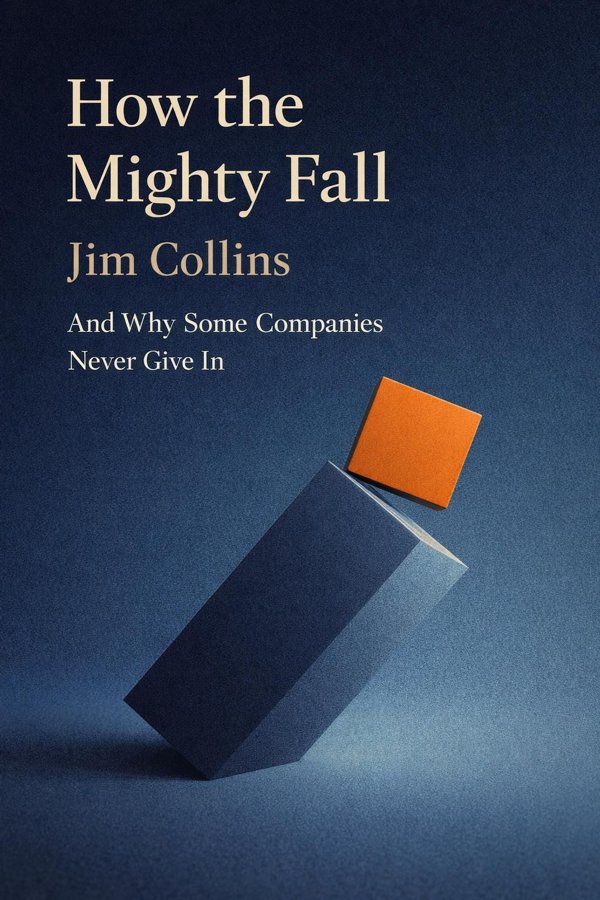
How the Mighty Fall: And Why Some Companies Never Give In: Summary & Key Insights
by Jim Collins
 10 min9 chaptersAudio available
What Is How the Mighty Fall: And Why Some Companies Never Give In About?
How the Mighty Fall: And Why Some Companies Never Give In by Jim Collins is a leadership book spanning 9 pages. In this management study, Jim Collins explores why once-great companies decline and how some manage to recover. Drawing on empirical research, he identifies five stages of corporate decline—from hubris born of success to eventual capitulation—and offers insights into how leaders can recognize warning signs early and reverse the downward spiral.
This FizzRead summary covers all 9 key chapters of How the Mighty Fall: And Why Some Companies Never Give In in approximately 10 minutes, distilling the most important ideas, arguments, and takeaways from Jim Collins's work. Also available as an audio summary and Key Quotes Podcast.
How the Mighty Fall: And Why Some Companies Never Give In
In this management study, Jim Collins explores why once-great companies decline and how some manage to recover. Drawing on empirical research, he identifies five stages of corporate decline—from hubris born of success to eventual capitulation—and offers insights into how leaders can recognize warning signs early and reverse the downward spiral.
Who Should Read How the Mighty Fall: And Why Some Companies Never Give In?
This book is perfect for anyone interested in leadership and looking to gain actionable insights in a short read. Whether you're a student, professional, or lifelong learner, the key ideas from How the Mighty Fall: And Why Some Companies Never Give In by Jim Collins will help you think differently.
- ✓Readers who enjoy leadership and want practical takeaways
- ✓Professionals looking to apply new ideas to their work and life
- ✓Anyone who wants the core insights of How the Mighty Fall: And Why Some Companies Never Give In in just 10 minutes
Want the full summary?
Get instant access to this book summary and 100K+ more with Fizz Moment.
Get Free SummaryAvailable on App Store • Free to download
Key Chapters
Every decline begins with a subtle and seductive illusion: the belief that success is self-perpetuating. In the first stage, companies forget why they rose in the first place. The very practices that built their greatness—curiosity, discipline, and the relentless pursuit of improvement—are replaced by arrogance. Leaders begin to assume that their success was inevitable rather than earned.
I observed that once-great enterprises start telling themselves stories of permanence: that their reputation alone will carry them forward, that they can make decisions without the same rigor that once guided them. They mistake the causes of success for luck or genius, rather than disciplined execution. Hubris manifests when leaders feel exempt from the rules that apply to others, when they rely more on their past fame than on present diligence.
Think of major corporations that dominated their industries for decades only to falter because they stopped listening—to their customers, to their data, even to the humble truths that once shaped their mission. Hubris blinds leaders, and blindness makes them careless. In this stage, the company’s internal culture shifts subtly: questions are replaced by certainty, and learning is replaced by complacency.
Yet, the lesson here is not condemnation but awareness. Success carries its own poison, and the antidote lies in humility. It demands remembering that greatness is never a permanent state; it must be constantly earned through disciplined thought and action. When leaders stay grounded, vigilant, and open to learning, success remains sustainable. When they drift toward arrogance, decline has already begun.
After hubris takes root, the next stage emerges almost naturally: overreach. Companies convinced of their invincibility begin to chase growth recklessly—more products, more markets, more acquisitions, more noise. In their drive for expansion, they abandon the principles of disciplined scaling that made them strong.
I’ve seen organizations that once thrived on focus and excellence scatter their energy into ventures that dilute their core. It’s not growth itself that destroys them—it’s undisciplined growth. The disciplined pursuit of greatness demands saying no to opportunities that don’t align with your core values, but arrogance distorts judgment. Leaders start confusing big with great, movement with progress.
Imagine a company whose strength lies in a single, perfected craft—seduced by the idea that success in one area guarantees success in all others. They leap into unfamiliar terrain without analysis or patience, hiring too quickly, diversifying too broadly, stretching resources too thin. This expansion feels exhilarating at first—revenues may even soar—but underneath, systems strain, culture fractures, and quality erodes.
The warning here is profound: when you abandon discipline for ambition, you sow the seeds of chaos. Sustainable growth must always be a result of tested principles, not feverish desire. The cure lies in returning to the question 'Why?' Why do we exist? Why do we choose this path? Why does this strategy serve our mission? Only disciplined leaders—those who balance boldness with control—can pursue growth without losing their soul.
+ 7 more chapters — available in the FizzRead app
All Chapters in How the Mighty Fall: And Why Some Companies Never Give In
About the Author
Jim Collins is an American researcher, author, and lecturer focused on business management and company sustainability. He is best known for his books 'Good to Great' and 'Built to Last', which have become foundational works in the field of leadership and organizational success.
Get This Summary in Your Preferred Format
Read or listen to the How the Mighty Fall: And Why Some Companies Never Give In summary by Jim Collins anytime, anywhere. FizzRead offers multiple formats so you can learn on your terms — all free.
Available formats: App · Audio · PDF · EPUB — All included free with FizzRead
Download How the Mighty Fall: And Why Some Companies Never Give In PDF and EPUB Summary
Key Quotes from How the Mighty Fall: And Why Some Companies Never Give In
“Every decline begins with a subtle and seductive illusion: the belief that success is self-perpetuating.”
“After hubris takes root, the next stage emerges almost naturally: overreach.”
Frequently Asked Questions about How the Mighty Fall: And Why Some Companies Never Give In
How the Mighty Fall: And Why Some Companies Never Give In by Jim Collins is a leadership book that explores key ideas across 9 chapters. In this management study, Jim Collins explores why once-great companies decline and how some manage to recover. Drawing on empirical research, he identifies five stages of corporate decline—from hubris born of success to eventual capitulation—and offers insights into how leaders can recognize warning signs early and reverse the downward spiral.
More by Jim Collins


You Might Also Like

Extreme Ownership
Jocko Willink
10 min
Dare to Lead
Brene Brown
10 min
Leaders Eat Last
Simon Sinek
10 min
The 21 Irrefutable Laws of Leadership
John Maxwell
10 min
Start With Why
Simon Sinek
10 min
How to Lead When You're Not in Charge
Clay Scroggins
10 minBrowse by Category
Ready to read How the Mighty Fall: And Why Some Companies Never Give In?
Get the full summary and 100K+ more books with Fizz Moment.