
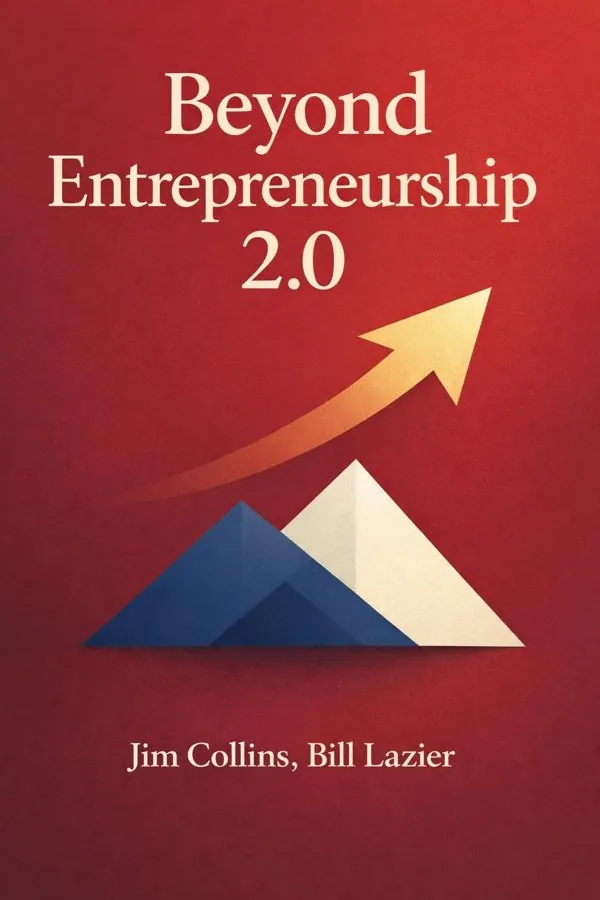
Beyond Entrepreneurship: Summary & Key Insights
by Jim Collins
 10 min9 chaptersAudio available
Key Takeaways from Beyond Entrepreneurship
The best leaders do not see themselves as heroes at the center of the story; they see themselves as stewards of something larger than themselves.
A company’s deepest strength comes from knowing why it exists and what it will never compromise.
In strong companies, vision is not vague inspiration; it is a disciplined combination of enduring identity and concrete direction.
Culture does not emerge from speeches.
Creativity without discipline creates chaos, but discipline without creativity creates stagnation.
What Is Beyond Entrepreneurship About?
Beyond Entrepreneurship by Jim Collins is a business book published in 2020 spanning 9 pages. Beyond Entrepreneurship 2.0 is Jim Collins and Bill Lazier’s guide to building a company that lasts. Originally published in 1992 and later expanded with Collins’s updated commentary, the book blends timeless leadership principles with decades of new insight into what separates merely successful businesses from truly enduring ones. Its focus is not on quick wins, startup hype, or flashy disruption. Instead, it asks a harder and more important question: how do you create an organization that can grow, adapt, and remain excellent over time? The book matters because many businesses are built around momentum, personality, or opportunity, but very few are built to endure. Collins and Lazier argue that greatness does not happen by accident. It comes from disciplined leadership, deeply held values, a clear vision, strong culture, and systems that turn good intentions into consistent results. Collins brings unusual authority to this subject through decades of research behind classics like Good to Great and Built to Last, while Lazier contributed deep practical wisdom from teaching and advising leaders. Together, they offer a thoughtful roadmap for entrepreneurs, executives, and managers who want to build not just a business, but a great company.
This FizzRead summary covers all 9 key chapters of Beyond Entrepreneurship in approximately 10 minutes, distilling the most important ideas, arguments, and takeaways from Jim Collins's work. Also available as an audio summary and Key Quotes Podcast.
Beyond Entrepreneurship
Beyond Entrepreneurship 2.0 is Jim Collins and Bill Lazier’s guide to building a company that lasts. Originally published in 1992 and later expanded with Collins’s updated commentary, the book blends timeless leadership principles with decades of new insight into what separates merely successful businesses from truly enduring ones. Its focus is not on quick wins, startup hype, or flashy disruption. Instead, it asks a harder and more important question: how do you create an organization that can grow, adapt, and remain excellent over time?
The book matters because many businesses are built around momentum, personality, or opportunity, but very few are built to endure. Collins and Lazier argue that greatness does not happen by accident. It comes from disciplined leadership, deeply held values, a clear vision, strong culture, and systems that turn good intentions into consistent results. Collins brings unusual authority to this subject through decades of research behind classics like Good to Great and Built to Last, while Lazier contributed deep practical wisdom from teaching and advising leaders. Together, they offer a thoughtful roadmap for entrepreneurs, executives, and managers who want to build not just a business, but a great company.
Who Should Read Beyond Entrepreneurship?
This book is perfect for anyone interested in business and looking to gain actionable insights in a short read. Whether you're a student, professional, or lifelong learner, the key ideas from Beyond Entrepreneurship by Jim Collins will help you think differently.
- ✓Readers who enjoy business and want practical takeaways
- ✓Professionals looking to apply new ideas to their work and life
- ✓Anyone who wants the core insights of Beyond Entrepreneurship in just 10 minutes
Want the full summary?
Get instant access to this book summary and 100K+ more with Fizz Moment.
Get Free SummaryAvailable on App Store • Free to download
Key Chapters
The best leaders do not see themselves as heroes at the center of the story; they see themselves as stewards of something larger than themselves. That idea sits at the heart of Beyond Entrepreneurship. Collins and Lazier argue that enduring entrepreneurship is built not on charisma, title, or force of personality, but on leadership rooted in responsibility, integrity, and service.
This matters because many companies rise quickly under bold founders and then weaken when everything depends on one person’s energy. A stewardship mindset changes the game. Instead of asking, “How can I win?” the leader asks, “How can I build something that thrives beyond me?” That shift affects hiring, delegation, succession, and decision-making. A steward develops people, protects the company’s values, and makes choices that strengthen the institution over the long term.
In practice, this can look like a founder who shares critical knowledge instead of hoarding it, creates leadership opportunities for rising managers, and resists shortcuts that would damage trust. It can also mean being honest about weaknesses and building a team that compensates for them. A leader who measures success only by quarterly growth may neglect culture and talent. A steward thinks in decades.
Collins’s broader work reinforces this principle: great companies are often led by ambitious people whose ambition is directed toward the enterprise, not their own image. That is why humility and discipline matter as much as boldness.
Actionable takeaway: Evaluate your leadership through a stewardship lens. Ask yourself what systems, people, and values you are strengthening today that would allow the company to flourish even if you stepped away tomorrow.
A company’s deepest strength comes from knowing why it exists and what it will never compromise. Beyond Entrepreneurship makes a crucial distinction between authentic purpose and empty corporate language. Purpose is not a slogan written for a website. Core values are not generic words like excellence, innovation, or teamwork pasted on a wall. They are enduring commitments that actually shape behavior.
Collins and Lazier argue that every great company begins with a clear purpose that gives meaning to the work. Purpose answers why the organization deserves to exist beyond making money. Profit is necessary, but it is not the reason the company matters. Core values then define the non-negotiable principles that guide decisions, especially when trade-offs become difficult.
For example, a healthcare company might define its purpose as improving patient outcomes through accessible care. If one of its core values is trust, then it cannot cut corners on safety to boost margins. A small design firm might value craftsmanship and honesty. That means turning down lucrative work that requires misleading clients or lowering standards.
When purpose and values are genuine, they help leaders make better decisions faster. They improve hiring because the company knows what kind of people belong. They strengthen culture because employees can see what behaviors are rewarded. They also help organizations navigate crises by providing a stable compass when external conditions shift.
Actionable takeaway: Write down your company’s purpose in one clear sentence and identify three to five core values that would remain true even if they came at a financial cost. If they would not survive pressure, they are not really core.
In strong companies, vision is not vague inspiration; it is a disciplined combination of enduring identity and concrete direction. Collins and Lazier explain that vision has two major parts. First, there is the core ideology: the company’s purpose and values, which should remain relatively stable over time. Second, there is the envisioned future: an ambitious destination that gives people a shared challenge and reason to stretch.
Many leaders confuse these elements. They change their values every few years, or they create inspiring language without translating it into strategic choices. Beyond Entrepreneurship insists that real vision must be both emotionally compelling and operationally useful. It should inspire commitment while also informing where the company is going and what it intends to achieve.
A useful example is a company that knows its purpose is to simplify financial life for ordinary families. That core purpose may endure for decades. But its envisioned future could be to become the most trusted digital platform in its category within ten years. That future goal can then shape investment priorities, talent needs, technology choices, and customer experience standards.
This approach helps organizations remain consistent without becoming rigid. The core stays steady; the strategy evolves. Teams understand what should never change and what must adapt. That balance is especially important in volatile markets, where companies need to pivot without losing their identity.
Actionable takeaway: Separate your company’s lasting identity from its medium-term aspirations. Define what should stay constant for decades, then articulate a bold but specific future target that can focus effort over the next five to ten years.
Culture does not emerge from speeches. It is built through repeated decisions about whom you hire, what you reward, what you tolerate, and how leaders behave when pressure rises. Beyond Entrepreneurship treats culture as a strategic asset, not a soft issue. Great companies do not leave it to chance.
Collins and Lazier emphasize that culture becomes durable when it is aligned with the company’s purpose and values. If leaders say people matter but routinely reward burnout and politics, the real culture becomes obvious. If the organization claims to value candor but punishes disagreement, employees quickly learn to stay silent. Culture is revealed more by consequences than by words.
A healthy culture supports both performance and belonging. It gives people clarity about standards and confidence that their work contributes to something meaningful. For instance, a company that truly values learning might hold regular after-action reviews, encourage respectful debate, and treat mistakes as opportunities for improvement rather than occasions for blame. Another company that values accountability may set clear expectations, measure outcomes transparently, and act quickly when behaviors violate standards.
Strong culture also improves scaling. As a business grows, founders cannot personally supervise every decision. Culture becomes the invisible operating system that guides behavior across teams and locations. Without it, complexity produces inconsistency.
Actionable takeaway: Audit your culture by examining real signals: hiring criteria, promotion patterns, meeting dynamics, conflict resolution, and what behaviors get rewarded. Then choose one cultural trait you want to strengthen and redesign a process around it this month.
Creativity without discipline creates chaos, but discipline without creativity creates stagnation. Beyond Entrepreneurship argues that great companies need both. Many leaders think discipline limits entrepreneurial energy. Collins and Lazier show the opposite: discipline provides the structure that allows innovation to be repeatable, focused, and productive over time.
Discipline begins with clear priorities, consistent standards, and systems that translate intentions into action. It means setting expectations, measuring performance, and following through. Innovation then works best when it happens inside a framework aligned with the company’s purpose and strategic direction. Not every idea deserves resources. The challenge is not generating possibilities; it is choosing the right ones.
Consider a software company that encourages experimentation. Without discipline, teams may launch too many side projects, confuse customers, and exhaust engineering capacity. With discipline, the company can create a clear process: test ideas in small pilots, evaluate them against defined criteria, and scale only those that fit strategic goals. The result is not less innovation, but better innovation.
This principle also applies to individuals. Teams become more creative when they know the boundaries, the goals, and the standards for success. Constraints often sharpen imagination. Leaders who combine freedom with accountability create environments where people can take intelligent risks rather than random ones.
Actionable takeaway: Identify one area where your organization has too much looseness or too much rigidity. Add structure where execution is drifting, or create room for experimentation where bureaucracy is suffocating progress. The goal is disciplined creativity, not either extreme.
Breakthroughs usually look sudden from the outside, but inside great companies they are the result of steady, cumulative effort. This is the logic behind the flywheel concept that Collins later made famous and revisits in Beyond Entrepreneurship 2.0. A flywheel is a heavy wheel that requires enormous effort to start moving, but each consistent push builds momentum until movement becomes faster, easier, and self-reinforcing.
In business, the flywheel reminds leaders that enduring success does not come from one dramatic initiative. It comes from aligning actions in a coherent sequence that compounds over time. For example, a retailer may improve customer service, which drives loyalty, which increases repeat business, which generates cash for better employee training and systems, which further improves service. Each part reinforces the next.
The danger is fragmentation. Companies often chase growth by launching disconnected programs, rebranding strategy every year, or searching for a miracle solution. That behavior interrupts momentum. The flywheel approach demands patience and consistency. Leaders must identify the few linked drivers that matter most and keep pushing them, even when results are initially modest.
This concept is especially useful for small and midsize businesses, which often feel pressure to move fast in every direction. A well-designed flywheel creates focus. It helps teams understand how daily activities contribute to long-term progress.
Actionable takeaway: Map your company’s flywheel in four to six linked stages. Ask how one success leads naturally to the next. Then prioritize actions that strengthen the whole cycle rather than isolated wins that do not build momentum.
What helps a company survive its early stage will not necessarily help it become great. One of the most valuable insights in Beyond Entrepreneurship is that leadership must evolve as the organization grows. Founders often succeed through instinct, speed, and personal control. But as complexity rises, those same habits can become obstacles.
Collins and Lazier explain that growing companies require leaders to shift from doing to directing, from reacting to designing, and from personal heroics to institutional capability. In the beginning, a founder may close sales, solve customer issues, hire people, and set product direction personally. Later, that approach creates bottlenecks. People wait for approval, decisions slow, and the organization becomes dependent on one overextended individual.
Leadership evolution means building management systems, developing other leaders, clarifying roles, and creating structures that preserve agility without chaos. It also requires emotional growth. Leaders must let go of the identity that comes from being the indispensable problem solver. They need to become architects of an organization, not merely the best operator inside it.
A practical example is a founder who moves from managing every marketing decision to appointing a strong leader, defining strategic guardrails, and reviewing results through regular metrics. This shift frees the founder to focus on vision, talent, and long-term priorities.
Actionable takeaway: List the tasks only you can do and the tasks you still do out of habit. Begin transferring one recurring responsibility to a capable team member, and pair the handoff with clear expectations, support, and accountability.
Companies rarely become enduringly great through isolated excellence. They do so by building a coherent system in which leadership, values, strategy, people, and execution reinforce one another. Beyond Entrepreneurship presents this broader architecture as a map to enduring greatness. The point is not to master one management technique, but to create alignment across the enterprise.
This systems view matters because organizations often try to solve deep problems with superficial fixes. If performance is weak, they launch a new incentive plan. If morale drops, they hold an offsite. If growth stalls, they rewrite strategy. But if the root issue is misalignment between values, leadership behavior, structure, and goals, no single fix will last.
Collins and Lazier encourage leaders to think holistically. A clear purpose informs strategy. Strategy shapes priorities. Priorities influence structure and resource allocation. Culture determines whether people execute those priorities with commitment and discipline. Leadership then holds the entire system together through consistency and example.
For instance, a company that says innovation is central to its strategy must hire curious people, reward experimentation, budget for research, tolerate some failures, and maintain processes that bring good ideas to market. If any major part is missing, the strategy weakens.
This is why greatness is difficult. It requires not only good ideas, but integration. The strongest organizations are those in which the pieces fit naturally rather than fighting one another.
Actionable takeaway: Choose one strategic priority and test whether your hiring, incentives, meeting rhythms, budgeting, and leadership behavior all support it. If they do not, fix the misalignment before adding anything new.
Ideas create inspiration, but frameworks create repeatability. One of the strengths of Beyond Entrepreneurship is that it does not stop at philosophy. Collins and Lazier offer practical tools that help leaders move from abstract ambition to operational clarity. These frameworks are useful because business complexity often causes organizations to drift. Tools create shared language and disciplined thinking.
The book encourages leaders to use structured reflection around purpose, values, strategy, goals, roles, and execution. This does not mean bureaucracy for its own sake. It means designing simple mechanisms that help people make better decisions consistently. Examples include setting clear objectives, defining responsibilities, conducting regular strategic reviews, and using planning processes that connect long-term vision to near-term action.
A practical framework might involve quarterly priorities tied directly to annual goals and long-range direction. Another might be a hiring scorecard aligned with core values, so cultural fit is evaluated systematically rather than intuitively. Teams can also benefit from review routines that ask what worked, what failed, and what should change.
These tools become especially valuable during growth, when informal communication no longer scales. Frameworks reduce confusion, improve accountability, and make the business less dependent on memory or personality. They also help leaders maintain discipline without micromanaging.
Actionable takeaway: Pick one important area where inconsistency is hurting performance, such as hiring, goal setting, or project reviews. Introduce a lightweight framework with clear criteria, regular cadence, and visible accountability so the team can execute with greater reliability.
All Chapters in Beyond Entrepreneurship
About the Author
Jim Collins is an American author, researcher, and speaker focused on business leadership, company performance, and organizational endurance. He is best known for influential books such as Built to Last, Good to Great, How the Mighty Fall, and Great by Choice, all of which explore why some organizations achieve lasting success while others fade. Collins began his career as a faculty member at the Stanford Graduate School of Business before dedicating himself to research and writing. His work is widely respected for combining rigorous analysis with practical lessons leaders can apply in real organizations. In Beyond Entrepreneurship 2.0, he revisits the original book he wrote with Bill Lazier, blending their early thinking with decades of additional insight into leadership, culture, and the disciplined pursuit of greatness.
Get This Summary in Your Preferred Format
Read or listen to the Beyond Entrepreneurship summary by Jim Collins anytime, anywhere. FizzRead offers multiple formats so you can learn on your terms — all free.
Available formats: App · Audio · PDF · EPUB — All included free with FizzRead
Download Beyond Entrepreneurship PDF and EPUB Summary
Key Quotes from Beyond Entrepreneurship
“The best leaders do not see themselves as heroes at the center of the story; they see themselves as stewards of something larger than themselves.”
“A company’s deepest strength comes from knowing why it exists and what it will never compromise.”
“In strong companies, vision is not vague inspiration; it is a disciplined combination of enduring identity and concrete direction.”
“It is built through repeated decisions about whom you hire, what you reward, what you tolerate, and how leaders behave when pressure rises.”
“Creativity without discipline creates chaos, but discipline without creativity creates stagnation.”
Frequently Asked Questions about Beyond Entrepreneurship
Beyond Entrepreneurship by Jim Collins is a business book that explores key ideas across 9 chapters. Beyond Entrepreneurship 2.0 is Jim Collins and Bill Lazier’s guide to building a company that lasts. Originally published in 1992 and later expanded with Collins’s updated commentary, the book blends timeless leadership principles with decades of new insight into what separates merely successful businesses from truly enduring ones. Its focus is not on quick wins, startup hype, or flashy disruption. Instead, it asks a harder and more important question: how do you create an organization that can grow, adapt, and remain excellent over time? The book matters because many businesses are built around momentum, personality, or opportunity, but very few are built to endure. Collins and Lazier argue that greatness does not happen by accident. It comes from disciplined leadership, deeply held values, a clear vision, strong culture, and systems that turn good intentions into consistent results. Collins brings unusual authority to this subject through decades of research behind classics like Good to Great and Built to Last, while Lazier contributed deep practical wisdom from teaching and advising leaders. Together, they offer a thoughtful roadmap for entrepreneurs, executives, and managers who want to build not just a business, but a great company.
More by Jim Collins

Good to Great
Jim Collins
10 min
Built to Last: Successful Habits of Visionary Companies
Jim Collins, Jerry I. Porras
10 min
Good to Great: Why Some Companies Make the Leap... and Others Don't
Jim Collins
10 min
How the Mighty Fall: And Why Some Companies Never Give In
Jim Collins
10 minYou Might Also Like




Browse by Category
Ready to read Beyond Entrepreneurship?
Get the full summary and 100K+ more books with Fizz Moment.