
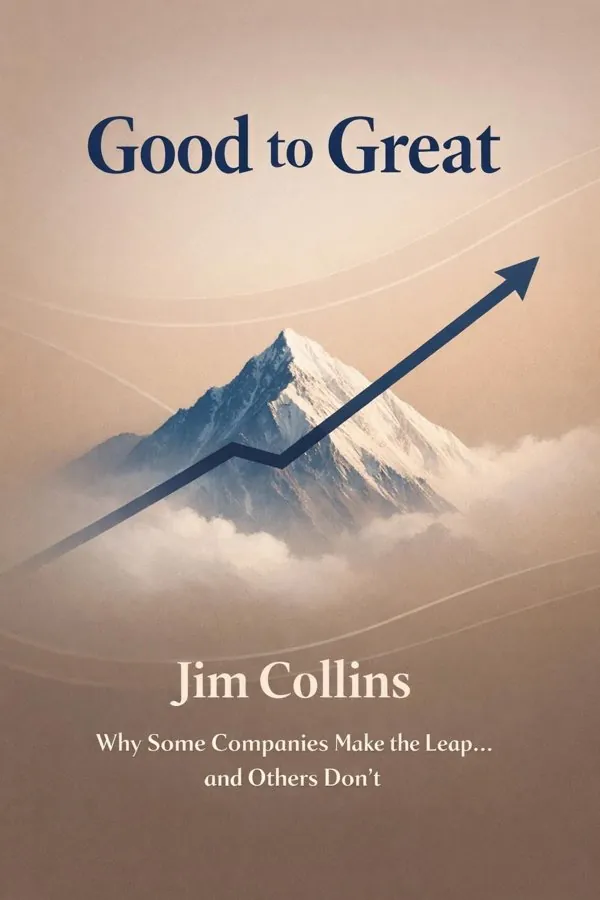
Good to Great: Why Some Companies Make the Leap... and Others Don't: Summary & Key Insights
by Jim Collins
 10 min10 chaptersAudio available
Key Takeaways from Good to Great: Why Some Companies Make the Leap... and Others Don't
Most business advice begins with a bold idea and then hunts for examples to support it.
The leaders who build enduring greatness are often less flashy than the leaders who dominate headlines.
Many leaders assume strategy comes first: define the vision, map the direction, then recruit people to execute it.
Optimism is not enough; disciplined hope requires truth.
Complexity often feels sophisticated, but greatness usually depends on simplification.
What Is Good to Great: Why Some Companies Make the Leap... and Others Don't About?
Good to Great: Why Some Companies Make the Leap... and Others Don't by Jim Collins is a leadership book spanning 10 pages. Why do some companies break out from mediocrity and sustain exceptional performance for years, while others with similar resources, talent, and opportunities never make the leap? In Good to Great, Jim Collins tackles that question with unusual rigor. Rather than relying on inspirational anecdotes or trendy management theory, he and his research team studied companies that made a dramatic transition from average results to outstanding long-term performance and compared them with similar firms that did not. The result is one of the most influential business books of the modern era. Collins argues that greatness is not built through dramatic turnarounds, celebrity CEOs, or lucky timing. It emerges from disciplined people, disciplined thought, and disciplined action applied consistently over time. Concepts such as Level 5 Leadership, First Who, Then What, the Hedgehog Concept, and the Flywheel have become foundational in leadership and strategy discussions because they are both memorable and practical. For leaders, founders, managers, and ambitious professionals, this book matters because it replaces vague ambition with a clear framework for building enduring excellence.
This FizzRead summary covers all 10 key chapters of Good to Great: Why Some Companies Make the Leap... and Others Don't in approximately 10 minutes, distilling the most important ideas, arguments, and takeaways from Jim Collins's work. Also available as an audio summary and Key Quotes Podcast.
Good to Great: Why Some Companies Make the Leap... and Others Don't
Why do some companies break out from mediocrity and sustain exceptional performance for years, while others with similar resources, talent, and opportunities never make the leap? In Good to Great, Jim Collins tackles that question with unusual rigor. Rather than relying on inspirational anecdotes or trendy management theory, he and his research team studied companies that made a dramatic transition from average results to outstanding long-term performance and compared them with similar firms that did not. The result is one of the most influential business books of the modern era.
Collins argues that greatness is not built through dramatic turnarounds, celebrity CEOs, or lucky timing. It emerges from disciplined people, disciplined thought, and disciplined action applied consistently over time. Concepts such as Level 5 Leadership, First Who, Then What, the Hedgehog Concept, and the Flywheel have become foundational in leadership and strategy discussions because they are both memorable and practical. For leaders, founders, managers, and ambitious professionals, this book matters because it replaces vague ambition with a clear framework for building enduring excellence.
Who Should Read Good to Great: Why Some Companies Make the Leap... and Others Don't?
This book is perfect for anyone interested in leadership and looking to gain actionable insights in a short read. Whether you're a student, professional, or lifelong learner, the key ideas from Good to Great: Why Some Companies Make the Leap... and Others Don't by Jim Collins will help you think differently.
- ✓Readers who enjoy leadership and want practical takeaways
- ✓Professionals looking to apply new ideas to their work and life
- ✓Anyone who wants the core insights of Good to Great: Why Some Companies Make the Leap... and Others Don't in just 10 minutes
Want the full summary?
Get instant access to this book summary and 100K+ more with Fizz Moment.
Get Free SummaryAvailable on App Store • Free to download
Key Chapters
Most business advice begins with a bold idea and then hunts for examples to support it. Collins reverses that process. The central insight of Good to Great is that real understanding comes from disciplined research, not managerial folklore. His team identified companies that achieved sustained stock returns far above the market after years of merely average performance, then compared them with similar companies that failed to make the same leap. This comparative method mattered because it filtered out easy explanations such as industry trends, short-term luck, or charismatic storytelling.
That research design is one of the book’s biggest contributions. Instead of asking what successful companies say they did, Collins asks what differentiates companies that became great from those that remained merely good. This approach allows patterns to emerge with surprising consistency. For example, the findings challenged popular assumptions about leadership, technology, and change. Greatness did not begin with grand vision speeches or revolutionary innovation. It began with quieter, more disciplined foundations.
The lesson extends beyond large corporations. A startup founder, school administrator, nonprofit director, or department manager can use the same logic. Compare your organization not only to famous winners, but to peer organizations facing similar conditions. Ask what specific behaviors and decisions truly distinguish superior performance. Replace motivational slogans with evidence, review outcomes over time, and be wary of explanations built only on hindsight.
Actionable takeaway: Before adopting any strategy, define what success looks like, identify comparable peers, and study the specific habits that separate sustained high performers from the rest.
The leaders who build enduring greatness are often less flashy than the leaders who dominate headlines. Collins found that the executives behind good-to-great transformations tended to display a paradoxical mix of personal humility and fierce professional will. He called this rare combination Level 5 Leadership. These leaders were ambitious, but their ambition was directed toward the institution rather than their own fame. They were determined, even relentless, yet modest in style and often uncomfortable with celebrity.
This idea challenges the myth that great companies require larger-than-life visionaries. A Level 5 leader is not weak or passive. On the contrary, these leaders make hard decisions, confront underperformance, and pursue long-term results with unusual intensity. What distinguishes them is where they place the spotlight. When things go well, they credit others, favorable conditions, or collective effort. When things go poorly, they take responsibility themselves.
In practice, this means building succession, not dependency. A manager who hoards decision-making may look strong in the short term but leaves fragility behind. A Level 5 leader develops people, creates systems, and strengthens the organization so it can thrive beyond one personality. Think of a CEO who resists the urge for media attention and instead focuses on recruiting strong operators, setting clear priorities, and improving execution year after year.
Actionable takeaway: Lead with quiet discipline—take responsibility for failures, share credit for successes, and make decisions that strengthen the organization long after you are gone.
Many leaders assume strategy comes first: define the vision, map the direction, then recruit people to execute it. Collins argues the sequence is backward. Great companies first got the right people on the bus, the wrong people off the bus, and the right people in the right seats before deciding exactly where to drive it. The deeper insight is that in an uncertain world, adaptable, disciplined people matter more than a perfectly detailed plan.
Why does this work? Because the right people do not need constant motivation, tight supervision, or elaborate control systems. They are self-driven, capable, and aligned with high standards. If conditions change, they help the organization respond intelligently. By contrast, the wrong people create friction that no strategy can fully overcome. A company with average strategy and exceptional people can often recover. A company with brilliant strategy and poor people usually struggles.
This principle applies far beyond executive hiring. Teams improve when leaders prioritize character, discipline, and learning capacity, not just technical skill or pedigree. A founder assembling an early team should ask: would I hire this person again? Would they thrive in a tougher environment? Are they in the role where they can excel? Likewise, tough personnel decisions should not be postponed in the hope that structure alone will solve them.
The point is not ruthless churn. It is thoughtful fit. Great organizations are rigorous, not cruel. They create environments where strong people flourish and misalignment is addressed honestly.
Actionable takeaway: Make people decisions early and rigorously—focus on getting the right individuals into roles where they can contribute at the highest level before finalizing major strategic moves.
Optimism is not enough; disciplined hope requires truth. One of Collins’s most powerful ideas is that great companies cultivate the ability to confront the brutal facts of reality while never losing faith that they will prevail in the end. This balance, illustrated through what later became known as the Stockdale Paradox, separates resilient organizations from those trapped by denial or wishful thinking.
Leaders often damage performance by filtering bad news, punishing dissent, or clinging to narratives that no longer fit the evidence. In contrast, good-to-great companies created climates where truth could be heard. They used mechanisms such as open dialogue, autopsies without blame, and data-rich review processes. The goal was not negativity, but clarity. When the facts are visible, better decisions become possible.
Consider a company whose flagship product is declining. A weak leadership team may hide behind hopeful forecasts or blame market conditions. A disciplined team asks harder questions: Is the offering obsolete? Are customers signaling a deeper shift? Have internal incentives distorted the truth? In a personal leadership context, the same principle applies. A team leader should invite uncomfortable feedback, examine missed targets honestly, and distinguish temporary setbacks from structural problems.
This idea matters because confidence built on illusion is fragile. Confidence grounded in reality is durable. By facing the facts early, organizations preserve optionality and can act before crises become catastrophic.
Actionable takeaway: Create routines that force reality into the room—review hard data, encourage candid debate, and separate the emotional discomfort of hearing the truth from the strategic necessity of using it.
Complexity often feels sophisticated, but greatness usually depends on simplification. Collins uses the Hedgehog Concept to describe the intersection of three critical questions: What can you be the best in the world at? What drives your economic engine? And what are you deeply passionate about? Companies that made the leap to greatness did not try to win everywhere. They discovered a clear, focused concept that aligned capability, economics, and conviction.
The image comes from the contrast between the fox, which knows many things, and the hedgehog, which knows one big thing. Many organizations behave like foxes. They chase multiple initiatives, react to competitors, and spread resources thin across attractive but unrelated opportunities. Great companies behave more like hedgehogs. They simplify strategic choice around a unifying idea and pursue it with consistency.
This is not the same as stating a vague mission. The Hedgehog Concept requires disciplined self-awareness. A company may be competent in many areas, but that does not mean it can become world-class in them. Likewise, passion without economic logic leads to struggle, and attractive economics without passion leads to mediocrity. A nonprofit can adapt the model by replacing profit with a resource engine such as donations, volunteer engagement, or measurable impact.
For individuals, the concept can guide career choices. Ask where your strengths, motivation, and value creation truly intersect. That is often where exceptional performance becomes possible.
Actionable takeaway: Identify the one strategic concept where your deepest capability, core passion, and economic engine overlap, then use it to filter decisions, investments, and distractions.
When organizations lack disciplined people and clear priorities, they compensate with layers of rules, approvals, and oversight. Collins argues that greatness comes from a culture of discipline: disciplined people engaging in disciplined thought and taking disciplined action. In such environments, bureaucracy becomes less necessary because individuals take responsibility within a coherent framework.
A culture of discipline is not about rigid control. It is about freedom within boundaries. People understand what matters, know the standards, and act consistently without needing constant direction. This combination allows organizations to move quickly without descending into chaos. Great companies did not rely on motivational campaigns or heavy-handed micromanagement. They created systems where self-disciplined people could deliver results aligned with the Hedgehog Concept.
Think of a retail company that limits expansion to locations meeting strict economic criteria. That discipline may look conservative when competitors are growing rapidly, but it protects long-term returns. Or consider a manager who sets a small number of non-negotiable metrics and gives team members autonomy in how to achieve them. Discipline becomes enabling rather than oppressive.
The warning is equally important: discipline without the right people becomes coercion, and freedom without discipline becomes disorder. The strongest cultures combine personal accountability with strategic consistency. They say no often, avoid scattered initiatives, and resist the temptation to pursue growth for its own sake.
Actionable takeaway: Build a small set of clear operating principles, hire people who can self-manage within them, and eliminate unnecessary controls that exist only because priorities and accountability are weak.
In every era, leaders are tempted to believe that the next technology will solve fundamental business problems. Collins found the opposite. Technology did not cause greatness. Instead, great companies used technology as an accelerator of an already coherent strategy. They were thoughtful, not reactive. They embraced technologies that fit their Hedgehog Concept and ignored those that did not.
This insight remains highly relevant in the age of AI, automation, and digital transformation. Many organizations adopt tools because competitors are doing so or because leaders fear being left behind. But technology layered onto a confused strategy usually amplifies confusion. If a company lacks the right people, disciplined processes, and strategic clarity, new tools may increase cost and complexity without producing durable advantage.
By contrast, when an organization knows what it can uniquely excel at, technology becomes powerful. A logistics company with a clear operational advantage can use analytics to improve routing and margins. A publisher with a focused audience strategy can use digital platforms to deepen engagement. A healthcare organization can apply automation not everywhere, but specifically where it improves accuracy, access, or patient outcomes in line with its mission.
The deeper principle is restraint. Great leaders are not anti-technology; they are selective. They avoid fads, study fit, and invest where tools reinforce the flywheel of performance already underway.
Actionable takeaway: Evaluate every major technology decision through a simple question: does this directly strengthen our core strategy and operating engine, or are we adopting it because it is fashionable?
Breakthroughs often look sudden from the outside, but Collins shows that most enduring transformations happen gradually. The Flywheel concept captures this reality. Imagine pushing a massive flywheel: at first, each push feels almost futile. Yet with persistent effort in the same direction, momentum builds until the wheel turns faster with less visible strain. Great companies achieved excellence through cumulative, reinforcing actions rather than one defining miracle moment.
This matters because leaders frequently search for dramatic change programs, acquisitions, slogans, or restructurings that will produce instant results. That mindset often leads to what Collins calls the Doom Loop: reaction without coherence. Companies lurch from one initiative to another, change direction after setbacks, bring in celebrity leaders, and hope each move will finally unlock success. Instead, they exhaust people and destroy confidence.
The Flywheel is more practical than glamorous. It means doing many things well, in sequence, over time. Hire carefully. Clarify strategy. Improve execution. Build trust. Generate results. Use those results to attract better talent and create more resources. Each gain reinforces the next. A small business can see this in customer referrals built through consistent service. A team can see it in steadily improving quality metrics that raise morale and performance.
The key is coherence and patience. Momentum is earned, not announced. Greatness is rarely a single event; it is the compounding effect of disciplined effort.
Actionable takeaway: Identify the few reinforcing actions that create momentum in your organization, commit to repeating them consistently, and resist the urge to abandon the process just because the early turns feel slow.
One reason organizations fail to become great is that they misunderstand what transformation looks like. Collins found no evidence of a single grand program that suddenly changed everything. There was no universal kickoff speech, no one-time restructuring, and no magical moment when average performance instantly became exceptional. Instead, the transition from good to great unfolded as a disciplined process built on cumulative choices.
This reframes how leaders should think about change. Real transformation begins with people, truth, and clarity. It then moves into disciplined action, strategic focus, and steady momentum. That sequence matters. Companies that skip foundational work and jump straight to large-scale execution often create motion without progress. They launch initiatives before the team is aligned, before the brutal facts are faced, and before the core concept is understood.
In practical terms, this means leaders should manage expectations carefully. If you are trying to improve a company, a division, or even your own career, waiting for a dramatic turning point is unhelpful. The better question is whether today’s decisions are strengthening the flywheel. Are you making better hires? Saying no to distractions? Using data more honestly? Repeating the right behaviors long enough for results to compound?
The transformation process is demanding because it is less exciting than corporate theater. But it is also empowering. You do not need to wait for perfect conditions. You can start with disciplined decisions now and let momentum build.
Actionable takeaway: Treat improvement as a long-term sequence—focus on the next right decision, align it with your broader concept, and measure whether repeated actions are steadily building momentum.
A subtle but profound conclusion of Good to Great is that enduring excellence is less a matter of circumstance than of choice. The companies in Collins’s study did not win simply because they operated in attractive industries, had better luck, or enjoyed ideal timing. In many cases, their comparison companies had similar opportunities. The difference was how leaders interpreted reality, selected people, imposed discipline, and sustained momentum.
This idea is liberating because it shifts attention from excuses to responsibility. External conditions always matter, but they do not fully determine outcomes. Two organizations can face the same market disruption and respond very differently. One reacts defensively, chases trends, and blames conditions. The other returns to first principles, confronts facts, doubles down on disciplined action, and adapts intelligently. Over time, those choices compound into dramatically different trajectories.
For readers, this is where the book becomes more than corporate history. It offers a philosophy of performance. Greatness is available to organizations willing to reject complacency. Being good is often the biggest obstacle because it reduces urgency. Teams that are doing reasonably well may never question assumptions deeply enough to become exceptional. The danger of good is that it feels safe.
At an individual level, the same pattern holds. Career growth often stalls not because of a lack of opportunity, but because of tolerance for comfortable adequacy. Moving toward excellence requires honesty, disciplined habits, focused priorities, and sustained commitment.
Actionable takeaway: Stop treating current limitations as fixed destiny—choose one area where you have settled for “good enough,” and apply stricter standards, sharper focus, and more disciplined follow-through.
All Chapters in Good to Great: Why Some Companies Make the Leap... and Others Don't
About the Author
Jim Collins is a renowned American business researcher, author, and speaker best known for his work on organizational excellence and enduring performance. He began his career in academia, including time as a faculty member at the Stanford Graduate School of Business, before dedicating himself to research and writing. Collins became widely influential through bestselling books such as Built to Last, Good to Great, How the Mighty Fall, and Great by Choice. His approach combines disciplined analysis, comparative case studies, and long-term performance data to uncover the principles behind exceptional companies and leaders. Rather than promoting quick-fix management trends, Collins focuses on the structures, choices, and behaviors that create lasting success. His ideas have shaped leadership thinking in business, government, education, and the nonprofit world.
Get This Summary in Your Preferred Format
Read or listen to the Good to Great: Why Some Companies Make the Leap... and Others Don't summary by Jim Collins anytime, anywhere. FizzRead offers multiple formats so you can learn on your terms — all free.
Available formats: App · Audio · PDF · EPUB — All included free with FizzRead
Download Good to Great: Why Some Companies Make the Leap... and Others Don't PDF and EPUB Summary
Key Quotes from Good to Great: Why Some Companies Make the Leap... and Others Don't
“Most business advice begins with a bold idea and then hunts for examples to support it.”
“The leaders who build enduring greatness are often less flashy than the leaders who dominate headlines.”
“Many leaders assume strategy comes first: define the vision, map the direction, then recruit people to execute it.”
“Optimism is not enough; disciplined hope requires truth.”
“Complexity often feels sophisticated, but greatness usually depends on simplification.”
Frequently Asked Questions about Good to Great: Why Some Companies Make the Leap... and Others Don't
Good to Great: Why Some Companies Make the Leap... and Others Don't by Jim Collins is a leadership book that explores key ideas across 10 chapters. Why do some companies break out from mediocrity and sustain exceptional performance for years, while others with similar resources, talent, and opportunities never make the leap? In Good to Great, Jim Collins tackles that question with unusual rigor. Rather than relying on inspirational anecdotes or trendy management theory, he and his research team studied companies that made a dramatic transition from average results to outstanding long-term performance and compared them with similar firms that did not. The result is one of the most influential business books of the modern era. Collins argues that greatness is not built through dramatic turnarounds, celebrity CEOs, or lucky timing. It emerges from disciplined people, disciplined thought, and disciplined action applied consistently over time. Concepts such as Level 5 Leadership, First Who, Then What, the Hedgehog Concept, and the Flywheel have become foundational in leadership and strategy discussions because they are both memorable and practical. For leaders, founders, managers, and ambitious professionals, this book matters because it replaces vague ambition with a clear framework for building enduring excellence.
More by Jim Collins


You Might Also Like

Extreme Ownership
Jocko Willink
10 min
Dare to Lead
Brene Brown
10 min
Leaders Eat Last
Simon Sinek
10 min
The 21 Irrefutable Laws of Leadership
John Maxwell
10 min
Start With Why
Simon Sinek
10 min
How to Lead When You're Not in Charge
Clay Scroggins
10 minBrowse by Category
Ready to read Good to Great: Why Some Companies Make the Leap... and Others Don't?
Get the full summary and 100K+ more books with Fizz Moment.