
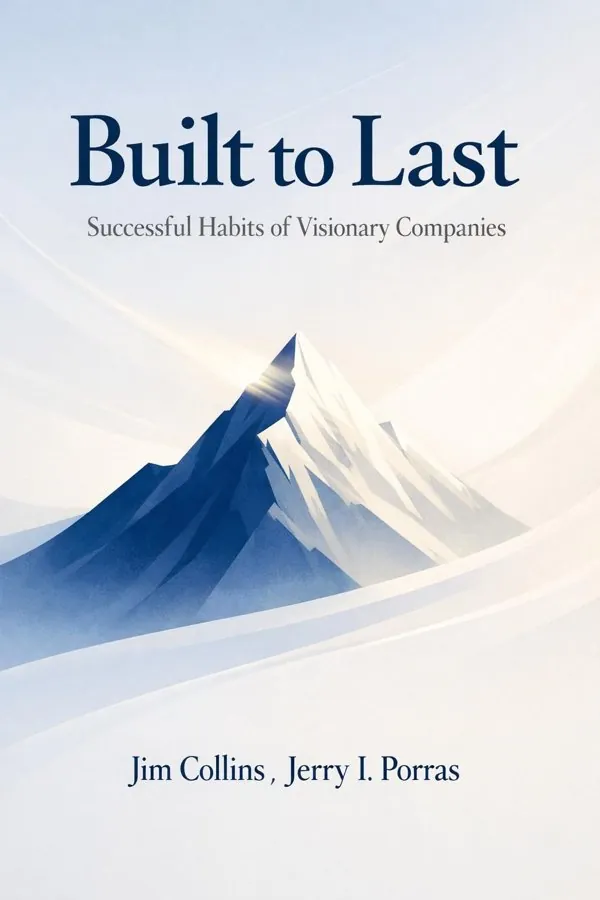
Built to Last: Successful Habits of Visionary Companies: Summary & Key Insights
by Jim Collins, Jerry I. Porras
 10 min11 chaptersAudio available
What Is Built to Last: Successful Habits of Visionary Companies About?
Built to Last: Successful Habits of Visionary Companies by Jim Collins, Jerry I. Porras is a leadership book spanning 11 pages. Built to Last: Successful Habits of Visionary Companies es un estudio sobre las empresas visionarias que han perdurado y prosperado a lo largo del tiempo. Jim Collins y Jerry I. Porras analizan las características comunes de compañías exitosas, destacando su propósito, valores fundamentales y capacidad de adaptación. El libro ofrece una guía práctica para líderes que buscan construir organizaciones duraderas y con impacto.
This FizzRead summary covers all 11 key chapters of Built to Last: Successful Habits of Visionary Companies in approximately 10 minutes, distilling the most important ideas, arguments, and takeaways from Jim Collins, Jerry I. Porras's work. Also available as an audio summary and Key Quotes Podcast.
Built to Last: Successful Habits of Visionary Companies
Built to Last: Successful Habits of Visionary Companies es un estudio sobre las empresas visionarias que han perdurado y prosperado a lo largo del tiempo. Jim Collins y Jerry I. Porras analizan las características comunes de compañías exitosas, destacando su propósito, valores fundamentales y capacidad de adaptación. El libro ofrece una guía práctica para líderes que buscan construir organizaciones duraderas y con impacto.
Who Should Read Built to Last: Successful Habits of Visionary Companies?
This book is perfect for anyone interested in leadership and looking to gain actionable insights in a short read. Whether you're a student, professional, or lifelong learner, the key ideas from Built to Last: Successful Habits of Visionary Companies by Jim Collins, Jerry I. Porras will help you think differently.
- ✓Readers who enjoy leadership and want practical takeaways
- ✓Professionals looking to apply new ideas to their work and life
- ✓Anyone who wants the core insights of Built to Last: Successful Habits of Visionary Companies in just 10 minutes
Want the full summary?
Get instant access to this book summary and 100K+ more with Fizz Moment.
Get Free SummaryAvailable on App Store • Free to download
Key Chapters
When we use the term 'visionary company', we are speaking of organizations that have stood the test of time—not just because they were successful or admired in a given era, but because they have shaped their industries and sustained excellence across generations. To identify such companies, we applied stringent criteria. Visionary companies had to be institutions admired by their peers, recognized as leaders in their fields, and at least fifty years old at the time of our study. We sought firms whose identity transcended any single product or personality—their name itself evoked a legacy of innovation, integrity, and durability.
Think of companies like IBM, 3M, or Johnson & Johnson. Each has adapted through countless shifts in technology and market environment. Yet beneath their adaptability lies a profound consistency in character. These are organizations where employees, customers, and even competitors know what the company stands for. Their greatness does not stem from perfect strategy or luck; it stems from an unwavering institutional soul. This definitional clarity—what we mean by 'visionary'—establishes the foundation for all subsequent insights. By contrasting them with non-visionary peers, we could see that enduring success is not accidental but the result of deliberate internal design.
At the heart of every visionary company lies what we call a core ideology—a guiding star that defines what the company stands for beyond the pursuit of profit. Core ideology comprises two distinct parts: core values, which represent the essential beliefs that the company holds regardless of circumstances, and core purpose, which expresses the reason the company exists apart from making money.
When we studied companies like Hewlett-Packard, we saw that their commitment to ‘respect for the individual’ and ‘contribution to society through technology’ were not slogans but living principles embedded in daily operations. Profit, while vital, was considered a byproduct of purpose—not the purpose itself. This orientation provides stability amid chaos; markets shift, technologies evolve, yet the ideology remains. It is the compass that keeps the organization focused on meaning.
A company’s core ideology must be authentic and enduring. It is not defined by the founder’s personality alone, nor should it change with management transitions. Visionary companies rarely alter their fundamental values; instead, they adapt everything else around those values. Such fidelity generates trust, inspires loyalty, and infuses even mundane tasks with significance. People crave belonging to something larger than themselves—when they find it in their company’s ideology, the enterprise gains an energy that cannot be replicated merely through strategy or competition.
+ 9 more chapters — available in the FizzRead app
All Chapters in Built to Last: Successful Habits of Visionary Companies
About the Authors
Jim Collins es un investigador y autor estadounidense especializado en liderazgo y gestión empresarial, conocido por sus estudios sobre las empresas de alto rendimiento. Jerry I. Porras es profesor emérito de la Escuela de Negocios de Stanford, reconocido por su trabajo en comportamiento organizacional y liderazgo visionario.
Get This Summary in Your Preferred Format
Read or listen to the Built to Last: Successful Habits of Visionary Companies summary by Jim Collins, Jerry I. Porras anytime, anywhere. FizzRead offers multiple formats so you can learn on your terms — all free.
Available formats: App · Audio · PDF · EPUB — All included free with FizzRead
Download Built to Last: Successful Habits of Visionary Companies PDF and EPUB Summary
Key Quotes from Built to Last: Successful Habits of Visionary Companies
“To identify such companies, we applied stringent criteria.”
“At the heart of every visionary company lies what we call a core ideology—a guiding star that defines what the company stands for beyond the pursuit of profit.”
Frequently Asked Questions about Built to Last: Successful Habits of Visionary Companies
Built to Last: Successful Habits of Visionary Companies by Jim Collins, Jerry I. Porras is a leadership book that explores key ideas across 11 chapters. Built to Last: Successful Habits of Visionary Companies es un estudio sobre las empresas visionarias que han perdurado y prosperado a lo largo del tiempo. Jim Collins y Jerry I. Porras analizan las características comunes de compañías exitosas, destacando su propósito, valores fundamentales y capacidad de adaptación. El libro ofrece una guía práctica para líderes que buscan construir organizaciones duraderas y con impacto.
Compare Built to Last: Successful Habits of Visionary Companies

You Might Also Like

Extreme Ownership
Jocko Willink
10 min
Dare to Lead
Brene Brown
10 min
Leaders Eat Last
Simon Sinek
10 min
The 21 Irrefutable Laws of Leadership
John Maxwell
10 min
Start With Why
Simon Sinek
10 min
How to Lead When You're Not in Charge
Clay Scroggins
10 minBrowse by Category
Ready to read Built to Last: Successful Habits of Visionary Companies?
Get the full summary and 100K+ more books with Fizz Moment.