
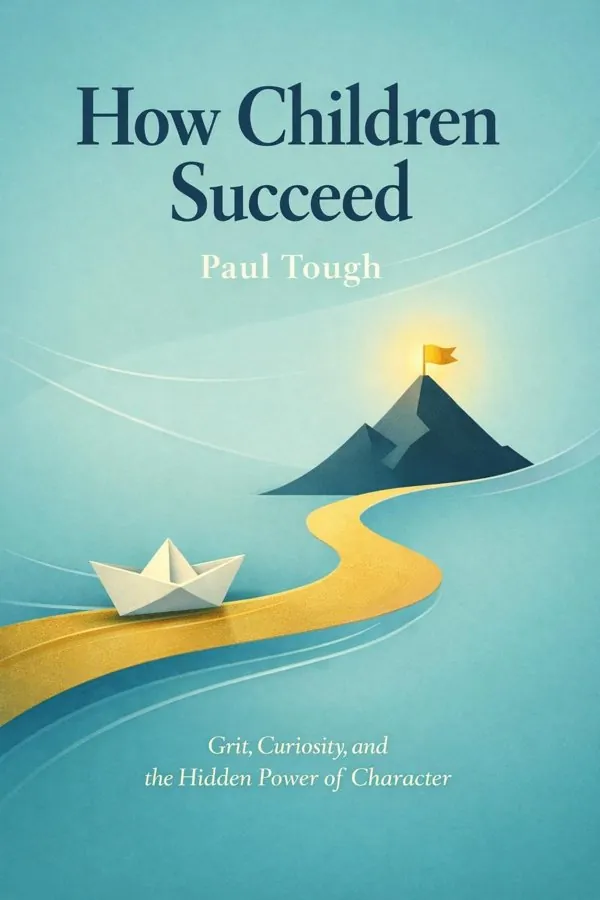
How Children Succeed: Grit, Curiosity, and the Hidden Power of Character: Summary & Key Insights
by Paul Tough
 10 min8 chaptersAudio available
What Is How Children Succeed: Grit, Curiosity, and the Hidden Power of Character About?
How Children Succeed: Grit, Curiosity, and the Hidden Power of Character by Paul Tough is a education book spanning 8 pages. In this influential work, journalist Paul Tough explores why some children succeed while others fail, arguing that character traits such as perseverance, curiosity, and self-control are more crucial to success than cognitive skills alone. Drawing on research in psychology, neuroscience, and education, Tough examines how parents, educators, and policymakers can help children develop these noncognitive skills to overcome adversity and thrive.
This FizzRead summary covers all 8 key chapters of How Children Succeed: Grit, Curiosity, and the Hidden Power of Character in approximately 10 minutes, distilling the most important ideas, arguments, and takeaways from Paul Tough's work. Also available as an audio summary and Key Quotes Podcast.
How Children Succeed: Grit, Curiosity, and the Hidden Power of Character
In this influential work, journalist Paul Tough explores why some children succeed while others fail, arguing that character traits such as perseverance, curiosity, and self-control are more crucial to success than cognitive skills alone. Drawing on research in psychology, neuroscience, and education, Tough examines how parents, educators, and policymakers can help children develop these noncognitive skills to overcome adversity and thrive.
Who Should Read How Children Succeed: Grit, Curiosity, and the Hidden Power of Character?
This book is perfect for anyone interested in education and looking to gain actionable insights in a short read. Whether you're a student, professional, or lifelong learner, the key ideas from How Children Succeed: Grit, Curiosity, and the Hidden Power of Character by Paul Tough will help you think differently.
- ✓Readers who enjoy education and want practical takeaways
- ✓Professionals looking to apply new ideas to their work and life
- ✓Anyone who wants the core insights of How Children Succeed: Grit, Curiosity, and the Hidden Power of Character in just 10 minutes
Want the full summary?
Get instant access to this book summary and 100K+ more with Fizz Moment.
Get Free SummaryAvailable on App Store • Free to download
Key Chapters
For much of the twentieth century, America operated under what I call the cognitive hypothesis—the belief that success in life and learning derives primarily from cognitive skills, measurable through IQ tests and standardized exams. Schools became factories for raising scores, and parents were told to begin boosting their children’s cognitive development from infancy, with Mozart CDs, flashcards, and tutoring regimes. Yet in my interviews and observations, I kept encountering students who seemed to defy this logic: bright, talented children who couldn’t translate their intelligence into endurance or motivation.
Scientific research began overturning this paradigm. Economists like James Heckman discovered that early interventions focusing solely on cognitive enrichment produced short-term improvements that often faded by adolescence. What endured were changes in personality and persistence—noncognitive skills that established lifelong patterns of behavior. Psychologists such as Angela Duckworth and Carol Dweck showed that traits like grit and a growth mindset are far better predictors of success than raw intelligence.
When I spoke with educators, many confessed frustration with the endless testing culture. They witnessed children who knew the material but froze under pressure, unable to cope with stress or failure. The cognitive hypothesis had created generations of students who were skilled at memorization but weak in resilience. I came to see that our obsession with intellect had blinded us to the emotional and psychological capacities that actually drive achievement—the ability to manage frustration, bounce back from mistakes, and keep curiosity alive when results don’t come easily.
Understanding this shift reorients our entire educational system. It means valuing what happens inside a child—the formation of motivation and optimism—as much as the content they learn. It invites parents and teachers alike to ask not only “What is my child learning?” but also “Who is my child becoming?”
As I delved deeper, I found that adversity—the hardship children face at home and in their communities—shapes character more powerfully than we ever imagined. In neighborhoods grappling with poverty, violence, or instability, stress becomes a near-constant feature of daily life. Neuroscientists studying early development revealed how chronic stress alters the architecture of the brain, particularly the prefrontal cortex, which governs impulse control and decision-making. When stress hormones flood a developing child’s system too often, they can impair memory, reduce attention, and trigger patterns of impulsive behavior.
The tragedy is that these physiological effects often translate directly into educational outcomes. Children in stressful households may appear distracted or disruptive, yet at a biological level they are fighting an invisible battle against hyperarousal and anxiety. In talking with pediatricians and psychologists, I learned that the key isn’t shielding children from all adversity—it’s giving them the tools and relationships to recover from it. Some trauma is manageable when a child feels securely attached to a caring adult; without that support, stress metastasizes into lasting emotional scars.
In many of the stories I share—from young people in inner-city schools to rural families facing economic hardship—the hero is not the child who avoids hardship but the one who learns to process and overcome it. Adversity, paradoxically, can forge strength if the environment offers compassion and guidance. Our policies, though, often punish distressed children instead of helping them heal. Schools resort to suspension or expulsion at precisely the moments when emotional scaffolding is most needed.
Recognizing the central role of adversity changes our approach to both child welfare and education. We move from viewing struggling students as broken to understanding them as adaptive—children whose behaviors make sense given their experiences. And with that shift comes the power to intervene wisely, to transform early hardship into the foundation for resilience.
+ 6 more chapters — available in the FizzRead app
All Chapters in How Children Succeed: Grit, Curiosity, and the Hidden Power of Character
About the Author
Paul Tough is a Canadian-American writer and journalist known for his work on education, child development, and inequality. He has written for The New York Times Magazine and is the author of several books exploring how children learn and succeed.
Get This Summary in Your Preferred Format
Read or listen to the How Children Succeed: Grit, Curiosity, and the Hidden Power of Character summary by Paul Tough anytime, anywhere. FizzRead offers multiple formats so you can learn on your terms — all free.
Available formats: App · Audio · PDF · EPUB — All included free with FizzRead
Download How Children Succeed: Grit, Curiosity, and the Hidden Power of Character PDF and EPUB Summary
Key Quotes from How Children Succeed: Grit, Curiosity, and the Hidden Power of Character
“Schools became factories for raising scores, and parents were told to begin boosting their children’s cognitive development from infancy, with Mozart CDs, flashcards, and tutoring regimes.”
“As I delved deeper, I found that adversity—the hardship children face at home and in their communities—shapes character more powerfully than we ever imagined.”
Frequently Asked Questions about How Children Succeed: Grit, Curiosity, and the Hidden Power of Character
How Children Succeed: Grit, Curiosity, and the Hidden Power of Character by Paul Tough is a education book that explores key ideas across 8 chapters. In this influential work, journalist Paul Tough explores why some children succeed while others fail, arguing that character traits such as perseverance, curiosity, and self-control are more crucial to success than cognitive skills alone. Drawing on research in psychology, neuroscience, and education, Tough examines how parents, educators, and policymakers can help children develop these noncognitive skills to overcome adversity and thrive.
You Might Also Like

Bedtime Biography: Florence Nightingale
Isabel Thomas
10 min
Introduction To Museum Studies
Howard H. Hoyt
10 min
A Mind for Numbers: How to Excel at Math and Science (Even If You Flunked Algebra)
Barbara Oakley
10 min
AI for Educators: Learning Strategies, Teacher Empowerment, and the Future of Education
Matt Miller
10 min
Animation For Beginners
Morr Meroz
10 min
Artificial Intelligence for Learning
Donald Clark
10 minBrowse by Category
Ready to read How Children Succeed: Grit, Curiosity, and the Hidden Power of Character?
Get the full summary and 100K+ more books with Fizz Moment.