
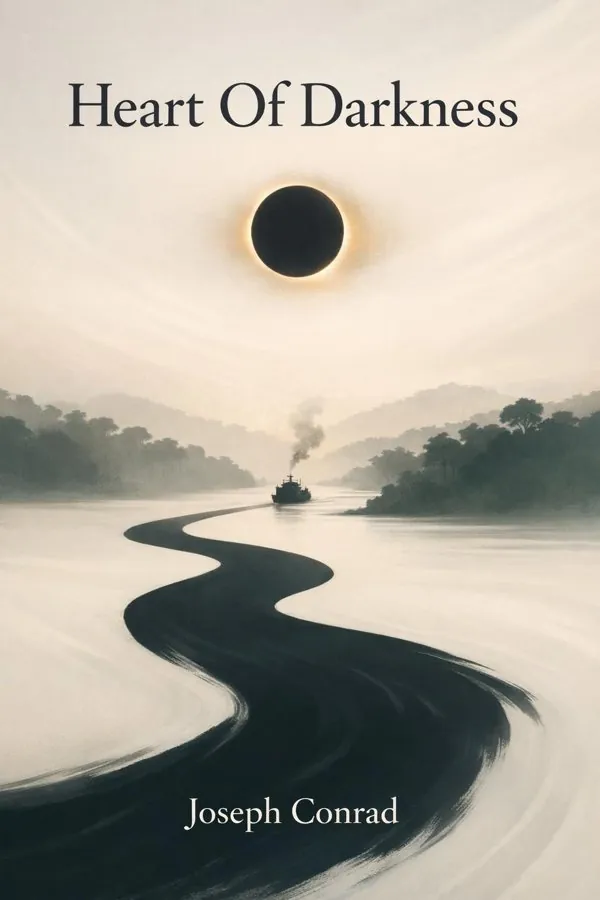
Heart of Darkness: Summary & Key Insights
 10 min9 chaptersAudio available
Key Takeaways from Heart of Darkness
A civilization often reveals itself most clearly not in its monuments, but in the stories it tells about its own innocence.
What draws people toward the unknown is not always courage; often, it is imagination mixed with ambition.
Corruption rarely announces itself as corruption; it often appears as administration, routine, and good manners.
Nothing exposes a false ideal faster than useless suffering.
The most dangerous figures are often those who begin with talent, conviction, and grand ideals.
What Is Heart of Darkness About?
Heart of Darkness by Joseph Conrad is a fiction book published in 2007 spanning 13 pages. Joseph Conrad’s Heart of Darkness is a short novel with enormous reach. On the surface, it tells a gripping story: sailor Charles Marlow accepts a job with a Belgian trading company and travels into the Congo to retrieve Kurtz, a brilliant and celebrated ivory agent who has become dangerously ill and strangely powerful. But Conrad turns that journey into something larger and more unsettling. As Marlow moves deeper into colonial Africa, the book exposes the violence, greed, and hypocrisy hidden beneath Europe’s language of civilization and progress. It also asks a harder question: what happens to human beings when familiar rules fall away and power goes unchecked? The novella matters because it is both an adventure narrative and a moral investigation. It remains central to conversations about imperialism, racism, corruption, and the fragility of identity. Conrad wrote from unusual authority. A Polish-born seaman who later became a British novelist, he had firsthand experience in the Congo, and that experience shaped the novel’s haunting realism. Heart of Darkness endures not because it gives comforting answers, but because it forces readers to confront how easily darkness can hide inside institutions, ideals, and the self.
This FizzRead summary covers all 9 key chapters of Heart of Darkness in approximately 10 minutes, distilling the most important ideas, arguments, and takeaways from Joseph Conrad's work. Also available as an audio summary and Key Quotes Podcast.
Heart of Darkness
Joseph Conrad’s Heart of Darkness is a short novel with enormous reach. On the surface, it tells a gripping story: sailor Charles Marlow accepts a job with a Belgian trading company and travels into the Congo to retrieve Kurtz, a brilliant and celebrated ivory agent who has become dangerously ill and strangely powerful. But Conrad turns that journey into something larger and more unsettling. As Marlow moves deeper into colonial Africa, the book exposes the violence, greed, and hypocrisy hidden beneath Europe’s language of civilization and progress. It also asks a harder question: what happens to human beings when familiar rules fall away and power goes unchecked?
The novella matters because it is both an adventure narrative and a moral investigation. It remains central to conversations about imperialism, racism, corruption, and the fragility of identity. Conrad wrote from unusual authority. A Polish-born seaman who later became a British novelist, he had firsthand experience in the Congo, and that experience shaped the novel’s haunting realism. Heart of Darkness endures not because it gives comforting answers, but because it forces readers to confront how easily darkness can hide inside institutions, ideals, and the self.
Who Should Read Heart of Darkness?
This book is perfect for anyone interested in fiction and looking to gain actionable insights in a short read. Whether you're a student, professional, or lifelong learner, the key ideas from Heart of Darkness by Joseph Conrad will help you think differently.
- ✓Readers who enjoy fiction and want practical takeaways
- ✓Professionals looking to apply new ideas to their work and life
- ✓Anyone who wants the core insights of Heart of Darkness in just 10 minutes
Want the full summary?
Get instant access to this book summary and 100K+ more with Fizz Moment.
Get Free SummaryAvailable on App Store • Free to download
Key Chapters
A civilization often reveals itself most clearly not in its monuments, but in the stories it tells about its own innocence. Heart of Darkness opens not in Africa but on the Thames, where Marlow sits aboard a boat and reflects on the great river that helped build the British Empire. The setting matters deeply. Conrad begins at the symbolic center of European power and reminds readers that even this proud imperial river was once, for the Romans, a dark and unknown place. In one stroke, he unsettles the comfortable idea that darkness belongs somewhere else.
This opening reframes the entire novella. The journey into the Congo is not simply a descent into a foreign wilderness; it is a mirror held up to Europe itself. The Thames, associated with trade, exploration, and national glory, becomes linked to conquest and historical brutality. Conrad suggests that every empire imagines itself as the bearer of light, even while benefiting from domination. That insight is one reason the novella still feels modern. Institutions, nations, and companies continue to justify harmful actions with noble language.
In practical terms, this idea encourages readers to question polished narratives of progress. A business may speak of innovation while exploiting workers. A government may praise freedom while practicing surveillance or violence. The contrast between image and reality is one of Conrad’s central concerns.
Actionable takeaway: whenever an institution presents itself as unquestionably enlightened, look first at the systems of power and profit beneath the rhetoric.
What draws people toward the unknown is not always courage; often, it is imagination mixed with ambition. Marlow recalls being fascinated as a boy by maps, especially the blank spaces that promised mystery and discovery. That childhood longing eventually leads him to seek work in the Congo. Conrad uses this desire to show how exploration can begin in wonder but become entangled with conquest.
The map is one of the novella’s most important symbols. To a child, it represents possibility. To an empire, it represents territory to name, divide, and exploit. By the time Marlow reaches Brussels and arranges his appointment, the once-romantic blank space has already been filled by European claims, trading posts, and bureaucracy. The dream of exploration gives way to paperwork, corporate hierarchy, and extraction. Conrad reveals how quickly curiosity can be absorbed by systems of control.
This remains highly relevant. Modern life is full of “blank spaces” that attract ambition: emerging markets, new technologies, remote ecosystems, or online communities. We often speak of entering these spaces in terms of opportunity, efficiency, or growth. But Conrad asks us to consider the costs. Who gets to define the space? Who benefits from entering it? Who is erased when it is mapped, measured, and monetized?
On a personal level, the lesson applies whenever we pursue something because it seems exciting or prestigious. Before stepping into a new venture, role, or environment, it is worth asking what larger system we are joining.
Actionable takeaway: when you feel drawn to a new opportunity, examine not just its promise, but the power structure that gives that promise its shape.
Corruption rarely announces itself as corruption; it often appears as administration, routine, and good manners. Marlow’s early experience in Brussels exposes this truth. The city, which he describes in eerie and funereal terms, is supposed to represent European order and sophistication. Instead, it feels lifeless and vaguely sinister. Conrad’s point is sharp: violence in the colony is made possible by clean offices, signatures, appointments, and polite conversations in the metropole.
Before Marlow even reaches Africa, he senses the moral distortion behind the mission. He encounters company officials who seem detached from the human consequences of their enterprise. The women knitting black wool in the waiting room create an atmosphere of fate and foreboding, as if applicants are being ushered toward something darker than employment. The doctor’s odd questions about changes in the mind further suggest that the journey will not only test the body but destabilize identity itself.
Conrad strips away the heroic veneer of imperialism by showing its bureaucratic foundations. The suffering later witnessed in the Congo is not accidental chaos. It is linked to a system organized far away by people who can afford not to see its effects. That dynamic is still recognizable today. Harmful structures often depend on distance: executives far from factories, policymakers far from battlefields, consumers far from supply chains.
This section teaches readers to pay attention to environments that seem respectable on the surface but are sustained by unseen costs. Ethical blindness thrives where procedure replaces moral responsibility.
Actionable takeaway: whenever you participate in a large system, ask what human realities are being hidden by paperwork, hierarchy, or professional language.
Nothing exposes a false ideal faster than useless suffering. When Marlow arrives at the Company’s Outer Station in Africa, he does not find efficiency, progress, or uplift. He finds broken machinery, pointless blasting, sick laborers, neglected bodies, and a landscape scarred by incompetent greed. This is one of Conrad’s most devastating achievements: instead of denouncing empire in abstract terms, he shows its daily absurdity and waste.
The chaos of the Outer Station reveals that the Company’s civilizing mission is a performance covering economic extraction. Men are worked to exhaustion and discarded. Tools and technologies exist, but they are misused, unmanaged, or abandoned. The result is not productive order but senseless destruction. Conrad makes readers feel the gap between what empire says it is doing and what it actually does.
This is a powerful lesson in how ideology operates. Systems built on exploitation often depend on noble slogans: development, efficiency, modernization, security. Yet if we look closely at outcomes rather than language, a different picture emerges. In modern contexts, this might apply to workplaces obsessed with metrics but indifferent to people, or projects launched for prestige that leave communities worse off.
For individual readers, the Outer Station is a reminder that dysfunction is not always accidental. Sometimes confusion and waste are features of a system designed for extraction rather than human flourishing. When accountability is absent, suffering can become routine and invisible.
Actionable takeaway: judge institutions by their effects on vulnerable people, not by their mission statements, branding, or claims of benevolence.
The most dangerous figures are often those who begin with talent, conviction, and grand ideals. Long before Marlow meets Kurtz, he hears about him as a legend: an exceptional agent, a gifted speaker, a man of immense promise who is expected to achieve great things. Kurtz arrives in the narrative first as reputation, and that is deliberate. Conrad shows how charisma can become a powerful moral disguise.
What makes Kurtz so compelling is that he is not merely a villain in the ordinary sense. He appears to have started as an idealist. He writes eloquently, speaks of lofty purposes, and seems to embody Europe’s confidence in its own mission. Yet his famous report for the “Suppression of Savage Customs” ends with a horrifying handwritten postscript: “Exterminate all the brutes!” In that moment, Conrad reveals how easily civilized language can coexist with brutality. The same person who speaks most beautifully may harbor the most violent fantasies.
Kurtz represents the collapse of moral restraint when intelligence is joined to unchecked power. He is admired because he produces ivory and dazzles others with his personality, but beneath that success lies spiritual ruin. This pattern remains relevant in public life. Charismatic leaders, founders, and experts can attract followers who confuse eloquence with integrity. Results can overshadow ethics.
Readers can apply this lesson by becoming more skeptical of hero narratives. Admiration is not the same as moral trust. The more exceptional someone appears, the more important scrutiny becomes.
Actionable takeaway: do not judge a person’s character by talent, rhetoric, or success alone; always ask how they treat others when no limits are imposed.
Some journeys move through geography, but their deepest direction is inward. Marlow’s slow voyage upriver is the structural and psychological center of Heart of Darkness. As the steamer pushes through fog, silence, and dense wilderness, ordinary markers of certainty begin to dissolve. Time feels altered, familiar rules weaken, and Marlow becomes increasingly aware that the trip is not just taking him toward Kurtz but toward a disturbing truth about human nature.
The river functions as more than a route; it is a symbol of regression, exposure, and confrontation. Marlow senses that he is traveling backward into something ancient, but Conrad resists simple oppositions between primitive and civilized. The real revelation is that the so-called civilized self is thinner than people imagine. The jungle does not implant evil; it strips away distractions and reveals what was already possible. Isolation, power, fear, and desire test the boundaries of conscience.
Marlow’s observations about the attack on the steamer and the behavior of the crew show how fragile composure can be under pressure. Yet he also notices moments of discipline, loyalty, and self-control. Conrad’s vision is not simplistic. Darkness exists, but so does the capacity to resist it. Human beings are not fixed; they are exposed by circumstance.
This idea has practical application beyond the novel. Stress, anonymity, and authority still reveal character in workplaces, online environments, and personal crises. We learn who we are not when life is comfortable, but when restraint is difficult.
Actionable takeaway: treat pressure, isolation, and power as moral tests, and build habits of self-awareness before circumstances strip away your illusions.
When no one can say no, corruption stops being a temptation and becomes a way of life. At the Inner Station, Marlow finally encounters the world Kurtz has made for himself, and it is terrifying not because it is chaotic, but because it is organized around one man’s unrestrained will. Kurtz has become a kind of idol, revered and obeyed. The severed heads placed on stakes outside his dwelling make visible the truth that others prefer to ignore: his greatness has been purchased through terror.
Conrad’s portrait of the Inner Station is one of the most powerful studies in literature of what happens when a person’s ego escapes social and moral limits. Removed from law, accountability, and meaningful community, Kurtz does not become free in any noble sense. He becomes consumed by appetite, domination, and self-worship. The jungle seems to “speak” to him because he has surrendered to impulses that civilized life usually contains.
This is not only a colonial insight. The same pattern appears wherever concentrated power lacks oversight: in politics, corporations, religious institutions, even families. People who are constantly praised, feared, or exempted from consequences often begin to believe they are exceptional beings entitled to special rules. The result may not look as dramatic as Kurtz’s domain, but the logic is the same.
Conrad also shows why bystanders matter. Others around Kurtz enable his rise, excuse his behavior, and remain captivated by his usefulness or brilliance. Power is rarely solitary; it depends on a circle of permission.
Actionable takeaway: never trust power that resists transparency, and never confuse a person’s centrality or charisma with moral legitimacy.
The most important judgment in life may be the one a person makes when no excuses are left. Kurtz’s final words, “The horror! The horror!”, are among the most famous in literature because they refuse easy interpretation while carrying unmistakable force. Marlow believes that in his final moment Kurtz achieved a terrible kind of clarity. He saw, however briefly, the truth of what he had become and what the world around him contained.
These words matter because Conrad presents recognition as both devastating and valuable. Kurtz has failed morally, but he is not entirely empty. At the edge of death, he confronts the abyss within himself. That moment stands in contrast to the complacency of many other characters, who move through cruelty without reflection. In Conrad’s moral universe, self-knowledge is painful, but blindness is worse.
For readers, this raises difficult but practical questions. What do we see when ambition, status, and justification fall away? Are there parts of our behavior we avoid naming because recognition would demand change? Conrad suggests that moral life begins not with perfection but with honest confrontation. The horror lies partly in violence and greed, but also in the human tendency to evade responsibility.
This theme applies in ordinary life whenever people rationalize harmful choices for career advancement, loyalty, convenience, or self-image. The challenge is to create moments of reckoning before disaster forces them upon us.
Actionable takeaway: practice deliberate self-examination, especially after success or conflict, and name uncomfortable truths early enough that they can still change you.
Sometimes the final moral question is not what happened, but whether the truth can be spoken. After returning to Europe, Marlow visits Kurtz’s Intended, who still cherishes an idealized image of the dead man. Faced with her faith in Kurtz’s nobility, Marlow cannot bring himself to tell her the truth about Kurtz’s final words or his moral collapse. Instead, he lies, saying that Kurtz’s last word was her name. The novella ends not with resolution but with a deepening sense of ambiguity and darkness.
This scene is crucial because it complicates the relationship between truth and mercy. Was Marlow protecting the Intended from unbearable knowledge, or was he preserving the very illusions that allow society to avoid confronting its own corruption? Conrad offers no simple answer. The lie is intimate and compassionate on one level, yet it also suggests that civilized life may depend on maintaining comforting fictions.
The ending returns us mentally to the Thames, now transformed. Darkness is no longer something located in the Congo or in Kurtz alone. It extends into Europe, into memory, into language, and into the stories people tell to preserve order. That is why the novel lingers. It suggests that moral darkness is not an exception but a permanent possibility within modern life.
In practical terms, the ending invites careful thought about honesty. Not every truth must be delivered brutally, but evasion has consequences. Families, institutions, and nations all sustain themselves through selective narratives.
Actionable takeaway: when deciding whether to soften or conceal a truth, ask not only whom the lie protects, but what reality it allows to continue unchallenged.
All Chapters in Heart of Darkness
About the Author
Joseph Conrad (1857–1924) was a Polish-British novelist, born Józef Teodor Konrad Korzeniowski in what is now Ukraine. After a youth marked by political upheaval and exile, he went to sea and spent many years as a sailor and merchant marine officer. English was his third language, yet he became one of the most accomplished prose stylists in English literature. Conrad’s fiction often explores isolation, loyalty, deception, and the moral pressures created by empire, commerce, and political violence. His experience working on a steamer in the Congo in 1890 deeply shaped Heart of Darkness. Other major works include Lord Jim, Nostromo, The Secret Agent, and Under Western Eyes. He remains one of the most influential novelists of modern literature.
Get This Summary in Your Preferred Format
Read or listen to the Heart of Darkness summary by Joseph Conrad anytime, anywhere. FizzRead offers multiple formats so you can learn on your terms — all free.
Available formats: App · Audio · PDF · EPUB — All included free with FizzRead
Download Heart of Darkness PDF and EPUB Summary
Key Quotes from Heart of Darkness
“A civilization often reveals itself most clearly not in its monuments, but in the stories it tells about its own innocence.”
“What draws people toward the unknown is not always courage; often, it is imagination mixed with ambition.”
“Corruption rarely announces itself as corruption; it often appears as administration, routine, and good manners.”
“Nothing exposes a false ideal faster than useless suffering.”
“The most dangerous figures are often those who begin with talent, conviction, and grand ideals.”
Frequently Asked Questions about Heart of Darkness
Heart of Darkness by Joseph Conrad is a fiction book that explores key ideas across 9 chapters. Joseph Conrad’s Heart of Darkness is a short novel with enormous reach. On the surface, it tells a gripping story: sailor Charles Marlow accepts a job with a Belgian trading company and travels into the Congo to retrieve Kurtz, a brilliant and celebrated ivory agent who has become dangerously ill and strangely powerful. But Conrad turns that journey into something larger and more unsettling. As Marlow moves deeper into colonial Africa, the book exposes the violence, greed, and hypocrisy hidden beneath Europe’s language of civilization and progress. It also asks a harder question: what happens to human beings when familiar rules fall away and power goes unchecked? The novella matters because it is both an adventure narrative and a moral investigation. It remains central to conversations about imperialism, racism, corruption, and the fragility of identity. Conrad wrote from unusual authority. A Polish-born seaman who later became a British novelist, he had firsthand experience in the Congo, and that experience shaped the novel’s haunting realism. Heart of Darkness endures not because it gives comforting answers, but because it forces readers to confront how easily darkness can hide inside institutions, ideals, and the self.
You Might Also Like



Featured In
Browse by Category
Ready to read Heart of Darkness?
Get the full summary and 100K+ more books with Fizz Moment.