
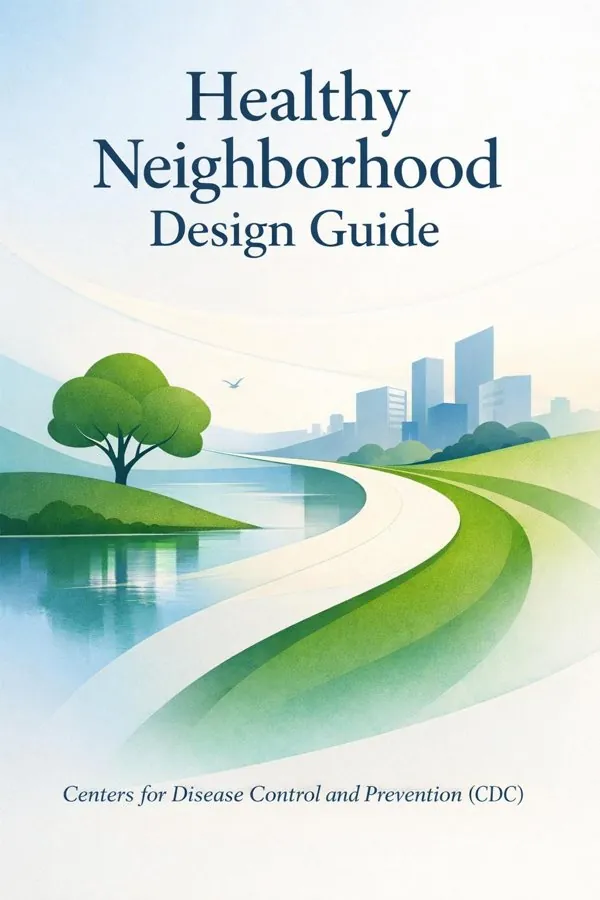
Healthy Neighborhood Design Guide: Urban Approaches for Population Longevity (Compilations): Summary & Key Insights
by Centers for Disease Control, Prevention (CDC)
 10 min9 chaptersAudio available
Key Takeaways from Healthy Neighborhood Design Guide: Urban Approaches for Population Longevity (Compilations)
A city’s layout can function like a public health intervention long before a doctor enters the picture.
Aging populations make healthy neighborhood design not a luxury, but a necessity.
The healthiest exercise plan may be the one people do without thinking about it.
Nature is not an urban luxury; it is a health asset.
Longevity depends not only on how far people can walk, but on whether they feel they belong.
What Is Healthy Neighborhood Design Guide: Urban Approaches for Population Longevity (Compilations) About?
Healthy Neighborhood Design Guide: Urban Approaches for Population Longevity (Compilations) by Centers for Disease Control and Prevention (CDC) is a health_med book spanning 6 pages. Healthy Neighborhood Design Guide: Urban Approaches for Population Longevity is a practical, evidence-based resource that shows how the places people live can either support health or quietly undermine it. Developed by the Centers for Disease Control and Prevention, the guide brings together research, planning principles, and real-world examples to help communities design neighborhoods that encourage longer, healthier lives. Its central argument is simple but powerful: health is shaped not only by medical care and personal choices, but by sidewalks, parks, housing patterns, transportation options, air quality, safety, and social connection. That insight makes this guide especially important for urban planners, public health leaders, policymakers, designers, and civic organizations seeking to build environments that prevent disease before treatment is ever needed. The CDC’s authority gives the work unusual credibility. Rather than offering design trends or abstract ideals, it translates population health evidence into concrete urban strategies. The result is a concise but influential framework for creating neighborhoods where walking is easier, green space is accessible, services are closer, communities are more inclusive, and longevity is supported by design itself.
This FizzRead summary covers all 9 key chapters of Healthy Neighborhood Design Guide: Urban Approaches for Population Longevity (Compilations) in approximately 10 minutes, distilling the most important ideas, arguments, and takeaways from Centers for Disease Control and Prevention (CDC)'s work. Also available as an audio summary and Key Quotes Podcast.
Healthy Neighborhood Design Guide: Urban Approaches for Population Longevity (Compilations)
Healthy Neighborhood Design Guide: Urban Approaches for Population Longevity is a practical, evidence-based resource that shows how the places people live can either support health or quietly undermine it. Developed by the Centers for Disease Control and Prevention, the guide brings together research, planning principles, and real-world examples to help communities design neighborhoods that encourage longer, healthier lives. Its central argument is simple but powerful: health is shaped not only by medical care and personal choices, but by sidewalks, parks, housing patterns, transportation options, air quality, safety, and social connection. That insight makes this guide especially important for urban planners, public health leaders, policymakers, designers, and civic organizations seeking to build environments that prevent disease before treatment is ever needed. The CDC’s authority gives the work unusual credibility. Rather than offering design trends or abstract ideals, it translates population health evidence into concrete urban strategies. The result is a concise but influential framework for creating neighborhoods where walking is easier, green space is accessible, services are closer, communities are more inclusive, and longevity is supported by design itself.
Who Should Read Healthy Neighborhood Design Guide: Urban Approaches for Population Longevity (Compilations)?
This book is perfect for anyone interested in health_med and looking to gain actionable insights in a short read. Whether you're a student, professional, or lifelong learner, the key ideas from Healthy Neighborhood Design Guide: Urban Approaches for Population Longevity (Compilations) by Centers for Disease Control and Prevention (CDC) will help you think differently.
- ✓Readers who enjoy health_med and want practical takeaways
- ✓Professionals looking to apply new ideas to their work and life
- ✓Anyone who wants the core insights of Healthy Neighborhood Design Guide: Urban Approaches for Population Longevity (Compilations) in just 10 minutes
Want the full summary?
Get instant access to this book summary and 100K+ more with Fizz Moment.
Get Free SummaryAvailable on App Store • Free to download
Key Chapters
A city’s layout can function like a public health intervention long before a doctor enters the picture. One of the guide’s foundational ideas is that neighborhood design directly influences physical activity, chronic disease risk, injuries, stress levels, and even life expectancy. Streets that prioritize cars over people often reduce walking, isolate residents, increase traffic danger, and worsen pollution exposure. By contrast, well-connected streets, mixed land uses, safe crossings, and nearby destinations make healthy routines easier to practice without requiring unusual effort or discipline.
The guide explains that health does not emerge only from hospitals or clinics. It is built into everyday choices: whether a parent feels safe walking a child to school, whether an older adult can reach groceries on foot, whether a worker has access to transit, whether neighbors can gather in welcoming public spaces. These design factors influence obesity, cardiovascular disease, injury risk, respiratory health, and mental well-being. Importantly, the guide frames these outcomes as predictable rather than accidental. Communities designed for inactivity and separation will often produce worse health patterns than communities designed for movement and connection.
A practical application is to review zoning, street design, and land-use plans through a health lens. A town updating its corridor plan might add sidewalks, bike lanes, bus shelters, shade trees, and mixed-use development standards rather than simply widening roads for traffic flow. Another city might evaluate school siting decisions to reduce long car commutes and increase opportunities for walking.
Actionable takeaway: Treat every planning decision as a health decision, and ask how the built environment will influence movement, safety, exposure, and daily quality of life.
Aging populations make healthy neighborhood design not a luxury, but a necessity. The guide emphasizes that demographic change is reshaping public policy priorities: populations are growing older while urbanization continues, meaning more people will spend later life in built environments that either support independence or hasten decline. Designing for longevity therefore becomes a core strategy for public health resilience.
The document highlights how older adults are especially affected by neighborhood conditions. If sidewalks are broken, crossings are too long, benches are absent, or essential services are far away, aging residents may become less mobile and more socially isolated. That loss of mobility can trigger a cascade of negative effects, including reduced physical activity, declining mental health, poorer access to care, and greater dependence on others. At the same time, neighborhoods that are easier for older adults to navigate tend to be better for everyone: children, people with disabilities, caregivers, and residents without cars.
The guide also connects longevity to equity. Aging does not happen under equal conditions. Lower-income communities and historically underserved populations often face higher burdens of pollution, heat, unsafe streets, and inadequate infrastructure. Planning for longevity means understanding which residents are most exposed to unhealthy environments and addressing those gaps deliberately.
A practical example would be an age-friendly retrofit of a suburban area: installing curb ramps, improving pedestrian signal timing, locating clinics near transit stops, and encouraging small neighborhood retail within walking distance of housing. These changes support independent living while reducing preventable health risks.
Actionable takeaway: Use demographic and longevity data to prioritize neighborhood improvements that help residents remain active, connected, and safe across the entire life course.
The healthiest exercise plan may be the one people do without thinking about it. The guide’s treatment of walkability centers on this insight: when neighborhoods are designed so that walking is convenient, safe, and pleasant, physical activity becomes embedded in daily life. Instead of depending entirely on gyms or scheduled workouts, residents gain health benefits simply by going to school, work, parks, shops, and transit stops on foot.
Walkability depends on several interacting features. Destinations must be close enough to reach. Streets must connect logically rather than forcing long detours. Sidewalks need to be continuous, accessible, and separated from fast traffic. Crosswalks should be visible and timed for real people, including older adults. Building frontages, shade, lighting, and street activity also matter because perceived safety and comfort influence whether people choose to walk.
The guide makes clear that walkability is not just about transportation efficiency; it is about disease prevention. More walkable neighborhoods are associated with lower rates of sedentary behavior and can support healthier body weight, better cardiovascular function, and stronger social interaction. Practical applications include complete streets policies, traffic calming, narrower lane widths, protected crossings near schools, and mixed-use zoning that places daily needs within a short walk.
Imagine a neighborhood where a resident can leave home and comfortably walk to a pharmacy, a small grocery, a bus stop, and a park within fifteen minutes. That design reduces car dependence while increasing incidental movement and social contact. Over time, these small built-in habits create measurable health benefits at the population level.
Actionable takeaway: Improve walkability by focusing on connected streets, safe crossings, nearby destinations, and pedestrian comfort so that healthy movement becomes the easy default.
Nature is not an urban luxury; it is a health asset. The guide underscores the important role of parks, street trees, natural corridors, and other green spaces in supporting both physical and mental well-being. Access to natural environments can encourage recreation, lower stress, improve mood, reduce heat exposure, and create places where communities gather. In dense or underserved areas especially, greenery can serve as a buffer against the pressures of noise, traffic, and social strain.
The health effects of green space operate through multiple pathways. People are more likely to walk, play, or exercise in attractive outdoor settings. Trees and vegetation can improve comfort, offer shade, and contribute modestly to air quality benefits. Natural views and quiet outdoor areas can reduce psychological fatigue and support emotional restoration. Parks also function socially by giving residents common ground for informal interaction, events, and family time.
The guide pushes readers to think beyond simply counting acres of parkland. Quality, accessibility, and safety matter just as much as quantity. A distant park reached only by crossing dangerous roads will not deliver the same benefits as a nearby, well-maintained, welcoming green space. Practical examples include converting vacant lots into community gardens, planting street trees along walking routes, adding pocket parks in high-density districts, and designing schoolyards for public use after hours.
A city seeking healthier neighborhoods might map which areas lack green access within a comfortable walk and prioritize investment there first. It might also integrate stormwater landscapes and shaded seating into streetscape projects to create ecological and health gains simultaneously.
Actionable takeaway: Expand equitable access to safe, inviting green spaces that people can easily reach and use as part of daily neighborhood life.
Average health improvements can hide deep neighborhood inequities. One of the guide’s most important implications is that healthy design must be intentional about who benefits. Communities do not start from equal conditions. Some neighborhoods have inherited decades of disinvestment, highway exposure, poor housing, unsafe streets, limited transit, and scarce green space. Without an equity lens, even well-meant planning can reinforce those patterns.
The guide encourages readers to understand health disparities spatially. Rates of asthma, injury, chronic disease, heat vulnerability, and premature mortality often cluster in places burdened by environmental hazards and weak infrastructure. This means that healthy neighborhood design is not just about making already-thriving areas more attractive. It is about correcting harmful conditions where health risks are concentrated.
Equity-oriented design asks practical questions: Which residents currently lack safe walking routes? Who lives furthest from parks, grocery stores, or primary care? Which communities face the highest traffic injury rates? Are planning meetings accessible in language, location, and timing? Are improvements at risk of displacing the very residents they are meant to serve? These questions shift the focus from general improvement to just improvement.
Examples include prioritizing sidewalk investments in low-income districts with high pedestrian injury rates, targeting tree planting in heat-vulnerable blocks, or coupling neighborhood revitalization with affordable housing protections. The guide’s broader message is that public health outcomes improve most meaningfully when structural disadvantages are addressed directly.
Actionable takeaway: Use disaggregated data and community engagement to direct healthy design investments first toward neighborhoods carrying the greatest preventable health burdens.
Healthy places rarely emerge from isolated projects; they are produced by rules, standards, and sustained coordination. The guide stresses that while design features matter, policy is what allows those features to become normal rather than exceptional. Zoning codes, transportation standards, capital budgets, health impact assessments, and cross-agency partnerships determine whether healthy neighborhood principles are adopted broadly or remain scattered pilot efforts.
This idea is crucial because many unhealthy environments were not accidental. They resulted from long-standing policy choices that separated land uses, prioritized vehicle speed, underfunded sidewalks and parks, and tolerated uneven service distribution. To reverse those outcomes, communities must align planning and public health goals at the policy level. That can include complete streets policies, form-based codes, park access standards, school siting guidelines, inclusionary housing, and requirements to assess health implications during major development decisions.
The guide also points to intersector collaboration. Public health departments can contribute data on chronic disease, injury, and environmental exposure. Planning departments can shape land use and urban form. Transportation agencies can redesign mobility systems. Housing agencies, school districts, and community organizations all have a role. The strongest results come when these actors share a common framework rather than working in silos.
A practical example is a city adopting a health-in-all-policies approach, requiring agencies to consider physical activity, safety, air quality, and equity in capital planning. Another is embedding public health staff into comprehensive plan updates so that health metrics influence zoning and infrastructure priorities from the beginning.
Actionable takeaway: Institutionalize healthy neighborhood goals through policy, standards, and cross-sector governance so health-promoting design becomes routine practice rather than a one-off ambition.
What gets measured gets defended. The guide emphasizes that implementation must be paired with evaluation if healthy neighborhood design is to earn lasting political and financial support. Communities need ways to track whether design changes actually improve safety, mobility, access, and health outcomes. Without measurement, even strong interventions can be dismissed as aesthetic upgrades rather than essential investments.
The guide points readers toward both process and outcome indicators. Process measures include miles of sidewalks added, number of trees planted, transit stop accessibility, park access within walking distance, or adoption of health-focused policies. Outcome measures may include changes in walking rates, injury frequency, air quality indicators, heat exposure, social participation, or disparities in chronic disease over time. While some health outcomes take years to shift, intermediate indicators can show whether a neighborhood is moving in the right direction.
Evaluation also supports accountability. If a city promises equitable investment, it should map where improvements occur and who benefits. If a corridor redesign is intended to reduce crashes, before-and-after safety data should be collected. If a new park is built, the city should assess actual use, programming, and perceived safety rather than assuming presence equals access.
A useful example is combining health department data with geographic information systems to identify high-risk areas, guide interventions, and revisit those same indicators after implementation. Community surveys can complement technical data by revealing whether residents feel safer, more connected, and more able to be active.
Actionable takeaway: Build clear health metrics into neighborhood planning from the start, and use ongoing evaluation to refine strategies, prove impact, and sustain support.
No neighborhood can be made healthy for people without being shaped with people. Although the guide is technical in orientation, one of its strongest practical implications is the necessity of meaningful community involvement. Residents are experts in their own daily environments. They know where crossings feel unsafe, which parks go unused, when buses are unreliable, where older adults struggle, and which spaces feel welcoming or exclusionary. Planning that ignores this lived knowledge often produces elegant designs that fail in practice.
Community co-creation improves both legitimacy and effectiveness. It helps agencies identify barriers that data alone may miss, such as fear of harassment on a route that appears technically walkable or cultural preferences affecting how public space is used. It also increases trust, especially in communities that have experienced disinvestment or top-down planning. When residents shape priorities, interventions are more likely to address actual needs and gain long-term stewardship.
The guide’s themes suggest practical methods such as participatory workshops, walk audits, multilingual outreach, youth and elder advisory groups, and partnerships with local institutions. For example, before redesigning a commercial street, planners might walk the corridor with parents, seniors, disability advocates, and shop owners to identify where curb ramps are missing, shade is inadequate, crossings are too long, or seating is absent. Those observations can then directly influence design drawings and budget allocations.
Co-creation also protects against unintended harm, including displacement, inaccessible amenities, or investments that privilege visitors over residents.
Actionable takeaway: Pair technical expertise with sustained resident participation so healthy neighborhood design reflects real daily experience, local priorities, and long-term community ownership.
All Chapters in Healthy Neighborhood Design Guide: Urban Approaches for Population Longevity (Compilations)
About the Authors
The Centers for Disease Control and Prevention (CDC) is the premier public health agency of the United States and one of the most influential health institutions in the world. Founded to protect population health, the CDC conducts research, monitors disease trends, responds to public health emergencies, and develops evidence-based guidance to prevent illness, injury, and premature death. Its work extends beyond infectious disease to include chronic disease prevention, environmental health, injury prevention, aging, health equity, and community well-being. In publications like Healthy Neighborhood Design Guide, the CDC applies scientific research to broader social and environmental conditions, showing how policy and place affect health. Its authority comes from its extensive data, interdisciplinary expertise, and long-standing role in translating public health evidence into practical recommendations for governments, professionals, and communities.
Get This Summary in Your Preferred Format
Read or listen to the Healthy Neighborhood Design Guide: Urban Approaches for Population Longevity (Compilations) summary by Centers for Disease Control and Prevention (CDC) anytime, anywhere. FizzRead offers multiple formats so you can learn on your terms — all free.
Available formats: App · Audio · PDF · EPUB — All included free with FizzRead
Download Healthy Neighborhood Design Guide: Urban Approaches for Population Longevity (Compilations) PDF and EPUB Summary
Key Quotes from Healthy Neighborhood Design Guide: Urban Approaches for Population Longevity (Compilations)
“A city’s layout can function like a public health intervention long before a doctor enters the picture.”
“Aging populations make healthy neighborhood design not a luxury, but a necessity.”
“The healthiest exercise plan may be the one people do without thinking about it.”
“Nature is not an urban luxury; it is a health asset.”
“Longevity depends not only on how far people can walk, but on whether they feel they belong.”
Frequently Asked Questions about Healthy Neighborhood Design Guide: Urban Approaches for Population Longevity (Compilations)
Healthy Neighborhood Design Guide: Urban Approaches for Population Longevity (Compilations) by Centers for Disease Control and Prevention (CDC) is a health_med book that explores key ideas across 9 chapters. Healthy Neighborhood Design Guide: Urban Approaches for Population Longevity is a practical, evidence-based resource that shows how the places people live can either support health or quietly undermine it. Developed by the Centers for Disease Control and Prevention, the guide brings together research, planning principles, and real-world examples to help communities design neighborhoods that encourage longer, healthier lives. Its central argument is simple but powerful: health is shaped not only by medical care and personal choices, but by sidewalks, parks, housing patterns, transportation options, air quality, safety, and social connection. That insight makes this guide especially important for urban planners, public health leaders, policymakers, designers, and civic organizations seeking to build environments that prevent disease before treatment is ever needed. The CDC’s authority gives the work unusual credibility. Rather than offering design trends or abstract ideals, it translates population health evidence into concrete urban strategies. The result is a concise but influential framework for creating neighborhoods where walking is easier, green space is accessible, services are closer, communities are more inclusive, and longevity is supported by design itself.
More by Centers for Disease Control and Prevention (CDC)

You Might Also Like

On Immunity
Eula Biss
10 min
The Three-Body Problem
Liu Cixin
10 min
Community Health Volunteer Toolkit: Training and Practical Activities
World Health Organization
10 min
Healing Back Pain: The Mind-Body Connection
John E. Sarno
10 min
Health Literacy for All: Practical Guides to Communicate Health Information (Compilations)
World Health Organization
10 min
The Complete Guide to Sports Supplements: An Evidence-Based Review
Anita Bean
10 minBrowse by Category
Ready to read Healthy Neighborhood Design Guide: Urban Approaches for Population Longevity (Compilations)?
Get the full summary and 100K+ more books with Fizz Moment.