
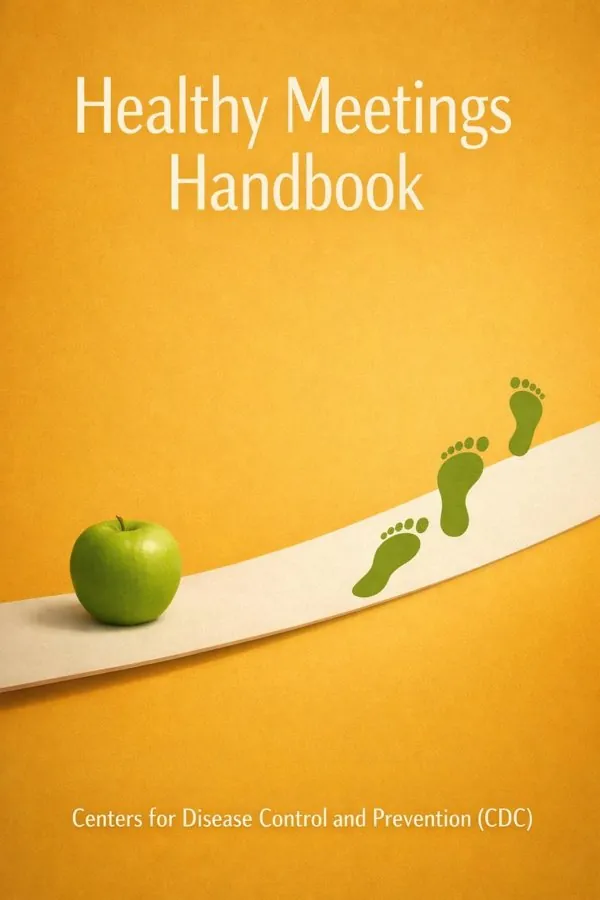
Healthy Meetings Handbook: Better Food, Movement, and Breaks for Productive Meetings: Summary & Key Insights
by Centers for Disease Control, Prevention (CDC)
 10 min9 chaptersAudio available
Key Takeaways from Healthy Meetings Handbook: Better Food, Movement, and Breaks for Productive Meetings
A meeting does not have to drain people in order to be productive.
Healthy meetings rarely happen by accident.
Food at meetings is often chosen for convenience, habit, or perceived popularity, but what is convenient in the moment can be costly in concentration later.
What people drink during a meeting can shape the rhythm of the entire event.
The longer people sit, the harder it becomes to stay mentally present.
What Is Healthy Meetings Handbook: Better Food, Movement, and Breaks for Productive Meetings About?
Healthy Meetings Handbook: Better Food, Movement, and Breaks for Productive Meetings by Centers for Disease Control and Prevention (CDC) is a health_med book spanning 6 pages. Most meetings are designed around agendas, deadlines, and logistics, but rarely around the well-being of the people in the room. The Healthy Meetings Handbook argues that this is a missed opportunity. Created by the Centers for Disease Control and Prevention (CDC), this concise yet practical guide shows how meetings and conferences can be structured to support better nutrition, regular movement, and restorative breaks without sacrificing efficiency. In fact, the handbook makes the opposite case: healthier meetings often become more focused, energetic, and productive. Rather than treating wellness as a perk, the CDC presents it as a smart operational choice. The guidance is simple, actionable, and adaptable, whether you are planning a small internal meeting, a multi-day conference, or a recurring team session. It covers how to select healthier foods and beverages, reduce sedentary time, build in physical activity, and communicate expectations so participants are supported rather than inconvenienced. Because the recommendations come from one of the world’s most trusted public health institutions, the handbook carries both scientific credibility and practical authority. Its core message is clear: every meeting can be redesigned to help people think better, feel better, and work better together.
This FizzRead summary covers all 9 key chapters of Healthy Meetings Handbook: Better Food, Movement, and Breaks for Productive Meetings in approximately 10 minutes, distilling the most important ideas, arguments, and takeaways from Centers for Disease Control and Prevention (CDC)'s work. Also available as an audio summary and Key Quotes Podcast.
Healthy Meetings Handbook: Better Food, Movement, and Breaks for Productive Meetings
Most meetings are designed around agendas, deadlines, and logistics, but rarely around the well-being of the people in the room. The Healthy Meetings Handbook argues that this is a missed opportunity. Created by the Centers for Disease Control and Prevention (CDC), this concise yet practical guide shows how meetings and conferences can be structured to support better nutrition, regular movement, and restorative breaks without sacrificing efficiency. In fact, the handbook makes the opposite case: healthier meetings often become more focused, energetic, and productive.
Rather than treating wellness as a perk, the CDC presents it as a smart operational choice. The guidance is simple, actionable, and adaptable, whether you are planning a small internal meeting, a multi-day conference, or a recurring team session. It covers how to select healthier foods and beverages, reduce sedentary time, build in physical activity, and communicate expectations so participants are supported rather than inconvenienced. Because the recommendations come from one of the world’s most trusted public health institutions, the handbook carries both scientific credibility and practical authority. Its core message is clear: every meeting can be redesigned to help people think better, feel better, and work better together.
Who Should Read Healthy Meetings Handbook: Better Food, Movement, and Breaks for Productive Meetings?
This book is perfect for anyone interested in health_med and looking to gain actionable insights in a short read. Whether you're a student, professional, or lifelong learner, the key ideas from Healthy Meetings Handbook: Better Food, Movement, and Breaks for Productive Meetings by Centers for Disease Control and Prevention (CDC) will help you think differently.
- ✓Readers who enjoy health_med and want practical takeaways
- ✓Professionals looking to apply new ideas to their work and life
- ✓Anyone who wants the core insights of Healthy Meetings Handbook: Better Food, Movement, and Breaks for Productive Meetings in just 10 minutes
Want the full summary?
Get instant access to this book summary and 100K+ more with Fizz Moment.
Get Free SummaryAvailable on App Store • Free to download
Key Chapters
A meeting does not have to drain people in order to be productive. That simple idea sits at the center of the CDC’s handbook. Too often, meetings are treated as neutral containers for work, but in reality they shape energy, attention, mood, and even decision quality. A schedule filled with sugary snacks, long sedentary stretches, and no meaningful breaks quietly undermines the very goals the meeting is meant to accomplish. The handbook reframes this problem by showing that healthier meetings are not a soft extra; they are a practical way to improve performance.
The CDC’s logic is straightforward. When people are offered balanced food, chances to move, and time to reset, they are more likely to stay engaged and less likely to experience the sluggishness and mental fatigue that often appear in long sessions. This is especially important for conferences, trainings, and strategy meetings where learning, creativity, and collaboration are essential. A healthier meeting environment also sends a cultural signal. It tells employees, guests, and partners that the organization values people, not just output.
Consider the difference between two all-day meetings. In one, participants sit for hours, drink soda, eat pastries, and rush through lunch. In the other, water is visible and easy to access, meals include fruit, vegetables, and whole grains, and short movement breaks are built into the agenda. The second setting is more likely to produce sustained focus and a better participant experience.
The handbook’s broader contribution is that it makes wellness operational. It gives organizations permission to think differently about what a successful meeting looks like. Actionable takeaway: stop viewing healthy meeting practices as optional hospitality upgrades and start treating them as tools for better thinking, better participation, and better outcomes.
Healthy meetings rarely happen by accident. They happen because someone decides, early in the planning process, that participant well-being is part of the event’s purpose. The CDC emphasizes that leadership support is the single strongest driver of this shift. When leaders ask for healthier menus, endorse activity breaks, and model participation, healthy practices become normal rather than awkward exceptions.
Planning begins with intention. The handbook encourages organizers to include wellness criteria alongside the usual concerns of budget, venue, agenda design, and scheduling. That means asking practical questions up front: Will water be readily available? Can the venue provide fruit, vegetables, lean proteins, and whole-grain options? Is there space for stretching or walking? Does the agenda allow time for breaks that are long enough to be useful? These questions are easiest to answer before contracts are finalized, not after the schedule is locked.
Leadership matters because meeting culture flows from example. If senior staff insist on back-to-back sessions with no breaks, others will assume that health-supportive changes are not truly valued. But if leaders open meetings by encouraging movement, choose healthier meals themselves, and protect break times from being swallowed by extra content, the organization begins to adopt a new norm.
A practical application might look like this: a conference planning team adds a wellness checklist to every event proposal, assigns one person responsibility for health-related logistics, and asks executives to mention the organization’s healthy meeting goals in opening remarks. Even small actions, such as requesting standing discussion tables or placing walking routes on an event map, reinforce the message.
The CDC’s point is that logistics and culture are inseparable. Healthy meetings require both operational planning and visible endorsement. Actionable takeaway: build health goals into meeting plans from the beginning and secure explicit leadership support so wellness is protected in both scheduling and execution.
What people drink during a meeting can shape the rhythm of the entire event. Hydration affects concentration, mood, and physical comfort, yet beverage planning is often reduced to coffee service and sugary drinks. The CDC broadens this conversation by highlighting how beverage choices can either reinforce or undermine a healthy meeting environment.
Water is the foundation. The handbook encourages organizers to make it readily accessible throughout the meeting, not hidden in a hallway or available only upon request. This might mean pitchers at tables, water refill stations, or clearly visible bottled water where reusable options are not possible. When water is easy to grab, people are more likely to stay hydrated without interrupting the flow of the day.
The guidance also suggests being more thoughtful about high-sugar beverages. Soft drinks, sweetened teas, energy drinks, and specialty coffee drinks can lead to sharp spikes and drops in energy. The CDC does not frame this as prohibition, but as a matter of balance and visibility. Unsweetened tea, coffee, sparkling water, and low- or no-sugar options can be offered as standard choices rather than afterthoughts.
A practical example is a training workshop that begins with coffee, hot tea, water, and fruit-infused water instead of soda. At lunch, the beverage station keeps water most prominent, with smaller quantities of sweetened drinks available but not central. Participants still have choice, but the default setup nudges healthier behavior.
This idea matters because meeting design quietly influences decisions. People often choose what is easiest, especially when they are busy or mentally taxed. By changing the default beverage environment, organizers support better physical and cognitive functioning without adding complexity.
Actionable takeaway: make water the easiest and most visible beverage choice at every meeting, then offer other drinks in ways that support moderation rather than automatic overconsumption.
The longer people sit, the harder it becomes to stay mentally present. The CDC’s handbook challenges the assumption that good meetings require stillness. It argues instead that movement can increase attentiveness, reduce fatigue, and improve the participant experience. This is especially valuable in long meetings, training sessions, and conferences where passive listening can quickly dull engagement.
Movement does not mean turning every meeting into a fitness class. The handbook focuses on practical, low-barrier strategies that fit naturally into professional settings. Organizers can schedule brief stretch breaks, encourage participants to stand periodically, include walking discussions, or use meeting formats that require people to move between stations or small groups. Even transitions between agenda items can become opportunities to reset physically.
Imagine a half-day planning session. Instead of four consecutive seated discussions, the facilitator inserts a two-minute stretch after the first hour, conducts one paired conversation while participants walk nearby, and holds a brainstorming activity at wall charts where people stand and contribute. These adjustments take little time, but they can make a substantial difference in attention and energy.
The CDC also recognizes environmental design. Venues can support movement by offering stairs that are easy to locate, open space for short activity breaks, and signage that encourages walking routes. For large events, planners may include optional morning walks or active networking sessions.
The key insight is that physical activity supports cognitive performance. People do not need less movement in order to think clearly; often they need more. By reducing prolonged sitting, meetings become more humane and often more effective.
Actionable takeaway: for any meeting longer than an hour, intentionally add at least one structured opportunity for participants to stand, stretch, or walk so movement becomes part of the agenda rather than an afterthought.
Breaks are often treated as expendable, the first thing cut when agendas run long. The CDC makes a compelling case that this habit is self-defeating. Without breaks, attention declines, irritability rises, and retention suffers. A meeting that powers through without pause may appear efficient, but it often produces lower-quality engagement and weaker results.
The handbook encourages organizers to think of breaks as active support for performance. Effective breaks allow people to use the restroom, rehydrate, eat mindfully, move their bodies, check urgent messages, and mentally reset. For conferences and all-day events, this can be the difference between sustained participation and afternoon disengagement. The quality of the break matters too. A five-minute pause between two dense presentations may not be enough, while a properly timed 10- to 15-minute break can restore focus.
Practical implementation is simple but intentional. A two-hour meeting might include a short stand-and-stretch reset halfway through. A full-day training could schedule breaks every 60 to 90 minutes, with one longer meal period that is not crammed with side meetings. Organizers can also use break spaces strategically by placing water nearby, offering healthy snacks, and creating an environment where people can move rather than merely line up for caffeine.
The CDC’s deeper point is that rest is not the opposite of productivity. It is one of its conditions. Breaks help people process information and return with improved readiness to contribute. They also communicate respect, especially to participants with health needs, caregiving responsibilities, or long travel days.
Actionable takeaway: protect breaks as part of the meeting design, not as optional buffer time, and make sure they are long enough to support genuine recovery rather than a rushed transition.
A healthy meeting can fail before it begins if participants are surprised by the format. The CDC highlights communication as a crucial but often overlooked part of successful implementation. People are more receptive to healthy changes when they understand the purpose behind them and know what to expect in advance.
Clear communication helps normalize wellness-supportive choices. If an invitation mentions that the event will include healthy meals, stretch breaks, and walking opportunities, participants are less likely to interpret these elements as odd interruptions. Instead, they see them as part of a thoughtful experience. Communication also creates trust when it addresses practical concerns, such as dietary accommodations, accessibility needs, attire appropriate for light movement, and the timing of breaks.
For example, a conference registration page can explain that the event follows healthy meeting principles, including water availability, balanced menu options, and brief activity breaks. A facilitator can open the day by stating that movement and breaks are built in to support learning and attention. Internal team meetings can include a short note in the calendar invite encouraging participants to bring water or be prepared for a short standing discussion.
This is not merely about logistics. It is about culture change. When organizations consistently explain why they are adopting healthier practices, they create shared understanding rather than quiet resistance. Over time, participants begin to expect these standards and may even request them in other settings.
The handbook also suggests that communication should extend to vendors, caterers, and venue staff. If expectations are explicit, partners are more likely to deliver solutions that align with the organization’s wellness goals.
Actionable takeaway: explain healthy meeting practices before and during the event so participants and partners understand both the logistics and the purpose behind the choices being made.
People do not make decisions in a vacuum; they respond to cues in their surroundings. One of the most practical insights in the CDC handbook is that meeting environments can be designed to make healthy behavior easier without relying on willpower. In other words, the room itself can become a subtle partner in better decision-making.
This idea shows up in many small choices. Where is the water placed? Are stairs visible and inviting? Is there open space for stretching? Are healthy foods positioned first on the buffet? Are chairs fixed in rigid rows, or can the room be rearranged to support interaction and standing activities? Each of these details influences what participants actually do.
A simple conference setup illustrates the principle. Water stations are placed at entrances and near meeting rooms. Fruit and vegetable options appear at the start of food lines. Signs indicate indoor and outdoor walking routes. Breakout rooms include enough open space for facilitators to invite participants to stand or move. None of these features force behavior, but together they create a context in which healthier actions become more natural.
The CDC’s approach aligns with a broader public health principle: defaults matter. If the healthiest option is convenient, visible, and socially acceptable, more people will choose it. This is especially useful in meetings because participants are often busy, distracted, and focused on content rather than self-care. Good environmental design reduces friction.
Importantly, these changes can be modest and low-cost. They do not require expensive renovations or complex programming. They require planners to notice how physical space affects human behavior.
Actionable takeaway: audit your next meeting space from the participant’s perspective and adjust the environment so water, movement, and healthier food choices are easier to access than less supportive alternatives.
The real value of the handbook extends beyond a single event. Its strongest implication is that healthy meetings can become part of an organization’s operating culture. When repeated over time, these practices stop feeling novel and start functioning as standard expectations. That shift matters because culture is what determines whether wellness survives under pressure or disappears when schedules get tight.
The CDC encourages organizations to think about sustainability. Rather than relying on one enthusiastic planner, healthy meetings work best when there are simple policies, checklists, and shared expectations. Procurement standards can request healthier catering options. event templates can include planned breaks. internal guidance can recommend movement for longer meetings. feedback forms can ask participants whether food, break timing, and activity opportunities supported their engagement. These small systems make healthy practices repeatable.
Measurement also helps. An organization might track how often healthy beverage options are provided, whether breaks are consistently scheduled, or how participants rate the meeting experience. Over time, this creates evidence that wellness-oriented design is not only feasible but beneficial. It also gives leaders a way to improve rather than guess.
Imagine a workplace where recurring meetings automatically include a midpoint reset, catered events follow nutrition guidelines, and conference requests must address wellness logistics. In that environment, healthy meetings are no longer dependent on persuasion each time; they are simply how things are done.
This is where the handbook becomes more than a planning guide. It becomes a quiet framework for organizational change. It links public health principles to daily administrative choices and shows how routine practices can reinforce well-being.
Actionable takeaway: convert healthy meeting ideas into repeatable systems such as checklists, vendor standards, and feedback measures so the practice becomes embedded in the organization rather than dependent on individual effort.
All Chapters in Healthy Meetings Handbook: Better Food, Movement, and Breaks for Productive Meetings
About the Authors
The Centers for Disease Control and Prevention (CDC) is the premier public health agency of the United States. Founded to protect health and safety through disease prevention and health promotion, the CDC conducts research, tracks health trends, responds to emergencies, and develops guidance for institutions, communities, and policymakers. Its work spans infectious diseases, chronic illness prevention, environmental health, workplace health, and community well-being. Because of its scientific expertise and national leadership role, the CDC is one of the most trusted sources of practical, evidence-based health information in the world. In publications like the Healthy Meetings Handbook, the agency translates broad public health principles into everyday organizational practices, helping workplaces and event planners create environments that support healthier, more productive human behavior.
Get This Summary in Your Preferred Format
Read or listen to the Healthy Meetings Handbook: Better Food, Movement, and Breaks for Productive Meetings summary by Centers for Disease Control and Prevention (CDC) anytime, anywhere. FizzRead offers multiple formats so you can learn on your terms — all free.
Available formats: App · Audio · PDF · EPUB — All included free with FizzRead
Download Healthy Meetings Handbook: Better Food, Movement, and Breaks for Productive Meetings PDF and EPUB Summary
Key Quotes from Healthy Meetings Handbook: Better Food, Movement, and Breaks for Productive Meetings
“A meeting does not have to drain people in order to be productive.”
“Healthy meetings rarely happen by accident.”
“Food at meetings is often chosen for convenience, habit, or perceived popularity, but what is convenient in the moment can be costly in concentration later.”
“What people drink during a meeting can shape the rhythm of the entire event.”
“The longer people sit, the harder it becomes to stay mentally present.”
Frequently Asked Questions about Healthy Meetings Handbook: Better Food, Movement, and Breaks for Productive Meetings
Healthy Meetings Handbook: Better Food, Movement, and Breaks for Productive Meetings by Centers for Disease Control and Prevention (CDC) is a health_med book that explores key ideas across 9 chapters. Most meetings are designed around agendas, deadlines, and logistics, but rarely around the well-being of the people in the room. The Healthy Meetings Handbook argues that this is a missed opportunity. Created by the Centers for Disease Control and Prevention (CDC), this concise yet practical guide shows how meetings and conferences can be structured to support better nutrition, regular movement, and restorative breaks without sacrificing efficiency. In fact, the handbook makes the opposite case: healthier meetings often become more focused, energetic, and productive. Rather than treating wellness as a perk, the CDC presents it as a smart operational choice. The guidance is simple, actionable, and adaptable, whether you are planning a small internal meeting, a multi-day conference, or a recurring team session. It covers how to select healthier foods and beverages, reduce sedentary time, build in physical activity, and communicate expectations so participants are supported rather than inconvenienced. Because the recommendations come from one of the world’s most trusted public health institutions, the handbook carries both scientific credibility and practical authority. Its core message is clear: every meeting can be redesigned to help people think better, feel better, and work better together.
More by Centers for Disease Control and Prevention (CDC)
You Might Also Like

On Immunity
Eula Biss
10 min
The Three-Body Problem
Liu Cixin
10 min
Community Health Volunteer Toolkit: Training and Practical Activities
World Health Organization
10 min
Healing Back Pain: The Mind-Body Connection
John E. Sarno
10 min
Health Literacy for All: Practical Guides to Communicate Health Information (Compilations)
World Health Organization
10 min
The Complete Guide to Sports Supplements: An Evidence-Based Review
Anita Bean
10 minBrowse by Category
Ready to read Healthy Meetings Handbook: Better Food, Movement, and Breaks for Productive Meetings?
Get the full summary and 100K+ more books with Fizz Moment.