
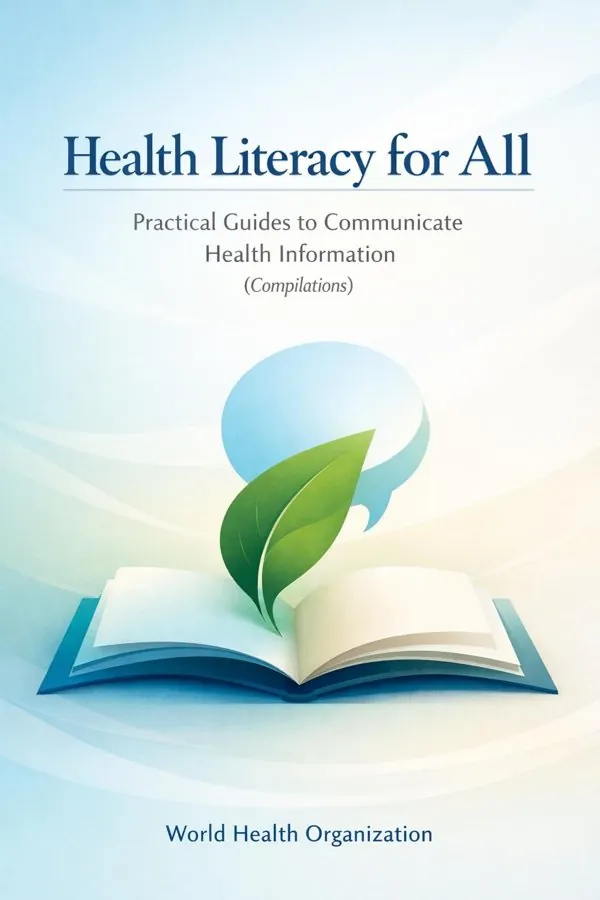
Health Literacy for All: Practical Guides to Communicate Health Information (Compilations): Summary & Key Insights
 10 min9 chaptersAudio available
Key Takeaways from Health Literacy for All: Practical Guides to Communicate Health Information (Compilations)
A prescription, brochure, or public campaign can fail even when the science is correct, because correctness alone does not guarantee comprehension.
People are more likely to follow health advice when it sounds human, direct, and respectful rather than technical and distant.
Good health information is not written for an ideal reader in calm conditions; it is designed for real people dealing with real constraints.
When people get lost in health systems, the issue is often systemic complexity rather than personal failure.
The same sentence can inform one audience and alienate another, because meaning is always shaped by culture, history, and lived experience.
What Is Health Literacy for All: Practical Guides to Communicate Health Information (Compilations) About?
Health Literacy for All: Practical Guides to Communicate Health Information (Compilations) by World Health Organization is a health_med book. Health information only helps when people can find it, understand it, trust it, and use it in real life. That is the urgent challenge at the heart of Health Literacy for All: Practical Guides to Communicate Health Information (Compilations) by the World Health Organization. Rather than treating communication as an afterthought, this work shows that clear, accessible, people-centered health communication is essential to better care, safer systems, and healthier communities. It brings together practical guidance on how to present health information in ways that respect people’s diverse literacy levels, languages, cultural contexts, and decision-making needs. The book matters because misunderstanding health information has real consequences: missed screenings, medication errors, delayed treatment, and growing mistrust. In a world shaped by misinformation, complex health systems, and unequal access to care, improving health literacy is not simply a communications task; it is a public health priority. The World Health Organization brings exceptional authority to this topic through its global leadership in health policy, evidence-based guidance, and equity-focused practice. The result is a highly practical resource for professionals who want health information to do what it is meant to do: help people make informed, confident, life-improving decisions.
This FizzRead summary covers all 9 key chapters of Health Literacy for All: Practical Guides to Communicate Health Information (Compilations) in approximately 10 minutes, distilling the most important ideas, arguments, and takeaways from World Health Organization's work. Also available as an audio summary and Key Quotes Podcast.
Health Literacy for All: Practical Guides to Communicate Health Information (Compilations)
Health information only helps when people can find it, understand it, trust it, and use it in real life. That is the urgent challenge at the heart of Health Literacy for All: Practical Guides to Communicate Health Information (Compilations) by the World Health Organization. Rather than treating communication as an afterthought, this work shows that clear, accessible, people-centered health communication is essential to better care, safer systems, and healthier communities. It brings together practical guidance on how to present health information in ways that respect people’s diverse literacy levels, languages, cultural contexts, and decision-making needs.
The book matters because misunderstanding health information has real consequences: missed screenings, medication errors, delayed treatment, and growing mistrust. In a world shaped by misinformation, complex health systems, and unequal access to care, improving health literacy is not simply a communications task; it is a public health priority. The World Health Organization brings exceptional authority to this topic through its global leadership in health policy, evidence-based guidance, and equity-focused practice. The result is a highly practical resource for professionals who want health information to do what it is meant to do: help people make informed, confident, life-improving decisions.
Who Should Read Health Literacy for All: Practical Guides to Communicate Health Information (Compilations)?
This book is perfect for anyone interested in health_med and looking to gain actionable insights in a short read. Whether you're a student, professional, or lifelong learner, the key ideas from Health Literacy for All: Practical Guides to Communicate Health Information (Compilations) by World Health Organization will help you think differently.
- ✓Readers who enjoy health_med and want practical takeaways
- ✓Professionals looking to apply new ideas to their work and life
- ✓Anyone who wants the core insights of Health Literacy for All: Practical Guides to Communicate Health Information (Compilations) in just 10 minutes
Want the full summary?
Get instant access to this book summary and 100K+ more with Fizz Moment.
Get Free SummaryAvailable on App Store • Free to download
Key Chapters
A prescription, brochure, or public campaign can fail even when the science is correct, because correctness alone does not guarantee comprehension. One of the book’s central insights is that health literacy is not merely an individual skill; it is a shared responsibility between health systems and the people they serve. When people struggle to understand health information, the problem often lies not in their motivation or intelligence but in how the information was designed, delivered, and explained.
The guide reframes health literacy as a practical issue of access, clarity, and usability. Many health materials assume background knowledge that people may not have. Terms like “screening,” “risk factors,” “contraindications,” or “adherence” may be familiar to clinicians but confusing to patients. Even simple instructions can become barriers if they are too dense, too abstract, or not culturally relevant. By making information easier to navigate and act on, organizations can improve not only understanding but also outcomes such as treatment adherence, prevention, and trust.
A practical example is discharge guidance after a hospital visit. A patient may receive a page full of instructions on medication timing, warning signs, and follow-up care. If the language is technical and the layout crowded, important details may be missed. But if the same information is broken into short steps, written in plain language, and confirmed through conversation, the patient is more likely to recover safely at home.
The actionable takeaway is simple: treat understanding as part of care itself. Before sharing health information, ask whether a person can realistically find it, grasp it, and use it under stress, time pressure, or uncertainty.
People are more likely to follow health advice when it sounds human, direct, and respectful rather than technical and distant. The book emphasizes plain language as one of the most powerful tools for improving health literacy. Plain language does not mean oversimplifying science or talking down to people. It means expressing accurate information in words, structure, and tone that make sense to the intended audience.
This involves replacing jargon with familiar language, shortening sentences, prioritizing the most important message, and explaining necessary technical terms when they cannot be avoided. Instead of saying, “Administer the medication bi-daily unless contraindicated,” a clearer alternative is, “Take this medicine twice a day, unless your doctor has told you not to.” That shift may seem small, but it can be the difference between correct use and dangerous confusion.
The book also highlights the role of formatting in readability. Headings, bullet points, white space, and visual hierarchy can dramatically improve how people process information. A leaflet about diabetes prevention, for example, becomes far more usable when key actions such as “move more,” “eat fewer sugary foods,” and “get tested regularly” are immediately visible.
Plain language is especially important in high-stress situations. During outbreaks, emergencies, or serious diagnoses, people may be anxious, frightened, or overwhelmed. Complex wording increases cognitive burden just when people are least able to process it.
The actionable takeaway is to revise every health message with one question in mind: would an ordinary person understand this quickly, correctly, and without needing expert help? If not, simplify the language until the meaning is unmistakable.
Good health information is not written for an ideal reader in calm conditions; it is designed for real people dealing with real constraints. A major lesson in the book is that effective communication depends on user-centered design. Health materials should reflect how people actually read, decide, and behave, especially when they are tired, worried, busy, ill, or navigating unfamiliar systems.
User-centered communication begins by identifying the audience clearly. Is the message for older adults managing chronic disease, parents deciding on vaccinations, adolescents learning about sexual health, or migrant communities unfamiliar with the local health system? Different groups have different levels of prior knowledge, cultural assumptions, digital access, and preferred communication channels. A single generic message may technically reach everyone while truly helping very few.
The book encourages testing materials before wide release. That might involve asking patients to read a draft leaflet and explain it back in their own words, or observing whether website users can easily find appointment information. Such testing often reveals hidden problems: icons that are misinterpreted, forms that use unclear labels, or messages that fail to answer the audience’s main concern.
Consider a maternal health handout. If the creators assume all readers are comfortable with written instructions, they may miss the needs of people who rely more on visual guidance or community discussion. A better version might combine short text, clear illustrations, and in-person explanation from health workers.
The actionable takeaway is to create with people, not just for them. Involve the intended audience early, test materials in realistic settings, and revise based on what users actually understand and need.
When people get lost in health systems, the issue is often systemic complexity rather than personal failure. The book argues that health literacy should not be limited to educational materials; it must also shape how services, forms, websites, appointments, and care pathways are organized. A confusing system can make even highly educated people feel powerless.
This broader perspective matters because many health decisions are made within institutional processes: booking appointments, understanding consent forms, navigating insurance or payment systems, following referral steps, or preparing for tests. If each step is difficult to understand, people delay care, miss treatment, or disengage altogether. The burden falls hardest on those already facing social disadvantage, language barriers, or limited digital access.
A practical illustration is a vaccination program. Clear information about the vaccine matters, but so do the logistics. Can people easily find where to go? Do they know whether they need an appointment? Are opening hours accessible? Is the registration process simple? Are reminders understandable? Health literacy improves when systems reduce the effort required to act on good information.
The book’s practical orientation suggests that organizations audit the communication burden they place on users. Long forms, inconsistent terminology, fragmented instructions, and poorly designed websites can all create unnecessary friction. Making the system easier to use is itself a form of equity.
The actionable takeaway is to look beyond leaflets and websites. Map the full user journey through a service and remove points of confusion, delay, and overload so that people can act on health advice without needing extraordinary persistence.
The same sentence can inform one audience and alienate another, because meaning is always shaped by culture, history, and lived experience. The book stresses that effective health communication must be culturally and contextually responsive. It is not enough to translate words if the underlying message fails to connect with people’s values, beliefs, realities, or concerns.
Cultural responsiveness includes recognizing family roles in decision-making, local beliefs about illness, stigma around certain conditions, and differences in how authority and trust are understood. For example, guidance on mental health may need to be framed differently in communities where distress is discussed through physical symptoms or where seeking formal care carries social risk. Similarly, nutrition advice must consider what foods are available, affordable, and customary, not just what is ideal in theory.
The book also points to the importance of channels and messengers. In some settings, community leaders, pharmacists, peer educators, or radio broadcasts may be more trusted than official institutional websites. During public health campaigns, communication works best when trusted local voices reinforce the message in familiar language and context.
A practical application would be adapting information about breastfeeding, vaccination, or chronic disease management with input from local communities. Instead of one universal script, communicators can tailor examples, visuals, and framing to local realities while preserving scientific accuracy.
The actionable takeaway is to ask not only, “Is this information correct?” but also, “Will this audience recognize it as relevant, respectful, and usable?” Communication becomes more effective when it meets people where they are, not where institutions assume they should be.
Images are often treated as decoration, but in health communication they function as meaning-making tools that can either support understanding or create misunderstanding. The book highlights the importance of visual communication in improving health literacy, especially for people facing reading difficulties, language barriers, stress, or information overload.
Effective visuals help users identify the main message quickly. Diagrams can show how to use an inhaler, wash hands properly, or prepare for a medical procedure. Icons can guide users through a clinic, indicate side effects, or mark urgent warning signs. Charts can help communicate risk, but only when designed carefully. Poorly chosen graphics, vague symbols, or cluttered layouts may confuse audiences or falsely imply certainty, danger, or simplicity.
The book’s practical approach suggests that visuals should always be tested for comprehension. An image that seems obvious to a designer may not be obvious to a patient. For instance, a symbol used to indicate fasting before a blood test might be misread unless paired with clear words. Risk graphics can also mislead if they use unfamiliar percentages without context; many people understand “3 in 100” better than “3%.”
Visuals should also reflect the diversity of the audience. Inclusive images can increase recognition and trust, while stereotyped or unrealistic imagery may make information feel distant or irrelevant.
The actionable takeaway is to use visuals with purpose. Every image, icon, or chart should make a health message easier to understand and act on. If a visual does not improve clarity in testing, revise it or remove it.
Putting health information online does not automatically make it accessible. In fact, digital health can widen gaps when information is hard to find, poorly structured, written for experts, or designed without considering different levels of digital literacy. The book shows that health literacy in the digital era requires more than publishing content; it requires helping people navigate, evaluate, and use information in fast-moving digital environments.
This issue has become especially urgent as people increasingly rely on websites, apps, patient portals, videos, and social media for health decisions. Digital tools can expand access, provide timely reminders, and support self-management. But they also expose people to misinformation, conflicting advice, and persuasive but unreliable content. Good digital communication therefore needs both clarity and credibility.
Practical strategies include using intuitive navigation, clear page titles, mobile-friendly design, searchable FAQs, and layered information that presents essentials first and details second. A page on blood pressure management, for example, should quickly answer key questions: what it is, why it matters, what the numbers mean, when to seek help, and what actions to take. Links should guide users to trusted next steps rather than leaving them overwhelmed.
The book also implies that digital access is unequal. Some users have limited bandwidth, low confidence with apps, or disabilities affecting how they interact with screens. Accessibility features, plain navigation, and alternative formats are therefore not optional extras.
The actionable takeaway is to design digital health content as a guided experience. Make trusted information easy to find, easy to understand, and easy to verify so users can make safer decisions in crowded information spaces.
One of the most dangerous assumptions in public health is believing that because a message was delivered, it was understood. The book repeatedly points toward a more disciplined approach: communication should be evaluated through evidence, feedback, and iteration. In other words, health information must be tested like any other intervention.
Testing can happen at multiple levels. At the simplest level, communicators can ask representative users to explain a message in their own words. This reveals whether the intended meaning survives contact with real readers. Organizations can also measure practical outcomes: are fewer forms completed incorrectly, are more patients attending follow-up appointments, are more people using medicines safely, are website users finding the correct service pages? These measures connect communication quality to real-world results.
The book’s practical orientation supports methods such as readability review, usability testing, focus groups, rapid feedback loops, and continuous revision. During outbreaks or emergency campaigns, iterative testing is especially important because public concern and misinformation can change quickly. Messages that worked one month may fail the next if they no longer address people’s primary fears.
For example, a flyer encouraging cancer screening may focus heavily on benefits, yet testing could show that the audience is mainly worried about cost, pain, or what happens after an abnormal result. Revising the message to answer those concerns directly can dramatically improve engagement.
The actionable takeaway is to stop guessing. Build feedback into every communication effort, measure whether people can understand and use the message, and revise materials based on evidence rather than institutional assumptions.
Health inequity is not only about unequal services or outcomes; it is also about unequal access to understandable information. The book makes clear that health literacy is deeply connected to fairness. When communication is difficult, the people most affected are often those already facing barriers due to poverty, disability, migration, age, stigma, or limited educational opportunity.
This means clear communication is not just a style preference. It is an ethical and policy issue. If consent forms are incomprehensible, if preventive guidance assumes high literacy, or if digital systems exclude people with limited access, health institutions unintentionally reproduce inequality. By contrast, when organizations communicate clearly and inclusively, they distribute decision-making power more fairly.
The book positions health literacy as a route to empowerment. People who understand their options are better able to ask questions, compare risks, advocate for themselves, and participate in their care. Communities that can access trustworthy, relevant information are better equipped to respond to crises, prevent illness, and challenge misinformation. This is especially important in public health, where collective trust and participation shape outcomes.
A practical example is multilingual, accessible information for refugee or migrant communities. If services provide translated materials, interpreters, visual aids, and respectful explanation, they reduce preventable confusion and improve continuity of care. The same principle applies to disability-friendly formats, low-literacy materials, and community-based outreach.
The actionable takeaway is to treat communication equity as a core part of health equity. Prioritize the needs of those most likely to be excluded, and design information systems that expand understanding rather than rewarding prior advantage.
All Chapters in Health Literacy for All: Practical Guides to Communicate Health Information (Compilations)
About the Author
The World Health Organization (WHO) is the leading international authority on public health within the United Nations system. Established in 1948, it works with member states, health institutions, researchers, and civil society organizations to improve health outcomes worldwide. WHO is known for setting global health standards, issuing evidence-based guidance, coordinating responses to disease outbreaks and emergencies, and advancing health equity across populations. Its work spans infectious disease control, maternal and child health, mental health, noncommunicable diseases, health systems strengthening, and universal health coverage. As an institutional author, WHO brings broad scientific expertise and deep practical experience in translating public health evidence into guidance that can be used in diverse countries, cultures, and care settings.
Get This Summary in Your Preferred Format
Read or listen to the Health Literacy for All: Practical Guides to Communicate Health Information (Compilations) summary by World Health Organization anytime, anywhere. FizzRead offers multiple formats so you can learn on your terms — all free.
Available formats: App · Audio · PDF · EPUB — All included free with FizzRead
Download Health Literacy for All: Practical Guides to Communicate Health Information (Compilations) PDF and EPUB Summary
Key Quotes from Health Literacy for All: Practical Guides to Communicate Health Information (Compilations)
“A prescription, brochure, or public campaign can fail even when the science is correct, because correctness alone does not guarantee comprehension.”
“People are more likely to follow health advice when it sounds human, direct, and respectful rather than technical and distant.”
“Good health information is not written for an ideal reader in calm conditions; it is designed for real people dealing with real constraints.”
“When people get lost in health systems, the issue is often systemic complexity rather than personal failure.”
“The same sentence can inform one audience and alienate another, because meaning is always shaped by culture, history, and lived experience.”
Frequently Asked Questions about Health Literacy for All: Practical Guides to Communicate Health Information (Compilations)
Health Literacy for All: Practical Guides to Communicate Health Information (Compilations) by World Health Organization is a health_med book that explores key ideas across 9 chapters. Health information only helps when people can find it, understand it, trust it, and use it in real life. That is the urgent challenge at the heart of Health Literacy for All: Practical Guides to Communicate Health Information (Compilations) by the World Health Organization. Rather than treating communication as an afterthought, this work shows that clear, accessible, people-centered health communication is essential to better care, safer systems, and healthier communities. It brings together practical guidance on how to present health information in ways that respect people’s diverse literacy levels, languages, cultural contexts, and decision-making needs. The book matters because misunderstanding health information has real consequences: missed screenings, medication errors, delayed treatment, and growing mistrust. In a world shaped by misinformation, complex health systems, and unequal access to care, improving health literacy is not simply a communications task; it is a public health priority. The World Health Organization brings exceptional authority to this topic through its global leadership in health policy, evidence-based guidance, and equity-focused practice. The result is a highly practical resource for professionals who want health information to do what it is meant to do: help people make informed, confident, life-improving decisions.
More by World Health Organization
You Might Also Like
On Immunity
Eula Biss
10 min
The Three-Body Problem
Liu Cixin
10 min
Community Health Volunteer Toolkit: Training and Practical Activities
World Health Organization
10 min
Healing Back Pain: The Mind-Body Connection
John E. Sarno
10 min
The Complete Guide to Sports Supplements: An Evidence-Based Review
Anita Bean
10 min
The McDougall Program For Maximum Weight Loss
John A. McDougall
10 minBrowse by Category
Ready to read Health Literacy for All: Practical Guides to Communicate Health Information (Compilations)?
Get the full summary and 100K+ more books with Fizz Moment.