
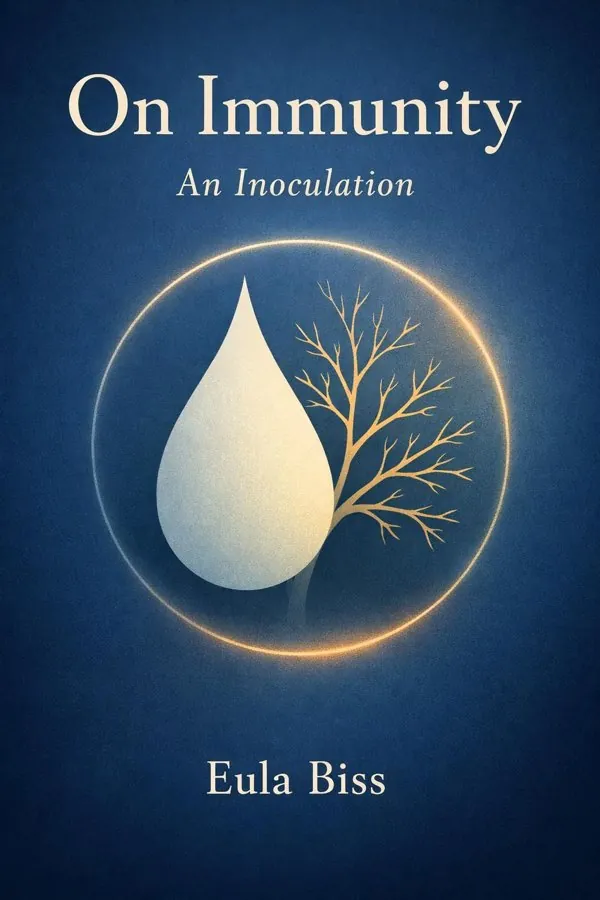
On Immunity: Summary & Key Insights
by Eula Biss
 10 min10 chaptersAudio available
Key Takeaways from On Immunity
Medical progress often begins in uncertainty, and vaccination is no exception.
Words shape how we think, and Biss shows that the word immunity carries political and moral meanings long before it reaches biology.
One of Biss’s most powerful claims is that the human body cannot be understood as a sealed, independent unit.
Fear is rarely distributed according to actual danger.
In vaccine debates, the barrier is not always ignorance.
What Is On Immunity About?
On Immunity by Eula Biss is a health_med book published in 2014 spanning 10 pages. On Immunity is not a conventional book about vaccines. Instead, Eula Biss uses vaccination as a lens to explore fear, motherhood, public health, social trust, and the uneasy boundary between the individual body and the collective world. Writing after the birth of her son, Biss begins with a familiar modern anxiety: how do we protect those we love in a world full of invisible risks? From there, she traces the history of inoculation, the language of immunity, the mythology of contamination, and the politics of responsibility. Her method is distinctive. She brings together science, literary criticism, philosophy, personal narrative, and cultural history, showing that debates about vaccines are never only about medical facts. They are also about power, purity, freedom, privilege, and what we owe one another. That is what makes this book so enduringly relevant. In an age shaped by misinformation, mistrust, and recurring public health crises, Biss offers a thoughtful, humane, and intellectually rigorous meditation on why immunity is both biological protection and a social relationship. The result is a book that deepens how we think about health, citizenship, and care.
This FizzRead summary covers all 10 key chapters of On Immunity in approximately 10 minutes, distilling the most important ideas, arguments, and takeaways from Eula Biss's work. Also available as an audio summary and Key Quotes Podcast.
On Immunity
On Immunity is not a conventional book about vaccines. Instead, Eula Biss uses vaccination as a lens to explore fear, motherhood, public health, social trust, and the uneasy boundary between the individual body and the collective world. Writing after the birth of her son, Biss begins with a familiar modern anxiety: how do we protect those we love in a world full of invisible risks? From there, she traces the history of inoculation, the language of immunity, the mythology of contamination, and the politics of responsibility. Her method is distinctive. She brings together science, literary criticism, philosophy, personal narrative, and cultural history, showing that debates about vaccines are never only about medical facts. They are also about power, purity, freedom, privilege, and what we owe one another. That is what makes this book so enduringly relevant. In an age shaped by misinformation, mistrust, and recurring public health crises, Biss offers a thoughtful, humane, and intellectually rigorous meditation on why immunity is both biological protection and a social relationship. The result is a book that deepens how we think about health, citizenship, and care.
Who Should Read On Immunity?
This book is perfect for anyone interested in health_med and looking to gain actionable insights in a short read. Whether you're a student, professional, or lifelong learner, the key ideas from On Immunity by Eula Biss will help you think differently.
- ✓Readers who enjoy health_med and want practical takeaways
- ✓Professionals looking to apply new ideas to their work and life
- ✓Anyone who wants the core insights of On Immunity in just 10 minutes
Want the full summary?
Get instant access to this book summary and 100K+ more with Fizz Moment.
Get Free SummaryAvailable on App Store • Free to download
Key Chapters
Medical progress often begins in uncertainty, and vaccination is no exception. Biss reminds readers that early inoculation developed long before modern germ theory existed. Smallpox devastated families and entire communities, and the earliest efforts to prevent it were risky, imperfect, and controversial. Reports of inoculation traveled from the Ottoman Empire and other regions into Europe and America, where the practice was met with both curiosity and horror. Even before vaccines became scientifically understood, people had to make decisions under conditions of incomplete knowledge. That historical fact matters because it reveals something enduring: public health choices are rarely made in an atmosphere of perfect certainty.
Biss uses this history to complicate the idea that vaccine skepticism is purely modern irrationality. Fear has always accompanied medical intervention, especially when the intervention introduces a small amount of danger in hopes of preventing catastrophic harm. Yet history also shows that waiting for absolute safety can itself be deadly. The smallpox vaccine, despite its early imperfections, helped transform one of humanity’s most feared diseases into an eradicated threat.
Today, the same dynamic appears whenever people weigh rare side effects against large-scale protection. Parents deciding on childhood vaccines, travelers considering disease prevention, or communities debating school immunization policies all confront a version of this old dilemma: whether to accept measured risk in order to reduce far greater danger.
The practical lesson is to evaluate medical interventions comparatively, not emotionally. Ask not whether a vaccine carries any risk, but how that risk compares with the disease it prevents. Actionable takeaway: when assessing a health decision, compare the danger of intervention with the danger of inaction before reaching a conclusion.
One of Biss’s most powerful claims is that the human body cannot be understood as a sealed, independent unit. We absorb air, water, food, microbes, care, and risk from the world around us. Our health depends on infrastructures we barely notice: sanitation systems, hospitals, supply chains, schools, public health agencies, and the vaccination decisions of other people. The fantasy of complete bodily autonomy is emotionally appealing, but biologically and socially it is false.
This is why Biss treats immunity as a relationship between bodies rather than a possession held by one person alone. A newborn depends on parental choices, medical systems, and the immunity of surrounding adults. An immunocompromised person may rely heavily on others being vaccinated. Even healthy people benefit from disease not circulating widely in the environments they inhabit.
In practical life, this means health decisions ripple outward. Choosing not to vaccinate is not equivalent to declining an optional consumer product. It alters the conditions under which vulnerable people move through the world. The same principle applies in offices, schools, nursing homes, and public transit. We are constantly affecting one another through exposure, prevention, and protection.
Biss does not deny individuality; she reframes it. We are distinct persons, but our bodies are sustained by collective systems. The tension between independence and interdependence lies at the center of modern life, and vaccines make that tension visible.
The practical lesson is to resist all-or-nothing thinking about personal choice. A choice can be personal and still have public consequences. Actionable takeaway: before making a health decision, identify who else may be affected directly or indirectly, especially those with less ability to protect themselves.
Fear is rarely distributed according to actual danger. Biss explores how modern parents and citizens become preoccupied with invisible threats, especially contamination. Vaccines can feel frightening not only because they involve needles and chemicals, but because they are administered intentionally. A disease acquired naturally may be statistically worse, yet psychologically it can seem less blameworthy than a side effect from a deliberate medical act. This emotional asymmetry helps explain why people may overestimate vaccine risks while underestimating disease risks.
Biss does not mock fear. She understands it intimately, especially through the experience of new motherhood. That is part of the book’s strength. She shows that fear is not solved simply by supplying more facts. Fear attaches itself to stories, images, moral intuitions, and cultural scripts about purity and corruption. A trace chemical in a vaccine may seem more alarming than a much larger threat because it fits a narrative of intrusion.
This dynamic appears across many modern health debates. People may dread airplane crashes more than car accidents, food additives more than chronic overconsumption, or vaccine side effects more than infectious disease outbreaks. The human mind responds strongly to vividness, novelty, and perceived control.
The practical implication is not to dismiss emotion but to interrogate it. Ask why a particular risk feels vivid, whether it is amplified by anecdote, and what baseline rates actually show. Public health communication improves when it addresses feelings and meaning, not data alone.
Actionable takeaway: when a health risk feels overwhelming, pause and compare emotional intensity with credible evidence, including the frequency and severity of the alternative risk.
In vaccine debates, the barrier is not always ignorance. Often it is mistrust. Biss examines how confidence in science is entangled with confidence in institutions, corporations, governments, and medical authorities. People do not encounter facts in a vacuum. They filter them through histories of betrayal, inequality, and conflicting incentives. If institutions appear opaque or self-serving, even accurate information can fail to persuade.
This point is especially important because it shifts the conversation away from simplistic judgments. Telling people to trust science can ring hollow if their broader experience has taught them that power is unevenly exercised. Pharmaceutical profits, public health mistakes, racial disparities in medicine, and contradictory messaging all affect how recommendations are received. Biss does not use these realities to reject science; she uses them to explain why scientific authority must be earned and maintained.
For readers, this offers a more mature model of public reasoning. Trust is built through transparency, humility, accountability, and consistency. Doctors who listen carefully, explain uncertainty honestly, and respect concerns may be more persuasive than those who rely solely on authority. Institutions that admit past failures may become more credible, not less.
This applies in everyday life whenever you evaluate health advice online or offline. Consider the source, the evidence, the incentives, and the way uncertainty is communicated. Reliable expertise does not pretend perfection; it demonstrates method and integrity.
Actionable takeaway: seek information from sources that are transparent about evidence, limits, and conflicts of interest, and build your judgments on trustworthy processes rather than charismatic certainty.
Parenthood, especially motherhood, often transforms ordinary risk assessment into a moral minefield. Biss captures how becoming a mother heightened her awareness of danger and responsibility. Suddenly, every decision seemed charged with ethical weight: what to feed a child, what products to buy, what environments to avoid, what medical interventions to accept. In contemporary culture, mothers are frequently positioned as guardians against all possible harm, even though such total protection is impossible.
Vaccination becomes especially emotionally loaded within this framework. If a mother consents to a vaccine and something goes wrong, however rare, she may feel personally responsible. If she refuses vaccination and the child becomes ill, the burden is equally intense. This structure of impossible responsibility fuels anxiety and makes certainty feel urgently necessary. But Biss shows that certainty is often unavailable. Good parenting does not mean eliminating risk; it means making thoughtful decisions amid uncertainty.
Her analysis also reveals how consumer culture exploits parental fear. Markets offer endless products promising purity, safety, and control, encouraging the belief that perfect vigilance can secure a child’s future. Vaccines disrupt that fantasy because they require trust in collective systems, not just private consumption.
The broader lesson is freeing as well as challenging. Parents cannot protect children by withdrawing entirely from shared institutions. They must participate in a world of interdependence, medicine included.
Actionable takeaway: if you are making health choices for a child, replace the question “How do I remove all risk?” with “What decision best protects my child within the realities of living among others?”
People do not live by data alone; they live by narratives. Biss emphasizes that myths, metaphors, anecdotes, and cultural stories powerfully shape how vaccines are understood. A single dramatic personal testimony can outweigh large bodies of statistical evidence in the public imagination. That does not happen because people are foolish. It happens because stories organize experience, assign blame, and make abstract dangers feel emotionally legible.
This is why anti-vaccine rhetoric can be so compelling. It often offers a clear villain, a harmed child, a betrayed parent, and a system that refuses to listen. Scientific evidence, by contrast, may sound impersonal and probabilistic. It can struggle to satisfy the human need for moral coherence. Biss’s great contribution is not merely to criticize narrative thinking, but to model a better one. She tells richer, more honest stories that include uncertainty, history, ambivalence, and interdependence.
In practical terms, this insight matters for anyone communicating about health. Facts should be accompanied by stories that are truthful, humane, and ethically grounded. Clinicians, educators, and public health workers need language that speaks to values as well as evidence. Parents deciding on vaccines may benefit from hearing not just percentages, but real accounts of disease prevention, community protection, and the consequences of outbreaks.
This lesson applies beyond medicine too. Climate change, financial fraud, and technological risk are all understood partly through narrative frames. The winning message is often the one that makes complexity meaningful.
Actionable takeaway: when evaluating a persuasive health story, ask whether it is emotionally vivid because it is representative, or simply because it is memorable.
One of Biss’s sharpest insights is that the ability to reject public health measures often rests on invisible privilege. People who refuse vaccination may still benefit from high overall vaccination rates, quality medical access, cleaner environments, and social insulation from the diseases they underestimate. Their apparent freedom is supported by systems and sacrifices maintained by others. In this sense, opting out is not always an act of independence; it can be a form of dependence disguised as autonomy.
Biss pushes readers to see how class, geography, race, and access shape perceptions of risk. A person living in a well-resourced area with low disease exposure and strong hospitals may imagine infectious threats as distant. Someone in a medically vulnerable community may not have that luxury. Public health debates are therefore never only philosophical. They are structured by unequal exposure and unequal backup options.
This perspective has practical relevance in policy and everyday ethics. Decisions about school mandates, workplace protections, and vaccine outreach should account for who bears the consequences of reduced immunization. The burden is rarely equal. Infants, disabled people, the elderly, and immunocompromised individuals often absorb risks created by others’ choices.
The deeper point is that privilege can make collective goods appear optional. When systems work well, we forget they are systems. We mistake stability for nature rather than maintenance.
Actionable takeaway: whenever a public health choice is framed as personal freedom, ask who has the resources to absorb the downside and who does not. Ethical judgment begins by noticing unequal vulnerability.
Many contemporary health anxieties are driven by the dream of purity: a body untouched by toxins, pathogens, chemicals, corruption, or unwanted influence. Biss interrogates this fantasy and shows how deeply it shapes public discourse around vaccination. Vaccines are sometimes feared not because they are proven harmful, but because they violate an ideal of natural, uncontaminated life. Yet this ideal is biologically impossible. Human life depends on contact, exchange, adaptation, and coexistence with countless organisms and substances.
The pursuit of purity can become morally distorting. It encourages people to treat all forms of exposure as suspect and to imagine safety as separateness. But the immune system itself does not operate by keeping the world entirely out. It learns, responds, and remembers through encounter. Vaccination, in this sense, works with the body’s relational nature rather than against it.
Biss also suggests that purity language can spill into politics and culture in troubling ways. The desire to remain untainted often mirrors exclusionary social fantasies about borders, class, race, and belonging. What sounds like health concern may carry hidden assumptions about who or what counts as contamination.
In everyday life, this insight encourages a more realistic and less anxious relationship to health. We can pursue cleanliness, caution, and evidence-based prevention without worshipping impossible purity. Health is not the absence of all contact; it is resilient participation in a shared world.
Actionable takeaway: when a health claim promises perfect purity or total protection, treat it with skepticism and ask whether it reflects evidence or an unrealistic fantasy of control.
All Chapters in On Immunity
About the Author
Eula Biss is an American essayist and nonfiction writer celebrated for her intellectually adventurous and stylistically elegant work. Her writing often moves between the personal and the political, using memoir, criticism, history, and cultural analysis to examine contemporary life. She is the author of several acclaimed books, including Notes from No Man’s Land and On Immunity, and has written widely on subjects such as race, education, motherhood, and public health. Biss is especially known for her ability to treat complex and emotionally charged topics with both rigor and empathy. In On Immunity, she brings these strengths together to explore vaccination not simply as a medical issue, but as a social and philosophical question. She has also taught writing at Northwestern University.
Get This Summary in Your Preferred Format
Read or listen to the On Immunity summary by Eula Biss anytime, anywhere. FizzRead offers multiple formats so you can learn on your terms — all free.
Available formats: App · Audio · PDF · EPUB — All included free with FizzRead
Download On Immunity PDF and EPUB Summary
Key Quotes from On Immunity
“Medical progress often begins in uncertainty, and vaccination is no exception.”
“Words shape how we think, and Biss shows that the word immunity carries political and moral meanings long before it reaches biology.”
“One of Biss’s most powerful claims is that the human body cannot be understood as a sealed, independent unit.”
“Fear is rarely distributed according to actual danger.”
“In vaccine debates, the barrier is not always ignorance.”
Frequently Asked Questions about On Immunity
On Immunity by Eula Biss is a health_med book that explores key ideas across 10 chapters. On Immunity is not a conventional book about vaccines. Instead, Eula Biss uses vaccination as a lens to explore fear, motherhood, public health, social trust, and the uneasy boundary between the individual body and the collective world. Writing after the birth of her son, Biss begins with a familiar modern anxiety: how do we protect those we love in a world full of invisible risks? From there, she traces the history of inoculation, the language of immunity, the mythology of contamination, and the politics of responsibility. Her method is distinctive. She brings together science, literary criticism, philosophy, personal narrative, and cultural history, showing that debates about vaccines are never only about medical facts. They are also about power, purity, freedom, privilege, and what we owe one another. That is what makes this book so enduringly relevant. In an age shaped by misinformation, mistrust, and recurring public health crises, Biss offers a thoughtful, humane, and intellectually rigorous meditation on why immunity is both biological protection and a social relationship. The result is a book that deepens how we think about health, citizenship, and care.
You Might Also Like
The Three-Body Problem
Liu Cixin
10 min
Community Health Volunteer Toolkit: Training and Practical Activities
World Health Organization
10 min
Healing Back Pain: The Mind-Body Connection
John E. Sarno
10 min
Health Literacy for All: Practical Guides to Communicate Health Information (Compilations)
World Health Organization
10 min
The Complete Guide to Sports Supplements: An Evidence-Based Review
Anita Bean
10 min
The McDougall Program For Maximum Weight Loss
John A. McDougall
10 minFeatured In
Browse by Category
Ready to read On Immunity?
Get the full summary and 100K+ more books with Fizz Moment.