
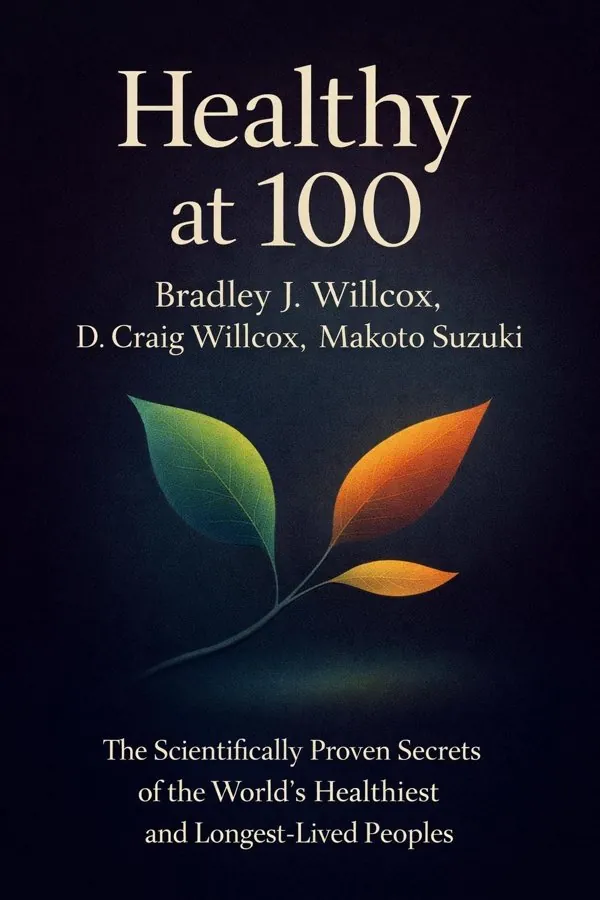
Healthy at 100: The Scientifically Proven Secrets of the World's Healthiest and Longest-Lived Peoples: Summary & Key Insights
by Bradley J. Willcox, D. Craig Willcox, Makoto Suzuki
 10 min5 chaptersAudio available
What Is Healthy at 100: The Scientifically Proven Secrets of the World's Healthiest and Longest-Lived Peoples About?
Healthy at 100: The Scientifically Proven Secrets of the World's Healthiest and Longest-Lived Peoples by Bradley J. Willcox, D. Craig Willcox, Makoto Suzuki is a health_med book spanning 5 pages. Healthy at 100 explores the lifestyles, diets, and social habits of the world’s longest-living populations, including Okinawans, Sardinians, and Adventists. Drawing on decades of research, the authors reveal how these communities achieve remarkable longevity and vitality through balanced nutrition, strong social ties, and purposeful living. The book offers practical guidance for readers seeking to extend their own healthspan and live with greater energy and fulfillment.
This FizzRead summary covers all 5 key chapters of Healthy at 100: The Scientifically Proven Secrets of the World's Healthiest and Longest-Lived Peoples in approximately 10 minutes, distilling the most important ideas, arguments, and takeaways from Bradley J. Willcox, D. Craig Willcox, Makoto Suzuki's work. Also available as an audio summary and Key Quotes Podcast.
Healthy at 100: The Scientifically Proven Secrets of the World's Healthiest and Longest-Lived Peoples
Healthy at 100 explores the lifestyles, diets, and social habits of the world’s longest-living populations, including Okinawans, Sardinians, and Adventists. Drawing on decades of research, the authors reveal how these communities achieve remarkable longevity and vitality through balanced nutrition, strong social ties, and purposeful living. The book offers practical guidance for readers seeking to extend their own healthspan and live with greater energy and fulfillment.
Who Should Read Healthy at 100: The Scientifically Proven Secrets of the World's Healthiest and Longest-Lived Peoples?
This book is perfect for anyone interested in health_med and looking to gain actionable insights in a short read. Whether you're a student, professional, or lifelong learner, the key ideas from Healthy at 100: The Scientifically Proven Secrets of the World's Healthiest and Longest-Lived Peoples by Bradley J. Willcox, D. Craig Willcox, Makoto Suzuki will help you think differently.
- ✓Readers who enjoy health_med and want practical takeaways
- ✓Professionals looking to apply new ideas to their work and life
- ✓Anyone who wants the core insights of Healthy at 100: The Scientifically Proven Secrets of the World's Healthiest and Longest-Lived Peoples in just 10 minutes
Want the full summary?
Get instant access to this book summary and 100K+ more with Fizz Moment.
Get Free SummaryAvailable on App Store • Free to download
Key Chapters
When we first began studying Okinawa, the world knew little about this cluster of islands far south of Japan. Today, Okinawa is synonymous with longevity, thanks to the meticulous demographic and medical research that forms the backbone of this book. Over several decades, we examined hundreds of centenarians, documenting what they ate, how they moved, what social structures sustained them, and even how they thought about their own lives. We discovered patterns that revolutionized how science understands aging.
At the center of the Okinawan lifestyle is the concept of *ikigai*, a Japanese word loosely translating as 'reason for being.' It represents a sense of purpose that continues long after traditional retirement. For these elders, purpose could mean nurturing grandchildren, tending vegetables, or serving as village historians. Their days are structured, meaningful, and inherently connected to community. This spiritual and emotional health underlies their physical resilience. Stress hormones are markedly lower among Okinawan elders compared with similar-aged populations elsewhere, a difference linked to both social integration and attitude toward aging itself.
Their diets demonstrate remarkable consistency: abundant vegetables, legumes—particularly soy—and a modest serving of fish or other animal protein. Energy intake is moderate; the cultural principle *hara hachi bu*—eat until you are eighty percent full—is a lifelong habit. Such caloric restraint coupled with nutrient density supports steady metabolism, low incidence of obesity, and extraordinary cardiovascular health. Blood pressure and cholesterol levels remain balanced well into old age, largely because whole foods are preferred over processed substitutes.
Physical movement flows naturally from daily life rather than imposed exercise regimens. Gardening, slow walking, and occasional manual tasks maintain strength and flexibility. One striking finding was bone density preservation even among women in their nineties—an outcome tied to lifelong outdoor activity and calcium-rich vegetable diets.
Behind these patterns stands the social architecture of Okinawa’s *moai*, or lifelong friendship circles. Each person belongs to a group offering emotional and material support. These networks create safety nets that prevent isolation, the silent killer of modern aging. Within such circles, problems are shared and resolved collectively, fostering mental peace. The Okinawan lesson, therefore, transcends diet and exercise—it teaches us how embedded companionship and purpose weave immunity against both physical and psychological decay.
Sardinia, an island off Italy’s coast, presents a contrasting yet harmoniously parallel portrait of healthy longevity. Unlike the subtropical climate of Okinawa, Sardinia’s terrain is mountainous, and its history is steeped in pastoral traditions. Our research revealed that in certain mountain villages, male centenarians are unusually prevalent—a rarity in global demographic patterns. The secret lies in how Sardinians have integrated hard work, simple food, and family ties into the rhythm of living.
Daily life here remains physically demanding. Shepherds traverse hills, maintaining cardiovascular fitness naturally through labor. Diet centers on the Mediterranean staples: whole grains, garden vegetables, olive oil, and modest amounts of goat milk or cheese. The balance of macronutrients reflects timeless wisdom—healthy fats instead of saturated ones, modest wine consumption within meals, and a reverence for home-cooked simplicity.
However, Sardinian longevity owes as much to emotional durability as to physical vitality. Their families are cohesive; generations dwell close together, often within walking distance. Elders maintain authority and respect, seeing their experience valued rather than dismissed. This dynamic produces a profound sense of belonging that nourishes mental health. Loneliness, the epidemic of Western aging, remains virtually absent.
Through comparative analysis of Sardinia and Okinawa, we found consistent markers of health: low chronic disease rates, strong social structures, continuous physical engagement, and diets rich in plant-based variety. The Sardinian pattern further illuminated the protective roles of light wine phenols, moderate caloric intake, and daily purposeful activity. These people do not exercise out of obligation—they live in motion because life demands it, and because community depends upon their contribution.
In observing Sardinian centenarians, I was struck by their optimism. Even in advanced age, they approach each sunrise with a kind of reverent pride—the simple joy derived from tending sheep or sharing stories at village gatherings. Purpose once again emerges as the defining thread connecting all longevity cultures. It is the psychological nutrient underlying biological youth.
+ 3 more chapters — available in the FizzRead app
All Chapters in Healthy at 100: The Scientifically Proven Secrets of the World's Healthiest and Longest-Lived Peoples
About the Authors
Bradley J. Willcox, M.D., is a physician and gerontologist affiliated with the University of Hawaii and the Okinawa Centenarian Study. D. Craig Willcox, Ph.D., is a medical anthropologist and co-investigator of the same study. Makoto Suzuki, M.D., is a Japanese cardiologist and the founder of the Okinawa Centenarian Study, recognized internationally for his pioneering research on aging and longevity.
Get This Summary in Your Preferred Format
Read or listen to the Healthy at 100: The Scientifically Proven Secrets of the World's Healthiest and Longest-Lived Peoples summary by Bradley J. Willcox, D. Craig Willcox, Makoto Suzuki anytime, anywhere. FizzRead offers multiple formats so you can learn on your terms — all free.
Available formats: App · Audio · PDF · EPUB — All included free with FizzRead
Download Healthy at 100: The Scientifically Proven Secrets of the World's Healthiest and Longest-Lived Peoples PDF and EPUB Summary
Key Quotes from Healthy at 100: The Scientifically Proven Secrets of the World's Healthiest and Longest-Lived Peoples
“When we first began studying Okinawa, the world knew little about this cluster of islands far south of Japan.”
“Sardinia, an island off Italy’s coast, presents a contrasting yet harmoniously parallel portrait of healthy longevity.”
Frequently Asked Questions about Healthy at 100: The Scientifically Proven Secrets of the World's Healthiest and Longest-Lived Peoples
Healthy at 100: The Scientifically Proven Secrets of the World's Healthiest and Longest-Lived Peoples by Bradley J. Willcox, D. Craig Willcox, Makoto Suzuki is a health_med book that explores key ideas across 5 chapters. Healthy at 100 explores the lifestyles, diets, and social habits of the world’s longest-living populations, including Okinawans, Sardinians, and Adventists. Drawing on decades of research, the authors reveal how these communities achieve remarkable longevity and vitality through balanced nutrition, strong social ties, and purposeful living. The book offers practical guidance for readers seeking to extend their own healthspan and live with greater energy and fulfillment.
More by Bradley J. Willcox, D. Craig Willcox, Makoto Suzuki

The Okinawa Diet Plan: Get Leaner, Live Longer, and Never Feel Hungry
Bradley J. Willcox, D. Craig Willcox, Makoto Suzuki
10 min
The Okinawa Program: How the World's Longest-Lived People Achieve Everlasting Health—And How You Can Too
Bradley J. Willcox, D. Craig Willcox, Makoto Suzuki
10 minYou Might Also Like

On Immunity
Eula Biss
10 min
The Three-Body Problem
Liu Cixin
10 min
Community Health Volunteer Toolkit: Training and Practical Activities
World Health Organization
10 min
Healing Back Pain: The Mind-Body Connection
John E. Sarno
10 min
Health Literacy for All: Practical Guides to Communicate Health Information (Compilations)
World Health Organization
10 min
The Complete Guide to Sports Supplements: An Evidence-Based Review
Anita Bean
10 minBrowse by Category
Ready to read Healthy at 100: The Scientifically Proven Secrets of the World's Healthiest and Longest-Lived Peoples?
Get the full summary and 100K+ more books with Fizz Moment.