
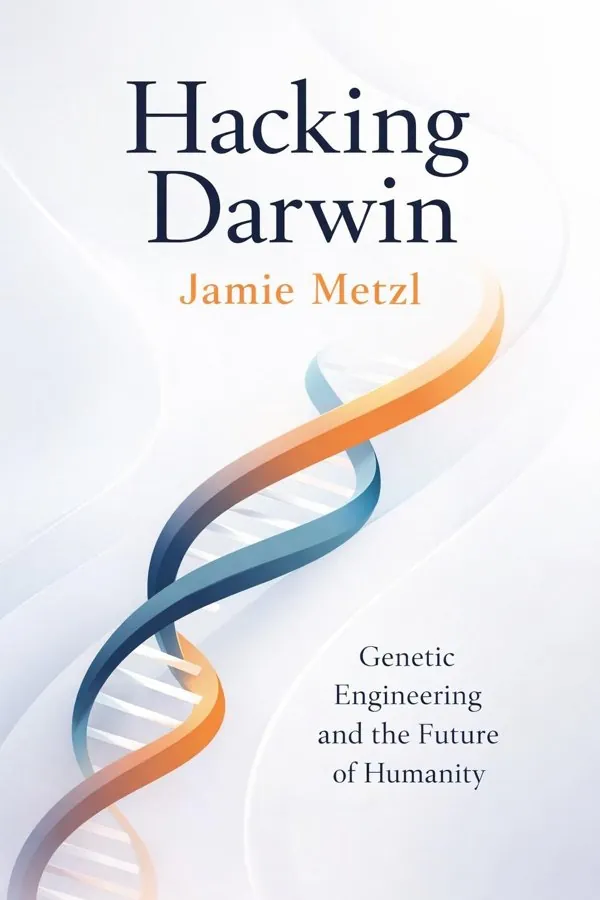
Hacking Darwin: Genetic Engineering and the Future of Humanity: Summary & Key Insights
by Jamie Metzl
 10 min4 chaptersAudio available
What Is Hacking Darwin: Genetic Engineering and the Future of Humanity About?
Hacking Darwin: Genetic Engineering and the Future of Humanity by Jamie Metzl is a future_trends book spanning 4 pages. Hacking Darwin explores how advances in genetic engineering are transforming the future of human evolution. Jamie Metzl examines the scientific, ethical, and societal implications of technologies such as CRISPR and gene editing, arguing that humanity is entering a new era where we can actively shape our genetic destiny. The book discusses potential benefits, risks, and moral dilemmas associated with designing future generations.
This FizzRead summary covers all 4 key chapters of Hacking Darwin: Genetic Engineering and the Future of Humanity in approximately 10 minutes, distilling the most important ideas, arguments, and takeaways from Jamie Metzl's work. Also available as an audio summary and Key Quotes Podcast.
Hacking Darwin: Genetic Engineering and the Future of Humanity
Hacking Darwin explores how advances in genetic engineering are transforming the future of human evolution. Jamie Metzl examines the scientific, ethical, and societal implications of technologies such as CRISPR and gene editing, arguing that humanity is entering a new era where we can actively shape our genetic destiny. The book discusses potential benefits, risks, and moral dilemmas associated with designing future generations.
Who Should Read Hacking Darwin: Genetic Engineering and the Future of Humanity?
This book is perfect for anyone interested in future_trends and looking to gain actionable insights in a short read. Whether you're a student, professional, or lifelong learner, the key ideas from Hacking Darwin: Genetic Engineering and the Future of Humanity by Jamie Metzl will help you think differently.
- ✓Readers who enjoy future_trends and want practical takeaways
- ✓Professionals looking to apply new ideas to their work and life
- ✓Anyone who wants the core insights of Hacking Darwin: Genetic Engineering and the Future of Humanity in just 10 minutes
Want the full summary?
Get instant access to this book summary and 100K+ more with Fizz Moment.
Get Free SummaryAvailable on App Store • Free to download
Key Chapters
To grasp this revolution, we must begin with the essence of life’s architecture—DNA. In our cells lies a spiral-shaped molecule that records four billion years of evolutionary trial and error. The sequence of those letters—A, T, C, and G—constitutes the operating system of life. When I explain this to readers, it is never to overwhelm but to remind us how simple building blocks generate infinite complexity.
For centuries, we could observe traits but not understand their origins. Gregor Mendel’s experiments with pea plants revealed that heredity follows patterns, but the molecular mechanisms remained a mystery until scientists like Watson and Crick uncovered the double helix structure in 1953. That moment gave birth to modern genetics. Yet even as we unraveled the structure of DNA, we lacked the instruments to manipulate it precisely.
The story transformed again when genome sequencing become affordable. Once the entire human genome was mapped in 2003, the next logical step was learning how to edit it. Technologies such as zinc finger nucleases and TALENs paved the way, but it was CRISPR—adapted from a bacterial defense system—that democratized gene editing. CRISPR gave scientists a molecular scalpel, allowing precise cutting and replacement of genetic code.
In practice, this means we can locate a faulty gene responsible for a disease, like cystic fibrosis or Huntington’s, and correct it. But more than that, CRISPR lets us imagine redesigning genes to enhance resistance to aging, intelligence, or strength. It is as if we have discovered how to rewrite the manual of life itself.
Still, each advance carries philosophical gravity. Understanding genetic science requires recognizing the humility embedded in it—we are learning to modify mechanisms forged by millions of years of evolution. That responsibility must temper our enthusiasm. To hack Darwin responsibly, we must marry scientific ambition with deep ethical reflection, because every edit touches the narrative of our species.
Medicine is already being reshaped by genetics in profound ways. When I examine the shifting landscape of healthcare in this book, I see a pattern: a move from reactive medicine to predictive and preventive systems. Genetic sequencing allows physicians to anticipate illnesses before symptoms manifest. Imagine a child born with predispositions mapped from their genome, enabling interventions before disease ever strikes.
We are entering an era of personalized medicine, where treatments correspond precisely to an individual’s molecular profile. Cancer therapies increasingly rely on targeting genetic mutations rather than tumor location. In the near future, your annual checkup may center on monitoring how your genes interact with lifestyle and environment, rather than measuring static indicators like blood pressure.
But this revolution extends beyond healing—it reaches into reproduction. Techniques like in vitro fertilization (IVF) already allow genetic screening of embryos. Add CRISPR or similar technologies, and the possibility arises not merely to select but to modify embryos. That prospect unsettles many because the implications are staggering. Imagine a parent choosing an embryo based on health, intelligence, or even temperament. The very notion of human enhancement challenges our concept of equality.
In my writing, I urge readers not to see this as science fiction but impending reality. The first steps have already begun with prevention of heritable diseases. Yet once the power exists, the desire to go beyond disease elimination will inevitably follow. History teaches that when humanity gains a tool of power, restraint rarely lasts without structured norms.
Therefore, I argue for global conversation about what lines should be drawn. Reproductive genetics could transform social structures, economies, and philosophical beliefs about fate and merit. The decisions of a few laboratories could ripple through generations, shaping not only bodies but society itself. Medicine once healed; soon, it may also design.
+ 2 more chapters — available in the FizzRead app
All Chapters in Hacking Darwin: Genetic Engineering and the Future of Humanity
About the Author
Jamie Metzl is an American technology futurist, geopolitical expert, and author. He has served on the U.S. National Security Council and the State Department, and is known for his work on the intersection of biotechnology and global policy. Metzl frequently writes and speaks about the future of genetics, artificial intelligence, and human evolution.
Get This Summary in Your Preferred Format
Read or listen to the Hacking Darwin: Genetic Engineering and the Future of Humanity summary by Jamie Metzl anytime, anywhere. FizzRead offers multiple formats so you can learn on your terms — all free.
Available formats: App · Audio · PDF · EPUB — All included free with FizzRead
Download Hacking Darwin: Genetic Engineering and the Future of Humanity PDF and EPUB Summary
Key Quotes from Hacking Darwin: Genetic Engineering and the Future of Humanity
“To grasp this revolution, we must begin with the essence of life’s architecture—DNA.”
“Medicine is already being reshaped by genetics in profound ways.”
Frequently Asked Questions about Hacking Darwin: Genetic Engineering and the Future of Humanity
Hacking Darwin: Genetic Engineering and the Future of Humanity by Jamie Metzl is a future_trends book that explores key ideas across 4 chapters. Hacking Darwin explores how advances in genetic engineering are transforming the future of human evolution. Jamie Metzl examines the scientific, ethical, and societal implications of technologies such as CRISPR and gene editing, arguing that humanity is entering a new era where we can actively shape our genetic destiny. The book discusses potential benefits, risks, and moral dilemmas associated with designing future generations.
You Might Also Like
Futureproof: 9 Rules for Humans in the Age of Automation
Kevin Roose
10 min
The Third Wave
Alvin Toffler
10 min
2030: How Today's Biggest Trends Will Collide and Reshape the Future of Everything
Mauro F. Guillén
10 min
A Very Human Future: Enriching Humanity in a Digitized World
Rohit Talwar, Steve Wells, Alexandra Whittington
10 min
AI 2041: Ten Visions for Our Future
Kai-Fu Lee, Chen Qiufan
10 min
Abundance: The Future Is Better Than You Think
Peter H. Diamandis, Steven Kotler
10 minBrowse by Category
Ready to read Hacking Darwin: Genetic Engineering and the Future of Humanity?
Get the full summary and 100K+ more books with Fizz Moment.