
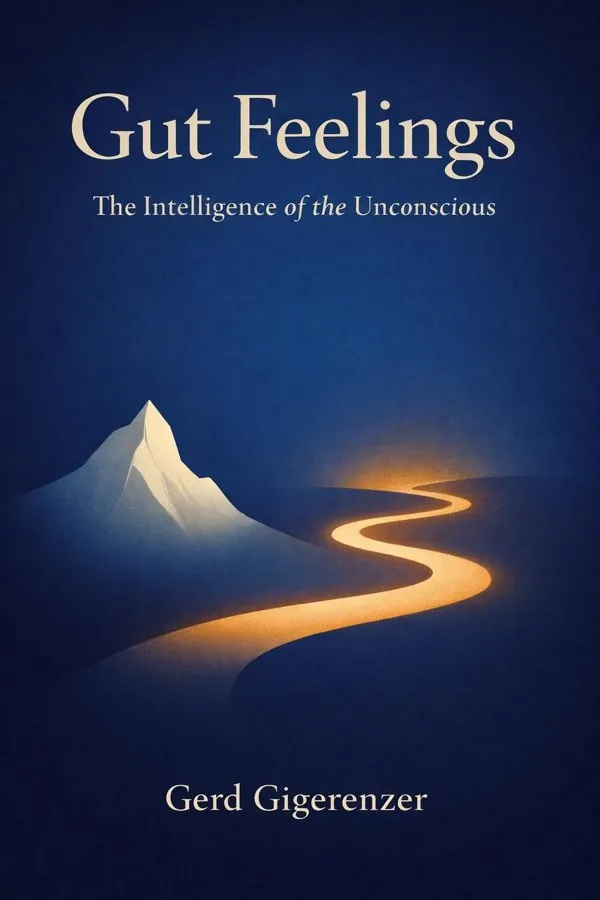
Gut Feelings: The Intelligence of the Unconscious: Summary & Key Insights
 10 min7 chaptersAudio available
What Is Gut Feelings: The Intelligence of the Unconscious About?
Gut Feelings: The Intelligence of the Unconscious by Gerd Gigerenzer is a cognition book spanning 7 pages. In 'Gut Feelings: The Intelligence of the Unconscious', psychologist Gerd Gigerenzer explores how intuition and instinct play a crucial role in human decision-making. Drawing on research in psychology, neuroscience, and behavioral economics, he argues that our unconscious mind often makes better and faster decisions than deliberate reasoning, especially in complex or uncertain situations. The book challenges the notion that rational analysis is always superior, showing how 'gut feelings' are adaptive tools shaped by evolution.
This FizzRead summary covers all 7 key chapters of Gut Feelings: The Intelligence of the Unconscious in approximately 10 minutes, distilling the most important ideas, arguments, and takeaways from Gerd Gigerenzer's work. Also available as an audio summary and Key Quotes Podcast.
Gut Feelings: The Intelligence of the Unconscious
In 'Gut Feelings: The Intelligence of the Unconscious', psychologist Gerd Gigerenzer explores how intuition and instinct play a crucial role in human decision-making. Drawing on research in psychology, neuroscience, and behavioral economics, he argues that our unconscious mind often makes better and faster decisions than deliberate reasoning, especially in complex or uncertain situations. The book challenges the notion that rational analysis is always superior, showing how 'gut feelings' are adaptive tools shaped by evolution.
Who Should Read Gut Feelings: The Intelligence of the Unconscious?
This book is perfect for anyone interested in cognition and looking to gain actionable insights in a short read. Whether you're a student, professional, or lifelong learner, the key ideas from Gut Feelings: The Intelligence of the Unconscious by Gerd Gigerenzer will help you think differently.
- ✓Readers who enjoy cognition and want practical takeaways
- ✓Professionals looking to apply new ideas to their work and life
- ✓Anyone who wants the core insights of Gut Feelings: The Intelligence of the Unconscious in just 10 minutes
Want the full summary?
Get instant access to this book summary and 100K+ more with Fizz Moment.
Get Free SummaryAvailable on App Store • Free to download
Key Chapters
Gut feelings are not random sparks of emotion; they are condensed expressions of experience and evolution. Over the course of human history, our brains have developed shortcuts for making fast and frugal decisions in uncertain environments. I call these shortcuts heuristics—simple rules that ignore most information but focus on what truly matters. Unlike algorithms that strive for exhaustive precision, heuristics reflect the way nature designed us to operate: efficiently, adaptively, and often unconsciously.
Gut feelings emerge from accumulated experience that becomes internalized through repeated exposure and feedback. A seasoned physician who instantly recognizes a subtle symptom or a tennis player who anticipates an opponent’s move does not consciously compute probabilities; they act on their embodied memory—the intelligence stored within their nervous system. Neuroscience supports this view, showing that much of our perceptual and emotional processing occurs automatically, guided by pattern recognition deeply rooted in past interactions.
From an evolutionary standpoint, the ability to act swiftly in uncertain situations was critical for survival. Our ancestors couldn’t afford to run regression analyses when facing predators or making social judgments. Intuition has therefore evolved as a tool for rapid uncertainty reduction. It enables us to make adaptive decisions that balance accuracy with speed. The gut feeling is not mystical, but a biologically efficient strategy: the unconscious mind distills vast experience into manageable insights without our conscious awareness.
Thus, gut feelings represent the intelligence of the unconscious in action—a system that continuously evaluates incoming information, aligns it with prior patterns, and outputs a decision before deliberative reasoning can intervene. Recognizing this process allows us to embrace intuition not as a flaw in rationality, but as its natural complement.
Traditional economics and psychology long assumed that rationality meant maximizing outcomes through complete information and unlimited cognitive capacity. But real humans operate under boundaries—limited time, knowledge, and computational power. My concept of bounded rationality acknowledges these constraints as defining features of human cognition, not defects. Within these bounds, people use heuristics that exploit environmental regularities to produce remarkably effective results.
When making decisions, we often encounter uncertainty far greater than our analytic models can handle. Take medical diagnosis, investment choices, or even choosing a spouse; we cannot calculate every possible outcome. Rather than failing under these conditions, humans excel by relying on adaptive rules that focus only on essential cues. For instance, when experts choose between similar alternatives, they frequently apply recognition heuristics—favoring what feels familiar because, in natural environments, familiarity often correlates with quality or relevance.
Bounded rationality thus defines the real architecture of the mind. It allows us to perform well despite complexity, precisely because we do not attempt to process everything. In this framework, intuition emerges as an expression of bounded rationality—a way to navigate uncertainty through selective attention and experiential learning. The unconscious does not violate reason; it redefines it under real-world conditions.
My research and experiments show that people using simple heuristics frequently outperform sophisticated models, not because the heuristics are perfect but because the environment rewards efficiency. Rationality is context-sensitive: our decisions are smart not in mathematical terms but in ecological ones. Understanding this principle liberates us from the unrealistic ideal of complete rationality and opens the door to appreciating true human intelligence—the kind rooted in adaptation, not optimization.
+ 5 more chapters — available in the FizzRead app
All Chapters in Gut Feelings: The Intelligence of the Unconscious
About the Author
Gerd Gigerenzer is a German psychologist and director of the Harding Center for Risk Literacy at the Max Planck Institute for Human Development in Berlin. He is known for his research on bounded rationality, heuristics, and decision-making under uncertainty. His work bridges psychology, economics, and public policy, emphasizing how people can make better decisions in everyday life.
Get This Summary in Your Preferred Format
Read or listen to the Gut Feelings: The Intelligence of the Unconscious summary by Gerd Gigerenzer anytime, anywhere. FizzRead offers multiple formats so you can learn on your terms — all free.
Available formats: App · Audio · PDF · EPUB — All included free with FizzRead
Download Gut Feelings: The Intelligence of the Unconscious PDF and EPUB Summary
Key Quotes from Gut Feelings: The Intelligence of the Unconscious
“Gut feelings are not random sparks of emotion; they are condensed expressions of experience and evolution.”
“Traditional economics and psychology long assumed that rationality meant maximizing outcomes through complete information and unlimited cognitive capacity.”
Frequently Asked Questions about Gut Feelings: The Intelligence of the Unconscious
Gut Feelings: The Intelligence of the Unconscious by Gerd Gigerenzer is a cognition book that explores key ideas across 7 chapters. In 'Gut Feelings: The Intelligence of the Unconscious', psychologist Gerd Gigerenzer explores how intuition and instinct play a crucial role in human decision-making. Drawing on research in psychology, neuroscience, and behavioral economics, he argues that our unconscious mind often makes better and faster decisions than deliberate reasoning, especially in complex or uncertain situations. The book challenges the notion that rational analysis is always superior, showing how 'gut feelings' are adaptive tools shaped by evolution.
More by Gerd Gigerenzer
You Might Also Like
A Field Guide to Lies: Critical Thinking in the Information Age
Daniel J. Levitin
10 min
A Theory of Cognitive Dissonance
Leon Festinger
10 min
Black-And-White Thinking: The Burden of a Binary Brain in a Complex World
Kevin Dutton
10 min
Born Liars: Why We Can’t Live Without Deceit
Ian Leslie
10 min
Collective Illusions: Conformity, Complicity, and the Science of Why We Make Bad Decisions
Todd Rose
10 min
Concrete Mathematics: A Foundation for Computer Science
Ronald L. Graham, Donald E. Knuth, Oren Patashnik
10 minBrowse by Category
Ready to read Gut Feelings: The Intelligence of the Unconscious?
Get the full summary and 100K+ more books with Fizz Moment.