
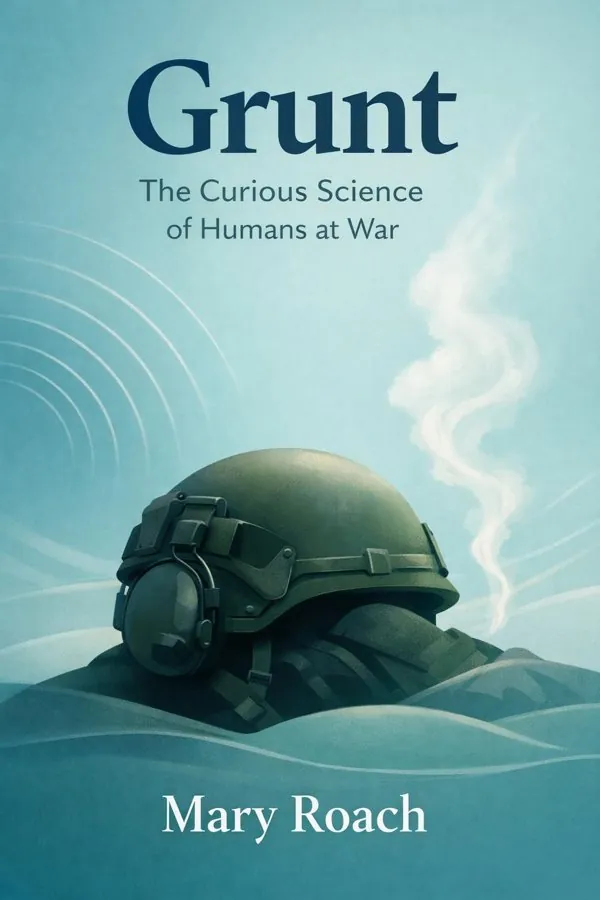
Grunt: The Curious Science of Humans at War: Summary & Key Insights
by Mary Roach
 10 min10 chaptersAudio available
Key Takeaways from Grunt: The Curious Science of Humans at War
The most advanced military in the world still depends on lungs that need oxygen, skin that burns, ears that rupture, and minds that tire.
A uniform may look simple, but in Grunt it emerges as a wearable survival system.
If war injures the body in brutal ways, medicine must respond with equal realism.
An army does not run simply on courage; it runs on calories, hydration, digestion, and morale.
Few things seem more incompatible with war than sleep, yet Roach makes clear that rest is one of the military’s most important operational assets.
What Is Grunt: The Curious Science of Humans at War About?
Grunt: The Curious Science of Humans at War by Mary Roach is a popular_sci book spanning 10 pages. War is often described in terms of strategy, weaponry, and geopolitics, but Mary Roach shifts the lens to something more intimate and more revealing: the vulnerable human body. In Grunt: The Curious Science of Humans at War, she investigates the hidden science the U.S. military uses to keep soldiers functioning in places that are hot, loud, exhausting, unsanitary, terrifying, and deeply unnatural. Rather than focusing on battlefield heroics, Roach explores sweat, sleep, digestion, hearing, infection, trauma care, and even the problem of unpleasant smells in confined military spaces. The result is a strange, funny, and surprisingly moving portrait of modern war seen through biology, engineering, and medicine. Roach is uniquely qualified to tell this story. Known for turning unusual scientific subjects into engaging narratives, she combines sharp reporting, curiosity, and humor with serious respect for researchers and service members. Her authority comes not from military experience but from immersion: she visits labs, field sites, trauma centers, and training grounds, asking the practical questions others overlook. Grunt matters because it reminds us that military power ultimately depends on ordinary human bodies pushed to extraordinary limits.
This FizzRead summary covers all 10 key chapters of Grunt: The Curious Science of Humans at War in approximately 10 minutes, distilling the most important ideas, arguments, and takeaways from Mary Roach's work. Also available as an audio summary and Key Quotes Podcast.
Grunt: The Curious Science of Humans at War
War is often described in terms of strategy, weaponry, and geopolitics, but Mary Roach shifts the lens to something more intimate and more revealing: the vulnerable human body. In Grunt: The Curious Science of Humans at War, she investigates the hidden science the U.S. military uses to keep soldiers functioning in places that are hot, loud, exhausting, unsanitary, terrifying, and deeply unnatural. Rather than focusing on battlefield heroics, Roach explores sweat, sleep, digestion, hearing, infection, trauma care, and even the problem of unpleasant smells in confined military spaces. The result is a strange, funny, and surprisingly moving portrait of modern war seen through biology, engineering, and medicine.
Roach is uniquely qualified to tell this story. Known for turning unusual scientific subjects into engaging narratives, she combines sharp reporting, curiosity, and humor with serious respect for researchers and service members. Her authority comes not from military experience but from immersion: she visits labs, field sites, trauma centers, and training grounds, asking the practical questions others overlook. Grunt matters because it reminds us that military power ultimately depends on ordinary human bodies pushed to extraordinary limits.
Who Should Read Grunt: The Curious Science of Humans at War?
This book is perfect for anyone interested in popular_sci and looking to gain actionable insights in a short read. Whether you're a student, professional, or lifelong learner, the key ideas from Grunt: The Curious Science of Humans at War by Mary Roach will help you think differently.
- ✓Readers who enjoy popular_sci and want practical takeaways
- ✓Professionals looking to apply new ideas to their work and life
- ✓Anyone who wants the core insights of Grunt: The Curious Science of Humans at War in just 10 minutes
Want the full summary?
Get instant access to this book summary and 100K+ more with Fizz Moment.
Get Free SummaryAvailable on App Store • Free to download
Key Chapters
The most advanced military in the world still depends on lungs that need oxygen, skin that burns, ears that rupture, and minds that tire. One of Mary Roach’s central insights is that war is not just a contest of firepower but a constant struggle against the body’s limits. Behind every weapon system, mission plan, and training doctrine lies a practical question: how do you keep a human being functional in conditions the human organism was never designed to endure?
Roach shows that the military has long understood this reality. Heat stress, dehydration, digestive illness, blast exposure, sleep deprivation, and panic can disable soldiers just as effectively as enemy action. The battlefield is therefore also a laboratory where physiologists, engineers, and medical researchers try to reduce breakdowns in performance. What sounds like a niche concern is actually foundational. If a soldier cannot hear commands, carry weight, stay alert, avoid infection, or think clearly under stress, no amount of sophisticated equipment can compensate.
This idea changes how we think about warfare. It shifts attention from machines to maintenance, from heroism to survivability. It also reveals why military research often focuses on seemingly mundane details: socks, food packaging, toilet waste, portable cooling systems, and helmet padding. These details are not trivial. They determine whether people can keep moving, deciding, and recovering.
In everyday life, the lesson extends beyond combat. Performance in any high-stress environment depends less on willpower than on designing systems that respect human limitations. Whether in medicine, sports, emergency response, or leadership, ignoring physiology invites failure.
Actionable takeaway: When evaluating performance under pressure, start by asking what the human body and brain need to stay functional, then design around those limits rather than pretending toughness can erase them.
A uniform may look simple, but in Grunt it emerges as a wearable survival system. Roach explores how military clothing and armor are shaped by a difficult tradeoff: the more protection you add, the more weight, heat, stiffness, and fatigue you create. A vest that stops shrapnel may also trap body heat. Flame-resistant fabric may save skin while reducing comfort. Boots, helmets, eye protection, and layered garments all become part of a delicate balancing act between survivability and mobility.
The science here is deeply multidisciplinary. Textile specialists study how fabrics breathe, wick moisture, resist fire, and tolerate harsh environmental exposure. Engineers test armor against bullets and fragments. Human-factors experts examine what soldiers can realistically wear for hours while carrying heavy gear. Roach’s reporting makes clear that “better protection” is not a simple engineering goal. Protection that exhausts the wearer, restricts movement, or impairs awareness may create a different kind of danger.
She also highlights the military’s use of dummies, sensors, heat chambers, and field testing to simulate the conditions soldiers face. This reflects a broader truth: good equipment must be evaluated not only in ideal lab settings but in sweat, mud, dust, and chaos. In practical terms, the best design is often not the strongest or most advanced, but the one people can actually tolerate and use effectively.
For civilians, this principle appears everywhere from workplace safety gear to sports equipment. The helmet you refuse to wear or the protective suit that causes heat stress may undermine the safety it was meant to provide.
Actionable takeaway: Judge protective gear by total performance, not maximum protection alone. The best system is one that people can wear, move in, and rely on consistently under real-world conditions.
If war injures the body in brutal ways, medicine must respond with equal realism. Roach’s exploration of wound ballistics and battlefield medicine shows that lifesaving progress often begins with uncomfortable questions: What exactly does a blast wave do to tissue? How does shrapnel travel through muscle? Why do some injuries kill quickly while others can be stabilized long enough for evacuation?
Rather than treating injury as an abstraction, the book examines the military’s efforts to understand trauma in granular detail. Researchers study how bullets deform, how explosives distribute force, and how organs respond to pressure. Surgeons and trauma teams analyze patterns in battlefield wounds to improve treatment protocols. This work has helped shape advances in hemorrhage control, tourniquet use, body armor design, burn treatment, and rapid evacuation systems.
One of the most important insights is that timing matters as much as technology. The difference between life and death may hinge on a medic’s immediate intervention, a better clotting agent, or a shorter transport window to surgery. The military’s intense focus on trauma has often produced innovations later used in civilian emergency medicine, especially in treating severe bleeding and blast-related injuries.
Roach handles this material with her trademark balance of candor and restraint. She never lets the science become detached from the human stakes. Injury research can seem cold from the outside, but its purpose is profoundly humane: to reduce suffering in circumstances where suffering is unavoidable.
Actionable takeaway: In any crisis system, prioritize fast, evidence-based intervention. Detailed study of failure and injury is uncomfortable, but it is often the price of saving lives.
An army does not run simply on courage; it runs on calories, hydration, digestion, and morale. Roach shows that military nutrition is far more than feeding large numbers of people cheaply. Combat rations must solve a dense cluster of problems at once: they need to be shelf-stable, portable, compact, safe, energy-rich, and acceptable enough that tired people will actually eat them.
This is harder than it sounds. In harsh environments, appetite changes. Heat can suppress hunger. Stress can upset digestion. Repetitive meals destroy morale. Packaging must survive transport and rough handling while staying easy to open in miserable conditions. Researchers therefore spend serious time on flavor, texture, nutrient balance, and even the psychology of food choice. The meal is not just fuel; it is also comfort, routine, and motivation.
Roach’s treatment of military feeding reveals how operational effectiveness depends on small biological truths. A dehydrated, underfed soldier becomes slower, more error-prone, and less emotionally stable. In contrast, well-designed rations support cognitive performance and endurance. Even something as mundane as a caffeinated snack or better heating method can improve alertness and morale during prolonged missions.
This idea has broad application. High performers in any domain often obsess over major goals while neglecting basic fueling. Yet sustained concentration, emotional regulation, and physical resilience are tightly linked to what and when we eat.
Actionable takeaway: Treat nutrition as performance infrastructure, not an afterthought. If your work demands endurance and clear thinking, plan food and hydration with the same seriousness you give tools, schedules, and strategy.
Few things seem more incompatible with war than sleep, yet Roach makes clear that rest is one of the military’s most important operational assets. A sleep-deprived soldier may still look capable, but judgment, reaction time, memory, and emotional control all begin to erode. In combat or high-risk operations, those invisible declines can be catastrophic.
The book explores how military researchers study fatigue, circadian rhythms, stimulants, naps, and scheduling strategies to preserve cognitive function. Sleep loss is not simply discomfort. It produces measurable deficits in attention, decision-making, and threat assessment. People become slower, less accurate, and more vulnerable to impulsive mistakes. In other words, exhaustion is a readiness problem, not merely a wellness issue.
Roach also underscores an important tension: military culture often admires toughness and endurance, which can make sleep seem like a luxury or a sign of softness. Science says otherwise. Rested personnel are not less committed; they are more effective. This insight parallels what many high-performance professions are learning the hard way: heroic overwork may feel admirable, but it often degrades the very abilities it is meant to prove.
The practical applications are immediate. Better shift design, strategic naps, light exposure management, and realistic workload planning can improve performance more reliably than sheer discipline. Even when perfect sleep is impossible, acknowledging fatigue allows institutions to reduce preventable errors.
Actionable takeaway: Stop treating sleep as expendable. If sound decisions matter, build rest into the system before fatigue quietly starts making choices for you.
Some of war’s most powerful forces are not visible. Roach investigates how sound and smell affect military life in ways that are practical, psychological, and deeply physical. Deafening noise from aircraft, artillery, gunfire, and machinery can damage hearing permanently, impair communication, and increase stress. Offensive odors in submarines, vehicles, medical settings, and field environments can lower morale, trigger nausea, and complicate already difficult working conditions.
These may seem like secondary issues until you consider their effects on functioning. Hearing loss makes coordination harder and situational awareness weaker. Chronic noise contributes to fatigue and irritability. Smell can influence appetite, stress, memory, and perceived cleanliness. In cramped or dangerous environments, sensory strain becomes part of the operational burden.
Roach’s genius is to take these odd-seeming topics seriously without draining them of their absurdity. She shows how military scientists work on hearing protection that preserves communication, odor control in enclosed spaces, and methods for reducing sensory overload. The implication is larger than the examples. Human beings do not perform in a vacuum; we perform through our senses. When the sensory environment is hostile, performance deteriorates.
This lesson applies well beyond the military. In hospitals, factories, open offices, classrooms, and transportation systems, poorly managed noise and unpleasant environmental conditions reduce accuracy, patience, and well-being. Leaders often focus on incentives and training while ignoring sensory design.
Actionable takeaway: Improve performance by improving the environment. Reduce unnecessary noise, protect hearing, and pay attention to sensory stressors that quietly drain concentration, morale, and coordination.
Military institutions are built for discipline and mission focus, but the people inside them remain social, sexual, emotionally attached human beings. Roach addresses sex, intimacy, and gender integration with a mix of humor and seriousness, showing that these issues are not side topics but practical realities of military life. Desire, relationships, privacy, pregnancy, harassment, and interpersonal tension all affect morale, cohesion, and policy.
A key insight is that institutions often wish inconvenient human realities would disappear rather than designing systems that account for them. But long deployments, close quarters, and mixed-gender environments make this impossible. Ignoring intimacy does not eliminate it; it merely drives it underground, where risks become harder to manage. Policies around conduct, health, accommodation, and fairness therefore matter not only ethically but operationally.
Roach also explores how debates about integration often reveal outdated assumptions about capability and distraction. The real challenge is rarely the mere presence of women or relationships. It is whether the institution can create standards and structures that treat people as adults while protecting safety and professionalism. That requires more than rules. It requires realism about behavior, incentives, and power dynamics.
For organizations outside the military, the parallels are obvious. Workplaces that ignore human relationships, embodiment, and vulnerability often create more dysfunction, not less. Mature institutions do not pretend people are machines.
Actionable takeaway: Build policies around how people actually behave, not how an institution wishes they behaved. Realism, fairness, and clear norms are more effective than denial.
Courage is often romanticized as the absence of fear, but Roach’s reporting points to a more useful definition: fear managed well enough to function. Combat stress, anticipation, uncertainty, and repeated exposure to threat place enormous strain on the nervous system. The military therefore studies not only weapons and tactics but also resilience, stress responses, and psychological adaptation.
Roach highlights how fear affects attention, memory, and decision-making. In moderate amounts, arousal can sharpen focus. Beyond a certain point, it narrows perception, disrupts judgment, and pushes people toward impulsive or rigid behavior. Training is meant in part to prevent this overload by making certain responses more automatic. Repetition, drills, and simulation do not remove fear; they help people operate through it.
This perspective matters because it rejects simplistic narratives about toughness. Psychological readiness is not a personality trait possessed by a brave few. It is influenced by sleep, leadership, unit cohesion, preparation, and recovery. People cope better when they trust their training, understand their role, and feel connected to the group around them. They cope worse when isolated, exhausted, or uncertain.
Roach also leaves room for humility. Not every reaction can be trained away, and no system can make war psychologically normal. But better understanding of stress can reduce avoidable breakdowns and improve support before, during, and after exposure to trauma.
Actionable takeaway: Do not aim to eliminate fear. Instead, build routines, preparation, and social support that allow people to keep functioning when fear inevitably arrives.
Some of the most uncomfortable parts of Grunt involve the use of animals and realistic injury models in military research. Roach does not sensationalize these topics, but she does not soften them either. Her treatment forces readers to confront a difficult truth: when the goal is to understand trauma, blast injury, or medical intervention in lifelike ways, researchers sometimes rely on methods many people would rather not think about.
The ethical dilemma is real. On one side is the moral cost of subjecting animals to harmful procedures. On the other is the possibility that such research may improve body armor, surgical techniques, or emergency responses that save human lives. Roach’s strength lies in refusing easy moral victory. She lets readers see the rationale, the safeguards, the discomfort of the personnel involved, and the unresolved tension built into this work.
The broader lesson is that applied science often advances in morally imperfect environments. This does not mean anything useful is justified. It means ethical seriousness requires more than outrage or indifference. It requires transparency, oversight, alternatives when possible, and a willingness to ask whether the benefits are real and necessary.
This theme resonates far beyond military science. In medicine, artificial intelligence, public health, and environmental policy, society repeatedly faces decisions where harm cannot be entirely avoided and tradeoffs are unevenly distributed.
Actionable takeaway: When judging ethically difficult research, ask disciplined questions: Is it necessary, is it well regulated, are alternatives being pursued, and are the claimed benefits concrete enough to justify the cost?
Modern militaries love technology, and Grunt is full of ingenious attempts to solve human problems with science and engineering. Yet one of the book’s deeper messages is that innovation is most valuable when paired with humility. Not every problem yields to a gadget. Not every intervention works as expected in the field. And not every measurable improvement translates into a meaningful human outcome.
Roach shows researchers wrestling with this reality across domains: armor that protects but overheats, systems that improve one metric while worsening another, medical advances that help some injuries but not others. The hidden story of innovation is compromise. Successful military science often looks less like dramatic breakthrough and more like incremental reduction of suffering, error, and vulnerability.
This is one of the book’s greatest contributions. It demystifies science without diminishing it. Researchers are not magicians delivering perfect solutions; they are careful problem-solvers working against biology, uncertainty, and the messiness of real life. That perspective invites both admiration and restraint. It also encourages moral reflection. If technology can make war more survivable for one side, does it also make prolonged conflict easier to sustain? If we become better at preserving bodies, what obligations do we have to preserve minds and dignity as well?
For readers in any field, the lesson is powerful. Progress usually comes from iterative testing, honest feedback, and respect for complexity.
Actionable takeaway: Embrace innovation, but resist solutionism. Measure success by real human outcomes, stay alert to unintended consequences, and treat complexity as a design requirement rather than an inconvenience.
All Chapters in Grunt: The Curious Science of Humans at War
About the Author
Mary Roach is an American bestselling author celebrated for her witty, deeply researched popular science books. She specializes in exploring unusual or overlooked topics and making them accessible to general readers through immersive reporting, sharp observation, and humor. Her well-known books include Stiff, Spook, Bonk, Packing for Mars, and Gulp, each of which examines a strange corner of science or human experience with curiosity and clarity. Roach is not a laboratory scientist, but her strength lies in journalistic investigation: she visits research facilities, interviews experts, and translates complex material into engaging narratives. In Grunt, she applies that same approach to military science, revealing the hidden biology, medicine, and engineering involved in keeping soldiers alive, healthy, and operational in extreme conditions.
Get This Summary in Your Preferred Format
Read or listen to the Grunt: The Curious Science of Humans at War summary by Mary Roach anytime, anywhere. FizzRead offers multiple formats so you can learn on your terms — all free.
Available formats: App · Audio · PDF · EPUB — All included free with FizzRead
Download Grunt: The Curious Science of Humans at War PDF and EPUB Summary
Key Quotes from Grunt: The Curious Science of Humans at War
“The most advanced military in the world still depends on lungs that need oxygen, skin that burns, ears that rupture, and minds that tire.”
“A uniform may look simple, but in Grunt it emerges as a wearable survival system.”
“If war injures the body in brutal ways, medicine must respond with equal realism.”
“An army does not run simply on courage; it runs on calories, hydration, digestion, and morale.”
“Few things seem more incompatible with war than sleep, yet Roach makes clear that rest is one of the military’s most important operational assets.”
Frequently Asked Questions about Grunt: The Curious Science of Humans at War
Grunt: The Curious Science of Humans at War by Mary Roach is a popular_sci book that explores key ideas across 10 chapters. War is often described in terms of strategy, weaponry, and geopolitics, but Mary Roach shifts the lens to something more intimate and more revealing: the vulnerable human body. In Grunt: The Curious Science of Humans at War, she investigates the hidden science the U.S. military uses to keep soldiers functioning in places that are hot, loud, exhausting, unsanitary, terrifying, and deeply unnatural. Rather than focusing on battlefield heroics, Roach explores sweat, sleep, digestion, hearing, infection, trauma care, and even the problem of unpleasant smells in confined military spaces. The result is a strange, funny, and surprisingly moving portrait of modern war seen through biology, engineering, and medicine. Roach is uniquely qualified to tell this story. Known for turning unusual scientific subjects into engaging narratives, she combines sharp reporting, curiosity, and humor with serious respect for researchers and service members. Her authority comes not from military experience but from immersion: she visits labs, field sites, trauma centers, and training grounds, asking the practical questions others overlook. Grunt matters because it reminds us that military power ultimately depends on ordinary human bodies pushed to extraordinary limits.
More by Mary Roach



You Might Also Like

Structures: Or Why Things Don"t Fall Down
J.E. Gordon
10 min
The Road to Wigan Pier
George Orwell
10 min
Bonk: The Curious Coupling of Science and Sex
Mary Roach
10 min
First Bite: How We Learn to Eat
Bee Wilson
10 min
In Pursuit Of The Unknown: 17 Equations That Changed The World
Ian Stewart
10 min
Napoleon's Buttons: 17 Molecules That Changed History
Penny Le Couteur and Jay Burreson
10 minBrowse by Category
Ready to read Grunt: The Curious Science of Humans at War?
Get the full summary and 100K+ more books with Fizz Moment.