
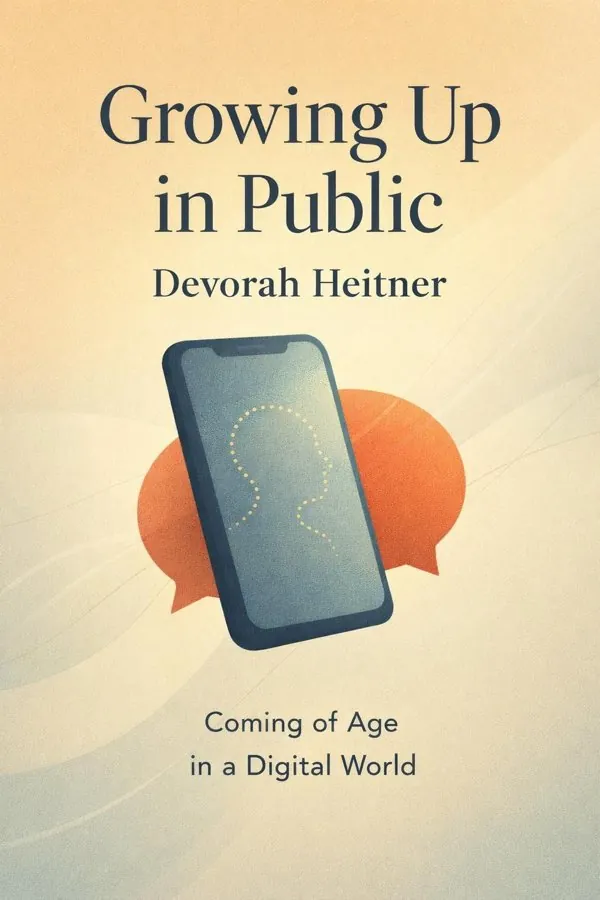
Growing Up in Public: Coming of Age in a Digital World: Summary & Key Insights
 10 min9 chaptersAudio available
What Is Growing Up in Public: Coming of Age in a Digital World About?
Growing Up in Public: Coming of Age in a Digital World by Devorah Heitner is a education book spanning 9 pages. In this insightful work, Devorah Heitner explores how children and teenagers navigate the challenges of growing up in an era of constant digital exposure. Drawing on research and interviews, she examines the impact of social media, online surveillance, and digital footprints on identity formation, privacy, and relationships. The book offers guidance for parents and educators to help young people develop resilience and healthy boundaries in a connected world.
This FizzRead summary covers all 9 key chapters of Growing Up in Public: Coming of Age in a Digital World in approximately 10 minutes, distilling the most important ideas, arguments, and takeaways from Devorah Heitner's work. Also available as an audio summary and Key Quotes Podcast.
Growing Up in Public: Coming of Age in a Digital World
In this insightful work, Devorah Heitner explores how children and teenagers navigate the challenges of growing up in an era of constant digital exposure. Drawing on research and interviews, she examines the impact of social media, online surveillance, and digital footprints on identity formation, privacy, and relationships. The book offers guidance for parents and educators to help young people develop resilience and healthy boundaries in a connected world.
Who Should Read Growing Up in Public: Coming of Age in a Digital World?
This book is perfect for anyone interested in education and looking to gain actionable insights in a short read. Whether you're a student, professional, or lifelong learner, the key ideas from Growing Up in Public: Coming of Age in a Digital World by Devorah Heitner will help you think differently.
- ✓Readers who enjoy education and want practical takeaways
- ✓Professionals looking to apply new ideas to their work and life
- ✓Anyone who wants the core insights of Growing Up in Public: Coming of Age in a Digital World in just 10 minutes
Want the full summary?
Get instant access to this book summary and 100K+ more with Fizz Moment.
Get Free SummaryAvailable on App Store • Free to download
Key Chapters
The digital footprint begins the moment a photo of a newborn appears online, long before the child can consent. As I listened to families, I realized most of us had not fully considered the permanence of these digital records. Every post, every comment, every piece of data contributes to a mosaic of identity that follows children into adulthood. Unlike an old diary that can be locked away, digital footprints are durable, searchable, and often out of one’s control.
I challenge parents to think carefully before sharing. Does that birthday photo reveal something personal a child may later wish private? Might a humorous story about a toddler’s meltdown online become a source of embarrassment when they’re older? Fundamentally, respect for children’s digital footprints begins with the notion of consent and care. But this isn’t only about protection — it’s about preparation. We need to teach kids to manage their digital footprints consciously, understanding that online impressions are part of how the world perceives them.
Through my research, I met teens who curate their social media as carefully as a résumé, and others who feel oppressed by the permanence of their online selves. Many understand intuitively that the internet never forgets, but few grasp what that means for their emotional development. Helping them means teaching reflection rather than instilling fear – how to understand the context, privacy settings, and audience of their actions. Their futures may depend less on erasing mistakes than on learning how to communicate authentically and responsibly.
Parents today have access to unprecedented tools of digital oversight — GPS trackers, message logs, school portals — each promising safety and transparency. Yet as I spoke with families, I noticed a paradox: the more we know about our kids’ lives, the less we seem to trust them. Surveillance, no matter how well-intentioned, can erode the mutual respect that forms the basis of true responsibility.
Children are acutely aware when adults are watching. Some become secretive, others anxious. When parents read every message or track every location, young people lose not only privacy but the opportunity to develop judgment. Teen years are, developmentally, a practice ground for independence. If we remove all risk, we remove the possibility of self-learning.
What I propose is mentorship over monitoring. Ask questions rather than demand access. Offer support when things go wrong instead of punishment. Share your experiences navigating online communities, your mistakes as well as your strategies. By engaging kids in dialogue about what could go wrong and how to respond, we build trust, the most powerful form of safety there is. Surveillance cannot replace relationship; in fact, it can undermine it. Trust, however, teaches discernment — the skill every young person will need when no parent is watching.
+ 7 more chapters — available in the FizzRead app
All Chapters in Growing Up in Public: Coming of Age in a Digital World
About the Author
Devorah Heitner is an American author, speaker, and expert on digital media and youth culture. She holds a Ph.D. in Media, Technology, and Society from Northwestern University and has written extensively on how technology shapes childhood and parenting. Her work focuses on helping families and schools foster empathy and responsible digital citizenship.
Get This Summary in Your Preferred Format
Read or listen to the Growing Up in Public: Coming of Age in a Digital World summary by Devorah Heitner anytime, anywhere. FizzRead offers multiple formats so you can learn on your terms — all free.
Available formats: App · Audio · PDF · EPUB — All included free with FizzRead
Download Growing Up in Public: Coming of Age in a Digital World PDF and EPUB Summary
Key Quotes from Growing Up in Public: Coming of Age in a Digital World
“The digital footprint begins the moment a photo of a newborn appears online, long before the child can consent.”
“Parents today have access to unprecedented tools of digital oversight — GPS trackers, message logs, school portals — each promising safety and transparency.”
Frequently Asked Questions about Growing Up in Public: Coming of Age in a Digital World
Growing Up in Public: Coming of Age in a Digital World by Devorah Heitner is a education book that explores key ideas across 9 chapters. In this insightful work, Devorah Heitner explores how children and teenagers navigate the challenges of growing up in an era of constant digital exposure. Drawing on research and interviews, she examines the impact of social media, online surveillance, and digital footprints on identity formation, privacy, and relationships. The book offers guidance for parents and educators to help young people develop resilience and healthy boundaries in a connected world.
You Might Also Like

Bedtime Biography: Florence Nightingale
Isabel Thomas
10 min
Introduction To Museum Studies
Howard H. Hoyt
10 min
A Mind for Numbers: How to Excel at Math and Science (Even If You Flunked Algebra)
Barbara Oakley
10 min
AI for Educators: Learning Strategies, Teacher Empowerment, and the Future of Education
Matt Miller
10 min
Animation For Beginners
Morr Meroz
10 min
Artificial Intelligence for Learning
Donald Clark
10 minBrowse by Category
Ready to read Growing Up in Public: Coming of Age in a Digital World?
Get the full summary and 100K+ more books with Fizz Moment.