
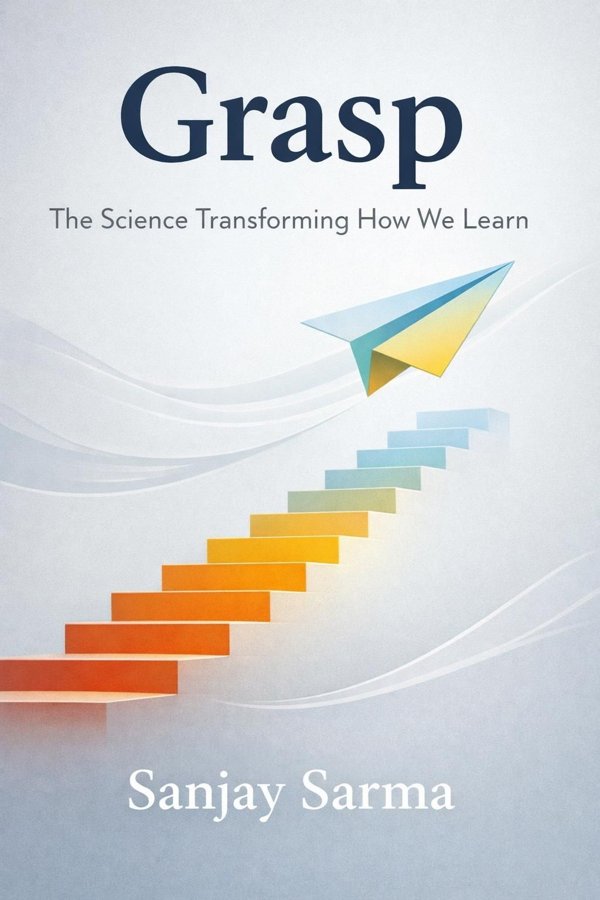
Grasp: The Science Transforming How We Learn: Summary & Key Insights
by Sanjay Sarma
 10 min9 chaptersAudio available
What Is Grasp: The Science Transforming How We Learn About?
Grasp: The Science Transforming How We Learn by Sanjay Sarma is a education book spanning 9 pages. This book explores the latest scientific insights into how humans learn, drawing on neuroscience, cognitive psychology, and educational research. Sanjay Sarma examines how learning can be optimized through curiosity, active engagement, and technology, offering a vision for transforming education in the modern world.
This FizzRead summary covers all 9 key chapters of Grasp: The Science Transforming How We Learn in approximately 10 minutes, distilling the most important ideas, arguments, and takeaways from Sanjay Sarma's work. Also available as an audio summary and Key Quotes Podcast.
Grasp: The Science Transforming How We Learn
This book explores the latest scientific insights into how humans learn, drawing on neuroscience, cognitive psychology, and educational research. Sanjay Sarma examines how learning can be optimized through curiosity, active engagement, and technology, offering a vision for transforming education in the modern world.
Who Should Read Grasp: The Science Transforming How We Learn?
This book is perfect for anyone interested in education and looking to gain actionable insights in a short read. Whether you're a student, professional, or lifelong learner, the key ideas from Grasp: The Science Transforming How We Learn by Sanjay Sarma will help you think differently.
- ✓Readers who enjoy education and want practical takeaways
- ✓Professionals looking to apply new ideas to their work and life
- ✓Anyone who wants the core insights of Grasp: The Science Transforming How We Learn in just 10 minutes
Want the full summary?
Get instant access to this book summary and 100K+ more with Fizz Moment.
Get Free SummaryAvailable on App Store • Free to download
Key Chapters
Learning begins with memory, but memory itself is not a static vault — it is a living process. When I speak of the science of learning, I often start by dispelling the notion that knowledge sits neatly stored in the brain waiting to be retrieved. Neuroscience shows us that each act of remembering reconstructs knowledge anew. Neural connections are strengthened through retrieval, shaped by attention, and intertwined with the emotions that give them significance.
Attention is the gatekeeper. Without it, even the most compelling information drifts by unnoticed. Yet attention is not sustained through discipline alone — it is guided by interest, surprise, and meaning. When something matters to us emotionally, when it is tied to our goals or fits within a coherent context, our neural systems light up. That’s why rote learning so easily fades, and why authentic engagement embeds knowledge deeply.
Emotion, in this sense, is not the enemy of reason but its enabler. What we feel guides what we notice, and what we notice becomes what we learn. Cognitive scientists call it emotional tagging: the binding of information to feeling, which determines recall and usefulness. A lesson, then, must be not only comprehended but *felt*.
Understanding learning as the union of memory, attention, and emotion leads to a crucial insight: knowledge formation is an active process of meaning-making, not a passive one of data storage. We must design education to honor that metabolism of the mind — feeding it with relevance, stimulating it with challenge, and grounding it in purpose.
Curiosity is the engine of learning. Every great discovery, from childhood exploration to scientific revolution, begins with wonder — the joyful frustration of not knowing. Studies in neurobiology show that when curiosity is piqued, dopamine floods the brain’s reward circuits, amplifying motivation and improving memory consolidation. Simply put: curiosity doesn’t just make learning pleasurable; it makes it *stick*.
In classrooms, however, curiosity too often gets extinguished. Compliance replaces exploration, and the question ‘Will this be on the test?’ takes the place of ‘Why is this so?’ The tragedy is that curiosity thrives naturally in all of us. The challenge for educators is to sustain rather than suppress it. That requires creating environments where discovery is rewarded, where questions are not deviations from the lesson but are the lesson itself.
When I was developing open learning initiatives at MIT, I saw learners flourish when they owned their process — when learning became a dialogue, not a lecture. Digital platforms, project-based experiences, and real-world problem-solving restored the thrill of experimentation. The results were measurable: higher retention, greater engagement, and, most importantly, renewed self-efficacy.
Curiosity teaches us something fundamental: knowledge gained through exploration feels like agency. Once you’ve figured something out for yourself, it becomes part of who you are. From that perspective, the goal of education is not to cover material, but to *discover meaning*.
+ 7 more chapters — available in the FizzRead app
All Chapters in Grasp: The Science Transforming How We Learn
About the Author
Sanjay Sarma is an Indian-American mechanical engineer, educator, and researcher. He is a professor at the Massachusetts Institute of Technology (MIT) and has served as Vice President for Open Learning. His work focuses on innovation in education, digital learning, and the intersection of technology and pedagogy.
Get This Summary in Your Preferred Format
Read or listen to the Grasp: The Science Transforming How We Learn summary by Sanjay Sarma anytime, anywhere. FizzRead offers multiple formats so you can learn on your terms — all free.
Available formats: App · Audio · PDF · EPUB — All included free with FizzRead
Download Grasp: The Science Transforming How We Learn PDF and EPUB Summary
Key Quotes from Grasp: The Science Transforming How We Learn
“Learning begins with memory, but memory itself is not a static vault — it is a living process.”
“Every great discovery, from childhood exploration to scientific revolution, begins with wonder — the joyful frustration of not knowing.”
Frequently Asked Questions about Grasp: The Science Transforming How We Learn
Grasp: The Science Transforming How We Learn by Sanjay Sarma is a education book that explores key ideas across 9 chapters. This book explores the latest scientific insights into how humans learn, drawing on neuroscience, cognitive psychology, and educational research. Sanjay Sarma examines how learning can be optimized through curiosity, active engagement, and technology, offering a vision for transforming education in the modern world.
You Might Also Like

Bedtime Biography: Florence Nightingale
Isabel Thomas
10 min
Introduction To Museum Studies
Howard H. Hoyt
10 min
A Mind for Numbers: How to Excel at Math and Science (Even If You Flunked Algebra)
Barbara Oakley
10 min
AI for Educators: Learning Strategies, Teacher Empowerment, and the Future of Education
Matt Miller
10 min
Animation For Beginners
Morr Meroz
10 min
Artificial Intelligence for Learning
Donald Clark
10 minBrowse by Category
Ready to read Grasp: The Science Transforming How We Learn?
Get the full summary and 100K+ more books with Fizz Moment.