
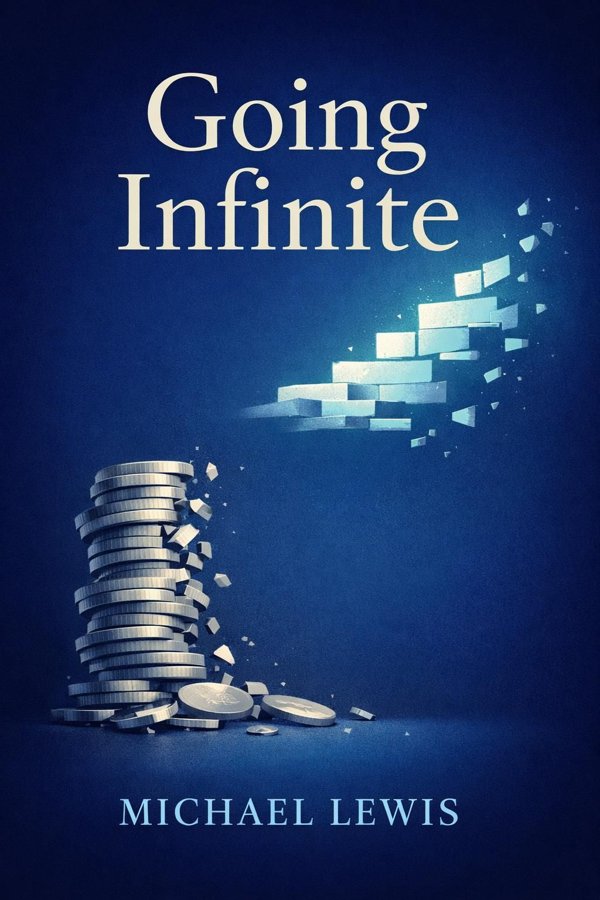
Going Infinite: Summary & Key Insights
 10 min8 chaptersAudio available
What Is Going Infinite About?
Going Infinite by Michael Lewis is a finance book spanning 8 pages. A nonfiction narrative exploring the rise and fall of Sam Bankman-Fried, the founder of FTX, and the world of cryptocurrency finance. Michael Lewis provides an insider’s account of Bankman-Fried’s ambitions, eccentricities, and the collapse of his empire, blending investigative journalism with character-driven storytelling.
This FizzRead summary covers all 8 key chapters of Going Infinite in approximately 10 minutes, distilling the most important ideas, arguments, and takeaways from Michael Lewis's work. Also available as an audio summary and Key Quotes Podcast.
Going Infinite
A nonfiction narrative exploring the rise and fall of Sam Bankman-Fried, the founder of FTX, and the world of cryptocurrency finance. Michael Lewis provides an insider’s account of Bankman-Fried’s ambitions, eccentricities, and the collapse of his empire, blending investigative journalism with character-driven storytelling.
Who Should Read Going Infinite?
This book is perfect for anyone interested in finance and looking to gain actionable insights in a short read. Whether you're a student, professional, or lifelong learner, the key ideas from Going Infinite by Michael Lewis will help you think differently.
- ✓Readers who enjoy finance and want practical takeaways
- ✓Professionals looking to apply new ideas to their work and life
- ✓Anyone who wants the core insights of Going Infinite in just 10 minutes
Want the full summary?
Get instant access to this book summary and 100K+ more with Fizz Moment.
Get Free SummaryAvailable on App Store • Free to download
Key Chapters
Sam Bankman-Fried’s origins illuminate everything that followed. Born into a family of Stanford academics—his father a scholar of tax law, his mother a philosopher—he grew up in an environment that treated arguments as sport and thought experiments as ordinary conversation. There was little indulgence in sentiment. What mattered was reasoning and outcome. This household nurtured in him an affinity for abstract problems and moral calculus.
From childhood, Sam absorbed the vocabulary of consequentialism—the idea that the value of an action lies solely in its consequences. His mother, Barbara Fried, was deeply involved in moral philosophy and the politics of fairness. These intellectual surroundings trained him to see moral dilemmas as logical puzzles, solvable if only one had enough data. It’s in that crucible that his lifelong devotion to utilitarianism took form.
But logic alone doesn’t prepare one for chaos. As he matured, Sam’s world view began to collide with the messy unpredictability of human institutions. His young self already saw discomfort as inefficiency to be corrected, risk as a variable to be quantified. What might appear cold or detached on the outside was, to him, clarity. This clarity set the stage for how he would later handle billions in customer deposits with analytical distance, seeing them as numbers in pursuit of a greater good.
In writing this section, I wanted readers to grasp that this was not a story born of greed—it was born of moral obsession. Sam believed that maximizing good required maximizing resources. From that premise, the road to global finance opened naturally. The tragedy came not because his moral intention failed, but because his system of belief couldn’t account for emotional, legal, and social realities that no algorithm could simplify.
MIT was less a school and more an incubator for Sam’s intellectual extremism. There he was surrounded by minds as restless and speculative as his own, yet his obsession turned toward practical math—quantitative reasoning that could measure the world’s uncertainty. Among his peers, he discovered a movement that would shape not only his ethics but his destiny: effective altruism.
The ideology was simple but radical—if you want to do the most good, calculate the optimal path. It suggested that earning vast sums in finance and donating them strategically might create more impact than any career in direct charity. For someone with Sam’s utilitarian rigor, this was revelation. Finance became not a profession, but a moral pursuit.
MIT also introduced him to the technical apparatus of markets. Probability theory, algorithmic trading, and computational modeling bridged his academic discipline with his ethical ambition. He began to see liquidity and volatility as metaphors for moral fluidity: uncertainty itself could be traded and profited from, and profit transformed into global welfare.
This was the period when the foundations for Alameda Research were laid—not in business plans, but in philosophical conviction. He envisioned market imperfections as moral opportunities. Arbitrage wasn’t just exploitation of inefficiency; it was the means to redistribute advantage from systems to people. Yet as the narrative later shows, the purity of that logic didn’t survive its scaling into billions and legal complexity. Still, the MIT years gave him both his intellectual armor and the ideological compass that he relied upon until the end.
+ 6 more chapters — available in the FizzRead app
All Chapters in Going Infinite
About the Author
Michael Lewis is an American author and financial journalist known for his works on economics and human behavior, including 'Moneyball', 'The Big Short', and 'Liar’s Poker'. His writing often examines the intersection of finance, data, and decision-making.
Get This Summary in Your Preferred Format
Read or listen to the Going Infinite summary by Michael Lewis anytime, anywhere. FizzRead offers multiple formats so you can learn on your terms — all free.
Available formats: App · Audio · PDF · EPUB — All included free with FizzRead
Download Going Infinite PDF and EPUB Summary
Key Quotes from Going Infinite
“Sam Bankman-Fried’s origins illuminate everything that followed.”
“MIT was less a school and more an incubator for Sam’s intellectual extremism.”
Frequently Asked Questions about Going Infinite
Going Infinite by Michael Lewis is a finance book that explores key ideas across 8 chapters. A nonfiction narrative exploring the rise and fall of Sam Bankman-Fried, the founder of FTX, and the world of cryptocurrency finance. Michael Lewis provides an insider’s account of Bankman-Fried’s ambitions, eccentricities, and the collapse of his empire, blending investigative journalism with character-driven storytelling.
More by Michael Lewis

You Might Also Like


Browse by Category
Ready to read Going Infinite?
Get the full summary and 100K+ more books with Fizz Moment.